iGaming API Integration Architecture 2026: Games, Payments, CRM and Sportsbook

iGaming API integration architecture is the contract layer connecting game providers, wallets, payment processors, CRM, and sportsbook feeds to one operator platform. Every connection moves money, session state, and audit records at the same time. A single-wallet casino integration alone carries four callback types: balance, debit, credit, and rollback. Each one needs an idempotency key, or a single timeout becomes a double debit.
Operators pay for this layer in engineering hours, not license fees. Forty direct studio connections mean forty schemas, forty test cycles, and forty change logs to maintain. The NuxGame casino API replaces that with a single integration covering 17,500+ games from 140+ providers, plus wallet events, reporting, and risk signals. Fewer connections leave fewer reconciliation breaks to explain to a regulator.
Key Takeaways
-
One system of record per domain: the wallet ledger settles round disputes.
-
Idempotency keys on signed callbacks stop duplicate debits after provider retries.
-
Tokenized checkout keeps card data — and PCI scope — inside the processor.
-
New Jersey demands ten years of replayable game play and account data.
-
Version-pinned schemas turn studio releases into planned work, not incidents.
What the iGaming API Architecture Covers in a Live Operation
Four domains sit behind a modern iGaming platform: content, money movement, player data, and betting markets. They fail differently. A content fault degrades the lobby, while a wallet fault creates financial exposure that lands in regulatory reporting. Mapping each domain to a single system of record is the first architectural decision, and the hardest one to reverse.
- Content: provider systems hold round state; the platform holds the catalog and launch permissions.
- Money: the operator wallet is authoritative; provider and processor records are claims against it.
- Player data: the player account management system owns identity, limits, and exclusions; CRM consumes copies.
- Markets: the odds feed owns prices; the ticket store owns accepted stakes.
Ownership decides recovery. When a game provider and the wallet disagree about one round, the ledger with sequence integrity resolves it. iGaming solutions differ mainly in how much of that ownership the vendor takes on. Version pinning carries similar weight, since studios ship breaking changes on their own calendar. Jurisdiction flags belong in the launch layer, never in front-end code.
Casino API Integration: Game Launch, Session Tokens, and Round State
A game launch is a handshake, not a redirect. The platform issues a single-use session token with a short time-to-live, and the casino game API returns a launch URL carrying it. Signing matters more than secrecy here: an HMAC over the raw request body, with timestamp and nonce, blocks replayed bet events from a captured request.
- The client requests launch; the platform checks jurisdiction, age, exclusion status, and currency.
- The platform mints a one-time token with a 60–300 second TTL and returns the provider launch URL.
- The provider validates the token, opens the round, and starts sending wallet callbacks.
- The platform logs the launch, the token exchange, and every round identifier against the session.
Round state decides audit outcomes. Each bet, win, and rollback carries a provider round ID that must survive a dropped connection and reappear in order. Casino games API integration fails certification on this point more often than on the launch handshake. Independent labs examine the behavior directly, and the interactive gaming systems standard sets shutdown, recovery, and incomplete-game rules.
Aggregation reduces how often game integration work repeats. The NuxGame casino game aggregator applies one schema across slots, live casino, and instant titles, and this casino API integration guide covers what to validate before go-live.
Wallet Model, Idempotency, and Rollback Behavior
Two wallet models dominate. A transfer wallet moves funds into a provider account before play and pulls them back afterwards, which strands balances during an outage. A seamless wallet keeps one balance on the operator side and answers debit and credit callbacks in real time, so the provider never holds player funds and no sweep job is required.
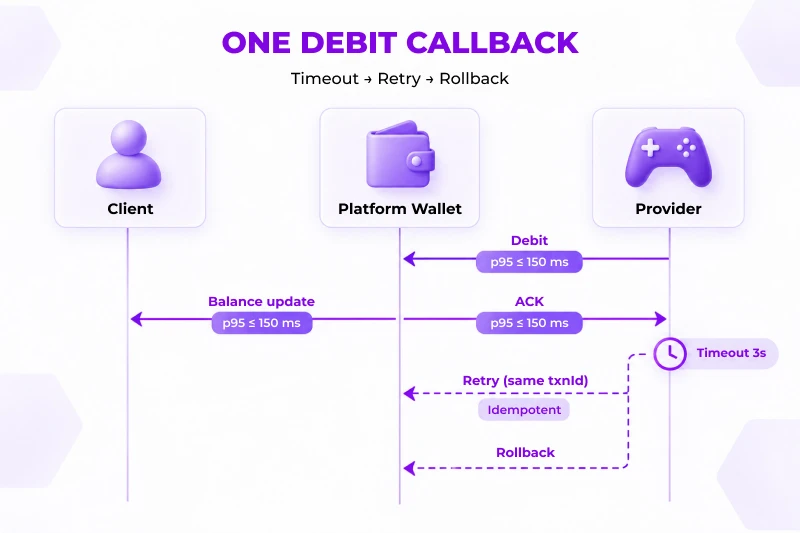
Real-time callbacks raise the bar on error handling. Providers retry any call that times out. The controlled retry limits described by AWS exist because unbounded retries amplify an incident rather than resolve it. Idempotency keys are the operator-side answer: store the transaction reference, return the original result, and never debit twice.
API performance targets to agree with each provider before signing, not vendor benchmarks:
| Call | Target p95 | Timeout | Behavior on failure |
|---|---|---|---|
| Session token issue | 120 ms | 1 s | Block launch, log refusal reason |
| Wallet balance | 100 ms | 2 s | Refuse round, no optimistic balance |
| Wallet debit | 150 ms | 3 s | Idempotent retry, then rollback |
| Wallet credit | 150 ms | 3 s | Queue and replay until acknowledged |
| Bet placement | 200 ms | 2 s | Reject ticket, release exposure |
| Deposit initiation | 400 ms | 5 s | Cascade to the next processor |
Most integration delays we see are not caused by difficult code. They come from unclear ownership of the money record. Operators who decide early which system holds the authoritative balance, and who signs each callback, usually launch weeks sooner. The rest is documentation, testing discipline, and a rollback path that somebody has actually rehearsed.

Denis Kosinsky
Chief Product Officer at NuxGame
Payment Gateway Integration: PCI Scope, Routing, and Reconciliation
Card data is the part of the stack an operator should touch least. Hosted fields and tokenization keep primary account numbers inside the processor environment, which narrows assessment scope considerably. Since March 31, 2025, every future-dated control in the payment card security standard applies in full. That includes payment-page script inventory and tamper detection under requirements 6.4.3 and 11.6.1.
Routing is a commercial decision with a technical implementation. A cascading configuration sends a declined attempt to a second processor without a second player action. Casino players rarely retry after a decline, so that fallback protects real deposit volume. Approval rate deserves tracking per method, per state, and per issuing bank.
Reconciliation duties sit on the operator side of the payment API:
- Match processor webhooks against internal deposit records hourly, not overnight.
- Flag pending payouts that exceed the published window before support tickets arrive.
- Store the processor reference, internal reference, and KYC decision on one row.
- Keep chargeback and refund flows separate; they carry different reporting duties.
CRM, Bonus Engine, and Player Event Streams
CRM value depends on event freshness rather than dashboard design. iGaming operators that segment on yesterday’s data pay for campaign reach they cannot convert. A platform with 100,000 daily sessions and roughly 20 tracked actions per session emits around two million events daily. Polling at that volume wastes capacity; a published event stream with a versioned schema keeps segmentation current within minutes.
- Identity events: registration, KYC status change, document expiry.
- Financial events: deposit, withdrawal request, bonus grant, wagering progress.
- Gameplay events: round opened, round settled, provider error, session end.
- Protection events: limit set, limit breach warning, self-exclusion, cool-off.
Bonus ledgers stay separate from cash ledgers because withdrawal eligibility and reporting depend on that split. Limit handling now carries a date as well: revised financial limit definitions under RTS 12B take effect on September 30, 2026 for British licensees. Self-exclusion updates need push propagation, since a nightly batch leaves a gap an excluded player can use.
Sportsbook API Integration: Feed Transport, Ticket Flow, and Settlement
A sportsbook API splits transport by workload. Fixtures, ticket placement, and settlement queries run over REST, while in-play prices arrive on a persistent WebSocket channel. The NuxGame betting API covers 125+ sports and 210,000+ events monthly, with peak feed latency under 100 ms. Market suspension messages take priority over price updates.
- Placement validation: market open, stake limits, exposure ceiling, player status.
- Acceptance with the stored price and timestamp for later dispute review.
- Result confirmation from the feed, including void rules for abandoned events.
- Settlement and wallet credit, reconciled line by line against the ticket store.
Cash-out and bet builder pricing add correlation logic that belongs on the pricing side, not in a front end. A full integration covers pricing, ticket flow, settlement, and risk signals rather than odds alone. Operators without a trading desk use managed trading services, where exposure and margin decisions sit with the provider team. Disputes then resolve from timestamped line movement, not player screenshots.
US Compliance Constraints on Provider APIs and Data Retention
Online casino operators in the US are licensed state by state, and integration scope follows the same borders. Internet gaming revenue across the seven live states reached $10.73 billion in 2025, a 27.6% rise reported in the State of the States analysis. Teams entering a new iGaming market can sequence licensing against technical work using this online casino launch guide.
Retention duties shape storage design more than traffic volume does. Under New Jersey gaming rules, a gaming system keeps all information necessary to recreate player game play and account activity for no less than ten years, including identity and location verifications. Geolocation runs at login and at the approved interval afterwards.
| Requirement | Integration control | Evidence produced |
|---|---|---|
| Ten-year recreation of play | Immutable round and session logging with provider IDs | Replayable round export |
| Platform certification | Sandbox build parity, versioned release notes | Lab report per jurisdiction |
| Payment page integrity | Script inventory and tamper alerting | Change-authorization records |
| Player location | Launch-time and interval geolocation checks | Verification log with timestamps |
| Self-exclusion enforcement | Real-time list query at registration and login | Query audit trail |
Failure Domains, Observability, and Migration Risk
Availability is a per-provider question. One studio timing out should not stall a lobby, so circuit breakers isolate each upstream and shed load to a cached catalog. Gambling and casinos ranked third among the most-attacked industries in the quarterly DDoS reporting from Cloudflare, which mitigated 47.1 million attacks across 2025.
Migration is where working systems break. A reliable casino API provider supplies migration windows, status history, and a named rollback contact. Dual-run the wallet, compare balances hourly, and cut over provider by provider instead of platform-wide. Technical change also triggers regulatory review: the Malta Gaming Authority schedules system audits around changes to key components, as its compliance audit manual sets out.
- Callback error rate and p95 latency per provider, alerted separately from platform-wide metrics.
- MTTR per integration, measured from first failed callback to confirmed recovery.
- Unmatched transactions per 10,000, reviewed daily by finance and engineering together.
- Schema drift alerts on every provider response field, not only on breaking versions.
Technical Snapshot
| Pre-launch checkpoint | Requirement | Indicator |
|---|---|---|
| Credentials | Separate API key per environment, rotation schedule, IP allow-listing | No key shared between sandbox and production |
| Certification | Lab-tested build identical to the release candidate | Report reference held per jurisdiction |
| Capacity | Load test at 3× projected peak concurrent sessions | Wallet callback p95 stable under test load |
| Data | Round-level logging with a documented retention plan | Sampled round replayed successfully |
| Payments | Two live processors per market with cascading enabled | Approval rate tracked by method |
| Rollback | Provider disable switch and rehearsed rollback path | Drill completed within the last quarter |
Dependencies run in one direction, and API implementation should follow it: identity before wallet, wallet before content, content before promotions. Reversing that order produces launches where bonuses credit accounts that cannot withdraw, which support teams then absorb for months.
Decide the Contracts Before the Code
iGaming API integration rewards early decisions about ownership, idempotency, and retention. The teams that launch on schedule are rarely the ones with the largest engineering group. They are the ones who documented which system holds the balance, how a failed callback resolves, and what evidence a regulator receives on request.
The NuxGame platform consolidates casino content, sportsbook markets, payment routing, KYC and AML touchpoints, and back-office reporting behind one integration layer. Technical support runs 24/7 through setup and after go-live. Share your current stack and target states, and the team will map the casino API integration scope against your launch timeline and certification dates.