iGaming Regulations in Germany 2026

Germany is one of Europe’s largest regulated markets, with a licensed sector reporting €14.4 billion in gross gaming revenue, yet also one of the most tightly controlled. That tension defines iGaming regulations in Germany 2026: a real commercial prize sitting behind hard product limits, a turnover tax, and mandatory state integrations. The Interstate Treaty on Gambling 2021 (GlüStV 2021) and the Joint Gambling Authority of the Federal States (GGL) set the terms, splitting authority between one national regulator and 16 states. For operators, the question is less whether to enter than how to build for it. NuxGame supplies the turnkey gambling software, aggregation, and compliance tooling operators use to configure these constraints per market.
Germany iGaming regulations Key Points
-
Germany gambling law splits oversight: GGL covers betting, slots, and poker; states regulate casino tables.
-
LUGAS enforces the €1,000 cross-operator deposit limit across online gambling in Germany.
-
German gambling tax hits 5.3% of stakes, not GGR, squeezing slot margins at ~88.5% RTP.
-
iGaming regulations in Germany require a safe server for live player and transaction data access.
-
The 2026 gambling law review may lift the €1 spin cap and add a B2B game-studio licence.
| Vertical | Licensing authority | Availability |
|---|---|---|
| Virtual slot machines | GGL (national) | Nationwide, stakes capped |
| Online poker | GGL (national) | Nationwide |
| Online casino table games | Individual federal state | State-by-state; monopoly or capped licences |
| Land-based casinos, betting shops | State authorities | Regional licences only |
The GlüStV 2021 Rulebook Operators Must Engineer Around
The Interstate Treaty on Gambling reads less like policy and more like a product spec. Germany introduced this comprehensive legal framework — a new Interstate Treaty agreed by all 16 states — with one aim: preventing gambling addiction while keeping legal gambling attractive. Every rule maps to a configuration flag inside the platform. Operators translate them into wallet logic, session timers, and responsible gambling controls. A single wrong flag risks a fine of up to €500,000 per breach.
The core limits every licensed operator must implement are fixed and non-negotiable:
- €1 maximum stake per spin on virtual slots, with autoplay and turbo disabled.
- A minimum five-second interval between slot spins to slow session velocity.
- A €1,000 monthly deposit limit applied across every operator combined.
- A five-minute lockout when a player switches from one operator to another.
- A mandatory five-minute break after each hour of continuous play.
- A panic button that triggers an immediate 24-hour self-exclusion.
- No live-dealer casino games and no progressive jackpots nationwide.
These caps reshape unit economics before a single player registers. The new gambling framework flattens lifetime value and pushes retention ahead of acquisition. Live casino and jackpot bans remove two high-margin verticals from the roadmap entirely. Higher limits up to €30,000 exist, but require an annual affordability check per player. The gambling laws and regulations in Germany reward operators who plan around the ceiling, not the exception.
LUGAS, OASIS, and the Safe Server: The Mandatory Technical Integrations
Three state systems sit between an operator and a legal launch. OASIS is the central self-exclusion register, and each player is screened against it before access. LUGAS pairs a limit file with an activity file to enforce the deposit cap and block parallel play. The safe server, funded by the operator, gives the authority live access to player and transaction data. None of these three are optional.
These integrations impose real constraints on session design and data flow. An OASIS check must be resolved at login, before the wallet opens, so it sits on the critical path. LUGAS enforces one active session per player and forces tight wallet-state synchronisation across the stack. Player records must stay on EEA servers and be retained for five years after an account closes, in line with EU data-protection law and German data protection laws. Latency and data residency become architecture decisions, not afterthoughts.
In Germany, compliance is not a final stamp; it is the rail system the product runs on. Operators need deposit limits, exclusion checks, reporting, payments, and game access to move in sync from day one. When those controls are built into the platform logic, regulation becomes manageable instead of becoming a launch-day traffic jam.

Denis Kosinsky
Chief Product Officer at NuxGame
Licensing Economics: Security Deposit, Fees, and the 5.3% Stake Tax
The commercial case turns on tax structure more than licence cost. Germany taxes 5.3% of stakes for sports betting, virtual slots, poker, and horse-race betting. Taxing turnover, not gross gaming revenue, compresses margins hardest on high-RTP slots. With reported online casino RTP near 88.5%, the effective take on volume is thin. This single design choice explains much of the channelisation debate across the jurisdiction.
| Requirement | Detail |
|---|---|
| Security deposit | Minimum €5 million posted before launch |
| Licence term | 5 years initial, 7 years on renewal |
| Application timeline | Roughly 12–18 months |
| Stake tax | 5.3% of turnover |
| Maximum fine | €500,000 per violation |
| Applicant establishment | EU or EEA; no German office required |
Licensing fees scale with expected annual turnover, starting near €80,000 for larger operators. Securing a licence in Germany also ties up capital, since the €5 million security deposit lands before any revenue arrives. A 12-to-18-month review makes the German market a multi-year plan, not a single quarter. No physical presence in Germany is required, yet iGaming operators eyeing Germany for online revenue must model the 5.3% turnover tax into pricing first. Legal operators carry costs the black market ignores, which is why the gambling industry keeps debating the caps.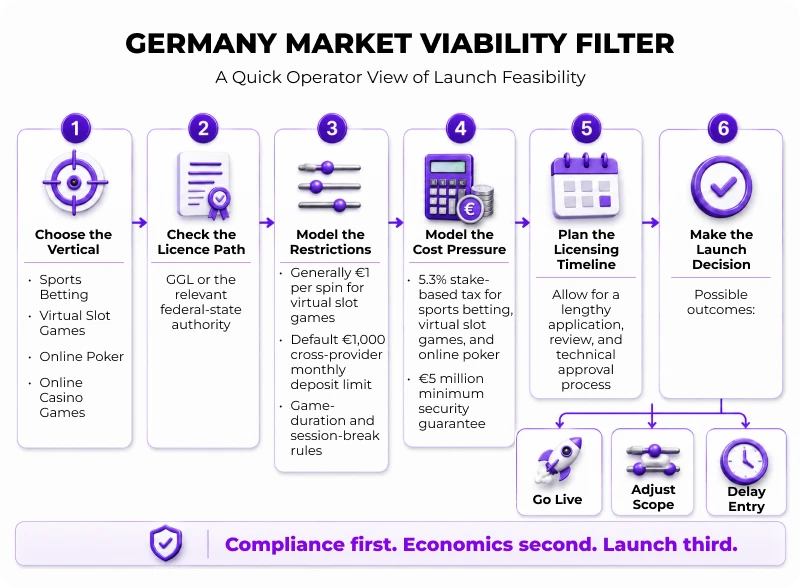
Compliance Architecture: KYC, AML, and the Certification Stack
Behind the player-facing rules sits a heavier certification burden. Each game — every gambling product an operator lists — needs GGL approval before launch, and an independent body must test technical and security compliance every year. Data centres are expected to hold a recognised security certification such as ISO 27001. Card payment flows must meet the card-data security rules maintained by the PCI Security Standards Council. These are gates, not badges.
Identity verification runs at registration, not at first withdrawal, so age verification and OASIS screening gate account creation. Anonymous and third-party payments are banned, and deposits must come from the player’s own account. Anti-money laundering duties follow EU directives and the German AML Act, requiring a nominated MLRO and risk-based monitoring under German law. Casino operators and betting brands alike must automate suspicious-transaction reporting. For gambling operators, onboarding friction is a compliance feature here, not a UX defect.
How the 2026 Review Reshapes iGaming Regulations in Germany
GlüStV 2021 is under its first five-year review, and the outcome will set the agenda for the rest of the decade. The GGL is due to report to the Bundestag this year, in 2026. As the national gambling regulator, it regulates gambling operations and all online gambling in Germany that crosses state lines. Applications to raise the €1 slot stake cap are already pending. On the regulator’s market data, the licensed sector reached €14.4 billion in gross gaming revenue at roughly 77% channelisation. Industry bodies dispute that, arguing the real online gambling market channels closer to 50%.
Three changes deserve room on the roadmap now. A B2B licensing regime for game studios has been floated, which would change how the framework certifies sports betting and virtual slot machines from third-party suppliers. The legal basis for ISP blocking of illegal gambling may be rebuilt after German courts struck it down. Amended gambling legislation could shift affordability thresholds and even the permitted list of sports events, changing how the €1,000 ceiling works for players in Germany. Build for configurable limits, because the numbers are provisional.
Technical Snapshot
The list below maps the launch-critical dependencies for the German online gambling sector. Timelines assume parallel workstreams and a complete application dossier. The platform, aggregation, and back-office tooling of NuxGame let operators configure these controls per market rather than rebuild them for each vertical. Treat every row as a gate before go-live.
| Checkpoint | Requirement | Primary owner |
|---|---|---|
| Self-exclusion | OASIS status check before every login | Platform / PAM |
| Deposit control | LUGAS limit and activity file integration | Wallet |
| Regulator access | Safe server with live data feed | Infrastructure |
| Data residency | EEA hosting, 5-year retention | Infrastructure |
| Game approval | Per-title GGL sign-off | Compliance |
| Annual audit | Independent technical and security test | Compliance |
| Payment rules | Named-account deposits, no anonymous methods | Payments |
| Capital | €5 million security deposit posted | Finance |
Bottom Line
iGaming laws in Germany 2026 reward operators who treat compliance as architecture, not paperwork. The gambling market in Germany is large and taxed on turnover, so viability is decided in the financial model long before launch. With the treaty review in motion, the practical move is to build configurable limits and modular integrations that absorb rule changes without a rebuild. Decide your vertical scope first, then engineer for the constraints that scope carries.
Entering a regulated market like Germany rarely fails on strategy; it fails on integration timelines and configuration errors. NuxGame supplies the casino aggregation, sportsbook, wallet synchronisation, payment routing, and back-office controls operators use gambling laws and regulations to align a live product with framework rules. That approach reduces the number of separate vendor connections a compliance team maintains. Talk to the team at NuxGame to scope a Germany-ready build.