Русский
Is Your KYC Ready to Scale? What Operators Should Review Before the Next Traffic Surge
Your KYC is ready to scale when it handles higher verification volume within your approval-time targets, without weakening checks or creating a review backlog your team cannot clear. Faster KYC comes from removing unnecessary work and getting each case to the right checks sooner. Before adding reviewers, examine what you are asking them to review.
NuxGame has been building iGaming platforms since 2018 and supports more than 140 operators worldwide. Its partner ecosystem brings together around 200 integrated partners covering payments, compliance, CRM, game content and marketing. Verification sitting inside the registration flow is part of that platform perspective. This guide combines it with research and product results from Jumio, an AI-powered identity intelligence and KYC partner, to explain how operators can reduce repeated checks and manage risk as traffic grows.
Compliance and commercial teams share the same challenge: help legitimate players complete registration while keeping suspicious activity under review. When traffic rises, both depend on how checks are assigned and how quickly flagged cases reach someone who can act.
TL;DR
-
Verification capacity depends on how work is distributed. Sending routine and unclear cases through the same process creates avoidable queues.
-
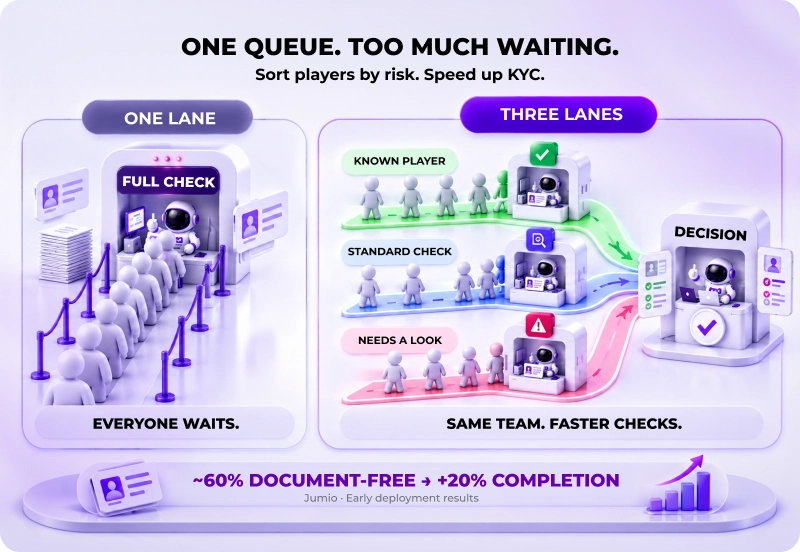
Reusable identity reduces repeated document checks. Jumio reports up to 60% of returning trusted users verifying document-free and up to a 20% increase in completion rates with selfie.DONE™ deployments.
-
A faster flow must still identify suspicious attempts. Approval time, missed fraud, incorrect rejections, and review workload belong in the same assessment.
-
Trust needs reassessment after signup. Jumio reports up to 25% more risk detected after onboarding in early Watch studies.
-
An alert becomes useful when it reaches a defined workflow, with an owner, a response, and a recorded decision.
Verification Queues Often Start With How Work Is Assigned
A queue grows when checks and review tasks arrive faster than the process can clear them. Reducing unnecessary work gives the existing team more capacity for cases that need attention.
Before adding reviewers, look at where players and cases spend their time. A failed upload needs a different fix from a slow provider response. A case waiting for someone to open it needs a different fix from a case that takes a long time to investigate.
Compare a busy period with a quiet one. Check approval times, failed attempts, repeated uploads, abandonment, and the share of cases sent to manual review. Break the results down by market, device, and verification route so a good overall average does not hide a problem affecting one group of players.
Then examine whether your flow asks everyone to do the same work. A new player with little available information and a returning player with a trusted identity may need different checks. Sending both through the same document process can add avoidable work.
Jumio’s 2026 iGaming Report describes risk-based workflows that add checks when needed. The operator’s job is to set clear routes: trusted cases receive the appropriate shorter checks, ordinary registrations follow the standard process, and unclear cases receive closer review. Each route must meet the relevant market requirements.
NuxGame builds verification into the registration flow. For operators reviewing that flow, the next step is to agree with their platform and verification teams how each result will be handled: which cases proceed, which require more information, and which go to a reviewer. Confirm those rules before testing higher volumes.
After removing unnecessary work, test the remaining load. Provider limits, platform performance, and reviewer availability still determine how much traffic the flow can handle.
If you want the groundwork first (what identity checks cover and why regulators require them), our guide to the ID verification process in iGaming sets it out. This article picks up where volume becomes the problem.
Traffic Planning Must Include Fraud Attempts
A verification flow needs enough capacity to investigate suspicious attempts while legitimate players continue through the required checks.
Review how your flow handles multiple accounts, bonus abuse, synthetic identities, and account takeover. Check how it responds to deepfakes and attempts to feed manipulated images or video into the verification process.
Jumio reported a 700% year-over-year increase in injection attempts in its April 2026 Watch announcement. That figure describes attempts observed by Jumio. It gives operators a concrete reason to include manipulated-image and video attacks in their testing.
The operational concern is what happens when more suspicious cases arrive alongside legitimate players. If they all reach the same review queue with the same priority, urgent cases can wait while reviewers work through routine ones.
Define which signals require immediate attention, which require additional verification, and which can enter a standard review queue. When you test a faster flow, check missed fraud, incorrect rejections, and review workload alongside completion rates.
During peak-load testing, confirm that flagged cases still reach the required checks within your review targets.
Trusted Players Should Not Repeat Checks Without a Reason
Reusable identity gives eligible, previously verified players a shorter route by removing the need to submit documents again. The route still includes a current assessment of risk.
Jumio first launched selfie.DONE in Brazil in October 2025, expanded it across Latin America in April 2026, and then rolled it out to North America, Asia-Pacific and EMEA later in 2026. According to Jumio, up to 60% of users in early deployments completed document-free verification, with up to a 20% increase in verification completion rates.
The service recognizes trusted users through a selfie. If no trusted identity is found or risk is detected, it automatically triggers full ID verification. Those results describe early deployments; operators should measure performance with their own player mix.
Jumio describes recognizing eligible, previously verified users when they register for a new service on Jumio-powered platforms. A player can therefore be new to an operator while already having an identity that Jumio recognizes. This is a capability within the Jumio network; it does not mean verification automatically transfers to an operator using another provider.
For the player, this removes a repeated task at registration. For the operator, it offers a way to reduce document-handling work and help more people finish verification. Measure manual-review and support demand separately rather than treating every document-free check as a reviewer case avoided.
Start with the markets where the service is available and where enough players are eligible to use it. Compare completion, verification time, manual-review demand, and fraud outcomes with your existing flow.
A Verified Identity Still Needs Risk Checks
An identity check establishes who the player is at verification; it does not settle every future decision about the account. Someone else may gain access to it. Its payment behavior may change. New information may connect it to activity that was not visible at registration.
Keep identity status and current risk separate in your processes. A player can remain correctly identified while a withdrawal, payment pattern, or account change requires investigation.
Jumio Watch provides one example of reassessment after onboarding. Jumio says the service analyzes identity signals and connections over time, alerting customers when new information raises concerns about a previously approved verification. In its Watch launch announcement, Jumio reports up to 25% more risk detected after onboarding in early studies. The finding concerns additional risk detection, not a measured reduction in fraud losses.
This identity information should be considered alongside the operator’s own account and payment data. Ongoing identity checks, AML screening and transaction monitoring serve different purposes. The team investigating a case needs the relevant findings from each.
An approval is a dated decision, not a lifetime pass. Operators should decide in advance what new information would make them reconsider it. Without that rule, ‘approved’ becomes a reason to stop looking. That is too much responsibility for one check at signup.

Philipp Pointner
Chief of Digital Identity at Jumio
A Risk Signal Is Worth the Response It Triggers
A useful risk signal starts a defined response: further verification, investigation, a temporary restriction, or a documented decision that no action is needed.
An alert needs somewhere to go and someone responsible for handling it. If it waits unread while the account continues making payments, the operator may lose the chance to act in time.
Operators should require a clear connection between compliance findings and the account, payment and reporting records needed to investigate them. Confirm with the platform team what reviewers can see, which actions are supported, and what still requires a separate process. For a flagged withdrawal, the reviewer should be able to see the player’s deposit history, bonus activity, and verification status without piecing the case together from separate exports.
The response should match the concern. Some cases need a temporary payout hold or an account restriction. Others need another identity check, a closer review, or a documented decision to take no further action. Not every alert needs the same restriction.
For each type of signal, define what happens automatically, what requires a person, who owns the case, and how quickly it must be handled. Record the evidence, action, decision, and time.
Also test the connection between systems. Confirm that an alert reaches the platform, that the intended action takes effect, and that failed delivery is visible to the team. An alert marked as sent is not proof that a withdrawal was paused.
Better Verification Protects Capacity, Conversion, and Compliance
Improving verification pays off in three ways: less repeated work, more legitimate players completing registration, and a process better prepared to meet compliance obligations.
If eligible players complete the appropriate checks with fewer uploads or retries, your team has more time for cases that need attention. Measure how much work actually disappears from the queue before deciding whether more staff are needed.
Players who leave during verification also represent acquisition effort already spent. Improving completion gives more of those players the opportunity to reach a first deposit. Track that next step to calculate the commercial return.
For compliance teams, keeping a clear record of the checks performed, findings reviewed, and decisions made helps explain how each case was handled.
Weigh these benefits against the cost of the changes: provider fees, integration work, monitoring, and reviewer time. Compare those costs with the improvement in completion, processing time, and fraud outcomes. That gives you a firmer basis for deciding whether to adjust the flow, add capacity, or do both.
A good doorman recognizes a regular and still notices when something is wrong. Operators need the same judgment. If a trusted player has to start from zero every time, we have created extra work for both sides. Hiring more people to repeat it is an expensive way to keep the process unchanged.

Denis Kosinsky
Chief Product Officer at NuxGame
5-Step Operator Plan: Prepare Your KYC for Higher Traffic
Preparing KYC for higher traffic means measuring the busiest periods, routing by risk, recognizing trusted players, reassessing accounts, and testing the response to alerts.
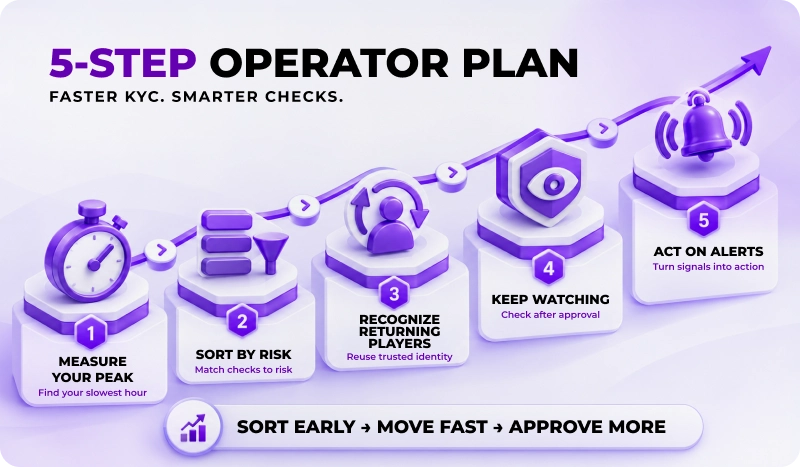
- Measure your peak, not your average. Pull your verification completion times for your busiest day this year and compare them to a quiet weekday. Look at the slowest cases as well as the average. Track abandonment, upload failures, retries, the share sent to manual review, and how long cases wait for a reviewer. Then test a defined increase in volume, such as twice your usual peak. Set acceptable processing times and queue limits before the test so the result gives you a clear decision.
- Route by risk, so effort follows the question. Build three paths instead of one: a fast path for players carrying signals you already trust, a standard path for ordinary new registrations, and an escalation path for cases that are genuinely unclear. Write down the conditions for each route and the checks it requires. An unclear case may need more information or a reviewer; uncertainty alone should not automatically become a rejection. Check that routing reduces unnecessary review without allowing cases that need attention to pass unchecked.
- Recognize returning, already-trusted players. Review where players are being asked to repeat verification that could be reused. Introduce the shorter route for players who meet its eligibility and risk requirements. Keep the fallback clear: if the identity cannot be trusted or new risk appears, the player moves to the required additional checks. Compare completion, review demand, and fraud outcomes before expanding the shorter route.
- Keep the file open after approval. Set screening to re-run against list updates rather than only at registration, and define in advance which behavioral changes warrant a second look — a sharp change in deposit pattern, a withdrawal profile that stops matching the account’s history, or signs that someone else may be using it. Include new identity-risk information where available. Decide which findings trigger reassessment, who reviews them and what may happen to the account while the review is open.
- Act on risk alerts. For each risk output, write down the appropriate response: which accounts hold, which payouts pause, which bonuses stop crediting, which cases need further checks, and what gets logged for reporting. Then confirm that the event reaches the systems responsible for those actions and that the person acting can see the player’s payments, bonus history, and verification status in one place. Test the full process with sample cases. Check alert delivery, the platform action, the reviewer’s decision, and the final record. Include what happens if an alert is delayed or an action fails.
Wrapping It All Up: KYC Readiness Means More Volume Without Losing Control
Your KYC is ready for the next surge when testing shows that it can meet your processing targets, clear review queues, and maintain the required checks at the expected volume.
Start with how work is assigned. Remove unnecessary repetition, give trusted players the appropriate shorter route, and reserve close review for cases that need it. Then check whether the remaining workload requires more capacity.
That is the platform decision behind faster KYC: how identity checks, account activity, and operational actions work together. It belongs in how you evaluate a platform partner, alongside the performance of the verification provider itself.
More players should not mean longer verification queues. Talk to the NuxGame team about reducing repeated checks and helping legitimate players complete registration as your business grows.