Provably Fair Games in 2026: Commit-Reveal Architecture, Seed Custody, and RNG Certification

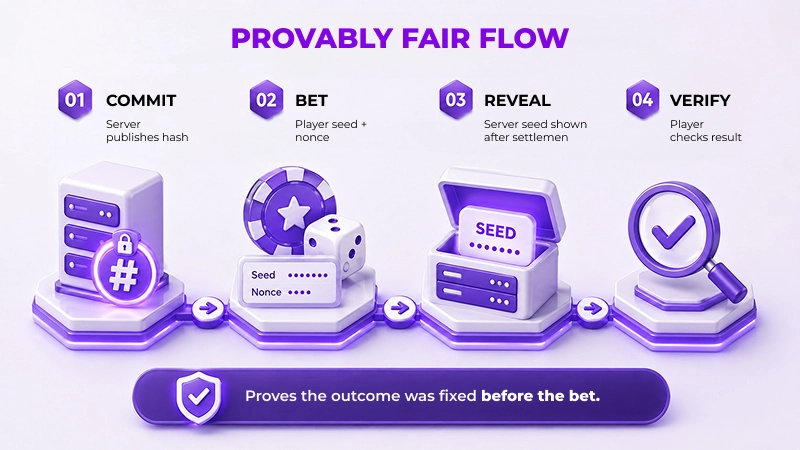
Provably fair games let a player verify a result mathematically instead of trusting an operator’s word. Before a bet is accepted, the server publishes the SHA-256 digest of a hidden seed of at least 32 bytes. That value is combined with a player-supplied input and a nonce to derive the outcome. The reveal after settlement makes the whole calculation reproducible offline.
Operators need this for two reasons. Verifiable rounds move dispute handling from support tickets to arithmetic. Crypto-native players now treat the feature as a baseline. The engineering cost sits in the platform layer: seed storage, per-round audit records, and reporting that testing labs request. NuxGame carries that layer through casino game aggregation, wallet and payment configuration, and back-office reporting.
What Is Provably Fair at the Protocol Level
Provably fair refers to a commitment protocol, not a randomness guarantee. Before a bet is accepted, the server publishes the output of a cryptographic hash function over a secret value. That digest binds the operator to one result. After settlement the input is released. Provably fair mechanics then allow players to verify a game result by re-deriving the seed and hash themselves.
So the guarantee is tamper-evidence, narrowly defined. The protocol proves a result was fixed in advance and derived by a stated algorithm. It says nothing about entropy quality, paytable accuracy, or house edge. Conflating those layers is the most frequent design error in early provably fair casino games.
The commitment proves:
- The outcome preceded the wager.
- The published derivation ran unmodified.
- Identical inputs reproduce identical values anywhere.
It does not prove:
- That the hidden seed is generated from a high-entropy source.
- That RTP and house edge are implemented correctly.
- That future seeds were not pre-selected.
Seed Inputs and Nonce Scoping
The client seed exists so the house cannot fix results unilaterally after seeing every input. The nonce is a monotonic counter that keeps each round distinct under one seed pair. Scope it per player, per game, and per commitment, or two titles will draw identical values.
Derivation should use HMAC-SHA256 keyed with the server seed, over the player input and counter. Plain hashing of concatenated strings invites length-extension behavior and ambiguous field boundaries. Without delimiters, “abc” + “12” and “ab” + “c12” collide into one input. Keyed derivation removes that bug class.
Provably Fair vs Certified RNG: Two Trust Models Compared
Certified randomness and player-side checking solve different halves of one problem. Under the lab model, an accredited facility inspects source code and statistical output, then issues a certificate. The UK Gambling Commission expects results to be acceptably random and bars adaptive behavior that reacts to how much a customer gambles.
A traditional casino engine exposes none of its internals. A provably fair system inverts that arrangement, so checking happens per round, on the player’s device, with no auditor involved. The trade is coverage: self-checking confirms one game outcome and ignores everything surrounding it. Builds aimed at licensed markets therefore run both models together.
| Dimension | Certified RNG | Provably fair |
|---|---|---|
| Who checks the result | Accredited test lab | The player, per round |
| Scope of assurance | Whole game and system | One outcome derivation |
| Evidence artifact | Lab certificate | Seed pair, counter, digest |
| Detects a rigged paytable | Yes | No |
| Detects a post-bet outcome swap | Indirectly, via logs | Yes, immediately |
| Accepted alone in US states | No | No |
| Recurring cost driver | Recertification on change | Seed storage and reveal endpoints |
Where Provably Fair Systems Break: Seed Grinding and Reveal Timing
Breaking SHA-256 is not the threat model worth budgeting against. The practical attack is seed grinding: a dishonest server generates many candidate seeds, computes the outcome each one produces against a known client seed, then commits to the profitable one. No hash is broken, and the fairness proof still validates.
Reveal timing is the second failure mode. Publishing an unhashed server seed while open bets still reference it makes later rounds predictable. Default player inputs create the same exposure at scale, since the house knows the value for everyone who never changed it. A forced rotation policy closes both gaps.
Clients arrive worried about the mathematics behind provably fair games, and the mathematics is rarely the problem. The housekeeping is what undoes projects — a seed revealed too early, a rotation policy nobody owns. Our advice is consistent: give the reveal rules a named owner before launch, not a paragraph in a document nobody opens twice.

Denis Kosinsky
Chief Product Officer at NuxGame
Pre-Committed Hash Chains and External Beacons
A reverse hash chain removes operator discretion. Generate one terminal value, hash it a fixed number of times, publish the final digest, then reveal the chain backwards. Each element hashes to its predecessor, so nobody can discover the original server seed early or reorder the sequence.
Mixing in outside entropy hardens the provably fair algorithm further. Public beacons such as the Cloudflare-backed publicly verifiable randomness beacon publish values on a schedule no single operator controls. Binding a chain segment to a future beacon round proves the input was unknown at commitment time. Blockchain block hashes offer weaker guarantees.
Server Seed Custody, Entropy, and Key Lifecycle
Seed quality is an infrastructure decision, not a game design decision. Use an approved secure generator drawing on the operating system entropy pool, following NIST guidance on deterministic random bit generators. Hash_DRBG, HMAC_DRBG and CTR_DRBG are the approved mechanisms. Math.random and Mersenne Twister disqualify a build from serious random number generation.
Lifecycle stages worth writing into the technical spec:
- Generate — 32 bytes minimum from a validated secure generator.
- Commit — publish the digest, store the plaintext value encrypted.
- Serve — derive each random outcome by keyed hash, key never exported.
- Rotate — on player request, at a counter ceiling, or on a fixed schedule.
- Reveal and retain — release after settlement, keep digest, counter and payout.
Unrevealed secrets carry a defined expiry, so custody has to match. Hold derivation keys inside validated hardware security modules: the AWS CloudHSM hsm2m.medium instance holds FIPS 140-3 Level 3 certificate #4703, and hsm1.medium moved to the CMVP historical list on January 4, 2026. Apply the key management lifecycle controls PCI DSS v4.0.1 sets for payment keys.
Verification Endpoints, Event Logging, and Throughput Cost
Outcome derivation costs almost nothing. One HMAC-SHA256 evaluation runs in microseconds on commodity hardware, so it never enters a latency budget. The expense sits in the write path, where every round persists a record that a regulator, a lab, or a player replays years afterwards.
Model that load before launch rather than after. A crash game cycling one round every twenty seconds across 5,000 concurrent sessions produces 900,000 settled bets an hour. At roughly 350 bytes per audit record, that is 315 MB hourly and about 7.5 GB daily, before indexes and replicas. Multi-year retention turns that into a procurement line.
Endpoint requirements that survive an audit:
- Publish the derivation as pseudocode plus signed test vectors, never as prose.
- Return digest, both seeds, counter and mapping function in one response.
- Rate-limit per account, because replay calls are cheap to abuse at volume.
- Host a static verifier page so third parties verify results independently.
US Compliance: Where Provably Fair Games Fit in Regulated iGaming
Regulated US iGaming produced $10.73 billion in gross gaming revenue during 2025, up 27.6 percent across seven live states, per the AGA State of the States report. Those markets settle in fiat through licensed rails. A provably fair bitcoin casino built on token deposits has no route into them, whatever its mathematics.
Certification is the gate, not the arithmetic. The New Jersey Division of Gaming Enforcement tests every internet gaming platform system before launch, and the GLI-19 standard sets the platform, random number generator and game requirements most state regulators adopt.
What Lab Certification Adds to a Provably Fair Deployment
- Source code submission and escrow covering derivation and mapping logic.
- Statistical testing of the underlying generator against its declared distribution.
- Change control: seed length, mapping or house edge edits force recertification.
- Retention of game records across the longest window in the license set.
Offshore frameworks are more permissive and host most provably fair casinos in operation. They accept provably fair gambling products with documentation supplied on request, treating the transparency claim as adequate player-facing evidence. Operators serving both footprints maintain two builds of one title, so budget that divergence during portfolio planning.
Which Game Types Actually Support Provable Fairness
Mechanical complexity decides feasibility. Single-draw formats map cleanly: fair dice needs one uniform integer, and provably fair crash needs one multiplier. Provably fair blackjack and provably fair poker commit to a shuffle, so the pre-image is a permutation rather than a scalar. Provably fair roulette sits between them.
Slots and live dealer tables resist the model. A modern spin draws reel positions, bonus triggers and cascading states at once, so the payload grows faster than any player checks. Provably fair slots appear mostly in simplified in-house titles. Live games are dealt physically, leaving no digital pre-image to commit to.
| Format | Committed object | Player uptake |
|---|---|---|
| Dice, limbo | One integer per bet | High |
| Crash, Aviator-style | One multiplier per round | High |
| Mines, plinko | One path or permutation | Medium |
| Table games | Full deck permutation | Medium |
| Slots, layered online games | Multi-stage draw tree | Low |
| Live dealer | None; studio controls apply | Not applicable |
Provably fair sports betting is a category error worth naming directly. Real-world results are not produced by the house, so nothing exists to commit to in advance. The checkable surface there is odds history, settlement timestamps and void logic. Number-driven side products stay in scope.
Integrating Provably Fair Games Through The NuxGame Platform
Adding engaging provably fair titles to a live online casino is an integration problem before it is a cryptography problem. Every supplier exposes seeds, counters and verifier pages differently, so players crossing two providers meet two mental models. Aggregation absorbs that variance at the wallet and session layer.
NuxGame connects operators to content through a single aggregation API, alongside sportsbook, payment configuration, player account management and back-office reporting. That structure keeps wager, settlement and rotation records inside one reporting layer rather than several supplier portals. Compliance and legal consulting from NuxGame covers the documentation packs that labs request at submission.
Configuration control that stays with the brand:
- Per-jurisdiction toggling of provably fair casino games by license.
- Rotation policy exposed in the back office, not hard-coded by the supplier.
- Unified bet history export carrying digest, counter, seed reference and settlement time.
Technical Snapshot
The table condenses what a production build needs before lab submission or market launch. Treat every checkpoint as a gate rather than a recommendation, since most are expensive to retrofit once a title is live.
| Layer | Requirement | Checkpoint |
|---|---|---|
| Entropy | Approved generator, hidden seed 32 bytes or larger | Approved DRBG mechanism in use |
| Derivation | HMAC-SHA256 keyed by the secret value | Test vectors published and reproducible |
| Commitment | Digest displayed before wager acceptance | Digest immutable in the round record |
| Counter | Scoped per player, game and seed pair | No cross-game collision under load test |
| Key custody | FIPS 140-3 Level 3 HSM or managed KMS | Secret never exported in plaintext |
| Reveal | Blocked until referencing bets settle | Automated guard rejects early disclosure |
| Storage | ~350 B per round, multi-year retention | Capacity plan approved pre-launch |
| Certification | Accredited lab review of the full title | Recertification triggered by config change |
Two indicators separate a working deployment from a marketing claim. An independent party must verify a settled round using published data alone. The reveal guard must demonstrably block disclosure while wagers remain open. Anything less leaves no transparent record of what was gambled and what was returned.
Deciding If Provably Fair Games Belong in Your Portfolio
Treat provably fair games as an evidence layer with a hard boundary. The protocol answers one question well — was this outcome fixed before the wager — and answers nothing beyond it. Decide early whether your target market rewards that evidence or demands a certificate instead, because the two paths diverge at architecture rather than at launch.
Growing acceptance of provably fair gaming has raised expectations across the iGaming industry, though the role of provably fair in iGaming stays deliberately narrow. Trust in iGaming platforms serving licensed US states rests on accredited testing, controlled change management and retrievable records. Build to the stricter requirement and the looser one comes free.
Operators weighing provably fair technology need two things at once: game logic that survives inspection, and a crypto casino platform able to carry the evidence behind it. The NuxGame team scopes aggregation, wallet, reporting and documentation requirements against your target jurisdictions, then maps what an accredited lab will ask for. Request a technical consultation to review your license set and content roadmap.