Русский
 Best Crypto Casino Providers in 2026: Software Platforms Compared

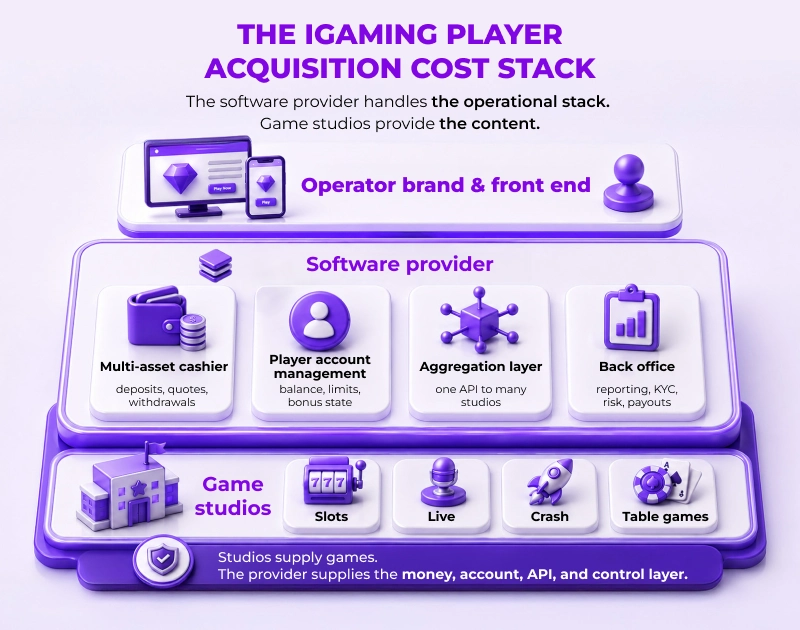
Crypto casino providers split into two categories that operators should never shortlist together. Software providers supply the platform — wallet, cashier, player accounts and back office. Game providers supply the studios and titles that run on top. This guide ranks each group separately, names the vendors worth considering in 2026, and shows how to judge them before signing.
The software provider decides what an operator can put in front of players: which currencies the cashier clears, how fast withdrawals settle, which licenses the stack satisfies. Six Bitcoin confirmations take about 60 minutes, while a stablecoin transfer settles in seconds. The NuxGame crypto casino software covers that platform layer, with turnkey and white label deployment, crypto payments across 30+ assets, KYC flows and content from 140+ studios through one integration.
Key Takeaways
What a Crypto Casino Provider Actually Delivers
A cryptocurrency casino is not a traditional online casino with an extra deposit button. In online gambling, the same casino games run on both stacks, but the ledger behaves differently. Fiat balances carry two decimal places, Bitcoin carries eight, ERC-20 tokens carry eighteen. Rounding wagers across those precisions produces the reconciliation drift that surfaces at month end.
Denomination is the second fork. Native-coin balances let crypto players stake 0.00042 BTC directly, parking volatility on the operator liability side. Shadow-fiat balances convert at a locked quote and move that exposure to the treasury desk. Traditional gambling sites never faced this choice, because a dollar settles as a dollar.
Components a software provider supplies that a game studio does not:
- Multi-asset cashier — deposit routing, quote locking, dust thresholds, withdrawal approval tiers.
- Player account management — one balance across casino and betting verticals, with limits and bonus state.
- Aggregation layer — a single API replacing one integration per studio.
- Back office — reporting, KYC queues, risk rules and payout controls the operator edits directly.
Best Crypto Casino Software Providers in 2026
Software providers are the platform underneath a brand. They hold the wallet, run the cashier and carry the compliance obligation, which is why the process of choosing a casino software provider outlasts every other vendor decision. The top crypto casino platforms below all handle crypto natively; they differ on deployment speed, crypto depth and how much backend an operator controls.
NuxGame — Turnkey Crypto Casino and Sportsbook Platform
NuxGame is the top pick for operators who want one platform running a casino and sportsbook against a single balance. The stack covers turnkey and white label deployment, a cashier handling fiat and digital rails together, player account management, and a back office operators edit themselves. Launch timelines run to a few weeks rather than months.
Content arrives through one integration, with native crypto transactions, Web3 wallet authentication and Telegram builds included rather than quoted as extras. For a mid-market operator entering crypto, that consolidation removes the vendor sprawl that turns a launch into a twelve-month program.
SoftSwiss — Crypto-Native Enterprise Platform
SoftSwiss shipped one of the first commercial Bitcoin casino solutions in 2013 and sits at the enterprise end of the market. Its modular stack pairs a casino platform with a game aggregator carrying 40,000+ titles, and it reports near-99.99% platform uptime. The depth suits high-volume operators, though onboarding weight and pricing scale with it.
EveryMatrix — Modular Stack for Regulated Growth
EveryMatrix ships casino, sportsbook, PAM, payments and affiliate tools as five separately integrated modules under one back office. Crypto is handled through its payment orchestration rather than as a native core, so it fits operators prioritizing regulated-market coverage and component-level control over a crypto-first launch.
Digitain — Sportsbook-Led Multi-Vertical Platform
Digitain’s strength is the sportsbook, with a casino layer that integrates against it and cryptocurrency payments across Bitcoin, Ethereum and USDT. It reads best for operators whose primary vertical is betting and who want casino content sharing one wallet, rather than crypto-casino specialists.
Slotegrator — Aggregation and API Integration
Slotegrator centers on game aggregation and modular API integration, giving operators a gradual path from white label toward a more self-managed build. Crypto acceptance runs through its payment module. It suits smaller teams weighing aggregation breadth against integration effort.
| Software provider | Deployment | Crypto handling |
|---|---|---|
| NuxGame | Turnkey, white label, API | Native cashier, Web3 wallets, 30+ assets |
| SoftSwiss | Turnkey, white label | Native since 2013, large aggregator |
| EveryMatrix | Modular, white label, turnkey | Payment orchestration, integrated |
| Digitain | Turnkey, white label | BTC / ETH / USDT via platform |
| Slotegrator | White label, API | Payment-module acceptance |
Rankings that mix software platforms with slot studios mislead buyers, because the two are not substitutes. A software provider is chosen once and lived with; a studio is added or dropped in an afternoon. Operators ask how many games we have long before they ask how quickly players get paid. The instinct is understandable — the catalog is the part you can see. But a library players cannot withdraw from is a shop window with the door locked. Assess the cashier first. Content is the easiest thing to add later.

Denis Kosinsky
Chief Product Officer at NuxGame
Best Crypto Casino Game Providers in 2026
Game providers are the studios behind the titles. On a well-built platform they reach operators through the aggregation layer, so adding a studio is a configuration change rather than a new contract. The game software providers below cover the spread most crypto audiences expect, from live dealers to crash.
Evolution — Live Casino Games and Dealer Streams
Evolution supplies live dealer studios, multi-table streaming and adaptive bitrate delivery. Live tables carry the highest bandwidth and latency sensitivity in any catalog, making streaming infrastructure the differentiator rather than table variety. It fits operators whose retention depends on dealers rather than slots.
Pragmatic Play — High-Volatility Slots and Live Tables
Pragmatic Play covers slot math and live content, with a shared jackpot layer spanning brands. That mechanic matters commercially: a smaller operator can advertise prize pools funded across the network. Release cadence is high, suiting content-led promotional calendars.
BGaming — Provably Fair Bitcoin Casino Games
BGaming builds crypto-native slots and instant titles with client-verifiable server and client seeds. Provably fair verification lets a player confirm a round outcome independently, answering the trust objection that follows every blockchain casino brand. It suits audiences arriving from crypto rather than traditional gambling.
Spribe — Crash Games and Round-Based Multiplayer
Spribe produces crash and turbo formats built on shared round state, where every participant sees the same multiplier curve. Sub-second synchronization stresses the wallet layer harder than slots do. These titles drive session frequency more than session length.
Hacksaw Gaming — Mobile-First Content
Hacksaw focuses on low asset-weight titles that load quickly on constrained bandwidth. Asset size is an underrated retention variable: a slow first load costs more players than an unfavorable RTP. It suits mobile acquisition in markets with uneven connectivity.
Ezugi, NetEnt and Wazdan — Depth Across Segments
Ezugi runs regional dealer tables with low stake floors for emerging markets. NetEnt supplies long-tail classic slots that anchor retention cohorts. Wazdan ships configurable-volatility titles for operators tuning a lean catalog rather than maximizing count.
How to Evaluate a Crypto Casino Platform Vendor
Catalog size is the weakest selection criterion available. Thousands of casino games rarely translate into proportional revenue, since activity concentrates in a few hundred titles. A curated range of casino games with reliable launch times shapes the gambling experience more than title count does. The decision comes down to the cashier, the compliance tooling and the incident record.
Cashier Design and Crypto Withdrawals
Treasury design decides how fast money leaves the building. A hot wallet signs automatically and covers routine payouts; cold storage requires multi-signature handling. Operators advertising fast crypto withdrawals are describing hot wallet float, not chain speed. Velocity caps per crypto wallet and a review path above a set value keep the automated crypto payout queue stable at peak.
Confirmation policy is the second question. Crediting after one block is fast and exposed to reorganization; six Bitcoin blocks remove that risk at the cost of an hour. Rails also differ in how quickly crypto transactions reach finality, which is why dollar-pegged transfers now carry a growing share of deposits across cryptocurrency gambling sites.
Wallet Integration and Session Continuity
A seamless wallet means the game server calls the platform for every bet and win rather than holding a local balance. That removes transfer friction and makes the wallet endpoint the single point of failure for a session. Budget it under 200 ms at p95, since a late debit callback produces a rejected bet, not a slow one.
Infrastructure and Uptime Evidence
Attack volume here is not theoretical. Cloudflare’s quarterly DDoS threat report for Q4 2025 recorded a 31% quarter-on-quarter rise in attacks, with the gambling industry ranked third among targeted sectors. A 99.9% uptime target permits roughly 43 minutes of downtime monthly, which one sustained attack consumes entirely.
Questions worth asking when comparing crypto gambling platforms:
- Documented mean time to recovery, and a status page with historical incident records.
- Sandbox access with live wallet callbacks before contract, not after.
- Chain-analytics vendor named in writing, with operator-configurable thresholds.
- Responsible gambling tools — deposit limits, reality checks, self-exclusion — exposed through the cashier API.
- A written exit and data-export process with defined timelines and formats.
Licensing and Compliance for Crypto Casino Operators
Regulatory attention has moved from whether operators accept digital assets to how they control them. Malta’s regulator listed a thematic review of crypto asset internal controls among its 2026 supervisory priorities, beside cash equivalents and player protection. Digital assets now sit apart from the payments policy of an online crypto casino.
Curaçao moved the same way. Under the National Ordinance on Games of Chance, in force since December 2024, master and sub-licenses disappeared. Each operator holds a direct license from the Curaçao Gaming Authority, and public rankings of crypto gambling sites still list anonymous brands that would fail that review. No-KYC crypto gambling sites have no path through that process.
| Control | Standard or authority | What the platform must produce |
|---|---|---|
| Crypto asset internal controls | MGA 2026 supervisory agenda | Documented AML typologies for wallet-funded accounts |
| Round-level event logging | GLI-19 v3.0 | Unique game cycle, session and player IDs per round |
| Payment page script integrity | PCI DSS v4.0.1, req. 6.4.3 and 11.6.1 | Authorized script inventory and tamper alerting |
| Source of funds on deposits | Curaçao LOK / CGA | Wallet attestation and address screening before credit |
Two rows carry real engineering costs. The GLI-19 v3.0 standard requires a unique game cycle, session and player identifier per round, setting minimum retention and export capability in the event store. On the card side, 51 future-dated PCI DSS requirements became mandatory on March 31, 2025, and the payment page security guidance from the PCI Security Standards Council explains why script inventories are assessed rather than assumed.
Crypto Gambling in the USA: Where It Stands in 2026
In the United States, online gambling is legal only at state level. Eight states license online casino play: New Jersey, Delaware, Michigan, Pennsylvania, Connecticut, Rhode Island, West Virginia and Maine. None licenses digital assets as a regulated deposit method. Offshore gambling sites offer American-facing play under Curaçao licenses, carrying UIGEA exposure on the payment leg.
Enforcement is tightening at the edges of the casino market. California’s ban on dual-currency sweepstakes took effect on January 1, 2026, with other states legislating along the same line. FinCEN and OFAC opened AML and sanctions rulemaking under the GENIUS Act in April 2026, effective 2027. Britain is moving from the opposite end, where the Gambling Commission has explored a regulated pathway for crypto assets since February 2026.
Geo-architecture consequences for anyone with US-adjacent traffic:
- Geolocation runs on IP and device signals at session start and re-authentication, not at registration only.
- State blocklists are held as configuration, so a legislative change is a deployment, not a release.
- Payment-rail segregation keeps restricted traffic away from processors with a US nexus.
- Affiliate territory controls are enforced by postback validation, not by contractual promises.
How NuxGame Supports Crypto Casino Launches
Every crypto project reaching the NuxGame team starts somewhere different. Some are fiat operators adding a digital cashier to an existing brand; others build from zero. The same components serve both paths, which is why integration scope varies far more than architecture does.
What the platform covers in practice:
- Deployment models — turnkey for speed, white label for structured entry, API integration for an existing front end.
- Cashier configuration — fiat and digital rails side by side, with quote locking, approval tiers and per-brand limits.
- Content aggregation — slots, live tables, crash titles, lotteries and virtual sports through one integration.
- Shared wallet — casino and betting settle against a single balance and one bonus state.
- Compliance tooling — KYC queues, limit enforcement and reporting exports aligned to license conditions.
- Telegram and mobile-first builds — formats aimed at audiences arriving through crypto channels.
Technical Snapshot
| Area | Requirement | Indicator to monitor |
|---|---|---|
| Cashier | Tiered confirmation policy by asset and value band | Median time from broadcast to credit |
| Custody | Hot, warm and cold split with per-tier approval thresholds | Hot float as a share of monthly payout volume |
| Wallet layer | Idempotent debit and credit endpoints with replay-safe rollback | p95 callback latency, rollback failure rate |
| Compliance | Address screening pre-credit, source-of-funds triggers, round-level logging | Screening hit rate, log export completeness |
| Card on-ramp | PCI DSS v4.0.1 script inventory and tamper detection | Unauthorized script alerts per month |
| Availability | Multi-region failover with anycast edge filtering | Uptime against the 43-minute monthly budget |
Talk Through Your Build With the NuxGame Team
Comparing crypto casino sites as a player is a bonus exercise. Selecting a software platform is a cashier and compliance decision, and the two rarely correlate. A vendor with a modest catalog and a well-instrumented wallet outperforms a bigger library sitting behind an opaque payout queue.
Decide the software layer first, then the license, then the studios. Reversing that order produces the integrations that consume a year of roadmap.
Bring a specification, a license in progress or a brand that needs a digital cashier, and the technical team will map it against the platform before anything is signed. That covers deployment model, cashier configuration, content scope and license-driven reporting. Contact NuxGame to start.