Русский
 Player Acquisition Costs in iGaming: The 2026 Cost Stack and Unit Economics

Player acquisition costs measure the total spend required to convert one prospect into a new depositing player. In mature US regulated iGaming markets, that figure sits between $250 and $650 per first-time depositor, and it climbs as taxes and media prices rise. Online casino and sportsbook operators track Customer Acquisition Cost (CAC) because thin margins turn a single mispriced channel into a direct loss. In highly competitive sectors, understanding CAC is the difference between sustainable scaling and burning through capital. When margins are compressed, acquisition strategies act directly as unit-economics levers rather than top-of-funnel vanity metrics.
The full cost stack spans media, welcome bonus liability, affiliate fees, payment processing, and compliance overhead. NuxGame provides an iGaming platform solution for operators through modular casino aggregation, player account management, and back-office tools that consolidate vendor connections and reduce the technology portion of that cost.
Digest List
-
Customer acquisition cost in iGaming spans a five-part stack: media, bonuses, affiliates, payments, and compliance.
-
A 3:1 lifetime value-to-CAC ratio marks the floor for sustainable acquisition, not the target.
-
Attribution lag and batch data sync inflate the measured figure without appearing on any campaign dashboard.
-
PCI DSS v4.0.1 script-management and page-change controls add engineering load to every deposit page.
-
Vendor consolidation and loyalty design cut the cost per depositor faster than paid-media adjustments.
What Player Acquisition Cost Actually Includes
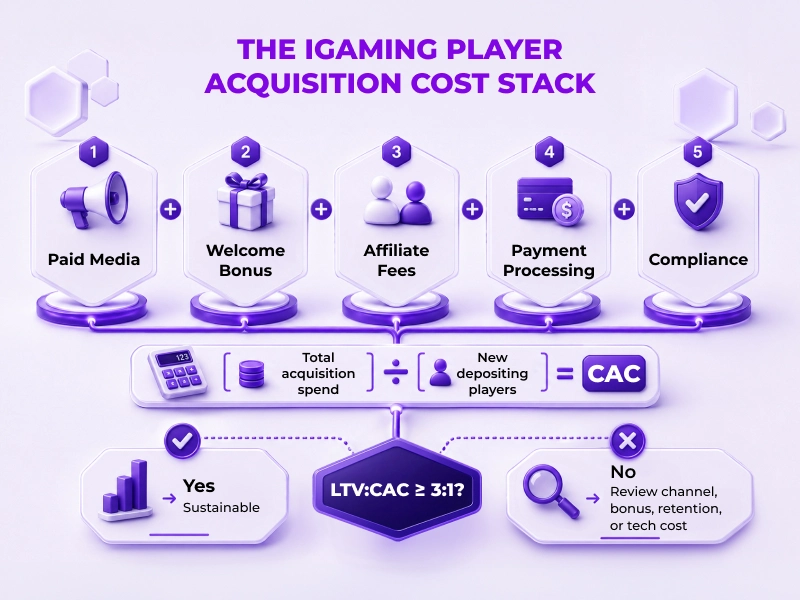
Customer acquisition cost in iGaming divides total acquisition spend by the number of new depositing players. The formula looks simple, but the numerator hides a five-part stack. Media, welcome bonus liability, affiliate revenue share, payment processing, and compliance overhead all load onto each first-time depositor. Ignore one line, and you understate the cost required to acquire a single player. That gap distorts the cost of acquiring a new qualified player.
| Cost component | What it covers | Share of total cost |
|---|---|---|
| Paid media | Search, social, programmatic, display | 30–50% |
| Welcome bonus | First-deposit match, free bets, cashback | 15–30% |
| Affiliate fees | CPA and revenue-share payouts | 15–35% |
| Payment processing | Deposit fees, failed-payment retries | 3–8% |
| Compliance | KYC, AML screening, responsible gambling | 2–6% |
Reported 2026 benchmarks place the cost per first-time depositor at $250–$650. Mature regulated iGaming markets like the UK show how local rules reshape that stack. Broader ranges reach roughly $1,400 per depositor where competition and channel mix push spend higher. Channel choice also sets player quality: affiliate marketing traffic converts differently from paid search. A depositor won cheaply through a discount-led promotion often churns before repaying the welcome bonus.
Why Acquisition Costs Are Climbing in US Regulated Markets
For online gambling businesses, tax policy is now a direct input to the cost math. New Jersey raised its iGaming and sports betting tax to 19.75% in July 2025, up from 15%, according to state gaming-enforcement filings. A 2.5% community investment fee sits on top. Every extra tax point removes margin that once funded promotions, which raises the effective cost to acquire one player.
Media inflation compounds the pressure. Search CPMs for tier 1 gambling keywords now exceed $350, and saturated states can push the cost per depositor above $800 for an active account. Responsible gambling mandates consume a further slice of marketing spend, while inefficient targeting raises ad spend. The US commercial gaming data shows demand rising, yet global iGaming market projections confirm that spending to capture that demand rises faster.
Unit Economics: Modeling Value and Payback
Acquisition cost means little without player lifetime value beside it. In iGaming, LTV equals the net gaming revenue a player generates across their active relationship. At the single customer level, customer lifetime value turns that relationship into a measurable unit. The industry benchmark is a 3:1 ratio: three dollars of LTV for every dollar of CAC. Anything at 1:1 or below wins depositors at a loss, and payback horizon decides survival.
Three inputs build that value:
- Active lifespan: Months between first deposit and churn.
- Monthly NGR: Gross gaming revenue minus winnings paid out.
- Net adjustments: Bonuses issued, payment fees, and gaming taxes deducted.
A blended figure hides weak channels, so teams compare acquisition strategies by cohort and channel source. A new depositing player is not the same asset as a retained one. Bonus-driven cohorts inflate registration counts while depressing quality. Measuring the cost per registration within each acquisition channel, then weighting each channel by 90-day cohort value, exposes where the spend actually returns net gaming revenue.
Acquisition cost is only half the equation. The real test is whether each new player has room to grow into long-term value. Operators need a clear view of channel quality, payback, and retention, because a full funnel can still hide an empty wallet. Sustainable growth starts when marketing spend and platform economics speak the same language.

Denis Kosinsky
Chief Product Officer at NuxGame
Attribution and Data Architecture Behind Every Cost Figure
Every cost figure depends on the data pipeline that produces it. Accurate tracking requires deposit, wager, and session events pulled from the player account management system through API or Kafka streams. Batch processing that refreshes overnight introduces sync lag. Marketing teams then optimize against segments that are hours out of date, and wasted spend inflates the number without surfacing on any dashboard.
A real-time layer changes the measurement and supports continuous optimization. Event ingestion scaled on cloud auto-scaling infrastructure handles deposit spikes during promotions without dropped records. Placing bot filtering and request routing on an edge network layer blocks fraudulent registrations that dilute conversion rates, so each conversion is more likely to represent a genuine player. Wallet synchronization should resolve within a few hundred milliseconds, and attribution windows must reconcile FTD events against the originating campaign.
Compliance Costs Built Into Acquisition Spend
Compliance is a cost line, not a separate budget. For casino players, KYC and AML screening at signup add friction and cost to every registration, and approval time directly affects conversion rates. Affordability checks under UK Gambling Commission rules and identity verification under the Malta Gaming Authority framework extend the funnel between click and first deposit.
Payment-page security carries its own engineering load. The PCI DSS v4.0.1 standard became mandatory in full on March 31, 2025, and 2026 assessments validate against it.
| Requirement | Technical obligation | Operator impact |
|---|---|---|
| Req 6.4.3 | Inventory and authorize every payment-page script | Slower release cycles on deposit flows |
| Req 11.6.1 | Detect unauthorized changes to payment pages | Continuous monitoring, not annual checks |
| Req 8 — MFA | Phishing-resistant authentication for access | Identity system rework and staff training |
Reporting obligations flow through the SAQ or Report on Compliance, and the cardholder data environment defines assessment scope. Narrower scope reduces audit cost. Emerging jurisdictions overseen by the GCGRA licensing regime add further reporting layers, so operators entering new regulated markets should model compliance as a recurring acquisition cost, not a fixed setup fee.
Cutting the Effective Cost Per Player
Player retention is the fastest lever on effective cost, and the handoff from acquisition to retention determines how quickly that lever pays back. Top iGaming operators hold Day 30 retention between 30% and 40%, which spreads the spend across more revenue before churn. Restructuring bonuses helps: tiered loyalty, cashback, and mission-based rewards retain value better than front-loaded welcome bonuses. Personalization based on player segmentation lifts repeat deposit rates without raising media spend.
An online casino platform can cut the technology portion of cost through consolidation. Analyst guidance on marketing technology consolidation points to integration over tool proliferation, and the same logic applies to operator stacks. NuxGame reduces the number of separate vendor connections through modular casino aggregation, integrated payment configuration, player account management, and back-office reporting. Fewer integrations mean lower fixed tech cost per depositing account and cleaner reporting data.
Technical Snapshot
| Area | Indicator or checkpoint | Reference point |
|---|---|---|
| Unit economics | LTV:CAC ratio target | 3:1 minimum |
| Cost per player | First-time depositor spend, mature iGaming markets | $250–$650 |
| Data pipeline | Wallet synchronization delay | Low hundreds of milliseconds |
| Attribution | Sync method for PAM events | Real-time API/Kafka, not batch |
| Compliance | PCI DSS validation version | v4.0.1, mandatory since March 2025 |
| Retention | Day-30 rate band, strong operators | 30%–40% |
| Tax load — NJ | iGaming gross-revenue tax | 19.75% + 2.5% fee |
| Consolidation | Vendor connections per capability | Reduce through single-platform aggregation |
Conclusion
In a competitive iGaming industry, player acquisition costs are no longer a marketing metric; they are an engineering and compliance problem with a finance deadline. Rising costs from taxes, media inflation, and mandatory security controls have pushed the cost to acquire one player to a level where sloppy tracking or vendor sprawl erases the return.
The operators who hold healthy unit economics through 2026 will be those who model the full cost stack, measure cost per channel against 90-day value, and remove the tech overhead they no longer need. Bring the cost model and the platform decision into the same room, and treat every integration as a line on the cost per player ledger.
If the cost math is the constraint on user acquisition growth, the platform layer is where operators recover margin. NuxGame consolidates casino aggregation, sportsbook, payments, player account management, and compliance tooling into one integration, which lowers the fixed technology cost carried by every depositing player. Request a technical walkthrough to map the cost stack against a single-platform build.