Русский
 How to Start a Crypto Casino in 2026: Architecture, Payment Flow Design, and System Performance

The decision to launch a crypto casino in 2026 starts with understanding system design rather than marketing. Choosing the right crypto casino solution becomes a major part of that process. Operators entering this space are no longer competing on visuals or game count. They are defined by infrastructure, payment reliability, and user trust. A crypto casino today is a performance system where every component directly affects retention and long-term profitability.
The adoption of crypto payments in iGaming has altered operator priorities. Speed, transaction certainty, and system uptime are now the main criteria of player satisfaction. Delays are tolerated in traditional environments. But when it comes to crypto users, they want instant confirmation and uninterrupted flows. This makes backend architecture a major business driver rather than a technical detail.
The Bitcoin gambling wallet is at the foundation of this system. It acts as both a payment mechanism and a user identity component. Wallet behavior directly influences deposit speed, withdrawal consistency, as well as fraud exposure. Operators must treat wallet infrastructure as a critical component of retention (never as merely a payment tool).
TL;DR:
Crypto Casino vs Blockchain Casino: What Actually Changes in the System
A blockchain casino operates with on-chain verification for every transaction. As for a standard crypto casino, it uses a hybrid model combining blockchain technology with off-chain processing for speed and scalability.
From a system perspective:
- Blockchain-only: transparency, but slower confirmation.
- Hybrid systems: faster performance, better UX.
- Operational balance: speed vs verification depth.
Hybrid architecture is the preferred model for most operators: it allows faster withdrawal processing and stable user sessions without sacrificing trust.
Technical Snapshot: Crypto Payment Flow Architecture (Illustrative)
The diagram below represents a simplified payment flow of how a crypto gambling platform manages transactions. This flow directly determines how fast deposits are processed, how reliably balances are updated, and how stable the player experience remains under load. Each step in this flow affects transaction speed, system reliability, and player trust.

This flow is supported by logic that allows the system to reroute or retry transactions automatically in case of delay or error. The simplified setup below shows how this can be configured at the system level:
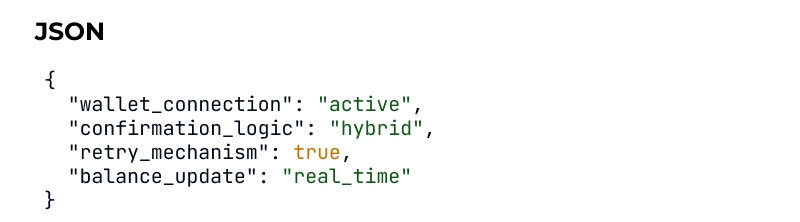
Implementation Note. The exact setup may vary depending on platform architecture, supported crypto assets, as well as regulatory requirements in each market.
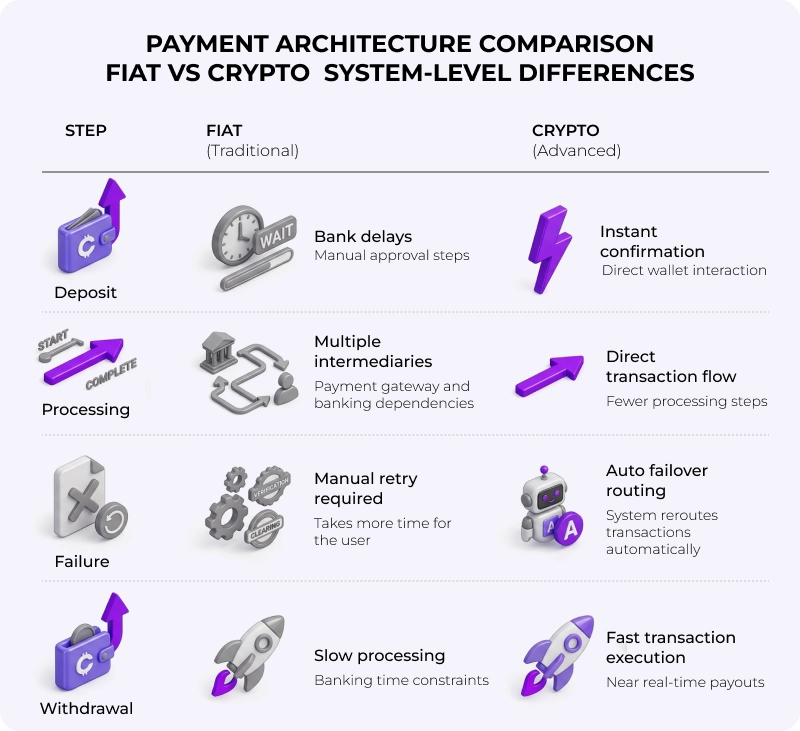
Crypto vs Fiat Payments: Main Distinctions
Modern iGaming payment solutions work differently in fiat and crypto systems, especially in how transactions move, complete, and recover from errors. The comparison below shows where delays happen and how system design affects speed and reliability.
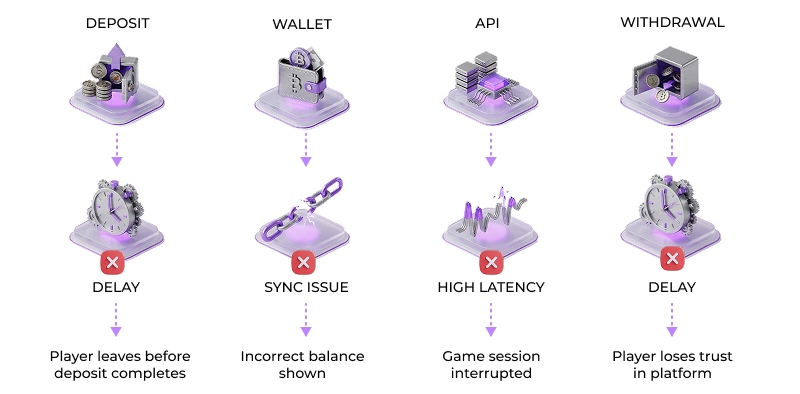
Where Crypto Casinos Lose Players: Key System Failure Points
Even small system issues can directly affect player behavior. The examples below show how technical problems at different stages can lead to drop-offs, trust loss, and reduced retention.
Engineering Analysis: What Makes a Crypto Casino Perform Well
Unlike traditional platforms, a crypto casino platform must handle multiple real-time processes simultaneously:
- wallet synchronization;
- transaction validation;
- balance updates;
- fraud monitoring.
Core system principles:
- low-latency API responses (<100ms typical benchmark);
- event-driven transaction handling;
- retry and failover logic for unstable nodes.
Think of a crypto casino as a system of connected gears. Each transaction, API response, and wallet update must move in sync. If one gear slows down or slips, the entire mechanism feels unreliable. Retention is not driven by features, but by systems that maintain consistent performance, even when transaction volume and load increase.

Denis Kosinsky
Chief Operating Officer at NuxGame
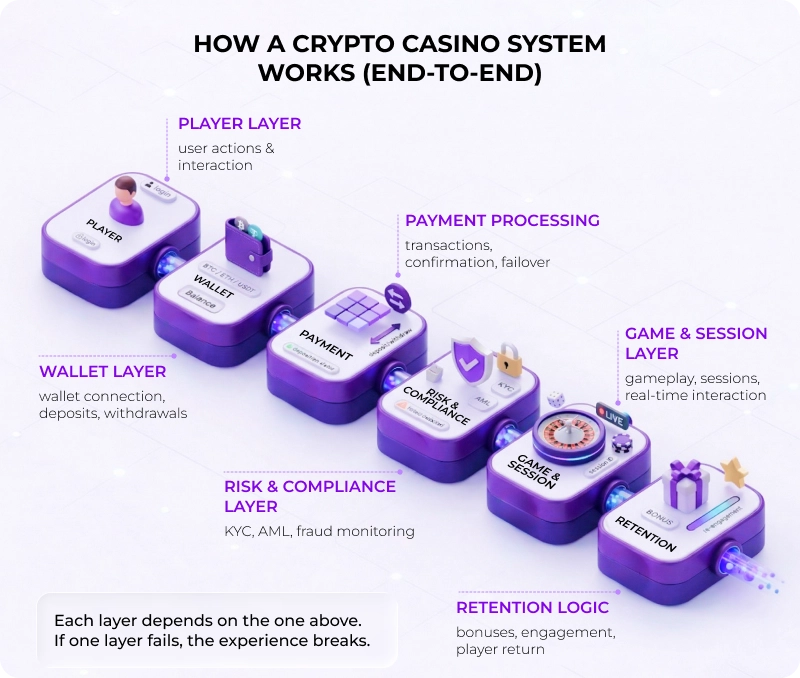
Crypto Casino System Architecture: How the Platform Works End-to-End
The diagram below shows how a crypto casino platform is structured at the system level, from player interaction to retention logic. Each layer plays a direct role in performance, payment reliability, and player retention. Weakness in any layer can affect the entire system.
Main System Components for Crypto Casino Operations
The table below shows the main parts of a crypto casino system and how they can be set up in a basic or more advanced way.
| Component | Basic Setup | Optimized Setup |
|---|---|---|
| Wallet Integration | Single wallet connection | Multi-wallet support with fallback |
| Transaction Handling | Manual confirmation delays | Automated confirmation + retry logic |
| Payment Method | Support Limited crypto assets | Multi-asset + fiat bridge support |
| Fraud Control | Basic monitoring | Real-time risk scoring |
| Performance | Variable latency | Stable low-latency response |
Regulatory and Compliance Logic in Crypto Gambling
Managing a crypto gambling website involves implementing compliance logic that connects blockchain-based transactions with established regulatory requirements. From an architectural perspective, the system must support how identity verification and risk controls operate within regulated iGaming environments. These processes are often built in line with standards such as ISO 27001 or PCI DSS where applicable.
Key requirements include:
- KYC processes for identity verification;
- AML checks for transaction monitoring;
- secure handling of crypto assets;
- alignment with jurisdiction-specific laws.
That said, operators planning to get an online gambling license must make sure their casino supports clear compliance processes. This is particularly vital in legal gambling markets, where regulations directly shape how payments and system behavior must function.
Infrastructure Requirements When Launching a Crypto Casino
System stability becomes the primary challenge as your crypto casino scales. Growth introduces higher transaction frequency and more concurrent interactions, requiring infrastructure that can maintain consistent performance without introducing latency or processing errors.
A crypto casino site must support:
- increasing transaction volume;
- concurrent player sessions;
- consistent performance during peak load.
Problems in the payment layer can quickly lead to loss of trust and lower revenue. Operators who want to start an online casino should focus on stable and reliable system performance, because even small disruptions in transactions can affect retention and long-term growth.
Scaling Challenges: What Breaks First
As a crypto casino begins to scale, system weaknesses often become visible under real operating conditions. Increased transaction activity, higher concurrency, and more complex processing flows place pressure on the infrastructure, revealing areas where performance consistency and system coordination are not fully optimized.
Most crypto casino operators encounter issues in three areas:
- payment confirmation delays;
- inconsistent balance updates;
- system latency under load.
These issues are usually rooted in system design rather than user volume itself. When comparing online casino software prices, operators should assess the underlying architecture, as systems that lack well-structured processing logic may become unstable as activity grows.
Technical Competitive Advantage: What Actually Improves Performance
Operators who succeed in running a crypto casino focus on:
- dynamic routing of transactions;
- modular API design;
- system monitoring at every layer.
| Feature | Typical Setup | Advanced Setup |
|---|---|---|
| Payment Flow Single-path processing Multi-path routing | Flow Single-path processing | Multi-path routing |
| Latency | Unstable | Optimized for consistency |
| Retention Strategy | Bonus-driven | Behavior-driven |
Operator Tips for Starting an Online Crypto Casino
If you plan to open a crypto casino, focus on these expert recommendations:
- Reduce transaction uncertainty. Players expect immediate confirmation. Delays in deposit processing or inconsistent confirmation times quickly reduce trust and conversion rates.
- Optimize onboarding. The first deposit flow defines retention. Simplify wallet connection, minimize steps, and make sure transactions complete errorlessly.
- Design for volatility. Cryptocurrency volatility affects player behavior. Adjust limits, balances, and timing logic to maintain stable user experience during price fluctuations.
- Build around behavior. Track how users interact with transactions, sessions, and flows. System behavior data is more valuable than spending metrics alone.
Market Reality: Crypto Users Expect More
Modern crypto users interact with online platforms differently compared to traditional players.
Their behavior typically follows these patterns:
- they expect instant actions;
- they value privacy;
- they leave quickly if systems fail.
To choose the best online casino games, operators must align content with player expectations:
- fast-loading games;
- mobile-first design;
- optimized integration.
At the end of the day, operators who want to create a gambling website must design systems that respond instantly and behave consistently. That’s because performance is no longer a competitive advantage but a baseline requirement for user retention.
Bottom Line
The difference between casinos that scale and those that stall is not marketing: it’s system design. Infrastructure defines revenue, and payment reliability defines retention in today’s casino sector. Operators who understand this build predictable, lasting growth. If you plan to start your own Bitcoin casino, focus on performance first. A well-structured crypto gambling platform earns trust through consistency. This is where the NuxGame iGaming platform fits — built for real operational pressure, not solely launch scenarios.