Русский
 Crypto Casino Trends 2026

The crypto side of the gambling industry is moving from coin novelty toward controlled settlement, stablecoin cashier rails, wallet risk logic, and stronger evidence. The market is no longer only about adding bitcoin or ethereum deposits. Product teams now need payment routing, settlement control, AML checks, cash visibility, and auditable records across casino and sport.
NuxGame supports this direction through casino aggregation, sports betting tools, payment configuration, player account management, and back-office reporting that help B2C brands manage crypto-funded play from one operating environment. The same pressure is reshaping regulated online gambling, where an online casino now has to prove every balance and every settled ticket.
Key Takeaways
-
Stablecoins are becoming the practical crypto cash layer.
-
Cash outs are becoming more important in crypto sport.
-
Wallet screening is shifting from a payment-side check into a player risk signal.
-
Hybrid fiat-crypto balances create a ledger architecture problem.
-
Compliance teams need event-level evidence for each stake, payout, cash out offer, and wallet movement.
-
The wider online gambling market is unifying these controls, so crypto reads like infrastructure, not a fad.
-
Layer-2 rollups are becoming the default settlement venue for cashier and per-bet traffic.
-
Account abstraction and ERC-4337 are removing the seed phrase barrier for mainstream players.
Where Crypto Gambling Is Heading in 2026
The real priorities here lean toward practical infrastructure rather than coin appeal. The serious roadmap is stablecoin settlement, stronger wallet checks, unified reporting, and product-level risk controls. These are the latest trends that product teams actually fund, and crypto casino growth tends to follow when the plumbing is reliable. What looked experimental in 2024 is now a core to the roadmap: players still see faster deposits, while the platform sees a harder problem, since every bet, payout, and wallet state needs clean reconciliation.
The USA angle is also changing. The GENIUS Act created a federal framework for payment stablecoins, and the Federal Reserve describes a payment stablecoin as a digital asset designed for payment and one-to-one value against the US dollar. That matters for a crypto casino because dollar-backed rails are becoming payment infrastructure, not only a crypto asset choice. For teams comparing options, the top crypto rails now mean dollar-first settlement, so read the market data before you commit to one network.
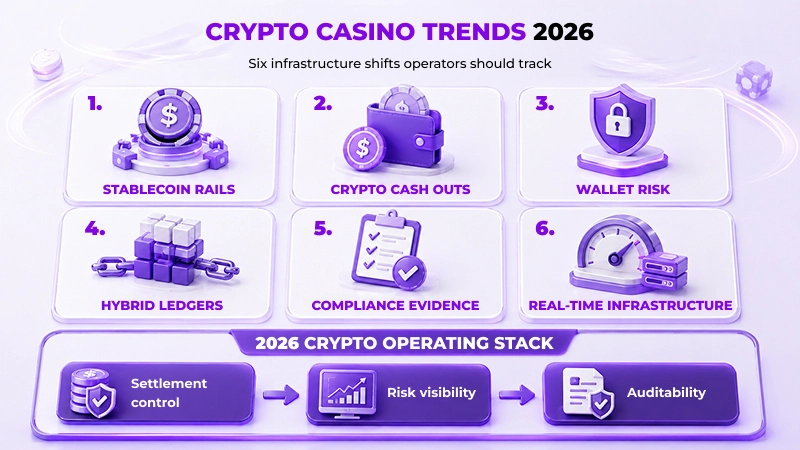
Trend 1: Stablecoin Cashier Rails Become the Main Crypto Payment Layer
Dollar-backed coins are becoming the default cash equivalent inside crypto cashier flows. They cut volatility and reduce exposure to coin price swings between deposit, play, winning settlement, and payout approval. This makes them more useful for teams that want crypto acceptance without letting every balance ride the market. The operational gain is clearer accounting across cash, bonus, and locked funds, whether the player prefers cards, a blockchain wallet, or newer web3 rails.
The cashier still needs rules, not just wallet addresses. USDT and USDC, the most popular crypto rails today, plus other cryptocurrencies, can sit on different networks with different confirmation times and fee behavior. A digital casino needs asset-network mapping, minimum deposit rules, refund logic, withdrawal screening, and clear balance display before it advertises global crypto acceptance. NuxGame helps teams configure payment methods and back-office visibility so cashier staff can track cash movement and crypto-funded activity across live casino tables, crash games, and slots. The same cashier feeds every format, from a live dealer room to a provably fair title to the VIP desk that reviews large withdrawals.
Stablecoin Settlements: Why USDT/USDC Will Represent 80% of 2026 Volume
Teams planning 2026 capacity should assume dollar-backed tokens carry the large majority of crypto turnover. A working planning figure of roughly 80% of deposit and withdrawal volume is reasonable, with BTC and ETH holding the remainder as a store-of-value preference rather than a settlement rail. The direction shows in how the flows behave: a stablecoin deposit needs no hedging decision, a stablecoin payout needs no price snapshot at approval time, and a stablecoin bonus does not change value while a wagering requirement is being cleared.
- Bankroll stability — the gap between deposit value and withdrawal value disappears.
- Accounting simplicity — no revaluation between stake, settlement, and payout approval.
- Regulatory framing — payment stablecoin rules push dollar-backed tokens toward payment infrastructure treatment rather than speculative asset treatment.
- Bonus math — wagering requirements and contribution caps stay meaningful when the unit does not move.
- Liquidity — USDT and USDC hold the deepest cross-network liquidity, which shortens withdrawal queues.
The practical consequence is that the hard question stops being which asset to accept and becomes which network carries each flow. USDT and USDC exist on several chains with very different confirmation times and fee behaviour, which turns settlement design into a Layer-2 decision.
Trend 2: Cash Outs Move Into Crypto Wallet Settlement
Cash outs are becoming a defining feature for crypto betting platforms because sport tickets do not settle like slot rounds. A ticket can stay open for hours, while live pricing may change every few seconds. A player wants control before the final whistle. The platform must price the cash out amount, lock the ticket, and update the wallet without creating duplicate settlement.
The idea is simple for players but complex for systems. Cash out works when the platform offers an early price on an original bet before the final result. The player can settle early to cut losses, lock in a profit, or take a guaranteed payout. Behind that action, the system validates real-time odds, market status, vig, original stake, cash out value, and available cash.
Product Controls Behind Cash Outs
| Control Point | What the System Checks | Why It Matters |
|---|---|---|
| Slip creation | Stake source, odds, limits, market status | Prevents invalid ticket creation |
| Price refresh | Market movement, margin, suspension state | Reduces stale cash out offer risk |
| Acceptance | Ticket lock, player confirmation, wallet state | Stops duplicate settlement |
| Ledger write | Cash balance, bonus status, settlement ID | Supports dispute review |
| Reporting | Event time, market ID, player status | Creates audit-ready evidence |
A FanDuel-style interface has trained players to expect a visible cash out option, but copying the interface is not enough. A crypto sportsbook needs deterministic settlement under wallet conditions. The value shown to a player must match the accepted value in the ledger. If a player is offered a cash out price during a suspended market, the platform must reject or refresh the offer before settlement.
Cash out lets a player exit a bet before the event is complete. This applies to moneyline picks and parlays, where each remaining leg changes probability. Bettors use the feature to minimize losses or lock in profits. Many products support this flow, but a licensed product needs stronger records than offshore crypto casinos often show, and the same discipline now spreads to casino platforms, gambling applications, and the prediction market well beyond sport.
Trend 3: Wallet Screening Becomes a Player Risk Layer
Wallet screening is no longer only a payment processor concern. It is becoming part of the player risk profile because a wallet can connect deposits, withdrawals, device behavior, session history, and suspicious fund movement. Chainalysis reported that illicit addresses received at least $154 billion in 2025, which keeps on-chain risk high on compliance roadmaps. Teams need cryptocurrency risk signals before approving cash withdrawals or higher-risk play.
The practical change is data linking. A crypto casino should connect wallet age, source-of-funds checks, velocity, country risk, KYC status, and gameplay patterns inside one review screen. This is where market share is won or lost, because gambling revenue leaks fast when good players are held and bad actors are not. NuxGame supports operators through player account management, risk visibility, and payment configuration that reduce the gap between cashier review and compliance review. As the igaming market expands into new regions, from Latin America to fresh dollar corridors, the clearest igaming trends now run straight through that review screen. The same tooling increasingly decides both risk and growth for global igaming brands.
Trend 4: Hybrid Fiat-Crypto Balances Create a Ledger Control Problem
Hybrid balances are becoming standard because many players move between fiat cards, crypto wallets, promo funds, and sport wallets. The risk is not the number of payment methods. The risk is a ledger that cannot explain which balance funded each stake, which balance received winning funds, and which part became withdrawable cash after settlement. This is now a defining problem for the whole product, not a corner case.
This matters when cash outs meet bonus rules. A cash out may close the active ticket record, but the resulting balance might still carry playthrough conditions. If the original bet used promotional funds, the cash out cannot simply release everything as cash. The ledger needs fields for stake source, original value, settlement status, payout type, and withdrawal eligibility. Any serious casino market player treats this as core plumbing, and every crypto casino industry roadmap eventually lands here.
Ledger Fields Teams Should Define Before Launch
| Ledger Field | Operational Purpose |
|---|---|
| session_currency | Shows the currency used inside the game or sport session |
| funding_source | Separates fiat, crypto, bonus, and locked funds |
| original_stake | Stores the starting value for ticket review |
| settlement_type | Marks win, loss, refund, manual adjustment, or cash out |
| cash_out_amount | Records the accepted early settlement value |
| withdrawal_status | Shows whether the funds are available, locked, or under review |
Trend 5: Compliance Evidence Moves Into Product Architecture
Crypto compliance in 2026 is becoming an architecture question. Teams need event logs, wallet records, player status, and payment evidence available before a regulator, PSP, or auditor asks for them. GLI-19 provides a technical reference for interactive gaming systems, while GLI-33 addresses event wagering systems. These standards affect how teams design records around casino play, sport events, account states, and settlement logic. The GLI-19 standard and event wagering requirements both point toward testable system behavior, not informal reporting, which is why gambling companies now bake them in from day one.
US-facing brands also need AML procedures that produce clear evidence. FinCEN rules for casinos require suspicious transaction reporting when activity may relate to legal or regulatory violations. PCI DSS adds technical and operational requirements for protecting payment account data. These controls affect cashier design, support tooling, access control, and reporting exports. Teams should map suspicious transaction reports and PCI DSS controls before launch, and align them with the regulatory frameworks that govern each licensed market. The pressure is highest where the crypto gambling market and the regulated market overlap, and where a crypto gambling trends review has to survive an audit rather than a headline.
Compliance Mapping for Crypto Gambling Operations
| Area | Technical Requirement | Operational Consequence |
|---|---|---|
| Player identity | KYC status linked to wallet activity | Faster review of high-risk accounts |
| Game integrity | Session logs and event history | Easier dispute handling |
| Sport settlement | Ticket lifecycle and offer snapshots | Evidence for cash outs |
| Payment security | Tokenization and access control | Reduced card-data exposure |
| AML review | Wallet and transaction monitoring | Better SAR decision support |
Trend 6: Real-Time Infrastructure Decides Retention and Risk
Real-time infrastructure matters because crypto products now combine fast cashier expectations with live sport pricing. A player expects the balance to update after deposit, stake, win, loss, refund, or cash out. If the wallet shows one value and the sport screen shows another, the experience loses trust quickly. Reliability becomes a retention feature as much as a technical target, and it is a big reason crypto has been one of the fastest-growing corners of online play.
The infrastructure target is not only speed. Teams need idempotent wallet writes, fallback handling, market suspension, rate limiting, and API protection. AWS frames reliability as the ability of a workload to perform its function when required, while Cloudflare reported a 31.4 Tbps DDoS attack in 2025. Those numbers show why reliability engineering and DDoS protection now belong inside launch planning, especially for immersive live formats. Even the influencer channels that drive signups fall flat when the wallet lags, so the same signals that guide marketing should guide capacity.
Beyond the Hype: Implementing Layer-2 Scaling for High-TPS Casinos
Layer 1 was never built for casino throughput. A live dealer table produces more state changes in a minute than an Ethereum block settles economically, and a crash round closes long before L1 finality. When gas spikes, the damage is not theoretical: deposits stall in the cashier, withdrawal batches get expensive, and players stare at pending balances during the exact minutes they wanted to bet.
| Operator problem | Layer-2 solution | What changes in the product |
|---|---|---|
| Gas fees spike during network congestion | Route cashier traffic to a rollup with sub-cent fees | Withdrawal batching stays affordable at peak instead of being deferred |
| Deposit confirmation is too slow for live play | Use a network with sub-second soft confirmation | A player can fund and join a live table inside one session |
| Per-round on-chain writes cost more than the round earns | Batch round proofs into a single rollup commitment | Verification becomes affordable per round, not only per session |
| Withdrawal finality delays treasury movement | Use ZK-rollup validity proofs instead of optimistic challenge windows | Exit time drops from days to hours for operator-side transfers |
| A single chain outage halts the cashier | Multi-chain aggregation with routing failover | Deposits keep clearing on an alternate network |
On-Chain Transaction Speeds for Betting: Ethereum vs Solana vs Arbitrum
The comparison that matters for betting is not raw throughput. It is how long a player waits before a balance is usable, and what a write costs when the platform does it thousands of times an hour.
| Network | Type | Player-visible confirmation | Typical fee | Best-fit betting role |
|---|---|---|---|---|
| Ethereum | Layer 1 | About 12s per block, roughly 13 min to full finality | Cents to several dollars, higher at peak | High-value settlement anchoring and audit proofs, not per-bet traffic |
| Arbitrum One | Optimistic rollup | Sub-second soft confirmation; native L1 exit waits a seven-day challenge window | Well under a cent | Per-bet writes, cashier movement, and live product state |
| Base | Optimistic rollup | About 2s blocks with sub-second soft confirmation | Well under a cent | Consumer onboarding and sponsored-gas flows |
| Polygon PoS | Scaling network | About 2s blocks, finality in seconds after recent upgrades | Fractions of a cent | High-volume deposits and withdrawal batching |
| Solana | High-throughput L1 | Roughly 400ms slots, finality around 13s | Fractions of a cent | High-frequency rounds and instant-feel cashier UX |
These figures move with network upgrades, so teams should re-baseline them against live data before committing a settlement design rather than treating any table as permanent.
The rollup type matters more than the brand. Optimistic rollups such as Arbitrum and Base assume transactions are valid and allow a challenge period, which is why a native withdrawal to Ethereum can take about a week. ZK-rollups replace that assumption with a validity proof, so exits do not wait on a dispute window. For a casino the difference appears in treasury movement rather than gameplay: both feel instant to the player, but only one lets an operator move funds off the rollup the same day.
Multi-Chain Aggregation: One Balance Across Several Networks
Players do not think in networks. They think in balances. Multi-chain aggregation is the layer that lets someone deposit USDC on Base, place a bet that settles on Arbitrum, and withdraw USDT on Polygon while the interface shows one number.
- Asset-network mapping, so every token has explicit deposit and withdrawal rules per chain.
- One internal balance with the chain recorded as an attribute rather than a separate wallet.
- Confirmation thresholds set per network instead of one global rule.
- Routing logic that selects the cheapest viable network for each withdrawal batch.
- Failover so a congested or halted chain does not block the entire cashier.
The reporting requirement is that every internal balance movement carries a chain ID and a transaction hash. Without those two fields, a hybrid fiat-crypto ledger cannot answer where funds actually settled, which is the first question an auditor asks.
Provably Fair 2.0: Verifiable Randomness at Layer-2 Cost
Classic provably fair systems relied on a server seed, a client seed, and a nonce the player could check after the round. Provably Fair 2.0 moves the randomness source off the operator’s server entirely, using an on-chain oracle or a verifiable random function so the seed is not something the platform could have selected in advance.
This only became practical at Layer-2 pricing. Writing a randomness request and a result hash for every round is unaffordable on Ethereum mainnet and routine on a rollup. ZK-rollups push the economics further, since many round proofs compress into a single validity proof and per-round verification cost falls as volume rises. For live dealer products the equivalent is anchoring shoe shuffles and round IDs rather than every individual action.
Account Abstraction: Removing the “Seed Phrase” Barrier for Mainstream Adoption
The largest drop-off in crypto onboarding is not the deposit. It is the wallet. Asking a casual player to install an extension, write down twelve recovery words, fund gas in a native token, and switch networks before placing a first bet removes most of the audience a mainstream brand is trying to reach.
Account abstraction, standardised as ERC-4337, replaces the standard externally owned account with a smart contract account. The player still holds the keys, but the account itself can carry rules: sponsored gas, expiring session permissions, spending caps, and recovery that does not depend on a seed phrase.
| Friction point | ERC-4337 mechanism | Control the operator gains |
|---|---|---|
| The player holds no native token for gas | A paymaster sponsors the transaction, enabling gasless transactions | Gas becomes a tracked acquisition cost per cohort rather than a blocker |
| A signature prompt interrupts every action | Session keys with defined scope and expiry | Stake size and session duration limits enforced at signing time |
| Losing a seed phrase ends the account | Social or multi-factor recovery written into the account contract | Fewer support escalations and fewer stranded balances |
| Network switching confuses the player | Chain routing handled at account level | Deposits accepted across networks without user action |
| Risk controls need an enforcement point | Spending caps and step-up checks inside the account | Responsible gambling and AML limits applied before a transaction is signed |
Account abstraction also changes login. Non-custodial wallet auth means a player proves control of an address by signing a challenge instead of submitting a password, so the platform never stores a credential that can leak. The operator still runs KYC on the person behind that address. Those two checks have to stay separate in the data model, because a verified address is not a verified player.
The trade-off is honest: account abstraction adds bundler and paymaster infrastructure to run or buy, and sponsored gas is a real cost line that needs a budget and a cap. The return is an onboarding flow that behaves like a normal casino signup while the player keeps custody of funds.
Technical Snapshot
The 2026 direction points to one operating requirement: every wallet event must connect to player status, product rules, and settlement evidence. Whatever the market size, any serious market report 2026 lands on the same point: the platform cannot treat casino, sport, promo, and payment systems as separate islands. NuxGame helps operators manage these dependencies through modular sport tools, casino aggregation, payment configuration, and back-office reporting, whether the client is a small brand or one of the largest crypto casino names in the market.
| Layer | 2026 Requirement | Suggested Monitoring Signal |
|---|---|---|
| Cashier | Dollar-backed and fiat routing | Failed deposit and withdrawal rate |
| Wallet | Atomic balance updates | Wallet synchronization delay |
| Sport | Cash outs and live pricing | Offer rejection and acceptance rate |
| Risk | Wallet and player scoring | Holds, step-ups, and blocked attempts |
| Compliance | Event-level audit logs | Missing or incomplete record count |
| Infrastructure | API protection and uptime | Error rate, latency, and MTTR |
The best product teams define these controls before adding new coins, sport markets, or online sport features. A cash out button looks small in the interface, but it touches pricing, ledger, bankroll control, support, and compliance. The same applies to stablecoin deposits and to newer NFT mechanics. A crypto wallet is not just a payment method when it affects play logic, payout review, and player risk. Strong crypto casino brands treat all of it as one system.
From Coin Novelty to Crypto Gambling Infrastructure
The crypto shift in 2026 is not about adding more coins to the cashier. The market has moved past the early bitcoin gambling era toward stablecoin settlement, wallet-based risk scoring, cash outs in sport products, and evidence-ready operations. Brands that treat these shifts as infrastructure decisions will have cleaner reporting, fewer wallet disputes, and better control over every bet lifecycle.
NuxGame helps operators connect casino aggregation, sport functionality, payment configuration, player account management, and back-office tools in one product environment. If your roadmap includes crypto rails, sport expansion, loyalty mechanics, or early settlement, the platform gives your team a more controlled way to manage cash, ticket records, and player activity. For retention planning, see the NuxGame guide to casino loyalty programs.