Русский
 Retail Betting Trends 2026: U.S. Sportsbook Infrastructure, Kiosks, and Omnichannel Operations

Retail betting trends 2026 in the U.S. are not about physical venues reclaiming volume from mobile. They concern how shops, kiosks, sportsbook counters, and mobile channels operate as one controlled system. Last year, online sports betting represented 96.5% of U.S. commercial sports betting revenue, and is expected to rise.
The NuxGame sportsbook platform supports online, venue-connected, and multi-product operations. The current product configuration covers 210,000+ monthly events across 125+ sports, with wallets, player accounts, risk management, and reporting connected within the same operating environment. That architecture matters when an operator wants physical locations without building another isolated technology stack.
Key takeaways
-
Measure venue economics by location and terminal performance.
-
Control kiosk software, device identity, connectivity, and failure states.
-
Keep one transaction and settlement state across all channels.
-
Align state rules with tax, payment, AML, and responsible gambling controls.
Sports Betting Trends for 2026: What Physical Venues Need to Prepare For
| Direction | What is changing | What operators should measure |
|---|---|---|
| Omnichannel venue role | Mobile remains the main revenue channel, while physical locations focus on cash access, service, acquisition, and venue economics. | Contribution per location, account conversion, terminal utilization |
| Self-service terminal governance | The GLI-33 v2.0 draft separates terminal management more clearly from remote operations. | Approved software version, device status, connectivity failures |
| Live pricing control | Fast-moving markets expose stale prices, delayed suspensions, and feed gaps. | Price age, rejection rate, quote-to-accept latency |
| Data-led operations | Risk models prioritize exceptions, while location analytics test whether each venue covers its operating costs. | Alert precision, review time, contribution margin |
For the betting industry, these changes reshape physical distribution rather than reverse the shift toward digital. Physical locations now need a defined operational job, measurable unit economics, and the same control logic used by remote channels. A sports betting market dominated by digital transactions leaves less room for duplicated systems, disconnected reporting, or venue technology that cannot share authoritative transaction state.
Market data supports that direction. The AGA annual report recorded $16.96 billion in annual sports betting revenue, while online sports betting represented 96.5% of market share and hold percentage reached 10.16%.
Trend 1: Physical Venues Become an Omnichannel Service Layer
Physical retail works best when sportsbooks give each location a defined role inside the wider bettor journey. Betting shops can introduce sports fans to an account, support cash customers, resolve ticket issues, and hand activity into mobile apps. The location therefore complements online platforms and online betting rather than competing with digital channels for every transaction.
This changes how betting operators should model a venue. Teams need account conversion, repeat visits, queue time, cash-handling cost, and contribution margin alongside betting volume. Gen Z customers may start on a phone but visit around major sporting events, making channel continuity more useful than building an isolated in-store experience. This is an operational implication of digital channel dominance rather than evidence that physical locations are disappearing.
Trend 2: Terminal Governance Moves Closer to Software Release Management
The GLI-33 v2.0 public comment draft, issued June 30, 2026, gives dedicated treatment to retail terminals, over-the-counter terminals, and terminal management. It also separates technical requirements from internal controls more clearly. That direction matters for a betting platform that must integrate several terminal types while keeping configuration ownership visible.
Each device needs a registered identity, controlled configuration, and defined behavior when required services become unavailable. A new betting feature should therefore move through release, certification, deployment, rollback, and monitoring stages. Hardware procurement alone does not solve terminal risk; technical teams also need version ownership, change records, and documented recovery procedures.
Trend 3: Live and In-Play Pricing Requires One Market State
Live betting leaves little tolerance for inconsistent event state. A price shown at a terminal should reference the same event identifier, market version, suspension state, and trading rules used elsewhere. During popular sports, short feed gaps can increase rejected tickets and manual review, especially when sports events attract concentrated traffic.
Teams should monitor price age, update delay, quote-to-accept time, rejection rate, and settlement delay separately. In-play betting becomes especially sensitive during major sports because sports betting activity can concentrate quickly around a few markets. The practical control is an authoritative market state that every channel checks before accepting a bet.
Physical venues and mobile channels should not settle the same bet through separate logic. One transaction identifier, one market-state model, and one auditable settlement path reduce reconciliation work when prices move quickly. That architecture also gives product and compliance teams a clearer view of what happened at the terminal, in the app, and in the back office.

Denis Kosinsky
Chief Product Officer at NuxGame
Trend 4: Data-Led Operations Replace Volume-Only Management
Artificial intelligence is more useful in venue operations when it ranks exceptions instead of making opaque customer decisions. Machine learning algorithms can compare ticket velocity, cashier void patterns, repeated device use, rapid limit-seeking, and correlated selections. The AI model should identify why an alert exists, while staff retain the review decision and an auditable reason for any override.
Location analytics should also separate market expansion from venue economics. The latest AGA revenue tracker available in August recorded $1.34 billion in May revenue from sports bets on $12.06 billion of handle; excluding Missouri, handle fell 2.7%. A new state launch or broader sports betting growth does not guarantee location profitability, while state tax revenue from the segment fell 2.4% in May. Sports betting market size helps with macro planning, but venue decisions still require contribution margin by location.
Transaction Architecture: Wallet, Ticket, and Ledger Synchronization
Every accepted bet should receive one transaction identifier before downstream services process it. The record needs market and event IDs, accepted price, stake, channel, timestamp, settlement state, payout status, and adjustment history. Idempotent processing is essential because a terminal retry after a network interruption must not create a duplicate transaction.
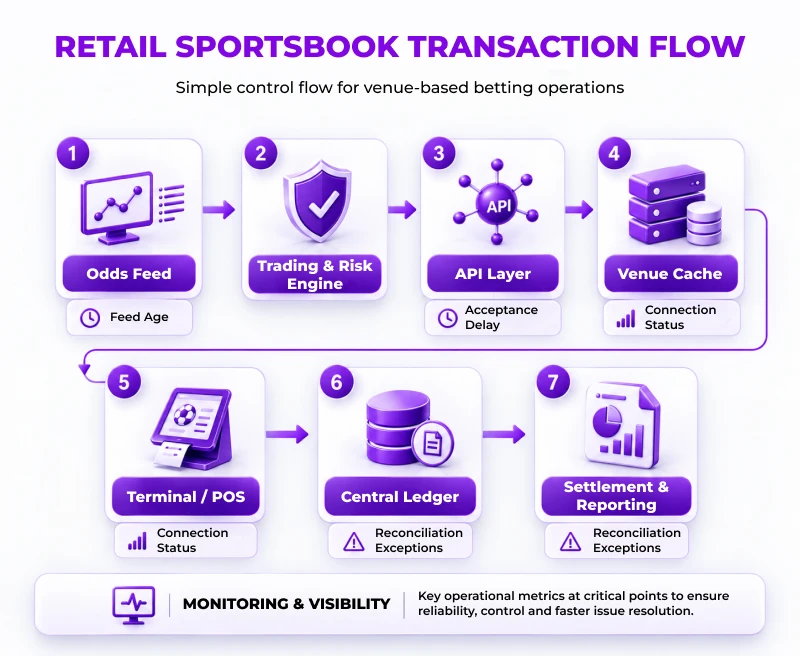
Operators that integrate physical terminals with mobile betting should keep one authoritative transaction state. Wallet and payment services record the corresponding movement, while the central bet engine controls acceptance and settlement. This reduces reconciliation gaps between venue terminals, cashier tools, digital channels, and back-office reporting. The NuxGame API architecture similarly connects event, odds, ticket, settlement, and risk data through a common integration layer.
Technical Snapshot
| Layer | Implementation requirement | Useful KPI |
|---|---|---|
| Odds and trading | Common event IDs, price versions, and suspension state | Feed age, rejection rate, missing updates |
| Bet processing | Unique transaction ID and idempotent acceptance | p95 acceptance latency, timeout rate |
| Venue edge | Device registry, approved software, printer monitoring | Uptime, disconnects, device faults |
| Ledger | Traceable stake and settlement movements | Settlement delay, unreconciled items |
| Back office | Role-based access and change history | Failed changes, incident MTTR |
A useful acceptance test deliberately breaks the flow. Product teams should simulate a dropped connection, duplicate request, suspended market, ticket reprint, corrected result, and failed cash-out instruction. Those scenarios expose dependencies that a successful demo does not show and help technical teams define recovery ownership before launch.
Compliance Architecture: State Controls, Cash, and Card Data
State-by-state betting regulations remain a design boundary. The AGA legal overview says legal sports betting is available in 38 states and Washington, D.C., while each jurisdiction sets operating rules. States that legalize the activity can differ on permitted channels, approved events, internal controls, reporting, and responsible gaming requirements.
Federal and payment controls add another layer. FinCEN reporting rules require covered casinos and card clubs to report currency transactions above $10,000 for one person, including qualifying aggregated transactions in one day. For gaming operators combining commercial casino gaming with physical sports channels, cash-monitoring data should not remain isolated inside one cashier system.
The IRS sports tax guidance applies a 0.25% federal excise tax to state-authorized stakes and a $50 annual occupational tax for each principal or agent accepting them. PCI DSS requirements are fully effective under v4.x, and 51 future-dated requirements took effect in March of the previous year. Payment scope, terminal inventory, access control, and logging should be mapped before deployment.
Build the Physical Channel Around a Clear Operating Model
Retail sports betting in 2026 is less about adding terminals and more about giving each location a measurable operational role. Teams should define the channel objective first, then map terminal controls, transaction ownership, live-price behavior, cash processes, compliance evidence, and mobile handoff around that objective.
NuxGame sports betting software supports online, retail-connected, and multi-product operations across 210K+ monthly events and 125+ sports. Odds delivery, wallets, player accounts, risk controls, and reporting operate as connected services. Teams planning a physical rollout can use the NuxGame retail launch guide to map requirements before selecting devices or venue configuration. Revenue growth should follow from channel economics rather than be assumed from footprint alone.