Русский
 Artificial Intelligence in Gaming Industry: Pipelines, Latency, and Certification in 2026

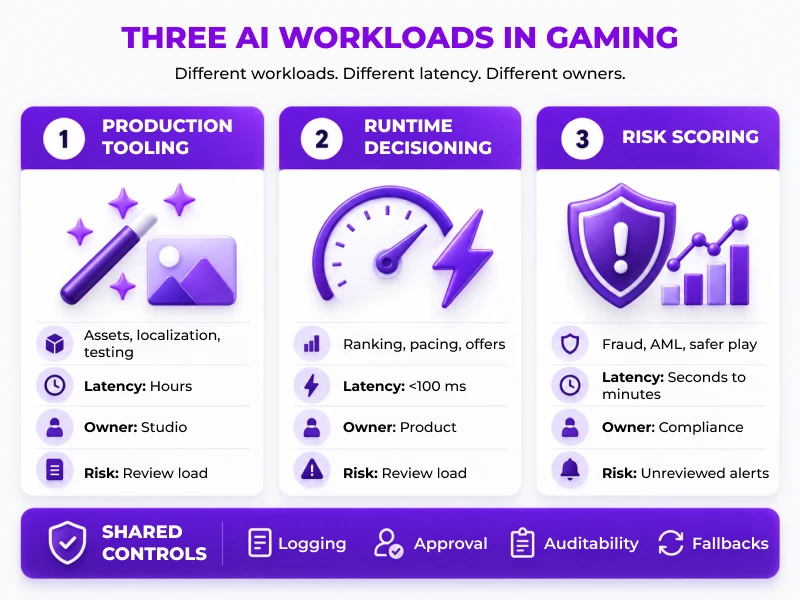
Work on artificial intelligence in gaming industry products divides into three workloads: production tooling, runtime decisioning, and risk scoring. They share a name and little else. Production tooling tolerates hours of latency. Runtime scoring gets roughly 100 ms before the round it was meant to shape has already been resolved. Certification adds a third constraint, since interactive systems record identifiers for every game cycle.
Operators feel the difference in procurement. A model priced for batch content generation cannot serve a live lobby, and a supplier who cannot show per-round logging will not clear certification. NuxGame handles the runtime and logging side for casino and sportsbook operators through event-driven player data, casino content aggregation, back-office configuration, and reporting that keeps model-triggered actions reproducible months later.
Key Takeaways
-
Runtime scoring gets a p95 budget under 100 ms, end to end.
-
A cross-region hop spends 60–80 ms before anything is computed, which is why inference moves to the player’s region.
-
36% of game professionals use generative AI; 52% call its impact negative.
-
Procedural generation cuts asset cost per build and raises review load.
-
GLI-19 v3.0 ties every model output to a game cycle ID.
-
Generated audio and art change presentation, never outcome, which keeps them outside RNG scope.
AI in Gaming Industry Workloads: Production, Runtime, and Risk
AI technologies land in three workloads that studios and operators keep merging into one budget line. Production tooling generates assets, code, and test coverage before release. Runtime models score live sessions and change what a player sees next. Risk models read the same telemetry for fraud and harmful play, on a clock measured in minutes rather than milliseconds; deployment detail for that layer sits in the companion analysis of AI in iGaming. Artificial intelligence spend only becomes legible once the three are separated by latency tolerance and sign-off owner.
Sizing follows the same split, and supplier figures vary by an order of magnitude depending on scope. Grand View Research put the segment at USD 3.28 billion in 2024, projecting USD 51.26 billion by 2033 at a 36.1% CAGR, with North America holding 34.98% of revenue. Independent market research data helps size a budget rather than justify one. Read market growth as evidence of supplier density.
- Production layer — asset generation, localisation drafts, adaptive audio, test coverage; hours of tolerance; studio leads approve output.
- Runtime layer — lobby ranking, session pacing, churn scoring; milliseconds to minutes depending on the surface; product owns the decision.
- Risk layer — AML scoring, bonus abuse, safer-play triggers; seconds to minutes; compliance owns the action.
AI in Gaming Trends Shaping Casino Product Roadmaps
AI in gaming trends for casino roadmaps have narrowed to a short list that survives review. Personalization moved from static segments to per-session ranking of lobby content. Inference moved toward the player, because a model served from another continent loses most of its latency budget to the network. Generated content moved from static assets into the presentation layer, where audio and art variants can be selected while a round plays without touching the outcome. Player expectations form against consumer apps, not against competing lobbies.
Two adjacent shifts belong to the operator side rather than this one. AI agents applying limits or holding withdrawals, and retrieval-drafted support replies, both redefine who approves an account action; vendor selection and approval chains for those sit in the companion analysis of AI in iGaming. What stays here is the engineering question of where a model runs and what it is allowed to change.
| Shift | Technical change | Owner | Measurable check |
|---|---|---|---|
| Per-session lobby ranking | Online feature store plus model serving | Product | p95 ranking latency |
| Regional and on-device inference | Endpoint in the player’s region, light models on the client | Engineering | p95 latency by region, payload size |
| Generated presentation layers | Audio and art variants selected at runtime, outcome untouched | Studio | Variants per build, no lab resubmission |
| Drift monitoring | Scheduled evaluation against a frozen holdout | Data | Days since last drift check |
How Game Developers Apply AI to Casino Content Production
Casino content reaches operators through studios, not in-house teams. Those studios adopted AI in art and testing pipelines well before operators saw any of it. Symbol sets, background art, and animation variants now begin as generated drafts that artists finish. Sector forecasts put the generative AI segment at USD 5.09 billion by 2030.
Almost none of the video game playbook transfers. NPCs, procedural world-building, and dynamic difficulty adjustment all assume outcomes can shift during play. Certified games cannot work that way, because outcome determination sits inside a certified RNG. A slot that adapted to player behaviour would fail its next lab submission, whatever it did for engagement.
- Art production — symbol sets and animation variants generated in bulk, then finished by hand at fixed art cost.
- Optical recognition — computer vision reads cards, wheel positions, and dealer actions in live studios, writing results into the game record.
- Quality assurance — automated device and resolution coverage replaces manual regression passes before submission.
- Localisation — machine translation of in-game text and paytables, with human review per market.
- Math verification — simulation harnesses run billions of rounds to confirm RTP and hit frequency; deliberately not a model, since the result must be reproducible.
Generative Audio and Adaptive Sound in Slot Content
Sound is the one production line where generation reaches the player without a lab problem. A slot ships a fixed sound bed, a win stinger set, and a handful of ambience loops, and the same loop plays for the thousandth spin as for the first. Generated stems change that arithmetic: a studio can produce dozens of variations of the same motif at one composition cost, and the client selects among them by spin count, session length, or volatility band.
The reason this clears certification is that none of it touches outcome. Music selection reads the result after the RNG has determined it, in the same way a win animation does. The constraint worth writing into the spec is the reverse direction: audio must never anticipate a result, because a sound bed that shifts before the reels stop is a disclosure channel and a lab will treat it as one. Keep selection logic downstream of outcome, seed it deterministically, and log the variant ID alongside the round so the presentation layer replays with everything else.
Production Economics: Tooling Spend, Review Load, and Cost per Build
Adoption and sentiment have been moving in opposite directions. The 2026 State of the Game Industry survey of more than 2,300 professionals, published as GDC survey data, records 36% using generative AI in their own work while 52% call its impact on the field negative, against 30% and 18% in prior editions. AI gaming companies selling packaged AI for gaming rarely price that friction. Licences are the visible cost; internal resistance is the unbudgeted one.
Spend lands downstream of generation rather than at it. One artist can produce forty asset variants in an afternoon, and approving forty variants still consumes a human afternoon. Automation repays fastest where review is cheap or itself automatable: test coverage, localisation drafts, placeholder audio. Each advancement in model quality shifts where the cost sits rather than removing it, and the benefits of AI in gaming production concentrate in throughput. The competitive advantage belongs to studios that shortened review, not to those that generated more.
- Licence spend — per-seat tooling, plus GPU hours for anything fine-tuned in-house.
- Review load — art direction, legal clearance, and QA scale with output volume, not with prompt count.
- Provenance tracking — training-data disclosure for AI-generated assets shipped inside a commercial title.
- Rework — assets rejected late in the build cost more than assets never generated.
Where the Math Actually Changes: A Workflow Matrix
Run this per workflow before funding a tool. The column that decides the case is the third one, because a workflow whose review step stays human keeps its cost and simply moves it.
| Workflow | Manual baseline | What changes with a model | Unit to track |
|---|---|---|---|
| Art variants | Artist hours per symbol set | Volume rises; art direction becomes the ceiling | Approved assets per review hour |
| QA regression | Manual passes per device matrix | Coverage automates end to end, review is machine-checked | Devices covered per build hour |
| Localisation | Per-word translation plus review | Drafts generated, reviewer edits rather than writes | Cost per market per release |
| Math verification | Simulation harness, no model | Unchanged, and deliberately so | Rounds simulated, RTP variance |
| Runtime ranking | Fixed lobby order | Per-session ordering under a latency budget | Inference spend per thousand decisions |
| Audio | Fixed loop set per title | Variant pool at one composition cost | Variants shipped per build |
Buying the model is the smallest line in the budget. The cost that surprises people arrives in month nine, when traffic has shifted and nobody owns the assumptions behind it. We ask clients to name an owner and a review date before launch. One meeting now, or an incident review later.

Denis Kosinsky
Chief Product Officer at NuxGame
Real-Time Inference Architecture: Latency, Throughput, and Session Continuity
Latency is the constraint that kills most in-game AI features before launch. A wager or session event must reach the feature store, return features, hit the model, and post an action. Budget backwards from 100 ms end to end: roughly 15 ms for feature lookup, 25 ms for inference, and the remainder for network and orchestration. Any hop crossing a region boundary spends 60–80 ms before computing anything.
Serving choices follow from that arithmetic. Managed real-time inference endpoints suit machine learning models answering synchronously under autoscaling, while micro-batch scoring suits profiles refreshed every few minutes — churn propensity is the usual example, since a score that ages by ten minutes costs nothing and a score that blocks the lobby costs the session. Payload ceilings are real, with SageMaker endpoints capping request bodies at 6 MB with a 60-second timeout, so feature vectors stay compact. Design the fallback first: on timeout, AI-based ranking degrades to a static list and the miss gets logged.
Edge Inference and the Mobile Budget
Most casino traffic is mobile, and mobile is where the 100 ms budget is hardest to hold. A player on a congested mobile network can lose 80 ms to the first hop alone, which leaves nothing for a round trip to a distant region. Two moves recover it. Serve the model from the region the player is in, so the network cost is measured in single-digit milliseconds rather than continental ones. Then push the smallest decisions to the client: recency ordering, tile prefetching, and ranking re-sorts over a candidate list the server already returned.
Client-side inference buys latency and costs control, which is the trade to plan for explicitly. Model weights on a device are extractable, so nothing that encodes bonus economics or risk thresholds belongs there. A practical split keeps candidate generation and any commercially sensitive scoring server-side, ships a small re-ranker to the client, and pins the version so a stale build cannot serve a retired model. Measure p95 by region and by device class rather than as one number, because a global average hides the market where the feature is failing.
Event Flow and Session Continuity
- Wager, deposit, login, and session events publish to one ordered stream keyed by player ID.
- Features compute once and serve every model from a single store, which is what makes the design scalable across brands.
- Model outputs write back with the game cycle ID, so player actions and system actions replay in order.
- Session state survives model failure; a scoring outage must never terminate an open round.
- Capacity planning targets concurrent sessions at peak, because AI systems fail at the peak, not at the average.
- Drift is monitored on a schedule, not on intuition: a frozen holdout, a fixed evaluation cadence, and an alert when input distributions move away from the training window.
Certification, Logging, and Model Auditability
Certification is where AI-driven features meet a document trail. Under the GLI-19 v3.0 standard, interactive systems record unique game cycle, session, and player identifiers for every round played. Any model that alters what a player is offered has to write into that same record, or the round cannot be reconstructed during a lab review. Architecturally this means the scoring service publishes to the audit log, never only to the application cache.
Governance evidence sits one layer above the logs, and two voluntary frameworks now define it. NIST published AI RMF 1.0 in January 2023 and added a generative AI profile in July 2024, naming twelve risk categories including data privacy and information integrity. The IGSA released nine ethical AI best practices in 2025, written with regulator input and covering supplier disclosure. Every new AI feature inherits the certification scope of the product hosting it.
| Instrument | Obligation it creates | System implication |
|---|---|---|
| GLI-19 v3.0 | Per-round and per-session identifiers | Model output joined to game cycle ID |
| NIST AI RMF and GenAI Profile | Govern, map, measure, manage | Model inventory, drift metrics, incident log |
| IGSA ethical AI best practices | Supplier disclosure to the operator | Version history and training-data statement |
Measuring Return: Production Efficiency and Unit Cost
The clearest returns in this layer are the ones that need no model to measure. Build time, assets approved per review hour, devices covered per release, and cost per market for localisation are all counted from the pipeline itself. Studios that use AI in production should report those first, because they survive a bad quarter and a seasonal swing, and because they are the numbers a finance team can check.
Runtime features need the harder measurement, and most reported uplift disappears under a control group. Hold back a slice of traffic, read player retention against that holdout rather than against last quarter, and track guardrails beside the headline number: a ranker that lifts engagement while raising complaint volume has moved cost, not value. Then divide by spend, because inference cost per thousand decisions is what turns a demo into a line item.
- Production efficiency — build time, approved assets per review hour, devices per build hour.
- Uplift — measured against a held-out control, never against a prior period.
- Guardrails — complaint rate, support contacts, and intervention volume, reviewed alongside uplift.
- Unit cost — inference spend per thousand decisions, tracked per feature and per region.
- Rollback time — minutes from decision to previous model version serving traffic.
Technical Snapshot
The table pairs implementation requirements with the indicator that proves each one works. Treat it as a pre-launch checklist, since engine choice and licence conditions differ by market.
| Component | Implementation requirement | Performance or compliance indicator |
|---|---|---|
| Event ingestion | Single ordered stream keyed by player ID | Under 2 s lag from event to feature store |
| Runtime scoring | Autoscaled endpoint in the player’s region | p95 under 100 ms per region and device class |
| Client-side models | Version pinning, no commercially sensitive weights shipped | Stale-version share of client traffic |
| Outcome integrity | Model outputs read the RNG result, never precede it | No presentation signal before outcome determination |
| Production tooling | Provenance record per generated asset | 100% of shipped assets traceable to a source |
| Round reconstruction | Game cycle ID joined to model version and variant ID | Any round replayable during lab review |
| Review workflow | Named approver per asset class | Median review time per hundred assets |
| Failure handling | Documented degradation path per feature | Zero terminated rounds during scoring outage |
Conclusion
Three decisions determine whether AI in gaming industry projects reach production or stall in review. Decide which workload you are funding, because production tooling and runtime decisioning share nothing except a budget code. Fix the latency budget, the serving region, and the fallback behaviour before selecting a model. Treat logging and provenance records as first-sprint deliverables. AI does not transform a studio on its own; the review process built around it does, and that is what an audit examines.
NuxGame supplies B2B casino and sportsbook platform infrastructure to operators deploying AI-driven features: player account management, content aggregation, payment configuration, and back-office reporting in one stack. Book a technical session to review your event schema, latency budget, and logging path before committing to a model vendor.