Русский
 AI in iGaming 2026: Deployment Architecture, Vendor Evaluation, and Compliance Controls

AI in iGaming is now a systems-integration problem rather than a modelling one. Operator value concentrates in four places: risk scoring, player messaging, support deflection, and trading automation. Each writes back into a licensed system, so each needs an approval path and an audit record. From 2 August 2026, EU transparency duties require disclosure when a person is interacting with an AI system rather than a human.
Operators carry the consequences alone. A supplier can absorb the cost of a bad decision, but the licence sits with the operator, and so does the explanation. NuxGame supplies the platform layer where those decisions land: player account management, online casino and sportsbook operations, payment configuration, and back-office reporting on one event stream.
Bot scores under 30 flag automated traffic before any fraud model runs. Gartner expects over 40% of agentic AI projects cancelled by end-2027. EU transparency duties apply 2 August 2026; high-risk obligations moved to December 2027. New Jersey's proposed thresholds start at $10,000 deposited in 24 hours. Portability and log export belong in the contract, not the demo.
Key Takeaways
Where AI in iGaming Fits Inside an Operator Stack
Artificial intelligence in iGaming enters an operator stack at four points, not one. Risk engines score deposits and wagers before funds move. The iGaming CRM decides which message a player receives and when it sends. Support tooling drafts replies before an agent opens the ticket. Trading systems price markets and flag exposure. Each point writes to a different system of record.
Scale explains the appetite. H2 Gambling Capital expects global gambling GGR above $1 trillion by 2030, with online casinos reaching $233 billion against betting at $248 billion. Published global GGR forecasts make a single point of margin material at that scale. The iGaming market rewards a lower cost per decision, not a longer list of models.
- Risk and payments — deposit scoring, chargeback prediction, AML triage; writes to the wallet and case queue.
- iGaming CRM — offer selection and send-time choice; writes to campaign and bonus systems.
- Customer support — retrieval-drafted replies and routing; writes to the ticket record.
- Trading — price movement and liability alerts on in-play markets; writes to the market ladder.
One boundary is worth setting early. The market for generative AI in gaming is measured mostly in studio tooling — asset pipelines, testing, and AI in game development — which sits outside an operator budget entirely. Use cases of generative AI in iGaming cluster elsewhere: support drafting, marketing copy, and synthetic test data. Different buyers, different evidence.
Fraud Detection, Bonus Abuse, and Bot Traffic
Detection works best as a layered filter, with the cheapest signal first. AI-powered scoring earns its place only after the cheap filters have run. Edge scoring removes obvious automation before a request reaches the platform. Cloudflare assigns each request a bot score from 1 to 99, where values under 30 are commonly automated. Filtering registration and bonus-claim endpoints on that field costs nothing per decision and removes a large share of scripted traffic.
What survives the edge needs behavioural analysis. Bonus abuse rarely looks fraudulent per account; it looks coordinated across accounts sharing devices, payment instruments, or wager timing. AI algorithms built for this read graph feature rather than row features. Supervised machine learning does the scoring; graph queries do the linking, and AI and ML pipelines here run on minutes, not milliseconds. Real-time blocking belongs at the edge; clustering belongs in the batch layer.
- Device and network — bot score, proxy reputation, device fingerprint reuse across accounts.
- Payment — instrument reuse, deposit-to-wager ratio, withdrawal immediately after bonus clearance.
- Behavioural — wager timing regularity, stake patterns near bonus thresholds, session length uniformity.
- Graph — shared attributes linking accounts that never overlap in a single session.
Responsible Gambling Monitoring and What Regulators Expect
Supervisors now assess the monitoring system, not the intention behind it. The UK Gambling Commission requires remote licensees to identify and act on indicators of harm, and its customer interaction guidance covers automated systems acting in or near real time. Malta’s Player Protection Directive sets minimum criteria for identifying gambling-related harm and requires retained evidence that procedures were followed.
Requirements are converging across the gambling industry while the detail diverges. New Jersey’s proposed rule 13:69O-1.2A sets a due-diligence review at $10,000 deposited in 24 hours or $100,000 in 90 days. The UAE’s federal gaming regulator makes harm-prevention programmes a condition of final certification before launch. A model that flags a player creates an obligation; the log of what happened next is what gets examined.
Authority
Expectation relevant to AI
System implication
UKGC
Identify harm and act in or near real time
Streaming features, timestamped action log
MGA
Evidence of reviews and player interactions
Immutable back-office notes per player
NJ DGE (proposed)
Numeric triggers plus due-diligence review
Rolling-window counters, case queue, SLA clock
GCGRA
Programmes operational before certification
Monitoring live at launch, not after
Operators often ask us to make detection more sensitive. The better question is how many cases the team can realistically review in a day. An alert nobody opens is worse than no alert at all — it is evidence you saw something and did nothing. Calibrate the threshold to your capacity, then grow both. Denis Kosinsky Chief Product Officer at NuxGame
AI Governance: EU Rules, Data Handling, and Payment Scope
Horizontal AI law now sits alongside gambling regulation. Under the EU AI Act, transparency duties apply from 2 August 2026, covering disclosure when a person interacts with an AI system and machine-readable marking of AI-generated content. Both duties attach to AI systems already serving players. The Digital Omnibus adopted in mid-2026 deferred stand-alone high-risk obligations to 2 December 2027. That runway is for conformity documentation and human-oversight design, not for delay.
Two further regimes bite earlier than teams expect. ISO/IEC 42001 gives a certifiable management system for AI technology, and enterprise counterparties increasingly ask for it during onboarding. Payment-adjacent tooling inherits PCI scope, where the future-dated requirements became mandatory on 31 March 2025. Any model reading cardholder data belongs inside the assessed environment.
- Inventory of every AI system in production, with owner, purpose, and permitted actions.
- Disclosure copy for player-facing assistants, reviewed by legal before release.
- Data map linking player fields to models, with retention periods stated per field.
- Human-oversight record: who can override, how fast, and where the reversal is logged.
Evaluating AI Vendors: Agent Washing, Integration Debt, Exit Terms
Vendor risk is now measurable rather than anecdotal. Gartner expects over 40% of agentic AI projects to be cancelled by the end of 2027, citing escalating costs, unclear business value, and inadequate risk controls. The same research describes agent washing, with only around 130 of thousands of suppliers judged genuine. AI agents acting on live accounts need the approval chain a human case handler already works under. Assessing AI solutions here means separating an interface from a decision system.
Integration debt then decides total cost. Each supplier adds an authentication path, a data-sharing agreement, and an incident owner who is asleep when the alert fires. AI infrastructure is rarely the expensive part; reconciling three vendor definitions of an active player is. iGaming operators that consolidate the platform layer reduce that reconciliation work, which is why iGaming companies increasingly buy the stack rather than assemble it.
- Portability — can the model, features, and thresholds leave with you, and in what format?
- Log export — full decision records, not dashboards, delivered on a schedule you control.
- Baseline test — the supplier must beat your existing rule set on your data, not on a reference set.
- Failure terms — defined behaviour and service credits when the model is unavailable.
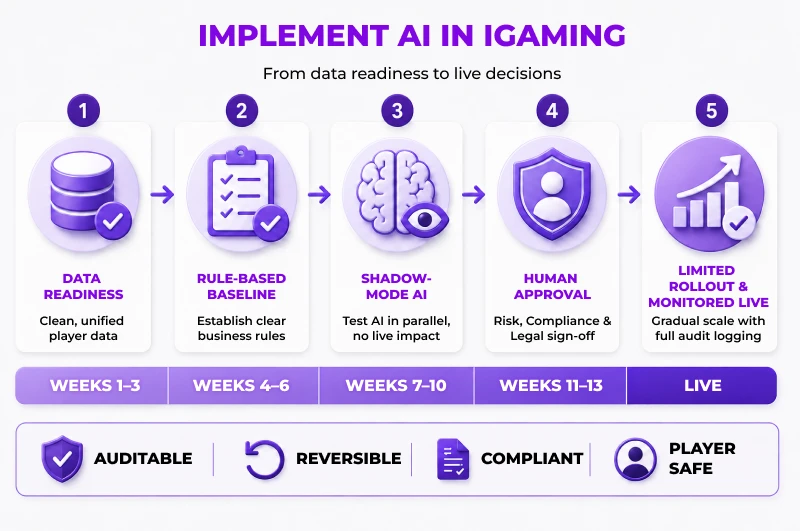
Implementation Sequence: Data Readiness to Live Decisions
Implementing AI in the iGaming industry fails most often at step zero. Event schemas drift between the platform, the CRM, and iGaming analytics, so iGaming development teams see the same wager three times with three timestamps. Fix identity resolution and event ordering first. An AI model trained on inconsistent joins will produce results that cannot be reproduced during a licence review.
Sequence the rest by reversibility. Start where a wrong answer costs a support minute, then move toward decisions touching funds. Operators that use AI on player engagement first, before payments, usually have the weakest evidence. The benefit shows up as fewer manual steps per thousand sessions, which is measurable without a model. NuxGame supports this sequence through unified player account management, aggregation, payment configuration, and reporting, so AI-driven iGaming features read one event stream instead of four.
- Weeks 1–3 — identity resolution, event schema freeze, backfill validation.
- Weeks 4–6 — rule-based baseline in production, with its performance recorded.
- Weeks 7–10 — shadow-mode model scoring, no player-visible effect, precision measured against the baseline.
- Weeks 11–13 — limited rollout behind an approval chain, with rollback tested before launch.
Technical Snapshot
The table pairs each control with the indicator that shows it working. Treat targets as design budgets, since thresholds differ by licence and product mix.
Control
Implementation requirement
Indicator
Identity resolution
One player ID across platform, CRM, payments
Duplicate-account rate under measurement
Edge filtering
Bot score rule on registration and bonus endpoints
Share of scripted traffic blocked pre-platform
Harm monitoring
Rolling-window counters on deposits and wagers
Trigger-to-interaction time inside the licence SLA
Decision logging
Model version and input snapshot per decision
100% of automated actions reproducible
AI disclosure
Assistant identifies itself to the player
Disclosure present on every assisted channel
Rollback
Previous version servable on demand
Minutes from decision to prior model live
Conclusion
Deciding on AI in iGaming comes down to sequence rather than selection. Fix identity and event consistency before evaluating any supplier, because every later measurement depends on it. Put a rule-based baseline in production so the model has something honest to beat. Keep decisions reversible until the logs prove otherwise. Tooling that does not transform the iGaming cost base rarely survives a second budget cycle, and the strongest programmes found that out in shadow mode.
NuxGame provides iGaming platform infrastructure for operators putting AI-driven features into production: player account management, casino and sportsbook aggregation, payment configuration, and back-office reporting on one event stream. Book a technical session to review identity resolution, logging, and approval paths before you sign with a model supplier.