Русский
 iGaming ID Verification Architecture for Biometric KYC + AML in 2026

In 2026, iGaming ID verification is no longer just an onboarding step. It is where player trust, fraud prevention, AML control, payment risk, and regulatory compliance meet. Operators need an architecture that can verify real users quickly, prevent underage access and duplicate accounts, and keep every decision traceable for audits.
That is why this article looks at biometric KYC and AML as one connected workflow — the same logic NuxGame supports by linking player accounts, payments, compliance tools, reporting, and back-office operations inside one platform environment.
Key Takeaways for Operators
Why Biometric KYC Changes the Onboarding Architecture
Biometric KYC does not replace the KYC process. It adds a second evidence layer when document data, device reputation, age verification, or payment signals create uncertainty. In licensed iGaming, the operator must confirm the player’s identity before product access creates regulatory, payment, or responsible gambling exposure.
The practical question is where the first check starts. A low-risk account may pass with database checks, device matching, and credential validation. A higher-risk profile needs face match, liveness, proof of address, or manual review. This design helps prevent fraud without forcing every legitimate customer through the same heavy path.
For product managers, KYC in gambling is a conversion problem and a control problem. The wrong flow rejects good users; a weak flow invites money launderers, bonus abuse, chargebacks, and underage gambling. What makes the KYC process effective is the ability to apply different checks to different risk patterns.
KYC + Transaction Monitoring Architecture in iGaming
A workable KYC and transaction monitoring architecture starts with one player record. That record should connect identity, wallet, device, IP, geolocation, payment method, session history, responsible gambling controls, and each transaction result. When these data points sit in separate tools, the operator loses the evidence chain behind suspicious behavior and weakens financial-crime review.
The policy engine should react to specific account events:
- Registration event: run identity verification, age checks, and document validation.
- Deposit event: compare payment method, amount, location, and account history.
- Payout event: reassess risk before funds leave the gaming platform.
- Session-change event: check IP, geolocation, device fingerprint, and login pattern.
- Manual-review event: store the reason code, reviewer note, and final decision.
An iGaming platform should keep these events connected to one customer profile. The NuxGame platform connects casino, sportsbook, payments, compliance tools, and back-office data, keeping control records attached to the account instead of scattered across provider portals.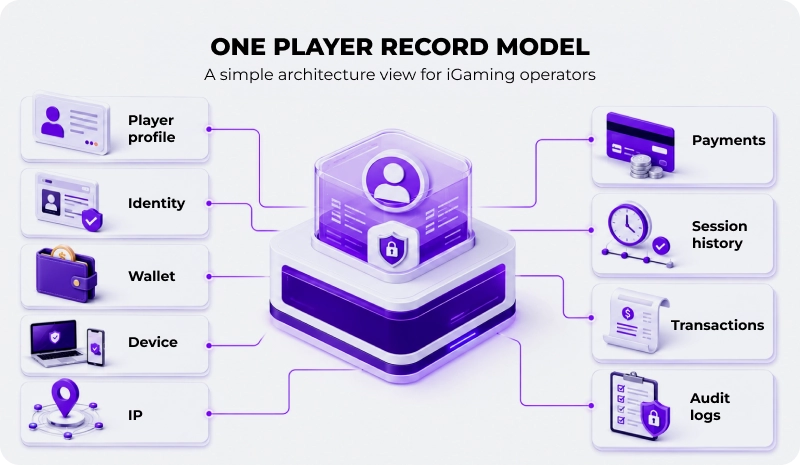
Risk Tiers: When an Operator Should Verify More Deeply
Step-up checks work when rules are specific. A first deposit from a domestic card and matched device does not carry the same risk as a new wallet, foreign IP, rapID deposits, and immediate withdrawal. The operator should define risk tiers before launch, not after the first regulatory audit.
| Risk tier | Trigger example | Review action | Financial-crime action | Operational evidence |
|---|---|---|---|---|
| Low | Data match, stable device, local payment | Database identity verification | Standard transaction score | Provider response and timestamp |
| Medium | New device, partial data match, higher deposit | Government credential and liveness | Screening plus velocity rule | Risk score and rule result |
| High-risk | VPN, document mismatch, chargeback history | Manual review and biometric verification | Source-of-funds review | Case note and reviewer decision |
| Block | Deceased data, sanction hit, duplicate identity | Account freeze | SAR review queue | Evidence package and lock reason |
High-risk workflows need strong KYC procedures and AML controls. These controls include enhanced customer due diligence, sanctions screening, source-of-funds review, device review, and payment velocity checks. They also help gambling operators separate normal player behavior from suspicious transactions that need escalation.
KYC architecture should not feel like a locked door for every player. It should work more like a smart checkpoint: quick for trusted users, stricter when signals change, and clear enough for audit teams to follow every decision. This balance helps operators protect revenue, reduce risk, and keep onboarding commercially realistic.

Denis Kosinsky
Chief Product Officer at NuxGame
U.S. Regulation: What Online Gambling Operators Need to Map
The U.S. does not operate one national online casino rulebook. Regulation is mainly state-led, while federal financial crime duties still affect casino and payment activity. The Bank Secrecy Act requires covered financial institutions to keep records, report cash transactions over $10,000, and report suspicious activity linked to money laundering or other crimes.
New Jersey gives a useful operational example for iGaming regulations. The Division of Gaming Enforcement requires multi-source authentication before deposits or other patron-initiated activity, including an exact match for date of birth, SSN, and last name. It also requires internal controls for manual KYC changes and incident reporting for certain data changes.
| Area to map | What the operator should check | System implication |
|---|---|---|
| State licensing rules | Which identity, age, and account checks apply before deposits or gameplay | Configure market-specific onboarding and eligibility rules |
| Federal financial-crime duties | Which records, reports, and suspicious activity reviews apply to casino and payment activity | Link risk alerts with transaction history and case evidence |
| Payment controls | Which deposit, withdrawal, refund, and chargeback events require review | Connect payment risk scoring with the player identity record |
| Gaming authority expectations | Which incident reports, manual changes, and audit logs must be available | Keep reviewer actions, timestamps, and status changes export-ready |
This means KYC and AML in online gambling cannot be copied from one state to another without review. Requirements for gambling differ by licensing model, product, payment method, and gaming authority. A regional AML matrix should map identity, payment, reporting, retention, and escalation rules before go-live.
GDPR, FTC, and Biometric Identity Data Controls
Biometric information used to identify a person creates a higher privacy burden than standard account data. Under GDPR, biometric data processed for identification is sensitive data, while U.S.-focused projects also need to consider state biometric laws and FTC enforcement risk. These rules affect how player data is collected, stored, accessed, and deleted.
A privacy-ready iGaming KYC flow should separate biometric templates from customer profiles and keep raw artifacts with a vetted provider where possible. The operator still needs enough evidence to verify the decision, answer regulatory questions, and prove that AML obligations were followed without storing more identity data than required.
Vendor Selection Checklist for iGaming Operators
Vendor choice affects conversion, support load, audit evidence, and fraud prevention. A provider comparison should go beyond pass rates and pricing. Technical teams should inspect API responses, failure codes, retry behavior, webhook signing, latency under traffic, sandbox coverage, and how manual review results return to the back office.
Robust KYC means clear integration ownership, not just more checks. The operator must know which system owns KYC checks, who can override decisions, where AML policies live, and how rejected users appeal. Without this map, compliance requirements become scattered across support tickets, provider portals, and spreadsheet exports.
Use this checklist during procurement and implementation:
- Coverage for credential types, document verification, liveness, sanctions, PEPs, and adverse media.
- API documentation, webhook authentication, retry policies, uptime reporting, and incident communication.
- Clear separation between KYC measures, AML measures, fraud rules, and responsible gambling controls.
- Audit logs for every verification process, manual review, decision change, and transaction alert.
- Configurable regional rules for each license, payment route, product, and online gambling market.
Reducing Abandonment Without Increasing AML Exposure
Fast onboarding needs fewer dead ends, not fewer controls. NuxGame describes automated checks in under a minute in some regions and support for more than 5,000 document types across 200+ territories. Those figures matter because slow retries, unclear errors, and unnecessary manual review increase dropout before first deposit.
A product team should set measurable thresholds. For example, target median automated approval below 60 seconds, provider API P95 response below three seconds, and manual review wait times under 15 minutes during peak traffic. These are operating targets, not legal guarantees, and they need monitoring dashboards.
The best pattern is progressive verification and fraud handling. Let low-risk users continue after basic iGaming identity verification, then request more proof before payout, limit increase, or unusual bet activity. This protects revenue while making the risk of gambling abuse visible through transaction and session signals.
Audit-Ready Reporting and Suspicious Activity Workflows
Audit readiness depends on traceability. A reviewer should see who changed a status, why the decision changed, which provider result was used, and which transaction triggered the alert. Automated SAR filing should support structured case creation, approval workflow, and export-ready reporting.
A suspicious activity case should connect:
- Identity checks and review results;
- Deposits, withdrawals, and transaction history;
- Bonuses, gameplay activity, and account limits;
- IP changes, device identifiers, and failed access attempts;
- Reviewer notes, timestamps, and final account action.
AI compliance auditing can support this workflow by checking whether case evidence is complete, highlighting unusual account patterns, and flagging inconsistent manual decisions. It should not replace compliance teams, but it can help them review routine cases faster, reduce missed signals, and prepare cleaner audit trails for regulator requests The NuxGame platform ecosystem supports this by linking player accounts, payments, KYC tools, reporting, and back-office management in one operational environment.
Technical Snapshot
| Layer | Implementation requirement | Compliance checkpoint | Performance indicator |
|---|---|---|---|
| Identity intake | Collect name, address, date of birth, SSN where required, and credential data | know your customer and KYC requirements | Field completion and match rate |
| Biometric step-up | Face match, liveness, replay attack checks, and template controls | Privacy notice and consent where required | False reject rate and retry rate |
| Financial-crime workflow | Sanctions, PEPs, adverse media, velocity rules, and ongoing monitoring | AML requirements and regulations | Alert volume per 1,000 active users |
| Payment link | Map each transaction to account, wallet, rail, and risk result | AML compliance and PCI DSS scope | Approval rate and review delay |
| Audit layer | Immutable event logs, reviewer actions, release notes, and evidence exports | iGaming compliance and regulator review | Case completion time and missing-field rate |
| Security layer | Access controls, encryption, key management, and vendor monitoring | ISO/IEC 27001:2022-aligned controls | MTTR, uptime, and access review closure |
GLI-19 explains that interactive gaming systems need internal process controls and testable configurations, while ISO/IEC 27001:2022 defines an information security management system for managing data security risks. PCI DSS v4.0.1 applies when cardholder data is stored, processed, transmitted, or the environment can affect payment security.
Bottom Line
Biometric KYC works best when it supports a wider control architecture built for regulatory compliance, operational speed, and clear decision-making. The decision is not whether to add more checks, but where each check belongs in the player lifecycle. For an operator, the practical goal is fast onboarding, clean evidence, and fewer blind spots between identity, payment, product, and financial-crime decisions.
NuxGame helps operators connect KYC, AML, payments, player accounts, reporting, and back-office workflows inside a single iGaming platform ecosystem. If your team is reviewing iGaming compliance architecture, NuxGame can help assess vendor connections, strict KYC and AML logic, and onboarding controls that help projects stay compliant before launch.