Русский
 Personalized Marketing for iGaming: Real-Time CRM Personalization and Bonus Automation in 2026

Personalized marketing for iGaming is no longer only about sending different messages to different player groups. In 2026, it depends on how quickly an operator can connect player behavior, consent status, wallet activity, CRM triggers, bonus rules, and user experience in one controlled workflow. This matters because the iGaming market is becoming more competitive, while operators also need to optimize compliance, bonus costs, and player retention more carefully. NuxGame iGaming Platform helps teams build this structure through player management, bonus automation, payments, casino aggregation, and reporting tools.
Key Takeaways
Why Personalized Marketing for iGaming Needs Operational Logic
Personalized marketing for iGaming works when it changes how the platform reacts to player behavior. A player who abandons onboarding needs different logic from a player showing churn signals after failed deposits. The operator must personalize timing, reward value, channel choice, and risk checks. NuxGame supports this through configurable segmentation, bonus rules, account workflows, and reporting.
The commercial task is not to send more messages across the funnel. It is to improve repeat activity through decisions based on gameplay, payments, bet frequency, support history, and account status. A modern iGaming business needs marketing connected to product and compliance logic. That structure helps improve retention rates without training players to wait for incentives.
Real-Time Data Layer for Personalization in iGaming
Real-time personalization depends on four synchronized records: identity, consent, session events, and wallet state. If one record lags, the player may receive an expired bonus or blocked message. The data layer needs timestamps, deduplication keys, and idempotent rule execution. AWS explains these principles through event-driven architecture guidance for reliable workload operations.
The NuxGame platform connects casino content, payments, account management, and bonus logic around one player profile. This helps iGaming companies provide a personalized experience without daily export and reconciliation. A five-minute delay may suit newsletters, but not deposit-triggered rewards. Real-time teams should monitor trigger latency, duplicate events, failed events, and wallet synchronization delay.
Manual CRM Personalization vs Automated Real-Time Personalization
The setup behind player journeys affects more than message delivery. It defines when an offer appears, what data supports it, how rewards are checked, and how teams review results. The table below highlights the main operational areas operators should assess before launching campaigns, quests, or bonus flows.
| Area | Manual CRM personalization | Automated real-time personalization |
|---|---|---|
| Trigger timing | Campaigns are launched on a fixed schedule or after manual segmentation. | Actions are triggered after verified player events, such as registration, verification, deposit activity, inactivity, or quest completion. |
| Data freshness | Segments may rely on exported or delayed data. | Rules use current account status, consent state, session activity, and wallet information. |
| Bonus control | Rewards are often reviewed manually or applied through broad campaign rules. | Bonus rules check eligibility, caps, expiry, cooldowns, and risk controls before reward issuance. |
| Compliance checks | Compliance is usually reviewed before campaign launch. | Consent, jurisdiction, KYC, self-exclusion, and risk status can be checked before every offer. |
| Risk of errors | Higher risk of duplicate rewards, outdated offers, or blocked-user targeting. | Lower risk when deduplication, wallet confirmation, and blocked-user rules are active. |
| Reporting | Performance is usually reviewed at campaign level. | Teams can track exposure, claim, cost, revenue, blocked rewards, and player-level outcomes. |
| Best use case | Newsletters, seasonal campaigns, and broad lifecycle messages. | Deposit-triggered rewards, churn prevention, quest progress, onboarding flows, and risk-sensitive offers. |
Automation is useful only when it behaves like a good pit crew: quick, disciplined, and aware of the rules of the race. For operators, the value is not in sending more offers, but in knowing when to act, when to stop, and how every reward affects margin, risk, and player trust

Denis Kosinsky
Chief Product Officer at NuxGame
Segmentation, Triggers, Quests, and Bonus Rules
Segmentation should use observable player behavior, not hidden assumptions about personality. Useful groups include verified newcomers, lapsed users, bonus-sensitive players, and high-session, low-deposit users. The operator can tailor journeys by verification state, payment activity, game interest, and risk level. This creates personalized interactions that feel relevant because they follow visible actions.
The execution path moves from segment to trigger, then from trigger to quest. A quest can ask a player to verify, return, or try selected game recommendations. The loyalty program should define reward caps, expiry, cooldowns, and completion proof. This keeps players engaged while protecting the bonus budget from unclear rules.
| Layer | Technical decision | Operational risk controlled |
|---|---|---|
| Segment | Use event history, payment status, and verification state | Wrong eligibility or blocked-user targeting |
| Trigger | Fire after a verified event with deduplication | Duplicate rewards and race conditions |
| Quest | Define action, time limit, and completion proof | Support disputes and unclear achievement logic |
| Bonus rule | Apply caps, expiry, and abuse checks | Margin loss and incentive farming |
| Reporting | Store exposure, claim, cost, and revenue data | Weak attribution and poor KPI review |
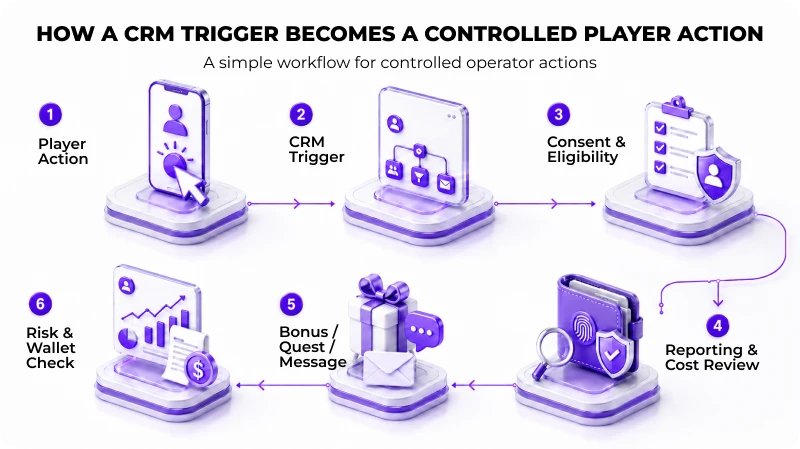
Bonus Automation for Retention, Cost Control, and Anti-Abuse
Bonus automation affects margin faster than normal marketing campaigns because rewards touch wallets and accounting. A promotion should not activate until age, location, KYC, risk, self-exclusion, and payment checks pass. NuxGame helps operators configure these dependencies through bonus rules and back-office workflows. This turns personalized offers into controlled financial actions with clear limits.
Anti-abuse controls need defined thresholds before launch. Common controls include one reward per verified user, maximum open bonuses, device correlation, and claim cooldowns. These rules protect lifecycle budgets from incentive farming and suspicious reward-claiming patterns. Cloudflare describes machine learning and behavioral analysis within bot mitigation controls for blocking automated abuse before it affects the application.
Compliance-Safe Personalization for Regulated Operators
Safe personalization means the system can explain why a player received an offer. For U.S. operators, this starts with state permissioning, privacy notices, and jurisdiction-aware controls. The AGA provides a state regulatory map covering commercial gaming requirements across U.S. markets. Product teams need those rules in feature flags, not only in policy files. As personalization becomes more automated across the iGaming industry, operators need CRM logic that connects player status, consent, bonus eligibility, and risk controls before any offer is delivered.
Compliance pressure increases when personalization uses sensitive data or automated decisioning. California privacy rules define rights to know, delete, correct, and limit certain sensitive data uses under CCPA consumer rights. UKGC rules also connect remote technical controls with security expectations under UKGC technical standards. Operators need audit logs, consent records, exclusion checks, and responsible gaming controls.
AI-Powered Retention Analytics Without Creepy Targeting
AI-powered lifecycle analytics should predict service needs, not private traits. Predictive analytics can identify churn risk, failed onboarding patterns, payment friction, or declining game variety. The model output should recommend a next action, not expose raw behavioral labels. This is effective personalization because it improves service without making the message feel intrusive.
Machine learning models need governance before they drive iGaming decisions. Gartner notes that CDP buyers assess orchestration, architecture, autonomy, and cost-to-value in the customer data platform market. NuxGame recommends holdout groups, budget caps, and confidence thresholds before rollout. KPIs should track player retention, customer retention rates, complaints, bonus cost, and player lifetime value.
Infrastructure, Latency, and Monitoring for Real-Time CRM
Teams also need visibility into event ingestion, queue depth, rule execution, wallet updates, and channel delivery – an iGaming CRM workflow fails when monitoring covers only uptime. A 99.9% availability target still allows about 43 minutes of monthly downtime. For real-time rewards, degraded decisioning should fail closed on bonuses and fail safe on responsible-gaming controls.
NuxGame separates soft personalization from hard wallet movement during implementation. Personalized game suggestions can tolerate delayed content recommendations, while deposit rewards need confirmed wallet state. A seamless cross-channel behavior means consent, exclusion, and wallet status remain consistent across mobile, web, and back office. This protects iGaming operators from inconsistent offers and support disputes.
Technical Snapshot
Personalization at scale requires a shared data model, not more templates. The minimum stack includes identity resolution, consent storage, event streaming, segmentation, trigger execution, bonus rules, fraud checks, channel delivery, and reporting. PCI DSS v4.0.1 matters when payment data enters the architecture. The PCI Security Standards Council says PCI DSS v4.0.1 clarifies v4.0 without adding or removing requirements.
The technical checkpoint for an iGaming platform is whether every personalized action has a traceable source event. It also needs an eligibility decision, communication record, reward record, and reversal path. Teams that deliver personalized game flows need rollback logic for misconfigured rules. Practical monitoring should include failed triggers, blocked rewards, manual overrides, and wallet confirmation delays.
| Requirement | Platform dependency | Checkpoint before launch |
|---|---|---|
| Identity resolution | Player account and KYC profile | One profile per verified user |
| Consent state | Preference center and channel rules | Permission checked before delivery |
| Bonus issuance | Wallet and bonus engine | No reward without eligibility confirmation |
| Risk controls | Fraud, exclusion, and payment checks | Blocked users cannot receive incentives |
| Reporting | Exposure, claim, cost, and revenue logs | Holdout groups and KPI dashboards active |
| Support readiness | Back-office player timeline | Agents see trigger and reward history |
Building Personalization That Operators Can Control
Personalized marketing for iGaming in 2026 is a control problem before it is a content problem. Operators need real-time events, permissioned data, rule-based rewards, and reporting that shows cost alongside engagement. NuxGame helps teams build this structure through modular platform configuration, bonus automation, loyalty logic, and operational tooling for the regulated iGaming landscape.
If your team wants to connect segmentation, triggers, quests, and bonus rules in one operational workflow, NuxGame helps map the required modules before implementation. The platform supports casino aggregation, sportsbook configuration, payments, player account management, compliance controls, and back-office reporting. This helps operators control iGaming lifecycle without turning personalization into uncontrolled bonus spending.