Русский
 2026 Online Casino Payment Methods: Stablecoins, A2A, and Open Banking for Faster Deposits and Safer Payouts
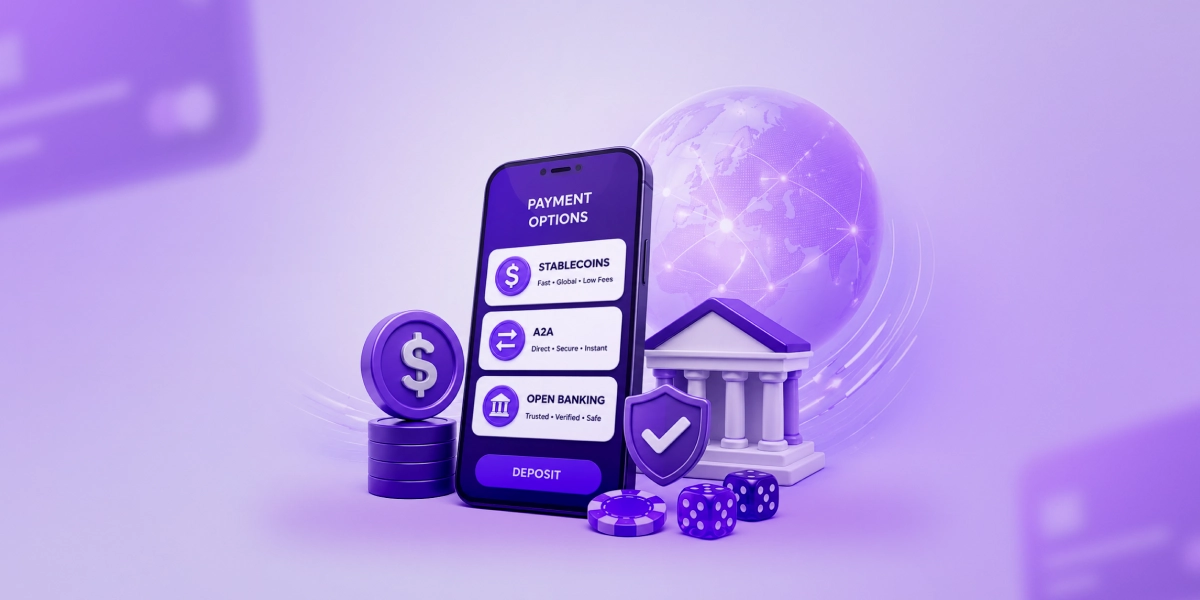
Online casino payment methods now decide more than checkout conversion. In 2026, a cashier stack affects KYC flow, fraud exposure, chargeback cost, payout speed, treasury planning, and regulator reporting. For a US-facing online casino site, the practical question is not the best payment method in isolation. It is which rail works best for each deposit, risk score, location, currency, and withdrawal scenario. The NuxGame platform helps operators configure cards, A2A, crypto, provider routing, wallet rules, and back-office monitoring from one operational layer.
Key Points for Operators
Why Online Casino Payment Methods Became an Infrastructure Decision
The old checkout question was simple: which online casino payment method lets a player make a deposit quickly? That view misses the 2026 operating problem. Every rail changes authorization logic, chargeback exposure, account validation, reconciliation timing, and fraud monitoring. The cashier now sits between product growth, compliance, treasury, and risk operations.
In regulated US online casino environments, many online casinos cannot treat cashier rails as a static menu. State-by-state licensing, provider terms, KYC status, and geolocation affect which methods should appear. The NuxGame platform approach keeps the cashier, player wallet, risk checks, and reporting tools connected, so operators avoid separate rules inside every provider account.
Cards, Digital Wallets, A2A, and Stablecoins: When Each Rail Works
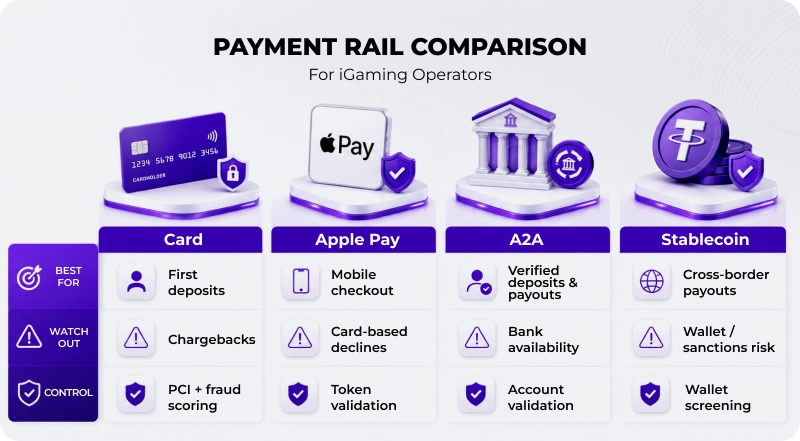
Cards still matter because players know the method, and Apple Pay adds a mobile payment layer over card rails. It is not a separate settlement network; it tokenizes card credentials and depends on issuer approval. This accepted payment method suits a first online casino deposit where conversion matters, but it leaves chargeback and PCI obligations in scope.
A2A uses online banking connectivity or bank-transfer rails to move funds from a verified bank account. Stablecoins work differently because the rail settles on blockchain infrastructure, then maps to the online casino account ledger. The best casino payment methods are not universal; they depend on player risk, state rules, and treasury appetite.
Routing and Settlement Infrastructure
Routing should not start with a player-facing cashier option. It should start with a rule engine that reads jurisdiction, KYC tier, player segment, method, deposit value, risk score, and payment provider uptime. If a provider declines, the routing layer chooses a fallback without showing unavailable methods for online casino users.
The technical model needs idempotent transaction IDs, ledger locks, webhook validation, retry limits, and status mapping. A deposit method that returns “pending” cannot credit the casino account like an approved card authorization. The NuxGame platform supports operator-side configuration across provider connections, cashier behavior, wallet updates, and back-office reconciliation queues.
Payments in 2026 are no longer a row of logos at checkout. They are the control tower for trust, speed, and margin. Operators need rules that know when to approve, pause, or reroute a transaction, because the fastest payment is only valuable when it is also compliant, recoverable, and clear for players.

Denis Kosinsky
Chief Product Officer at NuxGame
KYC, AML, and Transaction Monitoring Architecture
FinCEN casino AML rules require a written program designed to monitor compliance with BSA obligations. That affects cashier operations because every deposit or withdrawal creates risk evidence. Operators need customer identification, risk-based thresholds, suspicious activity workflows, sanctions screening, and audit trails that connect transaction behavior with player identity.
PCI DSS v4.0.1 also changes the operational view of online casino cashier flows. Hosted checkout pages and scripts must be inventoried, authorized, checked for integrity, and monitored for tampering. In practice, an iGaming payment gateway integration should reduce card-data exposure, preserve event logs, and separate tokenized authorization data from player wallet accounting.
| Control area | Implementation impact | Evidence operators need |
|---|---|---|
| AML monitoring | Link transaction patterns to player risk | Alerts, case notes, SAR workflow records |
| PCI DSS | Reduce cardholder data scope | Script inventory, PSP evidence, access logs |
| GLI-19 | Protect interactive gaming system integrity | Transaction logs, wallet events, change records |
| ISO 27001 | Govern information security controls | Risk register, access review, incident records |
Open Banking in US Online Casino Payments
Open banking is useful when a payment method for online casino deposits needs account verification, balance context, and cleaner name matching. The CFPB Personal Financial Data Rights framework implements section 1033, but the compliance dates were stayed by a court. Therefore, operators should treat open banking as vendor-enabled data access, not a complete regulatory safe harbor.
The operational value still matters. Online banking signals can reduce failed deposits at online casinos, identify mismatched ownership, and support affordability checks where policy requires them. A practical online casino banking flow stores consent status, account metadata, refresh timestamps, and provider response codes without copying unnecessary bank data into the gaming wallet.
Deposit and Withdrawal UX: Faster Does Not Mean Less Controlled
A good deposit and withdrawal design separates speed from eligibility. Players want to deposit and withdraw money with minimal friction, yet every deposit or withdrawal should pass rule checks before funds move. Minimum deposit thresholds, deposit and withdrawal limits, bonus status, rail restrictions, and responsible gaming controls all belong in the same decision path.
The cashier should explain why a chosen payment method is unavailable, rather than hiding failure behind generic decline messages. A popular payment method may be blocked for one player because KYC is incomplete. Another casino deposit method may allow withdraw funds only after the same banking method is verified for ownership and risk.
When an online casino offers a new way to deposit, the team should test whether it can be used safely after device, KYC, and location checks. If the casino accepts the rail for deposits only, the cashier should make this clear before players request a withdrawal. Depending on the payment method, settlement may reach the wallet instantly or remain pending until provider confirmation.
Stablecoin Rail Design for Cross-Border Casino Payments
Stablecoins can improve cross-border casino payments when fiat acquiring is expensive, slow, or unavailable. US rules changed after the GENIUS Act, which created a federal framework for stablecoins and related issuer obligations. This does not remove operator responsibility; it adds more structured due diligence around issuer type, reserve transparency, sanctions control, and redemption assumptions.
A stablecoin online casino payment method needs wallet screening before credit, confirmation thresholds before ledger posting, and limits by chain, token, and player risk tier. Operators also need treasury rules for conversion timing. If a casino accepts stablecoins, finance teams should reconcile on-chain transaction hashes, PSP settlement files, and internal wallet entries daily.
Choosing the Right Payment Method Without Creating Cashier Sprawl
Rail selection starts with segmentation, not a longer list. Operators should map player cohorts by geography, device, risk score, average deposit, preferred withdrawal speed, and historical approval rate. A wide range of payment methods helps only when rules prevent unsupported or risky choices from appearing in the cashier.
This is where iGaming payment processing becomes a product management issue. Many casino teams add every popular rail to improve conversion, then discover support tickets rise. A better approach is choosing each rail per segment, testing approval rate, failed-deposit reasons, payout queue age, and chargeback rate before adding another alternative payment.
Player-Facing Cashier Language and Operator Controls
Consumer pages often describe the best online casino payment methods, top online casinos, or a popular casino cashier by convenience. An operator reads those labels differently. A widely accepted payment method still needs licensing review, processor approval, responsible gaming checks, and state-level availability before a legal online launch.
Terms such as casino games, real money online access, online gambling sites, online casino sites, and casinos that accept instant deposits describe demand signals, not readiness. The useful question is how the method works inside controls for online transactions, online payments, payout review, and the online casino experience.
| Player-facing phrase | Operator interpretation |
|---|---|
| Top online casino payment | Approval rate, chargeback exposure, and state coverage |
| Popular casino payment methods | Support volume, provider cost, and refund handling |
| Variety of online casino payment | Configuration complexity and risk segmentation |
| Online casino payment methods available | Jurisdiction, KYC, currency, and device rules |
| Deposit and withdrawal methods | Ledger status, payout eligibility, and audit evidence |
| Find the best | Test before scaling across cohorts |
Technical Snapshot: Implementation Requirements for the Cashier Stack
A production payment system for real money online casino operations needs more than PSP credentials. The architecture should include a cashier API, provider adapters, immutable ledger entries, webhook signature validation, reconciliation jobs, AML alerts, and operator dashboards. Each rail works only when status changes remain synchronized across the PSP, player wallet, and accounting layer.
Key indicators should be visible daily. Track median cashier API latency below 300 ms, webhook-to-wallet synchronization below 5 seconds, provider uptime above 99.9%, approval rate by rail, chargeback rate by card BIN, and average payout review time. NuxGame helps operators manage these dependencies through modular cashier configuration, player wallet logic, and back-office controls.
Implementation checklist:
- Define available payment methods by jurisdiction, KYC tier, currency, and player segment.
- Keep card data out of the casino environment by using hosted forms or tokenized PSP flows.
- Validate bank account ownership before first A2A payout or high-risk deposit.
- Apply wallet screening and confirmation policies before crediting stablecoin deposits.
- Reconcile every deposit and withdrawal against PSP files, ledger events, and player account history.
Bottom Line
Online casino payment methods are now part of platform architecture, not just cashier design. The right method mix reduces avoidable declines, limits fraud exposure, protects payout quality, and gives compliance teams better evidence. A modern stack should let players deposit funds quickly, then deposit and withdraw through controlled, traceable, and auditable flows. NuxGame supports this approach with platform configuration, provider integrations, and operational tools for B2C operators.
NuxGame helps casino operators configure a range of payment options through platform-level cashier rules, provider integrations, wallet logic, AML workflows, and reporting tools. If your team is reviewing online casino payment options, the NuxGame team can map cards, A2A, stablecoins, and compliance controls against your launch market and operating model.