Русский
 How to Catch iGaming Player Churn Before Deposits Drop

Your highest-value players decide to leave long before the deposit line drops, and a World Cup summer is the easiest time of year to miss it. Right now, in early July, traffic and deposits are climbing on their own: the tournament runs to its July 19 final outside New York, the European club seasons restart within weeks of it, and holidaymakers drift back into their routines. Strong numbers hide a lot, including the top-tier regular who has already started heading for the door. The June piece with Gamzix covered how to win that incoming traffic, with fast, mobile-first games and compact sessions built to convert the surge into play. This one, created with Optimove, is about the test that starts the moment those players are through the door: retention readiness, measured in protected value rather than gross deposits.
Optimove is the CRM and player-engagement platform behind many of the industry’s biggest names. By its own count, Optimove is trusted by 52% of the 2025 EGR Power 50, including 70% of the Top Ten. NuxGame is the online casino software provider it’s directly integrated with, so logins, deposits and withdrawals reach Optimove in real time, without a rebuild in between. That live view is what makes the argument below possible: by the time you’re building a win-back campaign, the player is already gone, and winning them back is the costliest way to retain them. Real retention is detection — catching a valuable player as they drift, while they’re still, technically, yours.
TL;DR
High-Value Churn Starts Before the Deposits Stop
The decision to leave is behavioral, and it shows up weeks before the wallet does. A high-value player rarely announces the exit. They log in a little less, let a few days more pass between deposits, drift from the game they used to open first, and cash out a touch faster than usual. By the time the deposit line actually flattens on a report, the intent is old news — the player made the call a while ago and you’re reading the receipt.
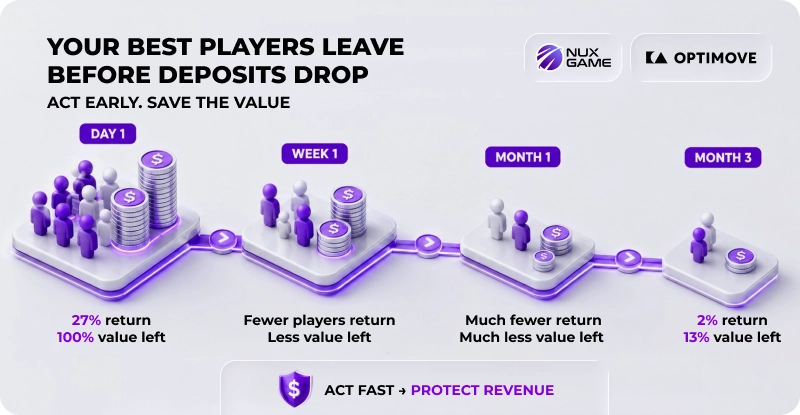
This is where Optimove’s own data stops being a talking point and starts being a warning. Its iGaming Churn Descending Recovery Curve, built on more than five million players across global operators between October 2023 and October 2024, tracks what happens after a player crosses into churn (defined as 30-plus days of inactivity following deposit activity). Engage on the first day and about 27% come back, carrying the highest predicted future value. Let three months pass and only around 2% return, worth roughly 87% less than the players you would have caught on Day 1. The window doesn’t just narrow. The prize inside it shrinks.
Chasing players after they leave is the priciest habit in this business. NuxGame gives operators a fast, flexible way to launch and scale a full iGaming business, from casino to aggregation to turnkey sweepstakes. Paired with our Positionless Marketing platform, that speed to market meets real-time retention: operators can react to player churn the moment it starts and keep players engaged, instead of paying to win them back later. Together, we give operators one connected stack to launch, grow, and scale.

Pini Yakuel
Chief Executive Officer at Optimove
Early Warning Signs Hide in Plain Sight
The early warning signs look like small, boring changes that any single dashboard would wave through. The useful signals are relative as opposed to absolute: this player’s own deposit cadence slowing, their session frequency fading, their game selection drifting toward lower-stakes titles, their time-between-logins stretching. None of these trip an alarm on their own. Read together, and ranked by the value of the player showing them, they’re an early exit notice.
Payments belong on that list, and most retention teams never look there. A declined deposit is one of the loudest churn signals an operator gets, and one of the most ignored, because it lives in a different team’s tooling. Payment challenges in iGaming aren’t only a revenue-at-checkout problem; a high roller whose card gets refused by an over-cautious issuer, sees “transaction declined,” and doesn’t bother to retry has just handed you a departure signal dressed up as a technical error.
Gambling transactions carry the MCC 7995 high-risk code, so they draw heavier scrutiny than ordinary retail. Online card payments already get declined far more than in-person ones (Worldpay puts it near 15% versus 4%) and high-risk gambling traffic runs higher still. Many of those declines are real players: Worldpay finds more than half of shoppers give up after one failed attempt, so a refused deposit often means a player who won’t try twice.
Knowing a VIP Is Slipping Won’t Save Them
The alert and the action sit in different places, and the clock runs in between. Spotting that a VIP is slipping does nothing if the response takes a week to design, get creative approved, and schedule. The player you flagged on Monday is a customer of your competitor by the time the message ships on Friday. The bottleneck is almost never the insight. It’s the distance between the insight and the send.
Optimove’s answer to that gap is journey orchestration that turns a signal into a live, personalized message on the channel the player actually uses, while the moment still matters. The integration with NuxGame is where this gets concrete: registration, login, deposit and withdrawal events stream across in real time, so a trigger can fire the instant behavior changes. When a player cancels a withdrawal (often the last twitch before they walk), a tailored response can go out immediately rather than surfacing in next month’s review. That’s the difference between reacting to churn and interrupting it.
Should You Try to Retain Every Slipping Player?
No. And treating retention as a save-everyone exercise is how margins leak. Not every player is worth the same effort, and spraying the same win-back bonus across a whole churn list silently subsidizes people who were never going to fund the business while under-serving the few who do. In most operations, a small minority of players generates the majority of revenue, which means the honest retention question isn’t “how do we keep everyone?” It’s “whose loss actually hurts, and are we spending there?”
That question gets louder in a surge. When a World Cup summer floods the funnel with active players, the easy move is to reward all of them, which is exactly how a strong-looking quarter still loses money. The operators who retain profitably tie every intervention to predicted value and let their campaigns learn against real outcomes. They measure incremental deposits and net revenue with control groups, not open rates, so they can tell a campaign that changed behavior from one that congratulated players for doing what they’d have done anyway. Concentrating spend on high-value players at risk, and being willing to let low-value churn go, is the part most teams underprice.
Give a bonus to every player who goes quiet, and the clever ones catch on within a week: slow down, collect the reward, repeat. Keep it up and you have put a price tag on leaving — teaching your most valuable players that the surest way to get paid is to pretend they are heading out.

Denis Kosinsky
Chief Product Officer at NuxGame
AI Makes Retention Campaigns Move at Player Speed
AI earns its place here by collapsing the assembly line that used to stand between a signal and a response. Churn prediction, journey orchestration, message creation and optimization only protect revenue if they happen at the speed players actually leave, and that speed stopped being humanly achievable once every step waited on a different team’s queue. The role of AI in iGaming here isn’t the sci-fi version; it’s the unglamorous work of letting one marketer spot the risk, build the journey, generate the message, and tune it without filing three tickets.
Optimove’s case materials show the same principle in practice: Caesars cut campaign build time from five days to five minutes, while FDJ United reduced work that once needed seven teams and six weeks to one person in one day. Retention is a timing game. When fewer handoffs stand between the signal and the campaign, operators have a better chance to reach valuable players while they are still ready to respond.
5-Step Operator Plan for Catching iGaming Player Churn Before Revenue Drops
Everything above explains why high-value players slip before your reports catch it. The five steps below are the fix, ordered by payoff: spot who’s worth saving, catch the signals early (declined deposits included), and act while the player still counts — protecting revenue instead of buying it back.
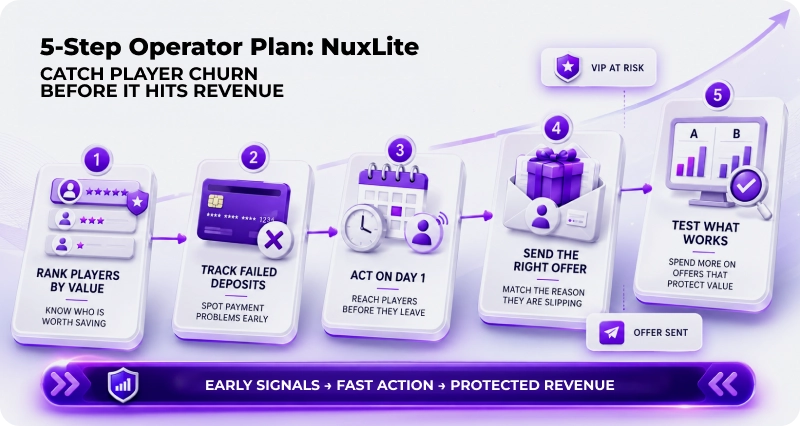
- Rank by value first, risk second. Then act on both together. Score every player on how much they’re likely to be worth, then add how likely they are to leave. A mid-value player drifting is worth a gentle nudge; your most valuable player showing the same signs is worth a response the same day. The trick is getting that ranked list straight into a marketer’s hands, without waiting on the data team. If you track one number this quarter, make it the churn risk on your highest-value players.
- Read payment failures as churn signals, not just finance data. When a good player’s deposit is declined or abandoned, treat it as an early warning and send it to the same team that handles win-back. On the technical side, you can improve payment approval rates for returning players with smarter routing and local processing, so a real player’s real money stops getting turned away. Every deposit you rescue is a player you never had to win back.
- Close the gap between spotting a signal and sending a message. Set your campaigns to fire the moment a player’s behavior changes, instead of waiting for a weekly report. The real-time data feed that makes this work comes built into the NuxGame turnkey casino software, so a player returning after a week away can land on twenty free spins for the game they play most, and a cancelled withdrawal can get an instant, personal reply. The offer matters less than the timing: reach the player inside the window Optimove’s curve says still counts, ideally on Day 1.
- Give every segment a message that fits, without a creative queue. Players leave gradually and for different reasons. Segmentation only pays off if each segment actually receives the right tone and offer on time, which is where on-the-spot content generation earns its place: it produces channel-ready copy and visuals so a relevant message reaches each group without a production backlog holding the whole thing hostage. A perfectly targeted message that ships two weeks late is a late message.
- Let your campaigns tune themselves, and be honest about what’s working. Run retention as a set of ongoing tests with control groups, so the system puts more spend behind what genuinely keeps your best players active and drops what only looks busy. A campaign that improves itself beats a manual review every few months, for the same reason a live trigger beats a weekly export: the player isn’t waiting for your reporting schedule.
There’s a seasonal edge to all of this in July. Summer traffic can make the dashboard look healthier than it really is, especially when major sports events keep deposits and sessions moving. That is exactly when operators need to separate normal seasonal movement from valuable players starting to slip. A green dashboard does not always mean a protected player base.
Wrapping It All Up
Retention readiness is the test that follows engagement readiness, and it’s harder because the thing you’re protecting (value) leaves quietly. The operators who win it stop treating churn as a status a player reaches and start treating it as a slope a player is already sliding down. This slope is visible in the deposit cadence, the game mix, and the declined transaction nobody flagged. Spot it early, act while the window is open, and spend where the value actually is. Do it now, while the World Cup crowd is still in the building, and you reach September with your best players still yours. The rest is just a well-designed goodbye.