Русский
 How to Get Mobile Casino Games Ready for Late-Summer Traffic Peak

You get mobile casino games ready for the late-summer peak by making them fast. The players returning in late summer are on their phones, and the games that load fast are the ones that keep them. Those players are already on the calendar.
The 2026 FIFA World Cup final lands in New York on July 19, and within weeks the domestic seasons roll back in — the Community Shield on August 16, the Premier League on August 21, the Champions League draw on August 27. Add holidaymakers settling back into their routines and a betting audience warming up again, and the climb in traffic is steep and easy to see coming. Nearly all of it lands on a phone in someone’s hand: on a train, in a queue, on a sofa with the TV on. The next few weeks decide who is ready for it.
This is where the two companies behind this piece come in. NuxGame works as an online casino aggregator. It connects operators to games from dozens of providers through a single integration, so an operator can launch new content quickly instead of wiring up each studio from scratch. Gamzix is one of those providers, a full-cycle slot studio built on a single instinct: make games fast and keep sessions short and repeatable.
That instinct is the reason for this piece. Through the Gamzix-NuxGame partnership, the two teams have spent 2026 stress-testing what holds up when traffic surges and what quietly breaks. The NuxLite read is blunt. Come August, a thousand-game library counts for nothing if the title a player taps takes four seconds to open — the phone in their hand sets the terms now, and it has no patience for a slow session.
TL;DR on Mobile-First Casino Games
Why the Late-Summer Traffic Peak Lands on Mobile
The late-summer peak lands on mobile because mobile is where the players now are. Phones and tablets already took the larger share of online gambling revenue in 2025, and analysts expect that share to grow faster than any other channel through the rest of the decade. So any surge in traffic is, first and foremost, a mobile surge.
And this surge is easy to see coming. The World Cup pulls a huge audience through June and into mid-July, then hands the baton straight to the club season; across Europe the leagues restart within a fortnight of each other, and the calendar barely lets the crowd cool down. The wave is visible weeks out, which is exactly why arriving unprepared is so avoidable. When August traffic doubles, it doubles on small screens, on mixed networks, in the spare minutes of someone’s day. Plan for the average desktop session and you have prepared for the wrong event.
Players Didn’t Get More Patient. Their Screens Got Smaller
There is a tidy story that mobile players are “impatient.” It is more accurate to say their context changed. A desktop player at a quiet desk will tolerate a beat of loading. A mobile player tapping into a game at a bus stop is splitting attention with three other things and will close the tab without a second thought. Understanding the link between online casino games and player behavior starts there: not with what players say they want, but with the situation they are in when they open the app.
That situation rewards a very specific shape of product: quick to start, quick to grasp, and easy to leave and come back to. Long, slow-building casino games that assume a settled, uninterrupted session are designed for a player who increasingly does not exist on mobile. The studios reading this correctly are building the opposite: compact cycles, fast feedback, a clear hook in the first few spins.
Gamzix sees this from the studio side. Its Chief Product Officer puts it this way: “As most players worldwide are shifting to mobile devices, their content preferences are also changing: faster, shorter, and more engaging experiences are winning attention. The same applies to slot games: players now expect quick excitement and compact game cycles rather than long, drawn-out sessions.”
The Gamzix catalogue leans this way, and it lines up with where slot design is heading in 2026: toward fast-paced formats over long, slow builds. Many of their titles are built on 3×3 and 3×5 grids with quick “Hold the Spin” respin cycles, alongside modern takes on fruit classics — all engineered for short attention and small screens rather than against them.
How Fast Should a Mobile Casino Game Load?
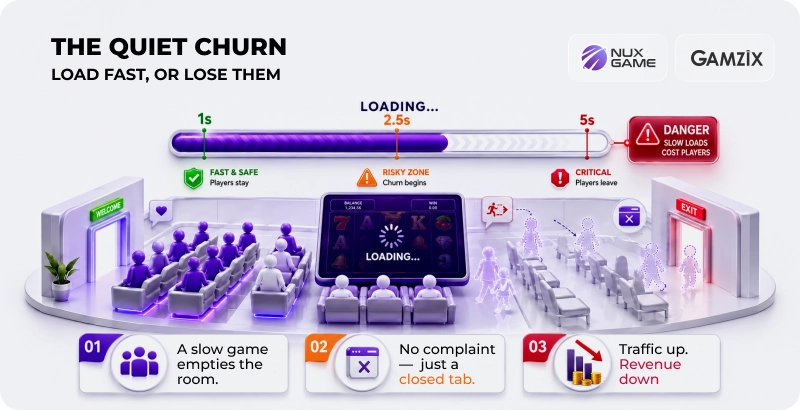
A mobile casino game should render its main content in 2.5 seconds or less (and the closer to instant, the better). Almost every modern slot is an HTML5 title that plays instantly in the browser, so it loads the same way a web page does, and Google’s web-performance standard maps straight onto it. Its Core Web Vitals metrics, the ones Google now ranks on, rate that loading as “good” only when the main content (for a player, the game itself) appears within 2.5 seconds, and “poor” once it crosses four. Hitting that on mobile is harder than it sounds: by the 2025 HTTP Archive Web Almanac, fewer than half of mobile sites (48%) clear the full Core Web Vitals bar, and loading speed is the one they most often miss. Operators underprice all of this, because load speed feels like something engineers handle rather than a product call. It is squarely a product call.
Translate that out of web-performance language and into a casino. A player who taps a game and waits four seconds for the first spin is already gone: no irritation, no complaint, just a closed tab. That is the cruelty of it: the loss is invisible. Your traffic graph looks healthy, your deposits don’t, and nothing in between explains the gap. The speed of your online casino software (how fast the lobby paints, how fast a game becomes playable on a mid-range Android over a congested cell) does quiet damage or quiet good every single session, and it does the most damage on the exact day you have the most traffic.
So measure it the way your players will. Open your top games on a mid-range phone over a busy mobile network (the conditions most of your audience is really in) and time how long it takes to reach the first spin. Aim to keep it under 2.5 seconds. A flagship handset on office Wi-Fi will always look fine; it just hides the players you’re losing everywhere else.
What Mobile-First Session Design Really Means
Mobile-first session design starts with the fact that people play on a phone, one-handed, with half their attention elsewhere, in whatever minutes they can spare. So the design follows the thumb: portrait screens, instant play, and almost nothing standing between opening the app and the first spin. The fewer steps a player has to take, the fewer chances they have to put the phone down.
This is where content weight is more important than content volume. A heavyweight title with cinematic intros and dense assets can be a showpiece on desktop and a liability on a throttled mobile connection. Lean slot development (efficient assets, progressive loading, mechanics that resolve in seconds rather than minutes) is what survives peak conditions. It is tempting to reduce all of this to a question of what casino API is fastest under load, and integration quality does matter, but the bigger lever is usually upstream: a library curated for compact, fast-loading play instead of one optimized for screenshots.
The operator’s job, then, is curation as much as acquisition. Surfacing the games built for short, repeatable cycles (the ones a player can drop into for ninety seconds and pick up again at half-time) does more for a mobile-heavy August than another hundred titles nobody can load.
Everyone treats the late-summer peak like a wave to surf. It behaves more like a turnstile at rush hour: the crowd shows up on its own schedule, and your only real decision is how wide the gate is. Mobile-first session design is that gate. The partners who widen it in July spend September counting deposits.

Denis Kosinsky
Chief Product Officer at NuxGame
What a Faster Session Is Worth
A faster session is worth the would-be players a slow one loses at the door, before they ever reach a spin. Those are players you already paid to acquire, and speeding up the games you already run wins most of them back, for far less than the cost of buying more traffic.
Approval graphs and acquisition spend get all the boardroom attention, but the session is where intent either converts or evaporates. Two operators can buy the same traffic, run the same promotions, and carry the same studios, yet post very different numbers. And the difference often sits in what gets in the way between a tap and a spin.
That is the unglamorous truth behind player retention in 2026: a large slice of churn comes down to how fast the product responds, long before loyalty or bonuses enter the picture. The cheapest retention campaign you will run this year is making your games open faster than the player can change their mind.
5-Step Operator Plan for Faster Mobile-First Casino Games: NuxLite Execution
Everything above is diagnosis. This is the part you can act on. Here is how operators turn a mobile-first instinct into measurable readiness while there is still runway before the August surge: five moves, in the order they pay off.
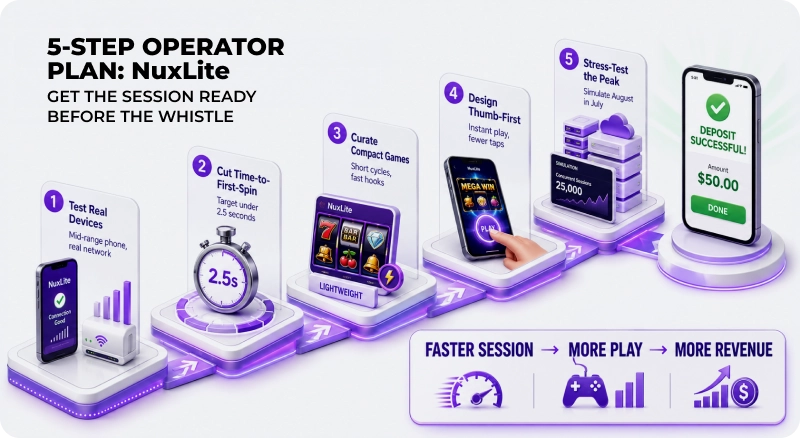
- Audit your real mobile load times against the device your players actually use. Most mobile testing happens on the newest phone in the office, over fast office Wi-Fi, by someone who already knows exactly where to tap. That tells you almost nothing about the player opening a game on a three-year-old Android, on a congested evening 4G cell, at a train platform on the way home. Before August, pull your time-to-first-spin and lobby-paint figures on mid-range hardware over a throttled connection, and segment them by your top markets: load behavior on a budget handset in one region can look nothing like another. If your heaviest, highest-grossing titles turn out to be your slowest to become playable, you are shedding your best players on your busiest day, and none of it shows up in the complaints inbox.
- Drive time-to-first-spin under 2.5 seconds. That is Google’s bar for a “good” load, and past it the drop-off climbs fast. Hitting it is usually less about a faster integration and more about what loads before the player can do anything: oversized intro animations, full asset bundles fetched up front, lobbies that try to paint the entire catalogue before the first game is reachable. Apply progressive loading so a game becomes playable while the rest streams in behind it, defer the heavy cinematic assets, and compress what ships on first contact. Operators who get under this line convert the same traffic at a higher rate. That’s the cheapest revenue increase on the table before the season even starts.
- Curate the lobby for compact sessions, not solely marquee titles. A mobile-heavy August is won by games that fit a ninety-second gap (half-time, a queue, an ad break), not by the showpiece release that photographs well in a press shot. Reorder your mobile lobby so fast, short-cycle, fast-loading titles surface first, and let go of the assumption that your biggest game is also your best mobile performer; more often than not, they are two different games. Gamzix’s catalogue is built around precisely this rhythm (quick to open, quick to read, easy to drop and pick back up) which is a large part of why it holds its shape when traffic spikes. Best of all, curation is a lever you can pull this week with no new integration work: the right ten games in the right order will frequently out-earn the next hundred you bolt on.
- Design the journey thumb-first and cut every tap you can. Build for how people hold a phone: one hand, portrait, half their attention already on something else. Every extra step between opening the app and the first spin is a chance to lose a distracted player. So the goal is fewer steps: games that open instantly, screens built for portrait, as well as sign-up and deposit handled inside the game flow instead of on separate pages. The things that spoil a mobile journey are usually small: a deposit that takes four taps instead of one, a game that makes the player rotate the screen, a confirmation page that reloads from scratch. Clean those up in July and the benefit repeats on every session through the peak, long after a one-off bonus has been spent.
- Stress-test the whole experience under peak load before it is real. The window to find and fix a mobile bottleneck is now in a simulation. Run load tests that mirror an August surge, watch closely for where the mobile experience starts to degrade under concurrency (load times that stretch, a lobby that stalls, a deposit flow that wobbles), and repair those points while the only players affected are synthetic. Check that your monitoring will actually surface a slowdown in minutes, because a problem you cannot see during a live match is a problem you find out about from the revenue report a week later. Operators who rehearse the surge in July walk into the season ready. Skip it, and the changes happen in August (when every slow session already carries a price tag).
Wrapping It All Up
The late-summer climb is one of the few growth events you can see coming. The traffic is scheduled, the device is known, the failure points are understood — so when the surge hits, traffic is the easy part. The win is getting players to a spin faster than they can lose interest, and that is decided on a phone, weeks before the first whistle. Build for that phone, and your hardest month becomes your best.