Русский
 Live Casino Game Shows 2026 Guide
Live casino game shows are no longer just flashy additions to an online casino lobby. In 2026, they are becoming a retention tool, a mobile engagement format, and a technical test for operators who want to offer live content at scale. These streamed studio formats combine a money wheel, a live host, TV-style production, and a real-money betting engine, but the real value depends on how well the feed connects to the platform behind it.
For operators, the topic matters because live game shows affect more than content variety. They require accurate bet timing, fast video delivery, wallet sync, mobile-first rendering, and certification readiness before launch. This guide looks beyond the spectacle and explains the studio infrastructure, feed synchronization, compliance requirements, and integration decisions that shape a successful live casino game show setup in 2026.
Key Takeaways
Traditional Live Dealer vs TV Energy: What a Live Casino Game Show Is
A live casino game show sits between a traditional live dealer table and a TV broadcast. Standard tables stream blackjack or a roulette game with minimal staging. A live game show adds a game show host, oversized props, and bonus triggers, moving players from pure betting toward entertainment. That shift from quiet table play to TV energy drives 2026 growth.
These formats borrow heavily from television. They are games with elements of world-famous game shows and board games for an immersive, broadcast-style session. Monopoly Live pulls board games and TV staging into one round, mixing familiar board games and TV game shows for the player. The show reads as a real TV game, not a static feed dealt from a shoe like standard live casino games.
Playing live game shows online is now routine in regulated US markets. They are streamed from fixed studios, and most promise short, repeatable rounds. The shows are played in continuous cycles with no shoe to reshuffle, which is why the fornat keeps pace with slots for session share.
Live game shows should not be treated as a simple content add-on. Operators need to look at how the studio feed, wallet, bet timing, and mobile experience work together from day one. When that foundation is clear, the format becomes easier to scale and easier for players to trust.

Denis Kosinsky
Chief Product Officer at NuxGame
Quick Comparison: Top 5 Best Live Game Shows
Operators rank live game show titles by retention, volatility, and mobile fit. The table below compares the five titles US lobbies request most, drawn from public studio data. Some competitor catalogs also file Crash and Mines instant titles under the game shows label; this guide treats those separately, since they run without a live host.
| Title | Studio | RTP | Max win | Format and 2026 note |
|---|---|---|---|---|
| Crazy Time | Evolution Gaming | 96.08% | 20,000x / €500k | Four bonus rounds, highest concurrency |
| Monopoly Live | Evolution Gaming | 96.23% | 10,000x | Board-game AR with the 3D board walk |
| Sweet Bonanza CandyLand | Pragmatic Play | up to 96.95% | 20,000x / €500k | Candy-themed vertical wheel, mobile-first |
| Adventures Beyond Wonderland | Playtech | 96.82% | up to €500k | Revolving studio with AR overlays |
| Mega Wheel | Pragmatic Play | ~96.5% | up to 500x | Fast vertical wheel, low entry stake |
The game mechanics center on a money wheel, while the features layer bonus rounds on top. Inside the game show studio, a big wheel live segment and a live Pachinko bonus drive each round. Titles such as Deal or No Deal Live add gamified decision-making, and roulette-like formats tend to retain steadier, lower-volatility players.
Studio Infrastructure: The Server Behind the Show
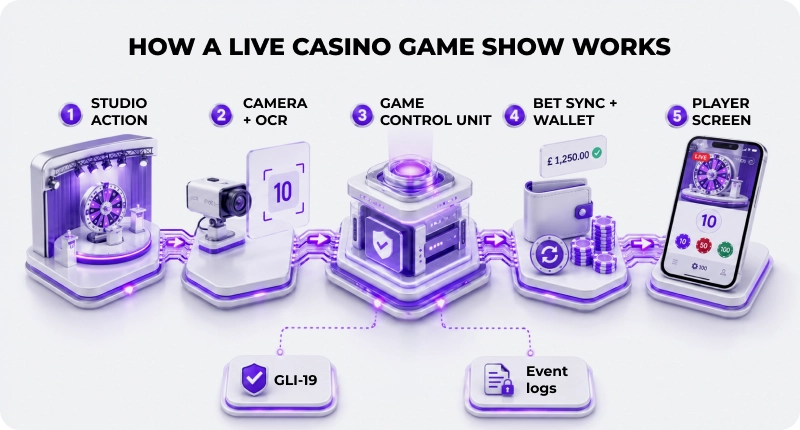
Operators see the show; they integrate the server. Each live table carries a Game Control Unit, a shoebox-sized device that encodes the video feed and manages game data. Optical Character Recognition reads the physical wheel or cards and converts each outcome into a digital result. The GCU is the bridge between a spinning wheel and your betting software.
Production sits at broadcast level. Studios capture at 50–60 fps across multiple camera angles, then compress 4K and HD feeds for delivery without losing clarity. AR-heavy titles add a layer: animated characters are composited over the live feed, typically through chroma-key staging and a revolving set. This raises studio cost and the API overhead an operator absorbs per table.
The integration cost is the pipeline, not the wheel. A single 4K interactive feed with bonus overlays consumes more bandwidth and CPU than a static table game. The aggregation layer of NuxGame brokers these feeds through one API, so an operator inherits the studio output without running encoding, OCR, or GCU infrastructure directly.
The Technology of Immersion: Syncing Live Feeds with Betting Engines
Immersion fails the moment the video and bet drift apart. The betting window must close against the dealer’s on-camera action, frame-accurate. GCU latency to the betting engine has to stay under one second, or players wager on stale states. A Sweet Bonanza CandyLand round opens a 12–15 second betting window the engine must enforce in lockstep with the wheel.
Delivery protocol sets the ceiling. Legacy HLS adds 2–3 seconds; low-latency HLS narrows the gap, and WebRTC delivery reaches sub-250ms while serving thousands of concurrent tables. Edge nodes near the studio and the player cut the round trip. The outcome flows from OCR to the GCU, then to the betting engine and wallet, and every event is logged so reconciliation is built in, not bolted on.
Session continuity is the hard edge. A dropped connection mid-multiplier must resume against recorded server state, not a client cache. The platform from NuxGame handles bet brokering, player account management, and event logging through shared back-office tooling, so a reconnect restores the authoritative round. An exciting live game show still has to clear the same sync and compliance bar as any table.
Implementing AR Overlay Features for Adventures Beyond Wonderland Integration
Adventures Beyond Wonderland from Playtech runs a revolving studio with AR overlays, a 96.82% RTP, and a 54-segment wheel. Integration is heavier than a plain wheel. The client renders AR HUD elements synced to the live feed and bonus state, and mobile builds must keep those overlays aligned in portrait without dropping frames. This is where integration complexity becomes measurable rather than cosmetic.
Mobile-First Portrait Mode: The 2026 Engineering Moat
Most US online casino traffic now arrives on a phone held vertically. A live game show built for landscape and letterboxed into portrait loses engagement fast. Vertical video formats render the wheel, host, and betting grid in portrait without cropping the action. This is the engineering moat for 2026 mobile-native players, and it outweighs the title itself.
Portrait delivery is more than a CSS change. The studio must produce a vertical feed or a crop-safe master, and the client must reflow the bet grid below the video. HTML5 responsive rendering adapts to screen size and orientation. Adaptive bitrate protects playback on cellular, dropping resolution before it drops the stream, which keeps live casino games playing on a weak signal.
Mobile browser support decides reach. iOS Safari and Android Chrome handle WebRTC and low-latency HLS differently, and codec support varies by device age. Testing across that matrix is a launch item, not a later patch. Vertical-first design separates a competitive lobby from a desktop port shrunk onto a small screen.
Compliance: GLI-19, Studio Audits, and US State Frameworks
Live game shows carry a regulatory layer that pure RNG content does not: the physical studio. The GLI-19 standard for Interactive Gaming Systems, now at V3.0, separates lab-tested technical requirements from post-install operational controls. Its live dealer studio requirements demand security perimeters such as controlled-entry gates, protection against fire and flood, and periodic physical review.
The implementation impact is concrete in the US. Michigan incorporates GLI-19 by reference into the Michigan Administrative Code (R 432.633), applying it across platforms, games, payment systems, and responsible gaming databases. An operator’s wallet, KYC, and game feeds all fall inside one certification scope. GLI-19 also mandates operational audits performed on-site after installation, at a frequency the regulator sets.
US live content adds a jurisdictional constraint absent offshore. Across the seven launched online casino states, live game shows must stream from studios physically located in-state, with geolocation enforced at the session layer. An operator entering Pennsylvania or Michigan cannot reuse a European feed. Studio placement, audit cadence, and per-state certification become product timeline items.
Portfolio, Wallet, and Commercial Decisions for Operators
The economics differ from a slot at the math level. The game show experience changes bet sizing throughout the game: variance clusters in bonus rounds, not base spins. Each game offers a different curve, and games with multipliers pull stakes up versus traditional casino and table games. That volatility is part of the game, and the live game show experience rewards players who wait for the trigger. The best game by retention is still Crazy Time.
A complete online casino offering now lists a game shows category beside slots and live tables. Players open one online casino account and reach the full online casino games library from a single login. That library holds a range of live dealer casino games: a single live dealer game like blackjack sits next to a full range of live game shows, from a live slot to a live show such as Money Drop Live.
To find the best titles, operators rank popular live casino game shows by retention, then margin. Not every game suits every segment, so a lobby carrying the best live game shows wins share when players want to participate. NuxGame supplies 17,500+ games from 140+ providers through one API, with familiar branding from popular TV game shows building recognition fast.
Technical Snapshot: Game Show Integration Requirements
| Requirement | Benchmark / spec | Operator implication |
|---|---|---|
| GCU sync latency | Under 1s, GCU to betting engine | Bets resolve against the live state |
| Stream latency | sub-250ms WebRTC; low-latency HLS | Bet window stays frame-synced |
| Bandwidth (4K interactive feed) | Higher than a static table; ABR fallback | Plan CDN and edge cost per concurrent table |
| Frame rate | 50–60 fps capture | Smooth AR overlay compositing |
| Mobile browser support | iOS Safari + Android Chrome; WebRTC/HLS codec matrix | Vertical portrait reach across devices |
| Uptime | 99.9%+ on the live feed | Continuous availability, no session loss |
| Certification | GLI-19 V3.0 incl. live dealer studio audit | Lab test plus on-site operational review |
| Catalog data | Crazy Time 96.08% / 20,000x; CandyLand up to 96.95% | Variance and bonus-cost modeling input |
Build Your Live Casino Launch on a Ready Technical Layer
The decision in 2026 is not whether to carry live casino game shows; the format is baseline lobby content. The decision is whether your integration syncs the feed to the betting engine, renders cleanly in portrait, and clears GLI-19 before launch, or carries that debt into production. Operators who treat GCU latency, mobile delivery, and studio audits as upfront engineering avoid costly remediation later.
If your roadmap spans US or multi-jurisdiction markets, the integration model decides your timeline and risk. Talk to NuxGame about aggregated access to the best live casino game show titles, single-API feed and wallet handling, vertical-first delivery, and back-office controls built for regulated launches. Define your licensing and payment requirements, and the technical layer is configured around them.