Русский
 How to Improve Payment Approval Rates in iGaming Before Summer Traffic Peaks

Summer 2026 will put pressure on every operator’s payment setup. With FIFA 2026 running through June and July, peak sports betting activity overlaps with seasonal casino traffic. This is when payment approval rates are truly tested. Approval levels that look stable under normal conditions often drop under peak load. Transactions fail more often, retries increase, and iGaming payment issues become visible to players.
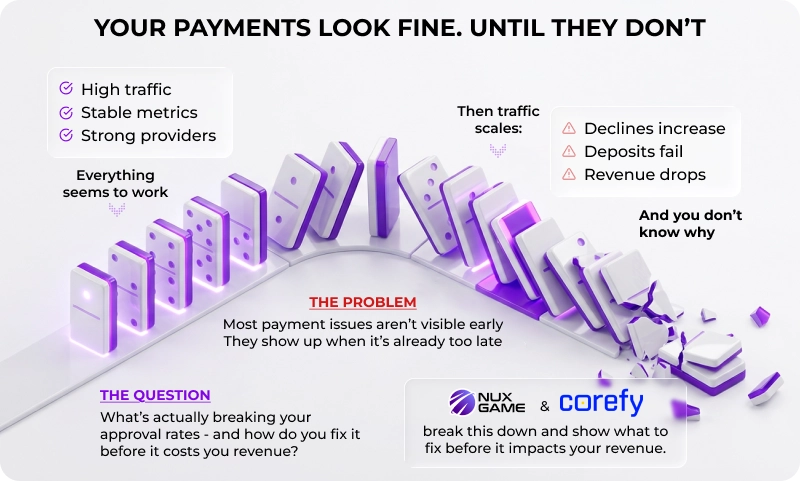
Looking beyond surface-level metrics, NuxGame partnered with Corefy to analyze what actually impacts payment approval rates — and what operators can improve before summer traffic peaks begin. The insights in this article are based on Corefy’s experience working with operators from multiple markets. Using the NuxLite approach, NuxGame translates this expertise into a clear 5-step action plan operators can apply immediately.
TL;DR on Payment Approval Rates in iGaming
What Really Affects Payment Approval Rates
When a payment fails, the first instinct is to blame the provider. But in most cases, the issue is not the PSP; it’s how transactions are routed, distributed, and retried. This is where many iGaming payment solutions fall short. They process payments efficiently under normal load, but they are not always optimized for peak conditions. Corefy’s data across operators shows that approval rate drops are usually driven by structural setup issues (gaps in routing, provider configuration, and retry logic), not traffic quality.
Most Approval Rate Issues Start With Routing
Not every transaction should go through the same provider.
Each payment has context:
- geography;
- card type;
- issuing bank;
- transaction size;
If routing ignores this, transactions are sent to providers that are less likely to approve them. Smart routing improves this by sending transactions to the provider with the highest success probability. This is one of the most effective ways to improve payment approval rates. Corefy’s data shows that routing optimization alone can increase approval rates by 2–20%, depending on the setup. As Corefy often sees in practice, operators are not struggling with bad providers; they are underusing good ones.
Single-Provider Setups Break Under Peak Traffic
Relying on one provider works, but only until traffic spikes.
During major sports events:
- providers may throttle;
- processing delays increase;
- temporary failures occur.
If all traffic depends on one PSP, approval rates drop immediately. This directly impacts online casino payments, as failed deposits translate into lost revenue and player churn. Operators with multi-provider routing and fallback logic maintain stable payment approval rates, even when transaction volume surges. The real question before summer is not “is my provider reliable?” It’s “what happens when it isn’t?”
MID Health Directly Affects Approval Rates
Merchant IDs (MIDs) are one of the least visible parts of payment infrastructure — and one of the most impactful. Banks monitor MID behavior closely. During traffic spikes, sudden increases in volume can trigger risk flags, even when transactions themselves are clean.
This results in:
- unexpected declines;
- lower payment approval rates;
- misdiagnosed issues.
The problem is not the player or the payment method: it’s how volume is distributed. Operators who spread traffic across multiple MIDs (including reserve ones) reduce this risk significantly. Within modern iGaming payment solutions, MID management is often overlooked until it becomes a problem.
Soft Declines Are Recoverable Revenue
A large share of failed payments are not final. These are soft declines — temporary bank-side rejections that can succeed if retried differently.
Without retry and cascade logic:
- these transactions are lost;
- approval rates remain artificially low.
With proper configuration:
- some payments succeed on the second or third attempt;
- overall payment approval rates increase without additional traffic.
Corefy data shows that optimizing routing and retry logic can reduce processing costs by 5–15%, while improved flow configuration can cut chargebacks by up to 40–50%.
On the Corefy website, you can use their ROI calculator to estimate how much revenue you’re leaving on the table — and what a 5–10 point increase in payment approval rates could change. Beyond tools and metrics, however, timing is often the most overlooked factor in payment performance.
Payment performance doesn’t break at peak: it reveals decisions made weeks earlier. The issue is rarely the provider itself, but how routing, MID allocation, and fallback logic are aligned with real traffic conditions. Operators who prepare in advance capture revenue others lose; those who don’t discover the cost when volume is already at its highest.

Denys Kyrychenko
Co-founder & CEO at Corefy
What Approval Rates Mean for Your Revenue
Approval rates directly define how much of your existing demand turns into revenue. Two operators can run the same campaigns and work with similar providers, yet see very different outcomes. The difference is rarely in traffic quality alone, but in how effectively the payment layer converts intent into completed deposits.
Operators who treat payments as a dynamic system (not a static setup) convert more of that demand into revenue. They don’t just monitor performance — they shape it by understanding where conversion is gained or lost. This allows them to extract more value from the same traffic, while others continue to optimize acquisition without realizing how much revenue is being left unclaimed at the payment stage.
5-Step Operator Plan for Improving Payment Approval Rates: NuxLite Execution
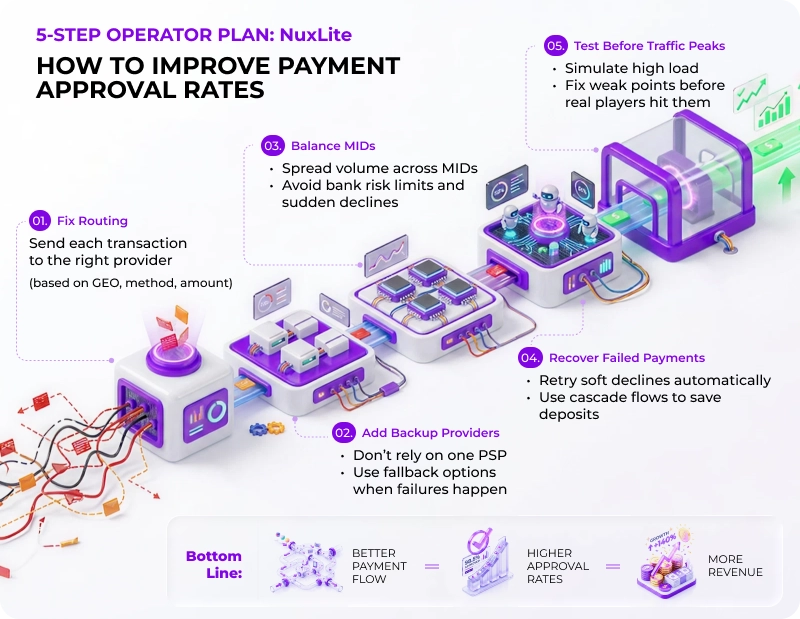
Here’s how operators can improve payment approval rates before peak traffic — and prevent revenue loss under high transaction volume:
- Audit your routing logic against current performance data. Routing rules set months ago may no longer reflect how your providers are actually performing. Before summer, pull approval rate data by provider, geography, and card type, and check whether your routing logic reflects those patterns. If you’re sending high-value transactions to a provider that underperforms on them, you’re losing revenue on every one. With FIFA 2026 running across multiple markets simultaneously, geography-aware routing becomes especially important — what works for one region may actively hurt conversion in another.
- Add provider redundancy and test your failover logic. Adding a backup PSP is not enough on its own — the fallback has to actually trigger cleanly when your primary provider degrades. Before peak traffic, simulate a provider failure and verify that transactions reroute automatically, without player-facing errors or processing gaps. Operators who discover their failover is misconfigured during a live match day face a much harder problem than those who find it in testing.
- Review MID distribution and reserve capacity for peak load. Banks flag MIDs that show sudden volume spikes, even when the underlying transactions are clean. If all your traffic flows through one or two MIDs, a major event like a World Cup match can push you into bank-side risk thresholds you wouldn’t hit on a normal day. Spread transaction volume across multiple MIDs and consider keeping dedicated capacity in reserve for high-load periods. The cost of setting this up in April is negligible compared to the cost of unexpected declines in June.
- Configure retry and cascade flows for soft decline recovery. A significant share of failed transactions are soft declines — temporary bank-side rejections that can succeed if retried through a different provider or after a short delay. Without automated retry logic, these register as lost and stay lost. With properly configured cascade sequences, a portion of those declines convert on the second or third attempt, improving overall approval rates without any additional acquisition spend.
- Stress-test your setup before volume peaks. The window to find and fix payment infrastructure issues is now, not mid-tournament. Run load simulations, review your routing logic under high-volume conditions, and check that your monitoring and alerting will surface problems quickly if something degrades during peak. Operators who prepare in April enter June with confidence. Those who don’t are making emergency changes when every failed transaction already has a cost.
Approval rates are often treated as a technical metric, but in reality they define how much revenue you actually generate. The gap is rarely in tools: it’s in how consistently the system is maintained before demand increases. Operators who get this right don’t just reduce failures, they avoid losing revenue they already paid to acquire.

Denis Kosinsky
Chief Product Officer at NuxGame
Wrapping It All Up
Approval rate drops during peak traffic are not random. They follow predictable patterns — but more importantly, they are preventable.
Operators who prepare their payment systems in advance don’t just improve approval rates. They protect revenue that would otherwise be lost under pressure. Those who delay are forced to fix issues when every failed transaction already has a cost.
At peak traffic, performance is no longer defined by volume alone. It is determined by how much of that volume you are actually able to convert into completed deposits.