Русский
 What is Blockchain Casino ? NuxGame Answers
Trust is the currency that every casino trades in — even more than chips or coins. Technology is changing how that trust is built. A blockchain-ready product gives players more ways to verify payment activity, game fairness, and selected settlement records instead of relying only on internal platform claims. Crypto user penetration is expected to reach 9.90% in 2026, with users projected to reach 795.87 million by 2027.
At the heart of it all is crypto casino software designed for operators that need more than a beginner-friendly explanation. This guide shows how the model works, where the technical value sits, and how NuxGame helps brands build a faster, safer, and more transparent product for modern players.
Blockchain casinos add verification layers to payment, fairness, and settlement events. Hybrid casino architecture is usually more practical than moving every action on-chain. EIP-4337 can reduce wallet friction through smart account flows. Base and Polygon-style scaling networks can support faster, lower-cost transaction flows. Operators should monitor wallet latency, bridge status, gas sponsor response, and settlement hashes. Smart contract audits, RNG certification, and transaction monitoring remain essential.
Key takeaways
Blockchain vs. Traditional: What’s the Difference?
A blockchain-based casino works like a regular online casino, but with stronger verification layers. The platform can still manage player sessions, games, bonuses, and reporting, while selected payment events or fairness proofs are connected to ledger records.
A traditional casino depends on internal systems, audits, and certification. Blockchain casinos add another trust layer by making important records easier to check. That is why the best blockchain casinos are not only about coins; they are about visible logic, cleaner settlement, and a better technical audit trail.
Model
Trust layer
Player visibility
Operator control
Traditional online casinos
Internal systems, certification, and payment reconciliation
Limited
High
Blockchain-ready model
Ledger records, automated rules, and verification tools
Higher
Balanced
Hybrid platform
Fast casino operations plus selected on-chain records
Practical and scalable
High
This difference matters for both players and operators. Players want to trust the casino before they gamble, while operators need systems that can prove what happened when a dispute appears.
How Blockchain Works in Casino Gaming
When people talk about crypto gambling trends, they often mention public ledgers, tokens, and faster payments. In practice, the value is more specific. A platform can use blockchain to verify selected actions such as a bet, a result, a balance update, or a settlement event.
In a provably fair setup, players can check that a result was not changed after the round. The platform may use open logic, hashes, oracle data, or other verification methods depending on the game type and technical model.
Step
What happens
Verification value
Player action
A user starts a round or places a bet
Creates a trackable event
Fairness check
The result is linked to verifiable logic
Helps confirm the outcome
Balance update
The casino account reflects the result
Keeps the session fast
Settlement record
Selected data is stored on-chain
Supports audit review
Player review
The user checks key transaction details
Builds confidence
To learn how blockchain supports the product, look at the split between fast platform actions and selected verification records.
Top Features to Know in a Blockchain Casino
Running this type of product gives operators features that legacy casino services cannot always match. The value is strongest when the platform connects transparency with a smooth user journey.
Take a look at what casinos offer in this model:
- Provably fair games that help players verify outcomes.
- Faster access to winnings through supported digital assets.
- A crypto wallet option for players who prefer direct asset control.
- Token-based loyalty or reward mechanics.
- Clear records for selected transactions, live casino content, and settlement events.
These features are what many top crypto casinos are built around. For any new crypto casino also looking to grow, using them well can make the difference between a launch that feels modern and one that looks like a standard payment add-on.
Why Blockchain Works for Operators and Players
Casino operators and players are not always on the same side, but this model creates a rare win-win. It improves operational visibility while giving users more control over how they pay, play, and verify activity.
Here are the main benefits of blockchain for iGaming teams:
- Lower payment costs because crypto transactions can be cheaper than legacy rails.
- Wider reach because digital assets can support markets where fiat processing is difficult.
- Better retention because verified fairness helps keep players engaged.
- Stronger technical appeal as digital-asset players expect transparency.
- More efficient crypto payouts when selected rules are automated.
In short, the user experience is not only faster — it is easier to explain. With fewer payment barriers and clearer records, operators can focus on growth while players can gamble with more confidence.
Blockchain should not be treated as decoration. It is useful when it turns trust into evidence: payment records, fairness checks, and settlement logic that teams can explain. The strongest products keep the player journey smooth while making the important parts easier to verify. That is where technology stops being a label and becomes operational value. Denis Kosinsky Chief Product Officer at NuxGame
Practical Examples of Blockchain in Online Casinos
Blockchain is already helping online casinos solve practical business problems. A modern operator needs flexible payment tools, dispute-ready evidence, and clearer proof that the casino overall is working as promised.
Here are a few common ways it is already in use:
- Game results are recorded or verified to reduce tampering concerns.
- Contract logic manages selected settlement rules with fewer manual steps.
- Tokens support loyalty programs and crypto casino bonuses.
- Crypto deposits help players fund accounts faster.
- On-chain records help reduce disputes around winning rounds.
This adds a stronger layer of accountability. For operators, that means fewer manual checks. For players, it means trust they can see before they choose a casino or make another deposit.
Eliminating UX Friction: Implementing Account Abstraction (EIP-4337)
One of the biggest barriers in blockchain adoption is not trust. It is usability. Players may understand transparent game logic, but seed phrases, network switching, and gas fees can slow down the experience.
Account Abstraction, often connected with EIP-4337, helps solve this by making account flows behave more like flexible user accounts. It can support self-custodial wallets while keeping the journey closer to a regular casino account.
Key benefits for casino platforms include:
- Gasless transactions for selected actions
- Session-based permissions for smoother gameplay
- Social recovery instead of seed-phrase dependency
- Spending limits inside automated account logic
- Step-up checks for higher-risk events
Event
What the platform should track
Connection
Time to connect, failed signature attempts, device mismatch
Gasless action
Sponsored gas status, paymaster response, failed relay reason
Session key
Expiry time, allowed actions, wager or withdrawal limit
Withdrawal request
Risk score, step-up trigger, approval status
Balance update
Deposit confirmation, chain used, transaction hash
For operators, this creates a better balance between control and convenience. Players get faster onboarding, while the platform keeps clearer visibility over deposits, withdrawals, and risk signals.
Scaling Beyond Layer 1: High-Throughput Play on Polygon and Base
A modern product cannot rely only on Layer 1 execution if it needs frequent deposits, fast balance updates, and low-cost withdrawals. Network congestion and gas fee spikes can damage the player experience during peak activity.
Layer-2 blockchain networks such as Polygon and Base help reduce that pressure. They can support faster transaction handling, lower fees, and more stable payment flows without removing the transparency benefits that crypto users expect. Visa tracks stablecoin movement across 10 major blockchains, which helps show why multi-chain monitoring and routing matter.
Layer
Role in operations
Operator value
Layer 1
Stores high-value settlement records or final proofs
Stronger verification and audit trail
Layer 2
Handles frequent account activity with lower fees
Faster deposits, withdrawals, and balance updates
Platform core
Runs sessions, game access, bonuses, and reporting
Smooth UX and operational control
During fee spikes, the platform can route smaller actions through lower-cost networks, delay non-urgent settlement checks, or flag high-value withdrawals for review. Cross-chain bridge logic can also separate deposit detection, balance crediting, and final confirmation, so players see a smoother cashier flow while operators keep a cleaner audit trail.
Provably Fair 2.0: Verifying Randomness via On-Chain Oracles
Provably fair gaming lets players check that outcomes were not changed after the fact. In a more advanced setup, this can go further with on-chain oracles and verifiable randomness.
An oracle can connect automated contract logic with external data or randomness sources. For casino games, this helps prove that a result came from a transparent process instead of hidden platform logic.
This is especially useful for:
- Jackpot mechanics
- High-value game rounds
- Tournament results
- Bonus-triggered outcomes
- Smart contract-based payouts
Verification point
Why it matters
Bet ID
Connects the player action with the game round
Randomness request ID
Shows where the verifiable result came from
Result hash
Helps confirm that the outcome was not changed
Release status
Shows whether winnings were calculated correctly
Settlement hash
Connects release logic with on-chain settlement records
Smart contract audit readiness also improves when randomness calls, result logic, and settlement rules are clearly separated. Auditors can review where the bet starts, how the random value is requested, how the outcome is confirmed, and how the release decision is made.
Zero-knowledge proofs can add another layer in advanced setups. They may help verify that a rule was followed without exposing unnecessary player or transaction data.
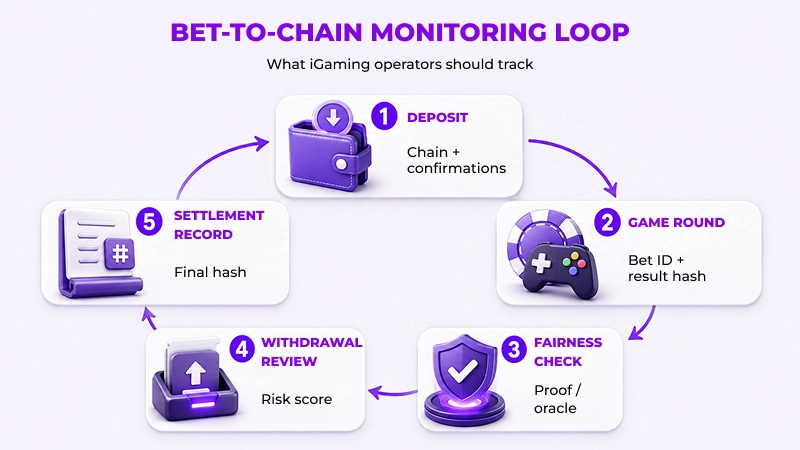
Bet-to-Chain Loop: What Operators Should Actually Monitor
The technical gap in many blockchain pages is that they explain what the product is, but not how it behaves under pressure. Operators need to know how payment, fairness, and settlement records move through the system.
A practical monitoring loop should cover:
- Wallet connection latency before play starts.
- Failed signature attempts during login or withdrawal.
- Gas sponsor status for gasless actions.
- Bridge confirmation state for cross-chain assets.
- Final settlement hash for audit review.
Operational event
Risk if ignored
Useful signal
Player deposit
Balance delay or duplicate crediting
Chain, amount, confirmation count
Game round
Dispute over outcome
Bet ID, result hash, fairness proof
Withdrawal
Fraud or approval delay
Risk score, review status, release hash
Bridge transfer
Lost or delayed funds
Source chain, destination chain, bridge state
Network spike
Poor cashier UX
Current gas, fallback route, retry status
This level of detail moves the page away from a beginner guide and toward the operational data that B2B buyers expect.
Technical Stack Comparison: Centralized vs. Decentralized vs. Hybrid Casino Architectures
Not every product needs the same architecture. A centralized model can be fast but less transparent. A fully decentralized model can be highly visible but harder to scale. For many operators, the practical answer is a hybrid setup.
Architecture model
How it works
Settlement model
Audit requirement
Best-fit use case
Centralized
Game logic, balances, releases, and reports are managed inside the operator platform.
Internal balance updates and operator-controlled records
Platform audit, RNG certification, payment reconciliation
Traditional brands adding crypto instead of rebuilding the whole product
Decentralized
Bets, releases, or game logic run through automated on-chain rules.
Contract-based betting, release, or game logic
Smart contract audit, oracle review, address security checks
Crypto-native projects built for advanced users
Hybrid
Casino operations stay fast, while selected events and fairness proofs are verified on-chain.
Fast gameplay with selected on-chain settlement proofs
Data mapping, transaction monitoring, smart contract audit planning
Operators that want scalable software with stronger trust signals
For most iGaming teams, the hybrid model is the most realistic path. It keeps the player experience smooth while adding verification where it creates value: payment activity, fairness checks, and settlement records.
Who Should Consider Launching a Blockchain Casino?
The modern casino space is not for every brand, and that is what makes it a smart opportunity for the right operators. If you value transparency, faster payment logic, and a technical audience that wants control, this model is worth a closer look before you decide to launch a crypto-based platform.
A bitcoin casino site may be right for you if:
- You are targeting emerging markets with high crypto adoption.
- Your audience is already familiar with digital currencies.
- You want to avoid common banking limits.
- You want to offer instant crypto transfer speed and automated withdrawals.
- You need a product that can connect blockchain records with familiar UX.
Top bitcoin casinos serve a global community of users who prefer speed, lower fees, and more control. These players are growing in number, and their expectations go beyond welcome offers. They want proof that the product works as described.
Types of Blockchain Casino Setups
Not every blockchain casino needs the same technical model. Some operators only need crypto payments, while others need provably fair game checks, automated rules, token-based rewards, or deeper on-chain settlement logic. The right setup depends on the audience, compliance model, payment flow, and level of transparency the product needs to show.
Setup
Technical structure
Best use case
Crypto payment casino
The casino accepts digital assets for deposits and withdrawals while core gameplay, bonuses, reporting, and player accounts stay inside the platform.
Operators adding crypto payments to a traditional casino product.
Provably fair casino
The product uses verification logic, hashes, or randomness checks for selected games so players can confirm that outcomes were not changed after the round.
Brands focused on fairness, player trust, and stronger game transparency.
Hybrid blockchain model
The platform keeps high-frequency casino operations fast while selected payment, fairness, or settlement records are verified on-chain.
Teams that need speed, audit visibility, and familiar player UX.
Crypto-native product
The setup supports address-first access, token mechanics, smart contract logic, and deeper on-chain flows.
Projects built for advanced digital-asset users and crypto-first communities.
This model gives operators room to start simple and expand later. A brand can begin with crypto payments, then add fairness checks, Layer-2 routing, smart contract logic, or deeper settlement records as the audience and product strategy mature.
Build a Crypto-Ready Casino With NuxGame
Innovation does not wait for anyone. It rewards operators that are ready. Blockchain has already changed how the casino industry thinks about fairness, payments, and player control. For operators, it is not just a trend — it is a smarter way to build trust.
NuxGame helps teams build the best crypto setup for their market, whether the goal is a mixed payment model or the best bitcoin casino experience for crypto-first audiences. The platform supports crypto-friendly payments, casino wallet visibility, risk controls, reporting, and blockchain-ready settlement logic.
The result is a product built for market entry and scalable operations. Instead of forcing operators into one rigid model, NuxGame supports full crypto, hybrid, and legacy gambling setups with the flexibility to grow.