Русский
 Top Online Casino Game Providers 2026
The best online casino game providers in 2026 are no longer judged only by famous slots, live casino tables, or recognizable game shows. For operators, the stronger filter is technical: how each provider connects, how quickly games enter production, how accurately wallet events return, and how well content performs across regulated markets.
This matters because every new casino game provider adds operational pressure to launch workflows, bonus rules, RTP monitoring, reporting, and compliance evidence. The NuxGame casino aggregation solution helps operators manage provider connections through unified API routing, back-office configuration, and centralized game management, reducing the need to treat every integration as a separate technical project.
Key Points for Operators
-
Unified API — fewer wallet, launch, reporting, and callback integrations.
-
Provider selection — check API complexity, RTP, bonuses, and regulation.
-
Live dealer games — require tighter session, stream, and table monitoring.
-
Bonus logic — must stay consistent across provider game engines.
-
TTL risk — depends on metadata, certification, wallet checks, and provider readiness.
Top 10 Casino Game Development Companies: Technical Comparison Matrix
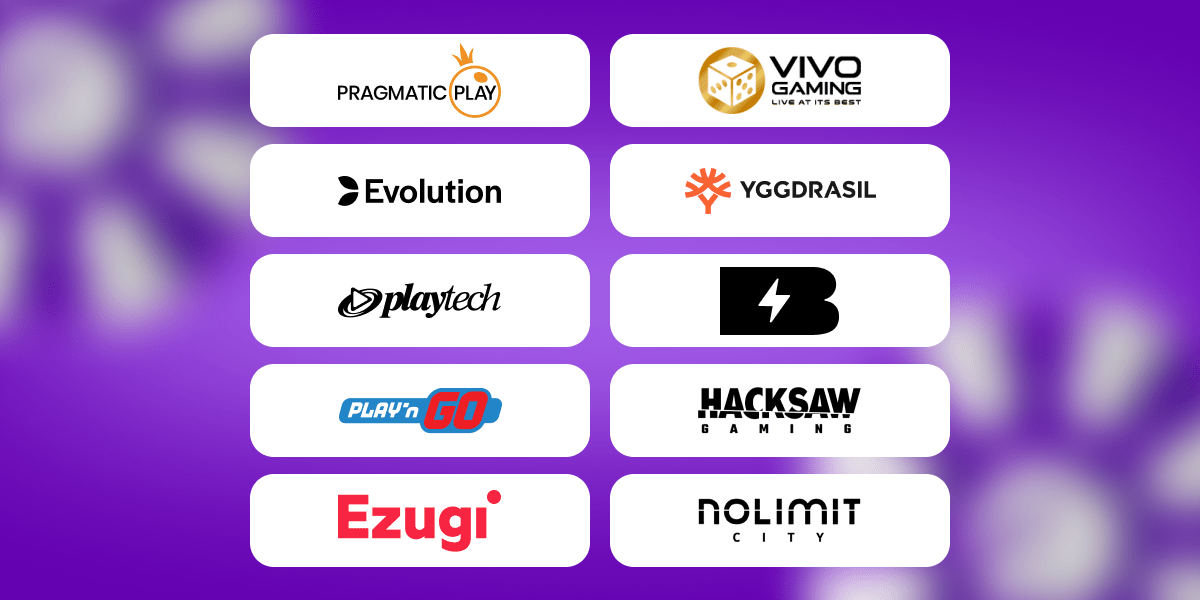
This top 10 casino game development view compares game development companies by operational value, not only by player popularity. The best providers support clear game metadata, stable launch URLs, configurable RTP visibility, bonus rules, and reporting that operators can audit. A famous casino game still creates operational risk if integration logic is slow or poorly documented.
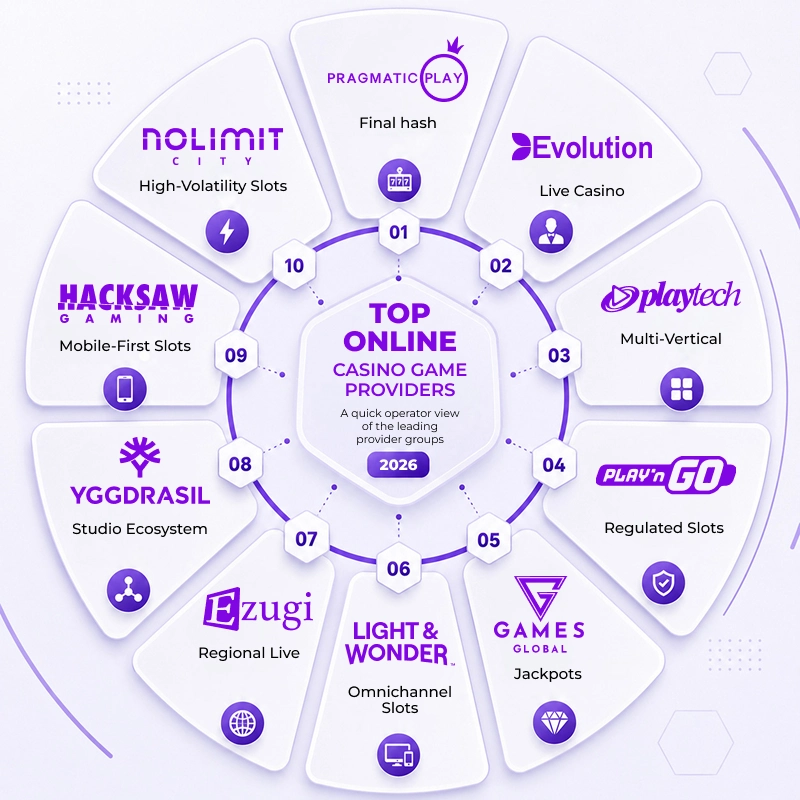
1. Pragmatic Play: Slot Volume and Single API Coverage
Pragmatic Play fits operators that need slot volume, online casino game coverage, and fast lobby refresh cycles. The provider promotes slots, live casino titles, and more through a single API, with availability across major regulated markets, languages, and currencies. That reduces integration fragmentation when teams want one commercial source for several types of casino content.
The technical value sits in catalog velocity and promotion compatibility. Product teams can map slot game releases, table games, bonus campaigns, and tournament mechanics into a central back office. Through NuxGame aggregation, Pragmatic Play content becomes easier to control through unified launch, wallet, and reporting logic instead of separate provider-side workflows.
2. Evolution Group: Live Casino Games, Game Shows, and Premium Studio Depth
Evolution Group deserves a top casino game provider position because it covers live casino games, online slots, RNG titles, and game shows through multiple brands. Its portfolio includes Evolution, Ezugi, NetEnt, Red Tiger, Big Time Gaming, DigiWheel, Livespins, and Nolimit City. That gives operators one of the broadest premium content ecosystems in casino gaming.
The integration challenge is live operations. Live casino requires stable streams, table availability, session continuity, and reliable state changes when a round closes or suspends. Operators also need correct routing for mobile players, market restrictions, and bonus exclusions, because not every live product should share the same campaign rules as online slots.
3. Playtech: Enterprise Casino Software and Multi-Vertical Control
Playtech is relevant for operators that want casino software, live casino, bingo, poker game development, and broader platform components under one enterprise supplier model. In 2026, Playtech continued expanding in the US, including Connecticut as its sixth regulated iGaming state. That makes it useful for product teams assessing regulated online rollout potential.
The main technical benefit is back-office depth. Playtech content often sits inside larger product ecosystems where wallet, player account, reporting, and promotional logic must stay consistent across verticals. For teams comparing casino software providers, Playtech belongs in the best software providers shortlist when enterprise control matters more than only slot count.
4. Play’n GO: Regulated Slot Game Development and Stable Content Operations
Play’n GO is a strong fit for operators that prioritize regulated slot game development, predictable release management, and recognizable game titles. The company lists 400+ games, while its public site states a presence in 30+ jurisdictions. That makes it a practical casino game development company for brands building long-term regulated lobbies.
The operational value is consistency. A Play’n GO slot game usually has clear math, mature mobile behavior, and stable lobby metadata. For NuxGame-powered online casino platforms, this helps product managers maintain cleaner segmentation between classic casino content, high-volatility slots, and promotional games without overloading internal release calendars.
5. Games Global: Jackpot Networks and Deep Game Libraries
Games Global is important because it gives operators access to thousands of titles from 50+ studio partners, including branded slots and progressive jackpots. Its public site also lists UK Gambling Commission and Malta Gaming Authority licensing information for relevant group entities. That combination supports game variety and regulated-market due diligence.
The technical issue is jackpot accounting. Jackpot content requires contribution tracking, win reporting, liquidity handling, and clear audit trails when several online casino sites share a network prize pool. Operators chasing best casino coverage should treat Games Global as a jackpot and content-depth layer, not only another slot supplier.
6. Light & Wonder: Land-Based Casino IP and Digital Slot Distribution
Light & Wonder gives operators access to game studios such as Light & Wonder, ELK Studios, Lightning Box, and Authentic Gaming. The provider has strong value where land-based casino familiarity supports digital conversion. This helps brands that want casino game content with mechanics already recognized by players across physical and online environments.
The technical maturity comes from omnichannel content planning. Games adapted from slot machine heritage need correct mobile rendering, jurisdictional configuration, and bonus compatibility. When product teams compare online casino software providers, Light & Wonder often belongs in the mix for operators that want familiar IP without building custom game content internally.
7. Ezugi: Regional Live Dealer Games and Localized Table Coverage
Ezugi is useful when an operator needs regional live dealer games rather than only global flagship tables. Evolution confirmed Ezugi as its second live dealer brand in the US, with New Jersey live and Michigan scheduled for the first half of 2026. That makes Ezugi relevant for operators targeting localized live casino coverage.
The implementation question is table routing. Ezugi content may require different lobby placement, currency settings, language handling, and market access rules than a standard slot library. For NuxGame aggregation, the practical goal is clean table mapping, wallet synchronization, and reporting separation between live dealer games and RNG casino game sessions.
8. Yggdrasil: Game Development Tools and Partner Studio Logic
Yggdrasil fits operators that want distinctive slot content and a partner studio ecosystem. Its public site lists 450+ offered games, 28 supported regulated markets, and 21 YGG Masters partners. That makes Yggdrasil relevant for game developers, studios, and operators looking beyond standard catalog rotation.
The value is not only content. Yggdrasil technology supports studio creation, testing, and launch infrastructure, which makes it relevant to casino software development discussions. For operators, this affects roadmap planning: partner-studio releases need metadata validation, game performance checks, and bonus testing before entering a high-performing casino lobby.
9. Hacksaw Gaming: Mobile-First Slots and Fast Release Operations
Hacksaw Gaming is one of the best providers for mobile-first slot content, scratchcards, and instant-win formats. Its investor materials describe Hacksaw as a technology-first RGS and game supplier, with 320+ games, 3,000 operator brands, and 35 regulated markets. That gives operators a clear signal of distribution scale.
The technical fit is speed and asset discipline. Hacksaw games often suit modern casino lobbies where short sessions, quick loading, and clear math presentation matter. Operators should still test volatility display, mobile frame behavior, and bonus contribution rules before pushing these titles into aggressive promotions or VIP campaigns.
10. Nolimit City: High-Volatility Slot Mechanics and Distinctive Game Features
Nolimit City belongs in the list because it gives operators high-volatility slot content with a clear studio identity. In 2026, Evolution launched Nolimit City slots in six US states: Connecticut, Delaware, Michigan, New Jersey, Pennsylvania, and West Virginia. That increases its relevance for USA-focused online gambling markets.
The integration concern is risk calibration. High-volatility game engines can affect bonus cost, player segmentation, and responsible gaming monitoring. Product teams should map Nolimit City content carefully by RTP version, maximum exposure, bonus buy availability, and market restrictions before placing it beside lower-volatility online casino gaming content.
The Aggregator Advantage: Managing 10+ Providers via a Single Technical Gateway
Running 10+ providers directly means 10+ wallet integrations, 10+ callback formats, 10+ reporting schemas, and 10+ certification cycles. A single technical gateway collapses that work into one unified API endpoint, one set of game aggregation logic, and one back office. The measurable outcome is time-to-live (TTL): how many days pass between a signed provider decision and playable, correctly configured games in a production lobby.
The table below compares typical direct-integration TTL with TTL through NuxGame casino aggregation, and adds the two signals a CTO usually asks for before approving a provider: API latency profile and back-office depth. Ranges are indicative delivery windows and still depend on commercial readiness, certification status, and target jurisdiction.
| Requirement | Operator value |
|---|---|
| Unified API endpoint | Reduces repeated launch, wallet, reporting, and callback integrations. |
| Game aggregation logic | Routes sessions, provider feeds, and game metadata through one gateway. |
| Cross-provider bonus engine | Keeps wagering, contribution caps, and excluded games consistent. |
| RTP monitoring tools | Helps detect wrong game versions, market mismatches, or configuration errors. |
| API throughput control | Protects session creation and bet callbacks during traffic peaks. |
| Multi-wallet support | Connects fiat, crypto, bonus, and regional balances to one player record. |
| Micro-frontend lobby logic | Lets teams update provider modules without rebuilding the full casino frontend. |
Three variables drive most TTL variance. First, certification: a provider already certified for the target market skips a full re-test. Second, metadata quality: clean game IDs, RTP versions, volatility labels, and thumbnails remove manual mapping work. Third, wallet callback testing: bet, win, rollback, and refund flows must be verified per provider before launch. Aggregation shortens the second and third variables because the provider feed is already normalized inside the gateway.
TTL through aggregation excludes commercial negotiation. Operators should still plan contract, licensing, and market-approval time separately from technical enablement.
Technical Snapshot: Aggregator Gateway Requirements
A casino aggregator is not only a content connector. It controls how provider feeds enter the casino platform, how game sessions open, how wallet events return, and how reporting data reaches the back office. For operators, the technical goal is to reduce separate provider work without losing control over game performance, RTP settings, bonus rules, or jurisdiction logic.
Game providers should not be selected like items on a shelf. Each connection brings wallet rules, market logic, reporting, and bonus behavior. The operator wins when these moving parts travel through one controlled lane, so content launches faster, the back office stays calm, and growth does not turn into cleanup.

Denis Kosinsky
Chief Product Officer at NuxGame
Technical maturity also affects compliance work. PCI DSS, UKGC remote technical standards, MGA system review expectations, and market-specific regulator rules usually need session logs, transaction records, game version control, and access evidence. When these records sit across separate provider integrations, audits take longer. With NuxGame casino aggregation, operators manage more of this evidence through centralized routing, reporting, and back-office visibility.
API throughput also affects launch stability during traffic peaks. Teams should review workload availability, routing resilience, and DDoS pressure before adding several providers at once, especially when live tables, jackpot games, and high-volatility slots share the same lobby traffic.
Optimizing Provider Feeds for Low-Latency Global Performance
Provider feeds are not only content. Game metadata, lobby categories, thumbnails, and launch URLs are requested constantly, and every slow response delays the first spin. For global operators, the technical target is simple: serve catalog data from close to the player, and reserve live network calls for session creation and wallet events.
- Edge caching for lobby feeds — serve game metadata, categories, and thumbnails from CDN nodes near the player instead of refetching from each provider.
- Regional session routing — open game sessions through the nearest gateway node to cut launch time on mobile networks.
- API throughput control — size session creation and bet callbacks in requests per second (req/sec), then load-test at two to three times expected peak before a provider goes live.
- Micro-frontend lobby logic — deploy provider modules independently so adding one game provider does not require rebuilding the full casino frontend.
- Feed refresh discipline — schedule catalog syncs off-peak and validate game metadata before publishing to a live lobby.
- Failover routing — keep a fallback path for provider timeouts so lobby rendering never blocks on one slow feed.
Micro-frontend lobby logic matters most for operators adding providers continuously. When each provider module ships on its own release track, a Hacksaw Gaming update or a new Nolimit City batch does not put the whole lobby into regression testing. Combined with req/sec headroom and edge-cached feeds, this is what keeps aggregation velocity high after the tenth provider, not only the first.
Choose the Best Providers Through Aggregation Readiness
The best online casino game providers in 2026 are the ones that strengthen the operator’s launch plan, not only the lobby design. A balanced casino offers premium live tables, reliable online slots, jackpot content, regional games, and high-volatility titles, but the technical gateway decides how quickly those assets become manageable.
NuxGame helps operators choose the best provider mix through casino aggregation, wallet synchronization, provider routing, reporting, and back-office controls. If your team wants to compare top casino game providers by integration effort, bonus compatibility, and compliance workload, NuxGame can support a provider rollout plan built around operational control rather than disconnected vendor work.