Русский
 White Label Sportsbook Solutions for Modern Betting Businesses

A white label sportsbook solution is a ready-to-launch sports betting product that lets operators enter the market under an existing license. It works by using a provider’s infrastructure while the operator focuses on branding and growth through a White Label Online Casino solution.
Operators still choose this model in 2026, and the reason is simple: they know that licensing is time-consuming, compliance costs keep piling up, and building a reliable sports betting platform requires deep expertise. And they also know that white label offers speed, but it also sets boundaries. If you want to enter sports betting fast, white label is the fastest door (just not the biggest room).
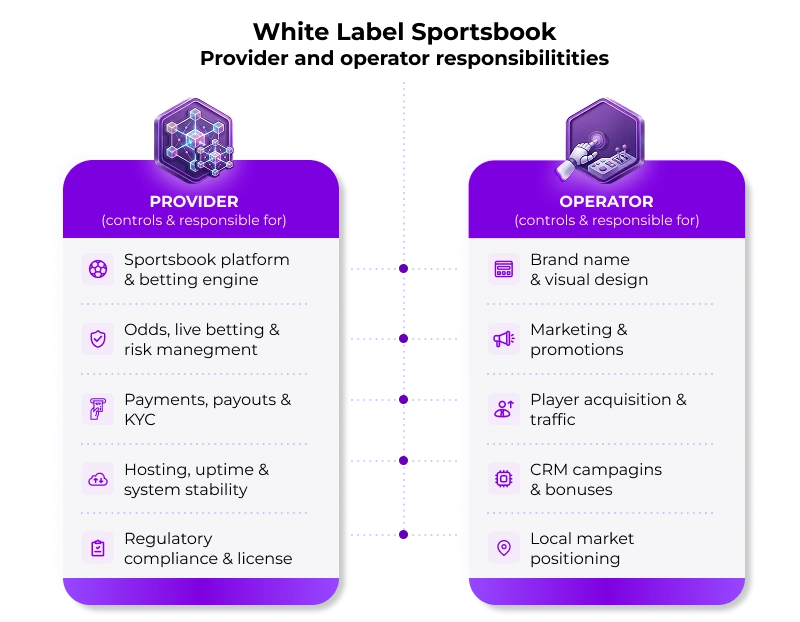
The white label sportsbook software provider controls the sportsbook software; that includes risk management, payment processing, hosting, and technical support. The operator runs the betting business, focuses on growth, and applies limited customization. White label is useful for testing and launch, but not for full market expansion.
TL;DR: White Label Sportsbook Model
White Label Sportsbook Operations Explained
This is how a white label sportsbook works in practice in 2026. In iGaming, the operator does not own the license or core technology. The sportsbook runs under the provider’s B2B gambling license, which legally covers compliance and responsibility for every wager placed on the platform.
The white label sportsbook software provider controls the sportsbook platform and delivers the full sports betting solution. This includes odds, settlement, exposure control, and access to multiple betting markets, including live betting. All activity runs in a fully managed system where risk and payouts are handled centrally. This protects platform stability for betting operators.
The operator manages the commercial side. They grow the brand, acquire players, and run promotions within a defined online sports betting business model. Customization is limited and depends on the provider. The model prioritizes speed and safety, not full platform ownership.
What You Get with a White Label Sportsbook Platform
A white label sportsbook platform provides operators with everything needed to work safely in a regulated sports betting market. This is important now that sports betting regulations are getting stricter, and mistakes at launch can be costly. A white label sports betting software package is designed to remove technical uncertainty and help operators go live with confidence.
The platform is part of a wider iGaming white label solution, often supporting both sportsbook and casino products within the same ecosystem. This provides stable real-time betting activity across the sportsbook website, even during peak traffic and live events.
What operators receive with a white label sportsbook platform:
- A preconfigured sportsbook engine ready for launch.
- Pre-match and live odds feeds, including esports.
- Built-in risk management tools and betting limits.
- Integrated payment processing via approved providers.
- Offshore or international licensing coverage.
- Hosting, monitoring, and first-line technical support.
What operators do not receive by default is also clear. Local licenses, full backend ownership, and unlimited integrations are excluded. Systems are connected through a controlled sports betting API, supporting stability and regulatory compliance.
How Quickly Can You Launch a White Label Sportsbook?
Launching a white label sportsbook in 2026 is faster than building from square one, but it still follows a certain process. Operators can usually go live within four to six weeks. This timeline assumes the sports betting license used by the provider is already approved for the target market. The goal is to help operators launch a sportsbook quickly, without skipping critical checks.
The real timeline depends on preparation. Branding decisions, content approval, and KYC verification all affect speed. Even with strong support from white label sportsbook providers, compliance steps cannot be rushed. This protects long-term stability.
A white label sportsbook usually launches in these steps:
- Legal and license verification.
- Brand and domain setup.
- Market, odds, and payment configuration.
- Payment and KYC approval.
- Platform testing and security checks.
- Final approval, launch, and initial system monitoring.
A fast launch means the system is ready to operate. Scaling comes later, supported by reliable iGaming technologies.

Operator Profiles That Use White Label Sportsbooks
Operators choose a white-label sportsbook when their priority is learning fast without overcommitting. It allows teams to launch a sportsbook business, observe player behavior, and refine strategy — provided they choose the right B2B iGaming partner from the start.
This model fits three distinct operator profiles:
- New Market Entrants. Startups entering sports betting carefully, with a customizable brand and limited exposure.
- Small and Mid-Sized Operators. Companies that need speed and stability without heavy technical ownership.
- Casino Operators Expanding Their Offer. Brands testing sports betting as an additional vertical before deeper investment.
White label works best where sports betting is legal, giving operators room to learn, adjust, and decide whether to move toward a more independent model later.
Business Advantages of White-Label Sportsbook Solutions
iGaming operators choose white-label sportsbook solutions in 2026 because they simplify the hardest part of sports betting: getting live without mistakes. Instead of managing every technical and legal detail, teams start with a platform designed to function properly right from the start.
This approach gives immediate access to secure payment gateways, stable odds delivery, and reliable in-play betting — all without internal development. Operators can focus on marketing, audience testing, and product positioning while the system runs in the background.
Let’s take a closer look at the main benefits of white-label sportsbook solutions:
- Faster launch compared to building in-house.
- Lower upfront cost and reduced financial exposure.
- Compliance managed outside the operator’s team.
- A sportsbook already tested in real conditions.
- Lower risk during first months of operation.
- Reliable in-play betting performance.
These advantages are most valuable at the start. For an iGaming startup, white-label sportsbook solutions provide a safe entry point before committing to full ownership later.
What White-Label Sportsbooks Don’t Give You
White-label sportsbook solutions simplify launch, but they come with limitations. As operators grow, some limits become more visible, especially in regulated markets where accountability, data access, and product flexibility matter more each year.
So here’s what white label sportsbooks don’t give you:
- Freedom to operate in every country.
- Full control over platform updates and changes.
- Full flexibility in user experience design.
- Full ownership of revenue without sharing.
- Custom-built player management systems.
- Easy switch to a local license later.
Regulation turns early decisions into long-term consequences these days. Operators must plan beyond launch to stay scalable. This is especially now that AI in sports betting raises expectations around data control and personalization.
White Label vs Turnkey vs In-House: Which Sportsbook Model Fits Your Business?
| Decision Area | White Label | Turnkey | In-House |
|---|---|---|---|
| Who owns the license | Provider | Operator | Operator |
| Speed to market | Very fast | Medium | Slow |
| Initial investment | Low | Medium | High |
| Customisation level | Limited | Flexible | Unlimited |
| Compliance responsibility | Provider | Shared | Operator |
| Long-term growth | Restricted | Scalable | Fully scalable |
Expert Tips for Operators
White label can be a strong starting move — if operators treat it as a phase, not a final structure. Experienced teams plan their next steps before launch, not after. This mindset helps avoid future issues when scaling, adding virtual sports, or moving away from pre-built betting logic.
Here are practical tips operators apply early:
- Define white label as a temporary setup.
- Ask providers about migration options.
- Avoid markets with tightening license rules.
- Secure access to player and bet data.
- Keep branding future-proof.
- Don’t lock strategy to one platform.
- Test demand before expanding content.
- Review turnkey solution options early.
Operators who plan transitions early gain flexibility later, even when moving toward automated betting software or deeper product ownership.
White label succeeds only when operators understand what happens inside the system. That means regular access to operational reports: payments, KYC pass rates, chargebacks, settlement problems, and downtime. Without this information, it becomes impossible to manage risk or explain decisions to banks and regulators.

Bar Konson
Chief Business Development Officer at NuxGame
Wrapping It All Up
Fast roads get you moving; smart roads get you further: that idea defines white label sportsbooks in 2026. A top white label sportsbook helps operators enter the market quickly, test demand, and deliver a solid betting experience without heavy technical risk. But real success comes from knowing what white label is meant for: speed, learning, and early player engagement. As expectations rise around app development, data control, and flexibility, planning the next step becomes just as important as launching. Operators who think ahead build brands that last. Looking for a white label strategy that fits your growth plans? Get in touch with the NuxGame experts to discuss how our iGaming software platform can come in handy.