Русский
 Game Aggregator vs Direct Integration in 2026: Architecture, Cost, Control, and Compliance Compared
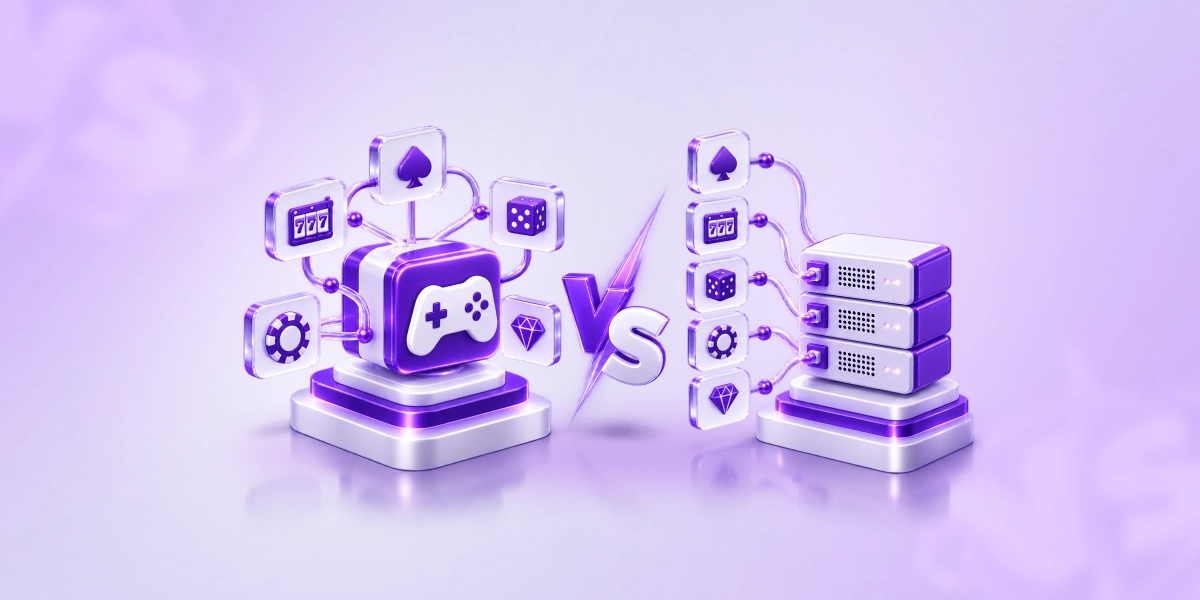
The choice between game aggregation and direct integration affects far more than how games enter a platform. It defines who owns connector maintenance, release work, incident escalation, data normalization, and supplier-specific changes. The architecture therefore shapes technical workload and long-term operating cost.
For online casino operators, the practical question is which responsibilities deserve internal ownership. A casino game aggregator reduces repeated connector work across a broad catalog, while dedicated links preserve deeper control over strategically important studios. The NuxGame casino game aggregation environment currently connects 17,500+ titles from 140+ suppliers through one API, providing a practical reference point for the centralized model.
How the Two Connection Models Differ
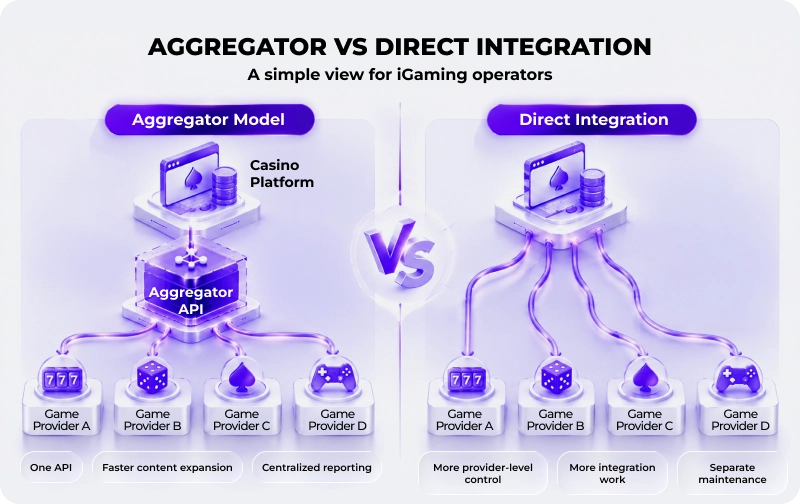
With an aggregator, a single integration connects the platform to a normalized gateway across many upstream systems. Game launch, wallet callbacks, metadata, reporting, and error handling follow a common structure. The shared hub absorbs much of the translation between technical specifications, so new suppliers do not automatically create another core-system connector.
Comparison area
Aggregator model
Dedicated supplier model
Connection structure
One normalized gateway for many suppliers
Separate connection for each selected supplier
Initial engineering
Concentrated on one shared specification
Repeated for every new connection
Wallet logic
Common callback and transaction structure
Supplier-specific mapping may be required
Game metadata
Normalized into a shared format
Mapped separately from each source
New supplier rollout
Usually enabled through the existing hub
Requires another implementation cycle
Native features
Limited to functionality exposed through the hub
Greater access to supplier-specific functionality
Release management
Centralized across the shared layer
Separate regression work for each connection
Reporting
Unified or normalized reporting
Multiple schemas and reconciliation processes
Incident path
Hub team joins troubleshooting
Casino team communicates with the supplier directly
Commercial relationship
Often consolidated, depending on contract
Negotiated separately
Compliance review
Includes the hub and underlying suppliers
Each supplier relationship is assessed individually
Best fit
Broad game libraries and frequent content expansion
Strategic studios requiring deeper control
With a dedicated connection, the platform talks to individual game providers without that intermediary layer. The casino team owns more supplier-specific mapping, release validation, monitoring, and troubleshooting. That additional technical work gives the operator more control, but every new connection adds another lifecycle to maintain.
Which Model Creates More Engineering Work?
The integration process differs mainly in repeated connector ownership. A single API integration gives the platform team one specification for authentication, launch logic, transaction callbacks, wallet synchronization, retries, and reporting. The engineering advantage is not that upstream systems become identical; it is that the operator maintains one adapter instead of a separate adapter for every supplier.
The main engineering difference appears in five areas:
- authentication and session mapping;
- wallet callbacks and transaction states;
- error handling and retry logic;
- regression testing after API changes;
- connector documentation and monitoring.
A provider integration moves more of this work into the platform team’s backlog. One supplier may structure round identifiers differently from another, while a second may use different callback ordering or error rules. Each connector needs development, QA, release management, documentation, and technical support throughout its lifecycle. When specifications change, the aggregator handles much of that adaptation in the hub model, while a separate integration remains the casino team’s responsibility.
Dedicated connections buy depth; aggregation buys breadth and operational consistency. The decision should follow the product roadmap, not a default technical preference. If a studio is strategically critical, deeper control may justify the extra ownership. For the rest of the portfolio, a unified layer keeps releases, monitoring, and reporting from multiplying with every new supplier. Denis Kosinsky Chief Product Officer at NuxGame
How Cost Structures Compare
The cheapest connection on day one does not necessarily produce the lowest-cost architecture over three years. Dedicated links require engineering hours, QA cycles, certification, monitoring, release work, and support. Those expenses recur when a business adds multiple game providers, then return when one supplier introduces a material technical change.
A useful total-cost comparison should include:
- initial development and certification;
- ongoing QA and maintenance;
- monitoring and incident management;
- supplier-specific release work;
- commercial fees and internal staffing.
A hub replaces part of that fragmented workload with a centralized commercial and operating model. The business should compare aggregator fees against the full internal cost of separate connections, not development alone. Direct deals may produce better economics for high-volume strategic studios, while a shared hub often reduces duplicated effort across the wider portfolio.
Where Each Model Gives More Product Control
A direct provider connection gives product teams closer access to the native supplier interface. That matters when an online casino needs custom promotion logic, dedicated tables, specialized reporting, or functionality unavailable through the shared gateway. Technical conversations also happen with fewer intermediaries.
Dedicated connections are usually strongest when the roadmap depends on:
- supplier-native functionality;
- custom promotional mechanics;
- dedicated or exclusive content;
- specialized reporting;
- deeper product collaboration with selected studios.
The hub model trades some supplier-level specificity for consistency. A common data model makes it easier to manage game libraries, categories, launches, reporting, and campaigns across a diverse game catalog. The NuxGame environment brings lobby controls, reconciliation, reporting, cross-supplier bonus tooling, and monitoring into the same operating layer. Normalized workflows reduce exceptions across the wider game portfolio and simplify adding new games without changing core platform logic.
Compliance in Regulated Markets
Neither architecture removes regulatory responsibility. Authorities in regulated jurisdictions assess the entities and systems involved in gaming services. New Jersey regulates businesses supplying Internet gaming software or systems, so compliance teams need to map the supplier chain under New Jersey licensing rules.
The compliance review should establish:
- which entity supplies each software component;
- where transaction and player data moves;
- who maintains certification evidence;
- who records material technical changes;
- how incidents are traced across suppliers.
Michigan also licenses platform suppliers and other businesses supporting internet gaming operations. Teams should document who supplies software, hosts components, receives transaction data, and supports game operation under current Michigan supplier licensing requirements. The public-comment GLI-19 v4.0 draft also addresses integrated-component testing, change management, reporting, player accounts, and security. For the iGaming industry, architecture changes evidence flow and testing scope rather than removing compliance obligations.
Performance and Incident Response
Adding an intermediary does not automatically make the hub slower, just as removing one does not guarantee lower latency. End-to-end performance depends on network routing, wallet processing, database work, supplier infrastructure, and client connectivity. Teams should measure game launch time, transaction response time, retries, and unfinished rounds across the full request path.
Dedicated connections shorten escalation because the casino team contacts the supplier directly. A hub offers a different advantage: one support interface can investigate issues across a collection of games from different sources. This matters across a broad range of games, including slot titles, table games, live casino games, crash games, and other gaming content. AWS Availability Zone architecture remains relevant because infrastructure resilience is independent of commercial routing.
Which Model Handles Content Expansion Better?
A hub has a structural advantage when the roadmap prioritizes breadth. Once the common connection is established, additional studios can often be enabled through the same data model instead of creating another operator-side connector. Product teams then spend more development capacity on discovery, lobby logic, campaigns, and player retention rather than repeating plumbing.
Aggregation becomes particularly practical when the roadmap includes:
- frequent addition of new studios;
- a large or changing catalog;
- common metadata and reporting rules;
- centralized lobby management;
- consistent launch and monitoring workflows.
Dedicated links become more attractive when the roadmap prioritizes selected suppliers rather than library size. A business may want early feature access, dedicated content, or closer collaboration with game developers. By contrast, aggregators work best when breadth and common controls matter more than native feature access. Teams seeking access to thousands of games should compare iGaming software providers by supplier reach, API ownership, and the operating model around the connection.
When a Hybrid Model Is More Practical
The choice does not need to be binary. A business can use casino aggregation for broad coverage while maintaining dedicated links with a few strategically important studios. This limits duplicated engineering without blocking deeper product or commercial relationships where they create measurable value.
A hybrid route makes the most sense when dedicated connections are reserved for suppliers that meet a clear business or technical criterion, such as:
- significant revenue or traffic volume;
- unique functionality unavailable elsewhere;
- special commercial terms;
- exclusive or dedicated content;
- strategic product collaboration.
The main risk is duplicated logic. Wallet ownership, game identifiers, reporting, bonus eligibility, reconciliation rules, and routing must stay explicit when games from multiple providers enter through different paths. Without clear boundaries, the hybrid architecture can inherit the maintenance burden of both models. Many aggregators support mixed estates, but the casino team still needs one source of truth for content status, transaction ownership, and reporting.
Technical Snapshot: What to Compare Before Signing
Before selecting a route, technical and product teams should map API integration boundaries in both proposals. That keeps supplier evaluation comparable when one bidder quotes connector work and another includes monitoring, reporting, and operational support.
Technical checkpoint
What to verify
Interface ownership
Who maintains connectors and version changes?
Wallet model
Who owns retries, idempotency, reversals, and unfinished rounds?
Session handling
How are tokens created, expired, and recovered?
Supplier outage
Can one source be isolated without disrupting others?
Observability
Are logs and supplier-level errors visible to the casino team?
Reporting
Are game, round, revenue, and supplier records normalized?
Reconciliation
How are mismatched transactions investigated?
Release process
Who tests upstream API and content changes?
Security
Which components process credentials, PII, or financial data?
Certification
Which components require testing after material changes?
Exit strategy
How easily can content move to another connection route?
Payment scope should remain separated from game connectivity wherever possible. Where systems handle cardholder data, the current PCI SSC document library lists PCI DSS v4.0.1 as the applicable published version. Teams should map those boundaries against PCI DSS requirements. Teams should also define measurable performance thresholds before go-live. The NuxGame content hub page reports a sub-five-minute reporting delay, subject to upstream data flow. The NuxGame Casino API page reports approximately 99.9% platform uptime.
Choose the Model Around Ownership
The final decision should define which responsibilities stay inside the operator’s stack. Teams should document casino content routing, connector ownership, supplier-specific exceptions, monitoring, and migration requirements before contracts are signed. This makes the trade-off measurable instead of treating either model as a default architecture.
For teams evaluating the centralized route, the NuxGame environment brings connectivity, lobby management, reconciliation, reporting, campaign tooling, and monitoring into one back office. Teams gain access to a diverse selection of games while keeping day-to-day controls consistent. Before committing, map the next studios and calculate the full operating cost of both models. NuxGame can review those requirements and help determine where a shared content layer fits the project.