Русский
 No KYC Online Casino Pros and Cons for Operators: 2026 Compliance and Payment Infrastructure Analysis

A no KYC online casino lets a player register and deposit without uploading identity documents. Verification is deferred, not deleted. Almost every platform marketed this way sits in a middle tier: play begins on an email address and a wallet, and the identity check fires at a withdrawal threshold or a risk flag. Malta fixes that ceiling at a cumulative €2,000 in deposits or the first withdrawal, whichever lands first.
Operators examine the model because onboarding is where acquisition spend disappears. The commercial pull is real, and so is the legal ceiling: in the United States, no licensed route to it exists. NuxGame treats verification as a configurable layer inside player account management, so operators set verification tiers, deposit thresholds, and payout hold rules per jurisdiction instead of per brand. That configuration work is covered in the NuxGame breakdown of KYC in online gambling.
Key Takeaways
-
"No KYC" in practice means threshold-triggered KYC, and the trigger is a product decision with an audit trail attached.
-
US-facing operators cannot run this model: New Jersey requires multi-source authentication before an account is created.
-
The Curaçao LOK regime mandates KYC on every player and geo-blocks US traffic, closing the historic offshore workaround.
-
The AGA puts unregulated gaming revenue at $53.9 billion a year, which is the market no-KYC casino brands compete in.
-
Deferred verification moves cost from acquisition to payouts, where held withdrawals generate tickets and disputes.
Demand Signals: What Players Look For
Search volume for anonymous online casinos runs well ahead of licensed supply in most markets. Affiliate rankings for top no KYC casinos and best no ID verification casinos compete on three attributes: registration length, payout speed, and banking options at no KYC brands. None of those is a game-library feature, which tells product teams where differentiation actually sits.
Player expectations are also narrower than the marketing implies. Sites ranked as top no verification online casinos or best anonymous casinos still publish document clauses deep in their terms. Payout speed outranks bonus size across most comparison tables, so casinos that offer instant payouts capture a disproportionate share of repeat play. That weighting matters when splitting a budget between promotions and payout operations.
Criteria that recur across no-verification casino sites:
- Fields required before depositing, and whether an email address alone is enough
- Minimum deposit thresholds, and whether a welcome bonus or free spins are attached
- Access to casino games without an account upgrade, including live casino tables
- Crypto withdrawal times measured in minutes rather than business days
- Which casino bonuses survive a later KYC check at the cashier
Pros of the No KYC Casino Model for Operators
The commercial argument rests on one funnel step. Document upload and liveness capture sit between intent and the first deposit, and both fail on low-end devices. Identity vendors report abandonment between 40% and 60% on manual or poorly instrumented flows. Removing that step pushes the drop-off point later, once the player has money at risk and a session history.
Second-order gains come from the payment stack rather than the sign-up form. Crypto-only cashiers avoid card networks, which removes interchange, acquirer reserves, and most of the fraud-loss provisioning fiat operators carry. The saving is measurable in cost per acquired depositor, not in efficiency language.
Conversion at the Deposit Step
Every additional registration field carries a cost per thousand sessions. A crypto gambling flow needs three inputs: email, password, and a deposit address. Session-to-deposit conversion improves because the player never leaves the app to photograph a passport. Players who choose no KYC crypto casinos are optimizing for speed. The trade is that fraud detection now leans on device and behavioral signals instead of a verified name.
Payout Speed and Support Load
Payout latency is what players discuss publicly, and it drives retention harder than bonus size. On-chain settlement clears in minutes once the hot wallet signs, against one to five business days on bank rails. Many no KYC casinos offer that speed as their main differentiator. Fewer manual payout reviews also means fewer tickets, which lowers cost per active player in the support queue.
A Smaller Personal Data Footprint
Not collecting passports means not storing them. That reduces breach blast radius, key management scope, and data subject access request volume. Where card data never enters the environment, assessed scope under the active card-data standard narrows, since PCI DSS v4.0.1 applies to cardholder data flows only. Crypto rails shift the burden to wallet custody and key isolation.
Time to First Revenue
Permissive licensing still clears faster than tier-one regimes. Many no KYC crypto casinos hold Anjouan or Curaçao authorizations for exactly this reason: an Anjouan file processes in roughly four weeks; a Curaçao file takes three to five months. For a team testing a vertical, that gap decides whether a brand launches this quarter. Speed is the advantage; durability is the problem the next section addresses.
Cons: Where an Online Casino Without KYC Costs More Than It Earns
Risks are not evenly distributed across a P&L. Two land in finance, two in legal and regulatory, and one in enterprise value at exit. Treating them as a single compliance line is what causes operators to underprice casinos without KYC during planning. Each has a different owner and a different remediation clock.
The 2025–2026 pattern is convergence. Offshore regulators that once tolerated anonymous play now require it to stop, so the cost curve rises while the legal footprint narrows. Online casinos without upfront checks now face AML expectations close to those of licensed brands, with fewer resources to meet them. Teams planning a two-year horizon should price the tightening rather than today’s rules.
The United States Is Closed to This Model
Real-money online casino play is live in seven states: New Jersey, Pennsylvania, Michigan, West Virginia, Connecticut, Delaware, and Rhode Island. New Jersey rules require multi-source authentication of patron data before an account exists, covering date of birth, address, and full or partial Social Security number. The Curaçao LOK framework compounds this by barring licensees from serving US players at all.
Federal obligations sit underneath state licensing, and they originate in traditional casino supervision rather than online play. Operators above $1 million in gross annual gaming revenue file Currency Transaction Reports over $10,000 per gaming day. Filing of suspicious transaction reports begins at $5,000 under 31 CFR 1021.320. A FinCEN proposal published in April 2026 would add board-approved risk assessments and a US-located responsible officer, with a twelve-month implementation window after any final rule.
Payment Rails and Banking Access
Acquiring banks price anonymity as fraud exposure, so fiat rails close first. Crypto-only operation then concentrates counterparty risk in exchanges and stablecoin issuers. Chainalysis found that stablecoins now carry 84% of illicit transaction volume, with $154 billion received by illicit addresses during 2025. Any operator holding a stablecoin float inherits freeze risk from that same enforcement capability.
Redundancy disappears alongside the rails. A deposit and withdrawal path running through one exchange has no failover when settlement pauses, and players read the outage as non-payment. A casino may also need to hold funds mid-review with no acquirer to arbitrate the dispute. Fiat operators absorb chargebacks but keep three or four acquirers; single-rail operators avoid chargebacks and keep one custody dependency.
Promotional Exposure: Welcome Bonus, Deposit Bonus, and Free Spins Leakage
Promotional liability is where unverified accounts convert into direct loss. A welcome bonus and a free spins package both assume one account per person. Without a verified identity, duplicate detection falls back to device fingerprints, IP reputation, and wallet clustering. All three are inexpensive to defeat. Cloudflare telemetry puts automated authentication traffic near 94% of login requests, with 41% of successful logins using already-compromised passwords.
Quantify the leakage before launch rather than after. If free spins carry a 40x wagering requirement and 8% of accounts are duplicates, effective promotional cost rises by roughly the same share. Reconciliation surfaces the gap only after payout. Many casino teams discover the gap when a campaign posts negative margin two months after it closed.
Controls that limit leakage without a verified identity:
- Free spins issued only after a minimum deposit reaches on-chain confirmation
- Casino offers capped per device fingerprint, deposit address, and IP subnet
- Deposit bonus value released across sessions rather than granted upfront
- Free spins winnings held in a separate balance until a KYC check completes
- Standard KYC applied automatically once cumulative bonus value crosses a set figure
Responsible Gaming and Exclusion Gaps
Self-exclusion, deposit limits, and cooling-off periods bind to an identity. Many no KYC casinos allow a fresh registration minutes after an exclusion request, because nothing links the two accounts. Cross-operator exclusion registers such as GAMSTOP cannot reach an unverified account. Regulators read this as a licensing objective failure rather than a technical shortcoming, and it remains the fastest route to enforcement against no KYC gambling sites.
Enterprise Value and Exit
Acquirers and payment partners run diligence on the player ledger. A book of unverified accounts discounts heavily, because a buyer cannot migrate those players into a licensed environment without re-verifying them. Retroactive campaigns typically lose a large share of the base. Product managers should treat verification records as a balance-sheet asset rather than paperwork.
Soft KYC, KYC Levels, and Trigger Design
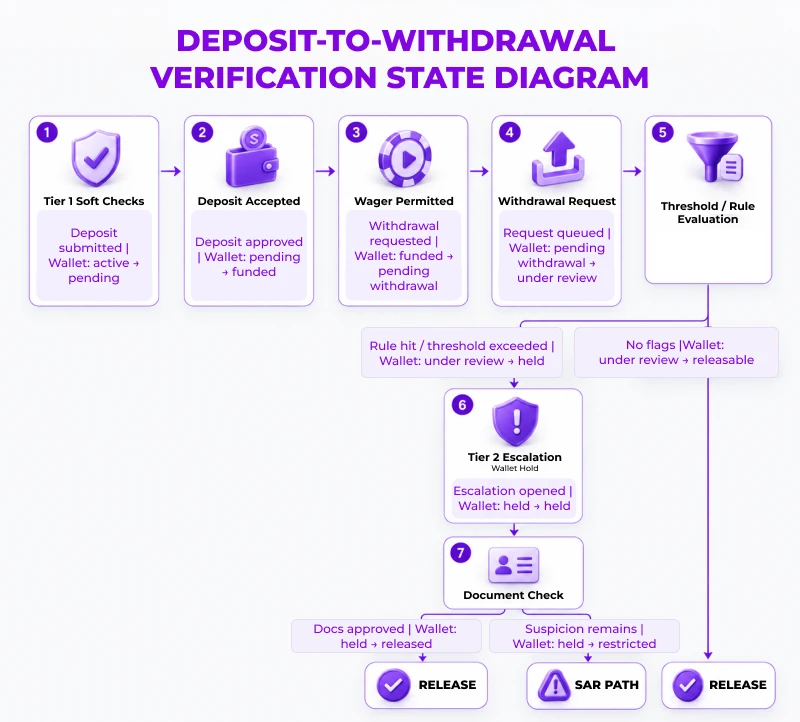
Verification is a state machine, not a gate. A casino with no verification at sign-up still needs a documented escalation path. The design question is which events trigger KYC escalation, and what the wallet may do at each level. Operators who document explicit tiers can defend decisions to a regulator; operators who leave it to payout-team discretion cannot. Documented thresholds are also the first artifact a bank asks to see.
Low-friction checks carry most of the early risk signal: email confirmation, device attestation, IP and geolocation consistency, sanctions screening on the deposit address, and behavioral scoring. Many online casinos use these to score an account long before documents appear. Because many no KYC casinos let this state persist indefinitely, unlicensed brands accumulate exposure a regulated operator cannot carry.
| Verification tier | Player effort at sign-up | Typical trigger to escalate | Primary operator exposure | License compatibility |
|---|---|---|---|---|
| Tier 0 — no verification at any point | None | None | Sanctions, underage play, no exclusion enforcement | Effectively none in 2026 |
| Tier 1 — soft KYC only | Email and wallet | Manual review flag | Multi-accounting, promotional abuse | Narrow: unlicensed or lightly licensed brands only |
| Tier 2 — threshold KYC | Email and wallet | Cumulative deposits, first withdrawal, velocity anomaly, PEP or sanctions hit | Held payouts, dispute volume, retroactive data gaps | Curaçao and Anjouan with a full AML program |
| Tier 3 — full KYC before deposit | ID document plus liveness | Not applicable | Onboarding drop-off, verification vendor cost | UKGC, MGA, all seven live US states, GCGRA |
Operators rarely want zero verification. They want verification that arrives at the right moment. The engineering question is not whether to check identity, but which event opens the check and what the player sees while it runs. Treat that trigger as product design, and the compliance cost stops looking like a tax.

Denis Kosinsky
Chief Product Officer at NuxGame
KYC, AML, and Transaction Monitoring Architecture
Deferred verification changes the wallet, not only the sign-up screen. A Tier 2 account needs a balance that accepts deposits and wagers while blocking outbound settlement, so the ledger carries a hold state distinct from available and bonus balances. Getting this wrong produces the failure players complain about publicly: a confirmed withdrawal that never arrives.
Screening has to run inline against the deposit event rather than in a nightly batch. Address screening, sanctions lists, and velocity rules should return inside a 400 ms budget so the deposit confirms in one round trip. Slower responses push operators toward asynchronous approval, which reintroduces the support load the model was meant to remove. NuxGame exposes these checks through the payment and wallet layer described in the overview of iGaming payment methods.
Wallet Synchronization and Payout Holds
Every tier transition needs an immutable record: trigger type, timestamp, rule version, reviewer, and outcome. Regulators reconstruct decisions from these logs, so schema design determines whether an audit takes days or weeks. Wallet state must synchronize with the verification service on the same transaction boundary, or a player withdraws straight through the gap.
On-chain rails add know-your-transaction screening alongside identity. Chain analytics scores the counterparty address before the payout signs, because a clean player can still receive funds from a sanctioned source. Ledger’s design background sits in the NuxGame explainer on blockchain technology in online gambling.
Jurisdiction Mapping: Where Verification Timing Is Fixed by License
Verification timing is not an operator preference in regulated markets. Each license names the point at which identity must be known, and the spread is wide enough to demand separate configuration profiles rather than one global rule set. Building a single onboarding flow for every market is the most common architectural mistake in multi-jurisdiction launches.
That spread also explains why the model persists commercially. Where KYC verification is required before play, funnel cost is fixed and advantage moves elsewhere. Where it is threshold-based, product teams tune the threshold, and that tuning is where most of the measurable difference between operators now sits.
| Regulator | Identity verification point | Crypto position | Reporting or check trigger |
|---|---|---|---|
| UKGC (Great Britain) | Before first deposit, wager, or free-play access, under LCCP Condition 17 | Not used as a player deposit currency in practice | Light-touch financial vulnerability check at £150 net deposits per rolling 30 days |
| MGA (Malta) | CDD by first withdrawal or €2,000 cumulative deposits over a rolling 180 days; €150 in the sandbox; full verification before any wager where smart contracts automate withdrawals | Virtual financial assets permitted inside the sandbox framework | Suspicious transaction report to the FIAU |
| NJ DGE (United States) | Multi-source authentication before account creation | Not permitted for player deposits | CTR above $10,000 per gaming day; SAR at $5,000 |
| GCGRA (UAE) | Risk-based CDD with Emirates ID processing and geo-restriction controls | Not addressed as a player deposit method | DNFBP obligations above AED 11,000; goAML reporting |
| Curaçao CGA (LOK) | KYC required on all players; EDD for high-value activity | Permitted via entity-owned wallets, with wallet disclosure and on-chain monitoring | Geo-blocking of the US, UK, Netherlands, France, Germany, and Australia |
The British position is the strictest and the most instructive. Britain removed the historic grace period, so licensees verify identity before deposit and before free-play access. Malta publishes its customer due diligence threshold explicitly, and the UAE sets licensee obligations through published GCGRA legislation and compliance material. Traditional online casinos in these markets absorb the funnel cost as a fixed input and compete on product instead.
Technical Snapshot
Implementation dependencies for a tiered build are narrower than they appear. The platform needs a verification service with versioned rule sets, a wallet ledger supporting hold states, an event store with immutable audit records, and a screening integration that meets a synchronous latency budget. Reporting sits on top of the event store, not beside it.
Monitoring matters more than the initial build. The indicators below show whether a threshold is set correctly, and all of them degrade quietly when a rule change ships without measurement. Weekly review costs less than reconstructing a quarter of decisions during an audit.
- Verification completion rate by tier — whether escalated players finish, not whether the flow exists
- Time from KYC triggers to decision — median and 95th percentile; holds beyond 24 hours generate disputes
- Held withdrawal ratio — share of payout value sitting in hold state at any moment
- Screening call latency — under 400 ms synchronous, with a defined timeout fallback
- Duplicate account detection rate — the direct proxy for free spins and bonus leakage
- False positive rate on escalation rules — high values indicate thresholds set for legal comfort, not risk
- Verification process duration by document type — passport, national ID, and driver’s license differ materially
Deciding Where the Threshold Belongs
The pros and cons of a no KYC online casino resolve into a single question: in the market an operator intends to serve, how long may it hold a player’s money before knowing who they are? In the United States the answer is zero seconds, and no configuration changes that. In threshold markets the answer is a number a product team owns and can defend, which makes it a lever rather than a loophole.
Regulated iGaming in the US generated $10.73 billion during 2025 against an estimated $53.9 billion in unregulated activity, per the AGA State of the States 2026 report. That gap is the commercial pressure behind low-friction models and the reason enforcement keeps tightening. Anyone modeling no KYC casinos in 2026 should assume the threshold moves down rather than up.
NuxGame supports operators through configurable KYC requirements, jurisdiction-specific onboarding profiles, wallet hold states, payment routing across fiat and crypto rails, and back-office reporting mapped to license conditions rather than one market. If you are scoping a launch and need to model where verification belongs in the funnel, the NuxGame team can walk you through the configuration against your target license and payment mix.