Русский
 Multi-Currency Payments in iGaming: Wallets, FX, Routing, and Reconciliation

Cross-currency iGaming payments move one player balance through four value layers: presentment, wallet, acquiring, and settlement. Each boundary applies an exchange rate and a rounding rule. ISO 4217 complicates the arithmetic by assigning zero, two, or three minor units to different currencies. Inconsistent rounding creates ledger drift that stays hidden until month-end and then appears as a variance that cannot be traced to one transaction.
Conversion economics can decide margin before content does. Card deposits under MCC 7995 are declined by issuers more often than standard online payments, and cross-border payments typically perform worse than domestic traffic. The NuxGame platform provides wallet support for 180+ currencies and combines payment orchestration, player account management, routing, and back-office reporting in one multi-currency iGaming payment solution. Operators can accept payments across markets without maintaining a separate ledger for every jurisdiction.
Key Takeaways
-
Every conversion needs a versioned FX rate ID, or a dispute cannot be reconstructed.
-
Visa's VAMP merchant ceiling dropped to 1.5% in April 2026, with an $8 fee per event above it.
-
FinCEN thresholds are USD-only, so amounts should be converted when the transaction occurs rather than at reporting time.
-
FedNow's limit reached $10 million in January 2026, widening the scope of instant US payouts.
-
Most operators settle through two to four acquirers; the fifth usually adds more reconciliation work than approval value.
What Moves Through an iGaming Payment Flow
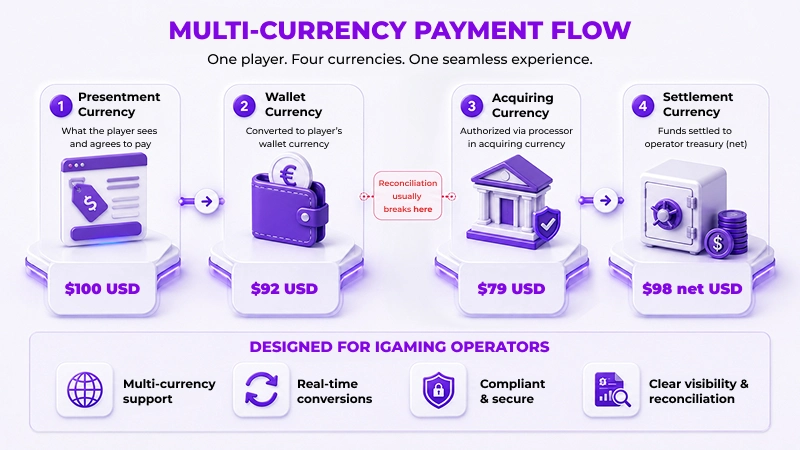
A deposit rarely stays in one denomination from card to ledger. The player sees one amount, the wallet credits another, the payment processor authorizes a third, and treasury receives a fourth. Many operators monitor only the first and last stages. The middle steps are where the payment process usually breaks.
Fixing the conversion point is a product decision, not an engineering preference. Converting at deposit gives the player a stable balance but leaves treasury exposed until settlement. Converting later protects treasury margin but allows the displayed balance to move. Both payment options can work, but only one policy should apply to each brand.
- Presentment currency — the amount displayed at the cashier, based on geo-IP, account preference, or license scope.
- Wallet denomination — the unit used for the stored balance and every bet, win, and bonus entry.
- Acquiring denomination — what the processor authorizes and captures, subject to BIN coverage and acquirer permissions.
- Settlement denomination — what reaches the operator’s bank account after spread and transaction fees.
Wallet Ledger Design, Precision, and Balance Integrity
Precision is one of the least visible sources of defects in gaming platforms. ISO 4217 assigns JPY zero minor units, USD and EUR two, and BHD three, while crypto ledgers may carry eight decimal places. Wallets that store balances as floating-point values accumulate errors across millions of rounds. Signed integers in minor units remove that class of defect.
Bonus liability turns payments in multiple currencies into a finance issue rather than a display issue. A wagering requirement set in EUR and played against a local balance must use the rate fixed when the bonus was granted. Recalculating the value in real time allows market movement to change the requirement without an explicit policy decision.
Rounding Rules That Need an Explicit Owner
- Apply round-half-even once per conversion and never repeat it when data is read.
- Maintain one residual account per pair to absorb sub-minor-unit remainders.
- Store the rate ID, timestamp, and source alongside every converted amount.
- Define reconciliation tolerance by pair instead of using one global threshold.
Payment Routing Across Corridors and iGaming Approval Rates
Routing is the highest-leverage control an operator has over deposit conversion. Issuers apply different risk policies to MCC 7995 than to other card payment traffic, and attempts made across borders clear less reliably than domestic ones. Sending a decline to a second acquirer can recover part of that loss, but only when the payment gateway returns a normalized decline reason from every provider.
Fraud tolerance has also tightened. Visa reduced VAMP merchant thresholds to 1.5% on April 1, 2026, combining reported payment fraud and disputes in one ratio, with a separate 20% enumeration threshold for card testing. Over-declining does not improve fraud prevention: rejecting legitimate traffic reduces the denominator while the numerator remains unchanged.
Operators often treat currency support as a marketing checkbox and routing as a finance problem. They are the same problem. Once a brand serves several corridors, approval rate, FX spread, and reconciliation effort move together. We advise clients to model all three before entering a new market, not after the first payout backlog appears.

Denis Kosinsky
Chief Product Officer at NuxGame
United States: State Perimeters, USD Flows, and Instant Rails
Eight states have legalized online casino play, seven of them live, while 38 states plus Washington, D.C. permit some form of sports betting. Each state is a separate perimeter with its own licensing, geolocation, and reporting requirements. Domestic gaming payments are USD-only, while exposure to other denominations remains at group treasury and supplier settlement.
Instant rails changed the cash-out calculation. The Federal Reserve increased the FedNow transaction limit from $1 million to $10 million in January 2026, with roughly 1,600 participating institutions and $853.4 billion moved during 2025. Fedwire completed its ISO 20022 migration on July 14, 2025, aligning US payment systems with other emerging real-time payment networks operating globally.
| Rail | Typical availability | Scope | Practical use in payment flows |
|---|---|---|---|
| FedNow / RTP | Seconds, 24/7/365 | USD only | Real-time payment for withdrawals to verified US bank accounts |
| ACH, same day | Same business day | USD only | Lower-cost bulk payouts with higher return risk |
| SEPA Instant | Under 10 seconds | EUR only | EU deposits and withdrawals |
| Credit cards under MCC 7995 | Authorization is immediate; capture is T+1 to T+3 | 150+ presentment currencies | Primary deposit rail with the highest decline exposure |
| Bank transfer | Same day to T+2 | Several denominations | High-value payout and treasury movement |
KYC, AML, and Threshold Monitoring Across Denominations
Threshold reporting in the iGaming sector is stated in a single denomination even when the business operates globally. US casinos with gross annual gaming revenue above $1 million file a CTR when currency transactions exceed $10,000 in one gaming day and a SAR at $5,000 where suspicion exists. CTRs are filed within 15 calendar days and retained for five years.
Player-fund requirements vary more than many integration plans assume. The UK Gambling Commission requires segregation and disclosure of the customer-funds protection rating, with a reminder every six months when funds are unprotected. Malta requires a platform token to convert back to fiat for withdrawal at the rate used when it was acquired.
| Jurisdiction or framework | Denomination-specific obligation | Data the platform must retain |
|---|---|---|
| FinCEN, 31 CFR 1021 | CTR above $10,000 in the defined daily period; SAR at $5,000 | Converted USD value, rate source, and aggregation window |
| UK regulator | Segregation and customer-funds rating disclosure | Per-currency balance and disclosure acknowledgement |
| Malta regulator | Token-to-fiat conversion at the original acquisition rate | Grant-time rate ID for each token issuance |
| PCI DSS v4.0.1 | Future-dated controls mandatory since March 31, 2025 | Script inventory, MFA logs, and authenticated scan evidence |
| EU Instant Payments Regulation | Verification of Payee before a credit transfer | Verification response stored against each disbursement |
Any operator processing payments by card should confirm that its environment meets the PCI DSS requirements that became mandatory in 2025. KYC, sanctions screening, and AML monitoring depend on the same normalized record. This is why normalization should sit upstream of the compliance layer rather than inside individual payment services.
FX Spread, Rate Locks, and Settlement Reconciliation
Rate handling is a contract issue disguised as a technical one. A quoted rate needs a time-to-live, usually 30 to 300 seconds at the cashier, after which the platform should re-quote rather than honor stale data. Seamless processing means conversion resolves server-side before authorization reaches the processor, so the payment experience does not include an unexpected prompt.
A timing gap remains even when deposits are instant. Capture on credit cards reaches settlement at T+1 to T+3 while the player already holds a credited balance, leaving the treasury exposed over weekends. Some operators net internally across pairs. Others hold working capital in stablecoins, although US Treasury and FinCEN had only issued proposals on payment-stablecoin rules by April 2026, with none finalized by July.
- Store the reference rate, spread, and effective rate as separate fields.
- Reconcile each pair daily because a blended report hides the corridor losing money.
- Alert on residual account growth, which is often the first sign of a rounding regression.
- Version FX solution providers as carefully as APIs because a source change affects historical comparability.
One Payment Gateway or Multiple Payment Providers Across iGaming Platforms?
The marginal value of every additional acquirer falls quickly. A second processor captures most recoverable volume. The third and fourth iGaming payment processors can add regional coverage and alternative payment methods, including the local payment methods that dominate a specific corridor and cannot be covered by traditional payment cards. Beyond four, payment operations, reconciliation, and dispute handling usually grow faster than approval rates.
Payment orchestration keeps that estate manageable. The NuxGame platform consolidates payment providers and payment solutions behind one configuration layer, while the Corefy partnership supports data-led routing and managed risk services. Operators can configure payment methods, availability, limits, and payment preferences from one dashboard instead of reconciling several payment platforms.
This approach also helps an iGaming business replace a legacy payment connection without redesigning the entire cashier. A consistent API, shared status model, and common reporting logic let teams add emerging payment methods while protecting the wallet and ledger from provider-specific behavior.
Technical Snapshot
| Area | Requirement | Verification checkpoint |
|---|---|---|
| Ledger precision | Integer minor units with the ISO 4217 exponent stored as metadata | No floating-point type in balance columns |
| FX capture | Rate ID, source, timestamp, and spread stored for every conversion | Any historical transaction can be replayed to the cent |
| Routing | Cascade rules, local acquiring by corridor, and retry caps | Decline reasons are available by acquirer |
| Card risk | VAMP ratio below 1.5% and enumeration below 20% | Ratio reported before month-end close |
| AML | Normalized aggregation before threshold logic | CTR and SAR triggers tested with non-USD data |
| Cash-out | Instant-rail eligibility checked before display | Failed attempts retry through another rail |
| Reporting | Per-denomination and consolidated back-office views | Both views reconcile to one base total |
| Cardholder data | PCI DSS v4.0.1 controls, including script integrity | Current AOC covers every in-scope component |
Where This Leaves Your iGaming Payment Roadmap
Operators that define policy early gain more control over the landscape in iGaming. Conversion point, rounding rule, rate storage, and routing hierarchy cost little at design time and much more to retrofit. Across the iGaming industry, payment methods now span cards, instant rails, bank transfer networks, and digital assets, and each one brings a different reconciliation obligation.
The practical test is whether finance can explain one player balance across several denominations without opening a spreadsheet. When it cannot, the payment stack is performing arithmetic that the platform should own. The gap widens with volume and weakens regulatory compliance, payment protection, and reporting as a brand enters the global iGaming market.
Map your corridors with NuxGame. The team reviews your market list, license scope, payment capabilities, and required payout methods, then demonstrates how an iGaming payment infrastructure can support local and global payment flows from one back office. Request a platform demo to see how the NuxGame solution for iGaming connects routing, wallet configuration, and reporting.