Русский
 Sweepstakes Scams in 2026: Fraud Vectors, Player Protection, and Platform Defense

Two very different problems share the word “scam” in this market, and only one of them is yours to fix. The advance-fee con aimed at consumers — a fake win, a fee, a prize that never lands — is not something an operator can stop. What it does is set the terms you operate under, because the deception that fleeces players is what tightens the scrutiny you now face from regulators, banks, and payment partners. The second problem lives inside the platform: the payment fraud, stolen cards, fake accounts, and bonus farming that legitimate operators absorb every day. This article covers why the first one lands on you, and the fraud, compliance, and infrastructure controls that answer the second.
The sweepstakes casino software from NuxGame answers that pressure with built-in identity verification, transaction monitoring, and dual-balance wallet logic, so operators separate legitimate players from bad actors before any payout leaves the ledger.
Why banks and regulators can’t tell you apart from the con
The con itself is crude. A prize notification arrives for a contest the target never entered, a fee is demanded as taxes, shipping, or processing, and the prize never lands. Crude is not the same as marginal: consumers reported $145 million in lottery and sweepstakes losses in 2024, up more than $18 million year over year. The test that separates a real promotion from a fake one is simple, and Federal Trade Commission guidance states it plainly: entry is free and winning is decided by chance. Every compliant sweepstakes operator already clears that bar. The difficulty is that the people setting your risk profile are not the ones applying the test.
Consumer schemes borrow the language of real promotions, so honest platforms inherit the suspicion. Banks, regulators, and players struggle to separate a compliant sweepstakes casino from a prize scam. That confusion accelerated enforcement across the United States, and the model moved from industry favorite to legislative target within twelve months.
By recent industry revenue estimates, US market sales approached $10 billion in 2024 before the crackdown intensified. The 2025 bans in California, New York, Connecticut, Montana, and New Jersey grew into a wider prohibition wave through 2026, and attorneys general issued hundreds of cease-and-desist letters. New laws now name payment processors, geolocation vendors, and affiliates directly. For operators, weak fraud prevention stopped being a support cost and became a licensing risk.
Fraud vectors on a live platform
On a live platform, abuse looks nothing like a mailed con. Attackers open fake accounts to farm free Sweep Coins, then redeem the promotional value. Others fund coin packages with stolen credit cards and file chargebacks after they cash out. Both patterns drain reward pools meant for legitimate players.
Multi-accounting concentrates during promotional surges, when a weekend campaign pulls duplicate signups across several states. Payment fraud, bonus abuse, and identity theft push the effective chargeback rate up and strain the redemption ledger. Card networks flag merchants once chargebacks pass roughly 0.9% of transactions, so unchecked online gambling abuse quickly threatens payment acceptance.
- Fake accounts and multi-accounting that farm free-entry promotional sweepstakes value.
- Stolen cards funding coin purchases, later disputed as a chargeback.
- Bonus farming that quietly drains prize winnings intended for real players.
- Synthetic identities built to launder money through redemptions.
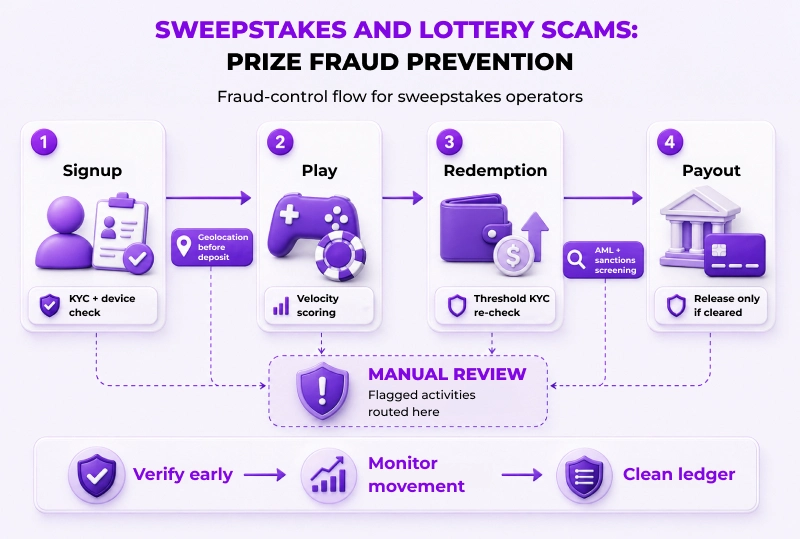
Fraud rarely knocks on the front door — it signs up, plays along, and cashes out. The operators who stay ahead treat every signup and redemption as a question, not a formality. Verify early, watch the money move, and keep the ledger honest. Do that, and the fraudster meets friction while the real player never feels a thing. Denis Kosinsky Chief Product Officer, NuxGame
KYC, AML, and transaction monitoring
Prevention begins at the identity layer, not at payout. The platform runs KYC checks at signup and again at redemption above a set threshold. Document verification, device fingerprinting, and geolocation confirm the player and their permitted state. Automated document checks typically clear a genuine player in under two minutes, while flagged cases route to manual review.
Screening runs against sanctions and politically exposed person lists for AML coverage, and velocity rules watch deposit and redemption behavior in real time. This mirrors the kind of customer due diligence that regulators such as the UK Gambling Commission demand of licensed operators. Automated bot mitigation filters out scripted signups before they reach the wallet. NuxGame’s dual-balance ledger reconciles Fun Coins and Sweep Coins, so every grant, wager and payout is traceable.
Payment data protection under PCI DSS
All online casinos that process card data are subject to PCI DSS. The only active version since 2025 is version 4.0.1. All future dated requirements became mandatory with no grace period on March 31, 2025, the PCI Security Standards Council confirmed. That reshaped how operators secure payment pages and control access to cardholder data.
Requirements 6.4.3 and 11.6.1 force script inventories and tamper monitoring to stop e-skimming during checkout. Multi-factor authentication now covers all access to the cardholder data environment. Non-compliance risks fines, higher processing costs, and loss of card acceptance, which for an operator means no path to sell coin packages.
- Inventory and authorize every script on payment pages (Requirement 6.4.3).
- Monitor payment pages for unauthorized changes (Requirement 11.6.1).
- Enforce multi-factor authentication for all cardholder-data-environment access.
- Patch critical vulnerabilities within 30 days of release.
Technical Snapshot
Control layer
Implementation
Checkpoint
Identity
KYC at signup and above redemption threshold; document and device checks
Genuine players auto-cleared in ~2 minutes
Location
Geolocation enforcing state eligibility
Excluded states blocked before deposit
Payments
PCI DSS v4.0.1, tokenization, payment-page script monitoring
Chargebacks held under the 0.9% network threshold
Monitoring
Velocity rules, sanctions and PEP screening
Real-time scoring on deposit and redemption
Wallet
Dual-balance ledger (Fun Coins / Sweep Coins)
Full trail from coin grant to redemption
Conclusion
Sweepstakes scams will keep exploiting the promise of a prize, and the fallout lands on every operator in the category. The practical response is architectural: verify identity early, monitor money movement continuously, and keep a clean ledger from coin grant to payout. Operators that treat prevention as core infrastructure, not an afterthought, are the ones regulators and payment partners keep trusting. Talk to the NuxGame team to map these controls onto your own launch or migration plan.
If you run a product in this vertical, the fastest way to reduce exposure is to see the controls in action. Book a platform walkthrough with NuxGame to review dual-balance wallet logic, KYC and geolocation configuration, and the payment and risk stack built for US market conditions.