Русский
 iGaming Software Cost in 2026: The Vendor Quote Is the Smallest Number You’ll Pay

iGaming software cost in 2026 splits into three layers: platform delivery, regulatory certification, and recurring revenue share. Vendors quote the first. Regulators and the number of third-party systems set the other two. A single New Jersey internet gaming permit carries a $400,000 issuance fee plus a separate $250,000 statutory contribution before any code ships.
Operators need this breakdown because quotes are rarely comparable. One supplier prices a software package; another prices a license-ready operation. Misreading that gap distorts the first-year plan by six figures. NuxGame works on the delivery layer through turnkey iGaming solutions that bundle platform, aggregation, payments, and configuration under a single contract.
Regulator fees and lab testing sit outside supplier quotes; each US state prices entry differently. Revenue share, not setup cost, dominates the five-year total on any vendor-hosted iGaming platform. Ten direct studio integrations cost more to run than one aggregated third-party connection. Wallet model choice fixes reconciliation expense for the lifetime of the platform. Percentage pricing compounds against a US market whose gross gaming revenue is still growing at double digits.
Key Takeaways
Where iGaming Software Cost Actually Accumulates
Proposals describe a product. Most iGaming development budgets break on everything that product depends on. Model an iGaming launch by cost layers, each with a separate owner and renewal cycle. Of the five, two are fixed by regulators; two more scale with player volume, not with the contract.
- Delivery — platform license, setup, front-end build, configuration
- Content — aggregation fees plus a studio share on each title
- Compliance — license fees, lab testing, audits, legal documentation
- Infrastructure — hosting, CDN, DDoS mitigation, observability, disaster recovery
- Operations — support, payments, fraud review, reporting, change requests
Software line items are also inflating independently of the gaming industry. The Gartner worldwide IT spending forecast puts 2026 software spend at $1.44 trillion, growing 15.1% year over year. Multi-year contracts written at 2024 rates rarely hold their terms. Models assuming flat supplier pricing across three years understate the overall cost.
Pricing Models: Turnkey, Vendor-Licensed, and Custom Development
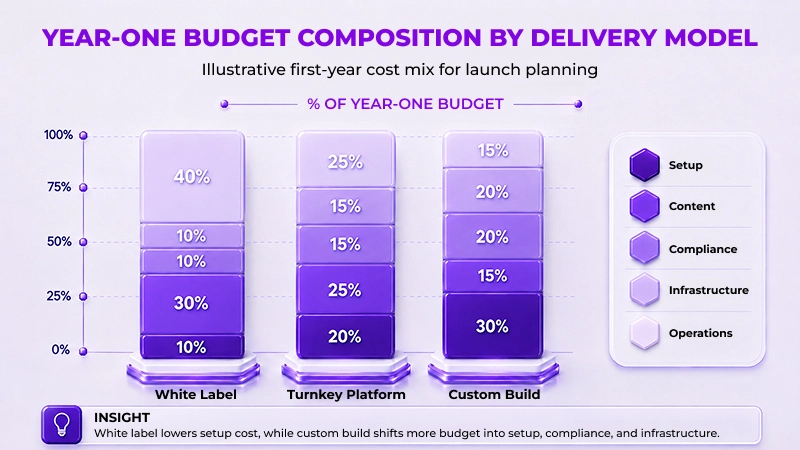
Three commercial structures dominate, each spreading the same total across different years. Turnkey pushes spend forward into setup and shortens time to first bet. Licensing a vendor’s brand and stack lowers entry cost while raising the recurring percentage. Building in-house removes that percentage and replaces it with payroll, hiring risk, and a longer certification path.
Delivery model
Upfront
Recurring structure
Time to launch
Roadmap control
Best fit
Turnkey
Moderate setup fee
Platform fee + revenue share
8–16 weeks
Configuration level
One or two jurisdictions
White-label
Low
Higher percentage under a vendor license
4–10 weeks
Limited
Best for startups testing demand
API / aggregation only
Low to moderate
Per-connection fee + content share
4–8 weeks
High on front end
Teams with an existing platform
Custom build
High engineering spend
Payroll, cloud, certification
12–24 months
Full control
Multi-state groups, in-house teams
What matters is the five-year curve, not the invoice on signature. A white-label solution at a higher percentage overtakes a turnkey deal once monthly GGR crosses the contract threshold. For most operators the main expense is not the build; it is the percentage compounding against growth. Adding sports betting to a casino platform triggers a second integration and a second certification, neither of which a development company includes in a fixed build price.
US Licensing, Testing, and the Fees Suppliers Never Quote
Eight states have legalized real-money iGaming, and seven were live entering 2026. Each state sets its own price to enter the market. The American Gaming Association State of the States report records $10.73 billion in US iGaming revenue for 2025, up 27.6%. Pennsylvania and New Jersey are the leading iGaming markets, and in both, online revenue now exceeds land-based casino win.
Jurisdiction
Operator entry cost
Renewal
Tax on iGaming GGR
New Jersey
$400,000 permit + $250,000 responsible gaming fee
$250,000 + $250,000 annually
19.75%
Pennsylvania
$4 million per vertical certificate, $10 million for all three
$250,000 every five years
54% slots / 16% tables
Michigan
$50,000 application + $100,000 license
$50,000 annually
20–28% graduated
Maine
Tribal-exclusive framework enacted; rules pending
Not yet set
Not yet live
Fee structure tells you what a regulator is charging for. The New Jersey published fee schedule prices continuous supervision; Pennsylvania interactive gaming certificates price scarcity through capped authorizations. Testing sits on top. Labs assess platform and RNG behavior against the interactive gaming systems standard written into several US rulebooks, and the UK Gambling Commission applies comparable remote technical standards. Certification recurs per jurisdiction and per material change.
Integration Load: Why Connection Count Drives the Bill
Every connection carries four costs: build hours, certification scope, monitoring, and counterparty terms. A direct link to one game provider consumes engineering time that a shared aggregation layer amortizes across hundreds of brands. Content from different developers arrives with mismatched session models, bonus hooks, and reporting formats. The expense sits in normalization.
- Content — studios ranging from large catalogs such as Microgaming to niche live casino suppliers
- Payments — card acquiring, local rails, crypto processors, payout routing
- Identity — verification provider, sanctions screening, adverse media checks
- Player data — CRM, bonus engine, affiliate and agent systems
- Reporting — regulator feeds, tax filings, data warehouse
Game aggregators exist to collapse that count. One certified connection replaces dozens of bilateral contracts with separate uptime and settlement terms. The NuxGame content aggregation layer exposes more than 17,500 titles from over 140 studios through a single integration point, configured from one back-office. Creating games in-house is a different business: game development studios carry their own certification burden.
Operators rarely overspend on the platform itself. They overspend on the connections around it, and on the second market nobody planned for. Price the integration map before the license application, not after it. A launch budget that covers only the software gets revised twice before the first player deposits. Denis Kosinsky Chief Product Officer at NuxGame
Wallet Architecture, Latency, and Session Continuity
Wallet design carries the longest cost tail of any early decision. Under a single-wallet model the operator holds one balance, and each round calls the wallet API to debit and credit it live. Under a transfer-wallet model, funds move into a provider sub-wallet before play. The first cuts player friction; the second cuts exposure to round-trip latency between backend systems.
- Debit and credit round trip under 200 ms at the 95th percentile
- Idempotency keys on every transaction, so retries never double-debit
- Round-close reconciliation windows agreed per studio and monitored daily
- Session recovery after disconnect, required under most technical standards
- Signed event logs retained per jurisdiction, commonly five to seven years
Latency budgets convert directly into hosting spend. Serving US players from one region adds transit time that no code change recovers, pushing operators toward multi-AZ deployments. AWS sets out the trade-off in its reliability pillar guidance, where the availability target drives redundancy cost. A gaming platform that is genuinely scalable — auto-scaling groups, connection pooling, queue-backed settlement — costs more at idle and less at peak.
KYC, AML, and Payment Cost per Verified Player
Identity and payment costs scale with acquisition, not with the platform contract itself. Each verification carries a per-check price, and you are billed for failed checks too. Manual review queues add labor that no supplier quote mentions. Transaction monitoring adds a second per-event charge plus a staffing requirement that regulators inspect directly during audits.
- Per-check identity verification, repeated at deposit and withdrawal thresholds
- Sanctions, PEP, and adverse media screening, priced per record
- Card scheme fees, acquirer margin, chargeback handling, and representment
- Cardholder data scope under PCI DSS, with annual assessment effort
- Data protection artifacts: privacy policy, cookie policy, retention schedules
Card scope is where architecture and budget meet. The 51 future-dated requirements published by the PCI Security Standards Council became mandatory on March 31, 2025, so every 2026 assessment tests them in full. Tokenizing card data at the acquirer keeps most systems out of scope. The NuxGame compliance and identity module runs player management checks, risk scoring, and case handling inside the same platform.
Ongoing Costs After Launch
Run-rate is where most models understate the total. Platform fees continue, content refreshes monthly, and each regulatory change consumes engineering time budgeted for product work. Tax policy moves as well: New Jersey lifted its online gaming rate to 19.75% under P.L. 2025, c.66, repricing every percentage-based model written before it.
- Cloud and CDN, scaling with concurrent sessions
- DDoS mitigation and WAF, priced on clean traffic volume
- 24/7 operations, payment reconciliation, and player support
- Content licensing and new title onboarding
- Annual penetration testing, security audit, and lab retesting
Defense spend is not discretionary in this vertical. The Cloudflare quarterly DDoS report counted 47.1 million attacks across 2025, more than double the prior year, averaging 5,376 mitigations an hour. Gambling and casinos ranked third among targeted industries in Q4. Most attacks ran under ten minutes, which rules out human-led response.
How to Evaluate iGaming Software Vendors on Comparable Terms
Quotes become comparable only after normalization. Ask every supplier to price identical scope: verticals, jurisdictions, expected monthly GGR, and the exact list of third-party systems. Separate essential features from advanced features before comparing any number. Then score the key factors that determine switching cost.
- Exit terms: data export format, player balance migration, notice period
- Certification ownership and reuse across jurisdictions
- SLA definitions with credits tied to measured uptime
- Change-request pricing and the queue position it buys
- Supplier licensing status in every target state
Supplier licensing is a hard gate, not paperwork. Under the Michigan administrative rules, an internet gaming supplier pays $5,000 initially and $2,500 each year, and a B2B partner without that license blocks the launch. There is no best iGaming software in the abstract; fit depends on vertical mix, capital structure, and the iGaming experience already on the team. Score the features offered against the markets you actually plan to enter.
Technical Snapshot: Cost Drivers and Compliance Checkpoints
Layer
Decision to specify
Measurable indicator
Compliance checkpoint
Wallet
Single-wallet vs transfer
p95 debit latency under 200 ms
Transaction log integrity
Content
Aggregation vs direct studio links
Days to onboard a new studio
Per-jurisdiction game approval
Payments
Routing, retry, and cascade logic
Deposit approval rate
PCI DSS v4.0.1 assessment
Identity
Automated vs manual review split
Median KYC decision time
Source-of-funds thresholds
Infrastructure
Multi-AZ, CDN, WAF posture
Concurrent sessions at peak
Data residency and retention
Reporting
Regulator feed automation
Reconciliation break rate
Monthly regulatory filings
Each row is a line the operator either owns or outsources, and that split moves the overall iGaming software budget more than headline pricing. Set these indicators as contractual thresholds during procurement. Where a supplier declines to commit to a measurable figure, treat the gap as unpriced risk.
Deciding Where the Money Should Sit
The question is not which supplier is cheapest. It is which risk you would rather carry: capital and hiring exposure on a custom build, or margin under a percentage deal. A startup entering one state on a fixed date rarely justifies developing iGaming software from scratch. Groups running four or more jurisdictions with in-house engineering often do.
Model iGaming software cost as a five-year curve, stress it against a 20% swing in GGR, then re-run it with one extra jurisdiction. That exercise reveals more than any feature comparison, because the cost of iGaming entry is set by regulatory surface area rather than by feature count.
If you are scoping a US or multi-market launch, the NuxGame team can map your integration list, jurisdictional requirements, and run-rate against a delivery model. Talk to the team for a scoped breakdown covering casino, sportsbook, payments, and licensing support — numbers built for a board paper rather than a brochure.