Русский
 2026 iGaming Industry in Malta: MGA Authorization, System Review, and Technical Readiness

The iGaming industry in Malta in 2026 is less about quick incorporation and more about online gaming platform evidence. A launch route requires correct license scope, GGR-based compliance contribution logic, System Review readiness, financial-crime controls, player-fund segregation, and regulatory reporting. The 2026 oversight priorities focus on evidence-led supervision, external audits, player protection, and operational resilience.
Key Takeaways
Why Malta is So Attractive for the iGaming Industry in 2026
Why Malta is so attractive for the iGaming sector comes down to regulatory concentration, not location alone. For launch teams, Malta reduces coordination friction between legal, compliance, payment, product, and infrastructure specialists during preparation.
Key factors include:
- EU member state status with a recognized regulatory framework.
- English-language administration and experienced licensing advisors.
- Access to legal and compliance firms focused on iGaming.
- Payment, testing, and financial services specialists in one market.
- SiGMA, gaming awards, conferences, and other events that connect industry stakeholders.
- Recruitment access across compliance, product, support, and platform operations.
The latest interim reporting shows €714.4 million in gaming GVA for H1 2025, equal to 6.5% of total GVA. It also reported 304 companies in Malta holding 312 authorizations at the end of June 2025. These figures show why Malta’s iGaming industry remains a serious European gaming base rather than a registration shortcut.
License Scope: From B2C Operations to B2B Critical Gaming Supply
A gaming service license applies when a B2C business offers gaming services directly to players. A critical supply authorization covers B2B software or material systems that generate, capture, control, or process essential regulatory records. This distinction changes liability, documentation depth, and the evidence expected during the application process.
| Authorization area | Applies to | Technical evidence needed |
|---|---|---|
| Player-facing authorization | iGaming operators offering online casinos, poker, lottery, bingo, or online sports betting | Player account management, wallet logs, KYC flows, responsible gaming tools, and payment records |
| Critical supply model | Platform providers, game systems, back-office tools, and control software | System architecture, API documentation, event logs, supplier controls, and reporting logic |
| Mixed operating model | Brands using owned systems and external vendors | Clear responsibility map across brand, platform, provider, and compliance teams |
License applications with the Malta Gaming Authority should begin with the System Documentation Checklist, not the form itself. The same iGaming licensing process tests financial viability, key persons, source-of-funds evidence, policies, and system implementation before approval. For NuxGame, this is where platform architecture matters: the platform reduces separate vendor connections across aggregation, payments, player accounts, bonus tools, and reporting configuration.
Preparing for the System Review: Technical Controls for 2026
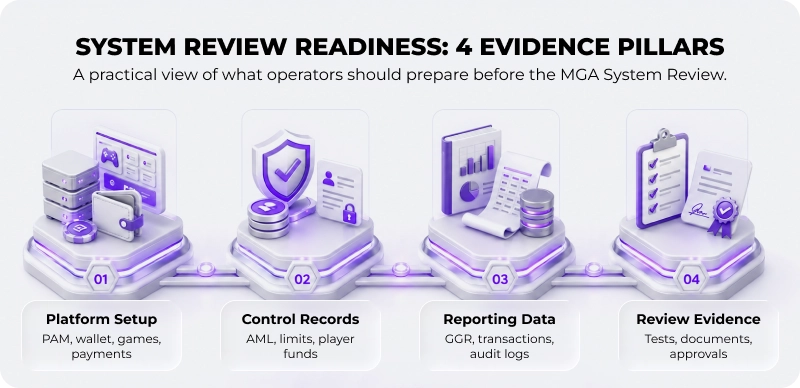
The MGA System Review is where many authorization plans become technical projects. The authority reviews whether the implemented gaming and control system reflects the submitted documentation. Under the official process, an applicant receives 60 days to implement the approved system on a technical environment before triggering the external System Audit.
After approval of an audit service provider, System Audits and System Reviews have a 60-day completion window, while Compliance Audits have 90 days. This creates a hard project-management constraint. Engineering, product, compliance, and finance teams need one evidence calendar covering test cases, release records, payment flows, monitoring controls, and reporting outputs.
For operators, Malta preparation is not only a licensing exercise; it is a product discipline. The platform must show how money, identity, limits, games, and reports move together. When that evidence is ready early, the review feels less like a fire drill and more like a scheduled inspection, with fewer surprises and better business control

Denis Kosinsky
Chief Product Officer at NuxGame
Automating Regulatory Reporting via API-Integrated PAM
A Player Account Management layer should not be treated as an account screen. In this regulatory context, PAM connects identity status, wallet balance, game rounds, limits, exclusions, bonuses, and payment activity. API-integrated PAM produces regulatory data without rebuilding reports manually from PSP exports, game provider logs, and CRM notes.
For iGaming Malta readiness, the key control is traceability. A product manager should confirm that each wallet movement links to a player, brand, game, payment route, bonus rule, timestamp, and status. That structure helps the team answer audit questions without depending on screenshots or ad hoc SQL requests.
Operator Cost Matrix: Application vs Compliance Contributions
The GGR-based compliance contribution is different from gaming tax. Compliance contribution is calculated monthly on gaming revenue and paid before the twentieth day of the following month. The 5% Malta-player charge applies to gaming revenue from players physically present in Malta. This distinction matters for cash-flow forecasting and wallet-ledger design.
| Cost or control item | Published rule or planning point | Platform implication |
|---|---|---|
| Application fee | €5,000 one-time non-refundable fee | Budget before submission, not after approval |
| B2C annual fee | Generally €25,000 | Add to launch-year fixed operating cost |
| B2B annual fee | €25,000–€35,000 by revenue band | Model revenue growth before scaling |
| Type 1 contribution | 1.25% on first €3 million, then decreasing bands | Requires accurate monthly GGR extraction |
| Type 2 contribution | 4% on first €3 million, then decreasing bands | Needs bet-level and settlement-level reporting |
| Malta-player tax charge | 5% on Malta-player gaming revenue | Requires reliable player-location classification |
| System Audit window | 60 days after audit provider approval | Requires pre-tested release and evidence pack |
| Compliance Audit window | 90 days after approval | Requires policy, finance, monitoring, and IT evidence |
Corporate tax planning should be handled separately from platform costing. The corporate tax position depends on company structure, shareholder refunds, substance, distribution timing, and advice from tax specialists. For a gaming business, the platform impact is indirect but important: finance exports must align revenue, player funds, contribution logic, and audit evidence.
Compliance Monitoring: AML, Player Funds, and ESG Reporting
AML requirements in Malta are risk-based and operational. The authority acts as an FIAU agent for monitoring compliance with the PMLA, PMLFTR, and legally binding Implementing Procedures. A licensed operation needs business risk assessment, CDD workflows, MLRO governance, suspicious-activity escalation, and player-risk segmentation built into daily operations.
| Compliance area | What must be controlled | Platform impact |
|---|---|---|
| Financial-crime monitoring | Customer risk, beneficial ownership, payment behavior, crypto exposure, and STR evidence | Risk scoring, case logs, KYC status updates, and transaction monitoring should connect to PAM and wallet data |
| Player funds | Segregated and separately identifiable player balances | PSP setup, ledger design, refund handling, chargebacks, and reconciliation need clear reporting logic |
| ESG reporting | Voluntary Tier 1 or Tier 2 disclosure readiness with annual reporting | Governance, player protection, workforce, and operational data need assigned owners and documented evidence |
The Sixth Anti-Money Laundering Directive and the EU anti-money laundering package raise the pressure on 2026 preparation, even where full timelines extend beyond the year. ESG reporting should be treated as governance evidence rather than a marketing exercise. The ESG reporting requirements are described as voluntary, with an annual cycle and 31 August submission deadline.
Infrastructure Mapping: Server Mirroring, ISO 27001, and PCI DSS
Remote gaming infrastructure in Malta must be documented, inspectable, and resilient. Technical files should identify gaming servers, control systems, internal IP ranges, virtual machines, hosting locations, cloud providers, and replication procedures. Where primary servers are not in Malta, live or real-time mirroring of essential regulatory data may be required.
Server mirroring is not only about disaster recovery. It allows regulatory data to remain accessible when the production environment sits outside Malta. ISO 27001 mapping converts information-security controls into audit language, while PCI DSS defines how cardholder data should be protected when payments touch the platform environment.
| Control area | Audit-facing evidence | Operational metric to track |
|---|---|---|
| Regulatory data access | Mirrored records, access logs, retention rules, and recovery procedure | Recovery time, replication delay, failed sync events |
| Information security | Access matrix, incident register, vendor-risk file, and change approvals | Incident MTTR, privileged-access reviews, unresolved vulnerabilities |
| Payment security | Tokenization setup, PSP contracts, PCI scope map, and refund workflow | Payment approval rate, chargeback rate, failed withdrawal rate |
| Mobile gaming stability | Device logs, session records, API monitoring, and release history | API error rate, wallet synchronization delay, concurrent sessions |
Mobile gaming adds more telemetry, device-risk signals, and session-continuity checks. The practical goal is not a generic uptime claim. Technical teams should monitor payment approval rate, KYC approval time, chargeback rate, incident MTTR, wallet synchronization delay, and API error rate during peak traffic windows.
Workforce, Vendor Density, and the Real Malta Network
The Maltese iGaming market has depth across product, payments, compliance, support, and platform operations. Workforce planning still needs discipline. Recruitment can become expensive when several gaming companies need the same MLRO, payment analyst, compliance officer, or technical product manager at the same time.
Salary packages should be included in the operating model before selecting the authorization route. Continuing professional development also matters because Key Function roles require competence, access, and regulatory scrutiny. A role responsible for compliance monitoring cannot be treated as a junior operations task hidden inside a growth team.
Maltese iGaming companies use local networks to reduce vendor search time, but market density does not remove due diligence. Game providers, PSPs, KYC vendors, fraud tools, and CRM systems still need contract review and technical testing. A growing iGaming team should document onboarding, SLA ownership, data processing, and exit procedures.
A leading iGaming location earns that label only when the business converts proximity into control. The strongest iGaming setup is the one where platform partners, the regulator, and internal teams share the same evidence model. Malta provides the hub, but governance decides whether launch risk falls or simply moves.
US-Facing Strategy: Malta as Base, Not Passport
For US-facing founders, Malta works best as an international operating base. It does not replace state-level approvals in the United States. The American Gaming Association lists legal sportsbook operators authorized by state authorities, which shows that US market access remains jurisdiction-specific and tied to local approval.
A Malta structure can support non-US markets, corporate governance, product buildout, sportsbook configuration, and third-party control. It can also support technical documentation for future expansion. However, online gambling and sports operations targeting US players require state-by-state legal analysis, geofencing, payment restrictions, and player-protection rules.
This is where modular platform design becomes valuable. NuxGame supports market-specific configuration across content, payments, bonuses, KYC flows, and back-office reporting. That helps a brand test a Malta-first model while preparing separate compliance layers for European countries, the Isle of Man, or future state-regulated US opportunities.
Technical Snapshot
| Technical area | 2026 readiness requirement | Evidence expected during review |
|---|---|---|
| Authorization scope | Match product model to player-facing or critical supply authorization | Product map, license type, game verticals, supplier list |
| PAM and wallet | Link players, wallets, limits, bonuses, payments, and game rounds | Transaction ledger, reconciliation reports, event timestamps |
| System Review | Prove implemented system matches submitted documentation | Staged environment, test evidence, release records |
| Server Mirroring | Keep essential regulatory data accessible where required | Replication design, data-location map, access procedure |
| CDD controls | Apply risk-based checks, monitoring, MLRO escalation, and STR workflows | Risk matrix, customer acceptance policy, alerts, case notes |
| Player funds | Keep player funds segregated and separately identifiable | PSP statements, ledger exports, refund and chargeback process |
| ESG readiness | Prepare voluntary Tier 1 or Tier 2 disclosures | ESG data owner, annual reporting file, 31 August deadline |
| Security controls | Map ISO 27001 and PCI DSS obligations to systems | Access controls, vendor scope, encryption, incident records |
| Product changes | Control new game, provider, channel, and market additions | Prior-approval tracker, release notes, vendor certificates |
Before submitting a Malta license application, map the platform evidence first. NuxGame can help review PAM, wallet, payment routing, game aggregation, KYC flows, reporting exports, and technical documentation against the expected System Review path.
Bottom Line
The iGaming Industry in Malta still offers a structured route into regulated operations in 2026. The stronger advantage comes after incorporation, when authorization scope, system evidence, cost modeling, player-fund controls, AML monitoring, and third-party governance work together.
Malta is not a shortcut; it is a jurisdiction where preparation is visible. Businesses that build the platform, reporting layer, and audit trail before submission gain a cleaner path through review and launch. For NuxGame clients, the practical next step is a technical readiness check before budget, timelines, and vendor contracts are locked.