Русский
 Types of Gaming Licenses in 2026: Fees, Timelines, and Technical Constraints by Jurisdiction

The different types of gaming licenses available in 2026 fall into two families. National authorizations grant access to one supervised market. International authorizations permit remote operation into territories that do not license locally. Published annual fees across the eight frameworks below run from €17,828 in Anjouan to €47,450 in Curacao. Filing to grant takes anywhere from four weeks to twelve months.
That spread does not measure quality. It measures the condition each licensing authority attaches to the grant, and conditions land on engineering rather than finance. Server location, vertical scope, share capital and player-fund design are fixed at filing, and rebuilding a wallet afterwards costs more than the fee itself. NuxGame maps platform configuration, aggregation and reporting to the filed operating model through a turnkey casino deployment, so gaming operators launch the system they described.
Key Takeaways
-
Three of the eight frameworks charge duty on revenue; the other five bill a flat annual fee.
-
Anjouan and Tobique clear in four to eight weeks, against six to twelve months for Malta.
-
Maltese gaming tax changes on October 1, 2026, but only for revenue from locally resident players.
-
Hosting location is a license condition rather than a launch decision in three of the eight frameworks.
-
No offshore gaming license grants US market access, because every state licenses separately.
The 2026 Fee and Timeline Matrix
Headline fees are a poor way to rank licensing options. A €17,828 permission with narrow acquirer appetite costs more in practice than a mid-priced grant with working payment rails. The real gaming license cost sits outside the schedule, in hosting, substance and certification obligations. Sub-licensing under a master license no longer exists in Curacao, so every figure below reflects a direct grant.
Two structural patterns sit inside the data. Cost-per-license regimes charge for the authorization and leave gaming revenue alone. Cost-per-market regimes take a share of local earnings instead. Frameworks with low gaming duty therefore reward scale, while revenue-linked markets impose higher costs as yield rises. The table pairs each published fee with the condition an operator cannot engineer away.
| Jurisdiction | Regulatory body | Application | Annual fee | Duty on revenue | Timeline | Binding constraint |
|---|---|---|---|---|---|---|
| Curacao | CGA | €4,592 | €47,450 (B2C) | None | 3–6 months | Tier-IV server on the island; resident managing director |
| Malta | MGA | €5,000 | €25,000 + €15,000–€375,000 contribution (Type 1) | 15% Type 1, 10% Types 2–4, locally resident players only | 6–12 months | Verticals approved individually; €100,000 share capital |
| Isle of Man | GSC | £5,250 | £36,750 (full) | 1.5% to £20m yield, 0.5% to £40m, 0.1% above | 10–12 weeks | Registration and gameplay servers on-island; two resident directors |
| Gibraltar | Gambling Division | — | £50,000–£200,000 per vertical | Banded by gross gaming yield | 4–6 months | A separate grant for every vertical |
| Kahnawake | KGC | US$35,000 + US$5,000 per key person | US$20,000 | None published | 4–8 weeks, then a six-month supervised term | Commission-directed equipment at the co-location facility |
| Tobique | TGC | €2,500 review + €33,500 | €7,000 supervisory package | None published | 2–8 weeks after pre-approval | Encrypted off-site backup every two weeks |
| Anjouan | AOFA | €17,828 | €17,828 | None published | 4–8 weeks | Mandatory independent dispute resolution provider |
| Costa Rica | None | Municipal business license | ₡26.3m–₡52.2m by headcount (about US$58,000–US$115,000) | Not applicable | 4–8 weeks | No license to show acquirers; AML registration with the financial supervisor |
Cost Per License Versus Cost Per Market
The Curacao Gaming Authority charges the same amount whether annual revenue is €1 million or €50 million. Great Britain sits at the opposite end. It pairs strict regulations with duty far above anything in the table above, raising Remote Gaming Duty from 21% to 40% in April 2026. License charges climb a further 25% in October under the confirmed government response.
Maltese rates change on the same date, and the detail matters more than the headline. Legal Notice 84 of 2026 replaces the flat 5% rate with 15% on Type 1 and 10% on Types 2 to 4. Under the reformed gaming tax framework, liability turns on player residence rather than physical presence. Operators with no local player base therefore see limited direct impact.
- Cost per license: a fixed annual charge with no revenue share, cost-effective for operators with growing volume.
- Cost per market: Great Britain, Gibraltar and Brazil scale fees and duty with local yield.
- Hybrid: a fixed annual fee plus a compliance contribution banded by revenue.
No framework here is genuinely tax-free once corporate residence and target-market duty are counted.
Choose a Jurisdiction by Architecture, Not by Fee
Every framework above will take your money. The harder question is which condition the operating model cannot absorb. Five constraints account for most abandoned files, and each lands on a different team. Legal owns two of them, engineering and finance own two more, and financial institutions apply the fifth.
Constraints also compound. An operator wanting crypto deposits, a single global cluster and multi-vertical launch has already excluded the Isle of Man gaming license on hosting grounds before anyone opens a fee schedule. Matching the grant to business needs beats matching it to budget, because a license confers the right to operate rather than the right to be banked. Player trust follows the same logic, tracking the supervisor’s standing rather than the fee paid.
- Server location — a mandated in-territory tier splits the deployment and rules out a single global cluster.
- Vertical scope — Malta licenses specifically by game type; offshore grants usually cover casino, poker and sports betting together.
- Local substance — resident directors, office space and payroll commitments that recur annually.
- Share capital — €100,000 for Type 1 and Type 2 authorizations, capped cumulatively at €240,000.
- Acquirer appetite — regulatory credibility converts into payment acceptance, and no fee schedule lists it.
Operators tend to choose on price, then discover the constraint during technical review. We ask the reverse question first: what can your architecture not change? Hosting tier, vertical roadmap and wallet design usually eliminate half the shortlist before cost enters the licensing process. Settling that order saves a rebuild, and rebuilds cost more than any application fee.

Denis Kosinsky
Chief Product Officer at NuxGame
Tobique and Anjouan: The 2026 Budget-Tier Alternatives
The Tobique Gaming Act 2023 created a one-year igaming license administered by the Tobique Gaming Commission. Published entry costs are €2,500 for preliminary review and €33,500 on full application, plus a €7,000 annual supervisory package covering five URLs. No physical server sits inside the territory. Critical transaction records instead need encrypted off-site backup every two weeks.
Anjouan runs a comparable cost model with a different compliance shape. Issuance and renewal are both €17,828 under the Computer Gaming Licensing Act 007 of 2005, with €500 per additional domain. More than 1,650 licenses had been issued by July 14, 2026, close to 1,500 of them active. That population means testing laboratories and payment providers already understand the legal framework, which shortens onboarding for online gaming brands.
Both deliver lower costs than EU-supervised alternatives without matching their recognition, which suits a startup testing demand before committing capital. Speed to market is the competitive edge on offer here, not credibility. The Anjouan gambling license offers a recognition route for B2B suppliers already approved elsewhere, shortening integration for igaming operators.
- Tobique requires geo-blocking of the United States, United Kingdom, New Brunswick and FATF-sanctioned countries.
- Player liabilities stay 100% covered, with seven days to restore a deficit and evidence it.
- A 30-day internal complaints window precedes escalation to an approved dispute resolution provider.
Technical Compliance: What the Platform Must Prove Before Approval
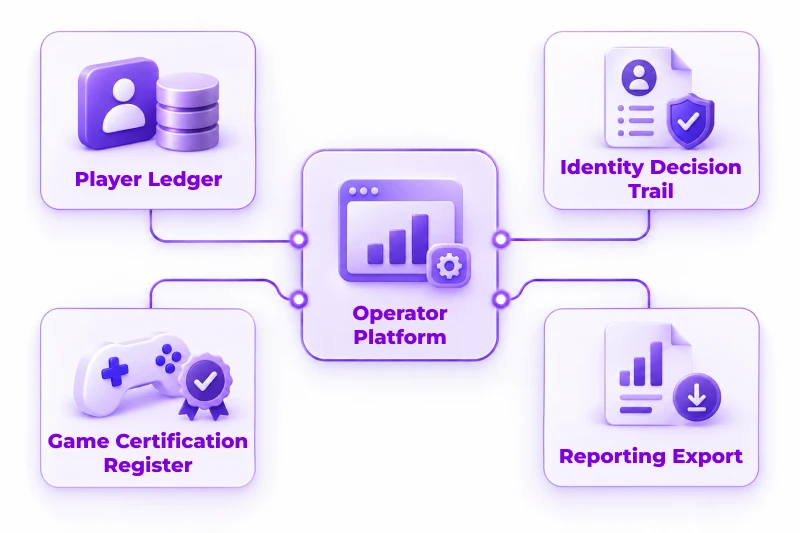
Running a gambling business in 2026 means proving the platform, not only the paperwork. Supervisors test whether submitted policies can be reproduced from live records. The most common cause of a stalled second-phase review is a license application that describes controls the product does not yet have. The evidence set stays consistent across the igaming industry even where fee models diverge.
KYC, AML, and Transaction Monitoring Architecture
Identity checks must produce timestamped outcome codes, not a pass or fail flag. Kahnawake requires verification before payout and within 30 days of funding, with independent review every two years. The CGA triggers customer due diligence once cumulative daily transactions reach 4,000 Caribbean guilders. Background checks on directors and qualifying shareholders run in parallel across every framework listed here.
Monitoring rules matter less than the trail they leave behind. Registration in the goAML reporting portal is a precondition of grant in Curacao, where incident reports fall due within 24 hours of the event. Kahnawake gates material control-system changes behind a 90-day submission window, and an unreported change draws a fine between US$1,000 and US$20,000. Alert logs and escalation records must survive a vendor change.
From Sandbox to Live: A 12-Week Implementation Sequence
Twelve weeks is realistic for a fast-track framework when platform work runs parallel to the legal file. It is not realistic when hosting and reporting are treated as launch tasks. The sequence below reflects how the application process actually runs, rather than how guidance documents describe it.
| Weeks | Legal track | Platform track |
|---|---|---|
| 1–3 | Incorporation, ownership chart, business plan, source-of-funds evidence | Hosting scope decided; wallet segregation configured |
| 4–6 | AML/CFT, responsible gaming and complaints policies drafted | Identity vendor integrated; audit logging enabled |
| 7–9 | File submitted; supervisor questions answered in batches | RNG certification collected; reporting exports built |
| 10–12 | Fees settled; conditions accepted | Geo-blocking rules tested; reconciliation evidenced |
What an Offshore Gaming License Does Not Buy
None of the eight authorizations above grants access to the United States. Online gambling there is licensed state by state, and casino gaming needs a state casino license that no offshore permission replaces. Operators targeting US players should treat where online casino is legal as a separate market-entry question entirely.
New federal regimes follow the same logic elsewhere. Federal Decree-Law No. 25/2025 took effect on June 1, 2026 in the United Arab Emirates, and the commercial gaming regulator holds exclusive authority across all seven emirates. Suppliers are licensed separately through a Gaming-Related Vendor category, with more than 20 vendor licenses now listed in the public directory.
Technical Snapshot
| System area | Implementation requirement | Evidence a supervisor or acquirer requests |
|---|---|---|
| Hosting | Regulated tier inside the jurisdiction where mandated | Data center contract, topology diagram, first invoice |
| Player funds | Segregated balances with continuous liquid coverage | Daily reconciliation, bank confirmation, adjustment trail |
| Identity | Verification before withdrawal, within the stated window | Timestamped outcome codes and exception queue |
| Game integrity | Fair play certified by an approved independent test house | Certificates, build versions, release records |
| Change control | Material system changes submitted before deployment | Classification record, sign-off, rollback plan |
| Payments | Approved providers with controlled routing changes | PSP contracts, settlement map, routing change log |
| Reporting | Scheduled exports without manual assembly | Portal submissions reconciled against platform data |
| Territorial exclusion | Layered blocking across access, payment and verification | Rule configuration export and blocked-attempt reports |
Deciding Before You Budget
The correct sequence is architecture, then constraint, then cost. An operator who prices the license first usually pays twice: once for the file, and again for the rebuild when hosting or vertical scope proves incompatible. Every option here works for someone, and none works for every gaming business. Teams that stay compliant after launch treat reporting as a product feature rather than an obligation.
A successful igaming business settles that order before it settles the invoice. NuxGame supports gambling operators with igaming services spanning company registration, beneficial ownership documentation, AML and responsible gaming policy preparation, banking setup, and platform readiness review. If you are weighing two options and want the architecture question answered first, the NuxGame legal services team provides licensing services and maps hosting, reporting and player-fund scope before you commit the first-year budget.