Русский
 Curaçao Gaming License 2026: LOK Fees, CGA Review Phases, and Technical Compliance
A Curaçao licence for remote games of chance is issued directly by the Curaçao Gaming Authority. The governing statute is the National Ordinance on Games of Chance (LOK), in force since 24 December 2024. A definitive license runs for an indefinite period, and gaming revenue itself is untaxed. Government fees are EUR 4,592 on application and EUR 47,450 a year for B2C. One condition separates this jurisdiction from its offshore peers: critical player records must sit on a Tier-IV certified server in Curaçao.
Operators come for the arithmetic. A single authorisation covers casino, sportsbook, poker, bingo and lottery, crypto deposits are permitted under a written policy, and the annual fee never moves with revenue. The trade-off is substance and supervision, including a resident managing director, an office on the island, an on-island data node and fixed reporting deadlines. Platform planning follows the same split, which is why turnkey casino deployment is mapped before filing rather than during technical review.
Curacao License Quick Facts
-
The Curaçao Gaming Authority (CGA) is the licensing authority and supervisor, and was formerly the Curaçao Gaming Control Board.
-
The National Ordinance on Games of Chance (LOK), P.B. 2024 no. 157, is the primary law behind every grant.
-
Four authorisations exist: the B2C online gaming license, the B2B supplier license, the provisional license and the service-provider certificate.
-
A definitive license runs for an indefinite period, while a provisional license is valid for up to six months and extendable by six.
-
Issuance costs EUR 4,592, plus EUR 150 for each UBO and qualified interest holder, and EUR 2,551 for each listed UBO.
-
Annual fees are EUR 47,450 for B2C, split as EUR 24,490 to the National Treasury and EUR 22,960 to the CGA, and EUR 24,490 for B2B.
-
Profit tax runs at 15% on taxable profit up to XCG 500,000 and 22% above it, applied territorially.
-
Each review phase takes eight weeks and is extendable by four, with three to five months realistic end to end.
-
The applicant must be a Curaçao NV or BV with its registered office on the island and one resident managing director.
-
Critical player, gaming and financial records sit on a server in a Tier-IV certified data centre in Curaçao.
-
Player funds are held in a segregated account, with ring-fenced balances and proven liquidity for expected prizes.
What Is the Curaçao Gambling License?
Nobody may organise or offer online gaming in or from Curaçao without a CGA license. The applicant must be a corporation or closed corporation formed under Curaçao law, with its statutory seat and at least one resident managing director on the island. The regulator verifies every beneficial owner, qualified interest holder and policy-maker, traces the source of funds, and requires proof of liquid assets to pay expected prizes. Registration in goAML is a precondition, and involvement in an operation under license suspension or revocation is a bar.
One license covers all remote games of chance on the domains approved in the operator’s portal account. Malta approves each vertical separately; the CGA does not. A license cannot be transferred, assigned or sub-licensed in any form. That ended the master license system and the four master license holders who sustained the offshore online gambling sector for three decades. All online gaming licenses in Curacao now appear in a free public register.
- Online gaming license (B2C) — online casino, sportsbook, poker, bingo and lottery offered directly to players.
- Supplier license (B2B) — critical gaming services and goods such as platform, RNG and sportsbook software.
- Provisional license — granted while the second-phase review runs, valid up to six months and extendable once.
- Service-provider certificate — up to three years for gaming-related suppliers outside the critical category.
- Nonprofit game notification — local charitable lotteries and bingo, notified to the CGA four weeks in advance.
Why Operators Choose the Curaçao License
-
No duty applies to gross gaming revenue.
The annual fee is fixed at EUR 47,450 regardless of turnover. At EUR 5 million of GGR that is below one percent of revenue, and at EUR 20 million it falls under a quarter of a percent. Fee-to-revenue ratios improve as volume grows rather than degrading.
-
One authorisation carries every vertical and every approved domain.
Adding a main domain costs EUR 250 and extending the game portfolio costs EUR 13 per title. Operators running several brands from one entity avoid a second license file. Multi-brand online gaming services scale on administrative fees, not licensing rounds.
-
The definitive license has no expiry date.
There is no renewal application, no periodic re-licensing and no re-submission of the corporate file. Annual invoices are simply due in full by 15 January. Budget planning becomes a fixed line rather than a recurring project.
-
Crypto acceptance sits inside a published regulator policy.
The CGA issued a crypto policy guideline in June 2026 covering wallets, analytics, prohibited assets and reporting. Fiat-backed regulated stablecoins are the preferred instrument. Operators get a written standard to build against, which little of the gaming industry offers.
-
The public register and dynamic seal support payment diligence.
Each licensed domain carries a seal linked to a live certificate URL that acquirers and aggregators can check independently. Suspensions and revocations appear in the register and the enforcement register. Verification takes seconds rather than a document exchange.
-
A provisional license shortens the path to first revenue.
The CGA may grant one for up to six months while phase two completes, with a further six-month extension available. Trading can begin before the full license is granted. The commercial launch and the compliance build then run in parallel.
Curacao Gambling License Costs in 2026
Curaçao charges per event, not per euro of revenue. A Curacao online gambling license carries no share of GGR, and the fee ignores headcount, verticals, brands and player numbers. B2C holders receive two invoices at once, one to the National Treasury and one to the CGA, each due within 14 days and visible in the online portal. Of the amounts collected, three percent goes to a sports fund, two percent to a fund for vulnerable persons and one percent to gambling-addiction prevention.
| License type | Annual fee | What it covers |
|---|---|---|
| B2C gaming licence | EUR 47,450 | All remote verticals on approved domains, plus CGA supervision |
| B2B supplier licence | EUR 24,490 | Critical services and goods supplied to licensed operators |
| Service-provider certificate | EUR 383 one-off | Up to three years for non-critical gaming-related suppliers |
| Additional main domain | EUR 250 | One registered domain or software application added to the license |
| UBO or qualified interest change | EUR 128 per person | Regulator approval of a change in ownership or control |
| Game or B2B service extension | EUR 13 per item | Permission to add a title or service to the approved portfolio |
The real gaming license cost sits outside the fee schedule. Online gaming businesses carry company formation, a resident managing director, one registered key person and dedicated office space, each with payroll or lease commitments. Add Tier-IV hosting, test laboratory certification, an independent AML audit, a certified ADR provider and banking onboarding. A realistic first-year budget for a B2C operator runs from EUR 75,000 to EUR 120,000. The LOK also provides for a guarantee fund whose premium has not yet reached the published fee schedule.
How to Get a Curaçao Gaming License
Applicants who want to obtain a gaming license now deal with the regulator directly. A gaming license application is accepted only through the CGA online gaming portal, and files submitted outside it are not considered. Processing begins once the application fee invoice clears. Phase one examines integrity and financial condition, while phase two covers the remaining license requirements in the LOK. Completeness is confirmed within two weeks of each submission, and phase-two documentation follows within four weeks of the phase-one decision.
- Incorporate a Curaçao NV or BV and appoint a managing director resident on the island.
- Register in the goAML portal and appoint a compliance officer independent of gaming operations.
- Pay the application fee, adding EUR 150 for each beneficial owner and qualified interest holder.
- File phase one with the corporate and business information form and a personal history disclosure per qualifying person.
- Evidence source of funds and source of wealth for the operation, not only for the shareholders.
- File phase two with the business plan, operations manual, AML/CFT, responsible gaming and information security policies.
- Contract the Curaçao hosting node, an approved test laboratory and a certified ADR provider.
- Register domains in the portal and settle the pro-rata invoices; the license and green seal follow payment.
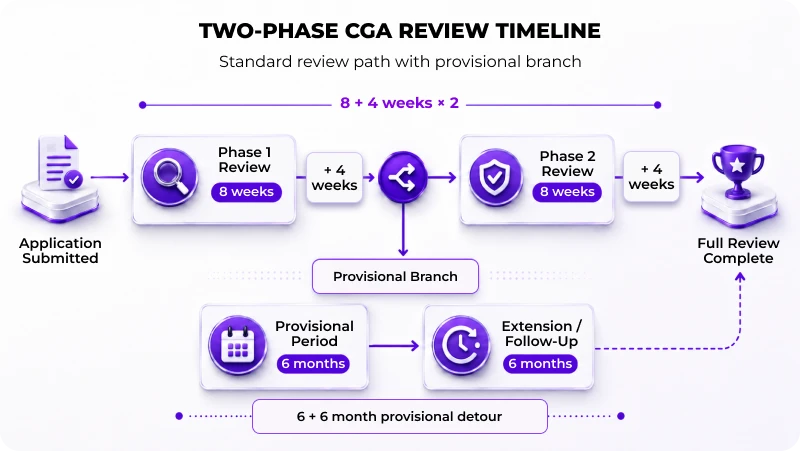
Three to five months is realistic for a clean file, and the statutory clock only runs once submissions are complete. A gaming application that arrives complete moves faster than one that arrives early. Unverifiable ownership chains, thin source-of-funds evidence and missing key-person disclosures stall phase one. Absent hosting contracts, an incomplete operations manual and unappointed ADR providers stall phase two. Non-payment runs to its own schedule. Reminders arrive at days 15 and 29, intended revocation at day 43, and rejection at day 57, before a full Curaçao gaming licence is ever issued.
The phase-two file is where timelines are won or lost. Operators who treat hosting, reporting and policy documents as launch tasks discover they were application tasks. We settle the Curaçao data node and the reporting integration before submission, so the technical review confirms what is already running rather than asking for it.

Denis Kosinsky
Chief Product Officer, NuxGame
Tier-IV Hosting, Player Funds, and Local Substance in Curaçao
Article 5.9 of the LOK is precise about location. Records of critical player, gaming and financial information must stay available to the CGA at all times. They sit on a server in a Tier-IV certified data centre registered in Curacao. Tier IV is the fault-tolerant classification in the Uptime Institute tier standard, built on 2N paths so that no single component failure interrupts service. The obligation is not a migration order. Operators keep the production platform where latency and cost dictate, then maintain a Curaçao node that holds the regulator-facing record set.
- Server location and the hosting contract disclosed to the CGA, with the first invoice as proof of operation.
- Player identities, deposits, wagers, wins, losses and balances present in the local record set.
- Encryption in transit and at rest, plus a secondary backup held on the island.
- Reconciliation between the production platform and the Curaçao node, evidenced on request.
- An operations manual containing a technical infrastructure diagram and recovery procedures, produced within five working days.
Player funds carry a parallel architecture requirement. All payment transactions run exclusively through the player account, and deposits, winnings and any amount otherwise owed sit in a segregated account designated for that purpose alone. Credit for wagering is prohibited outright. The CGA tests liquidity at application and can revoke a license where a holder cannot pay expected prizes immediately. Treasury design therefore belongs in the licensing file, not only in the finance function.
Local substance completes the picture for the gaming business. One key person besides the managing director must work at least 30 hours a week and appear in the Curaçao population register. Three are required from the fifth year after the LOK entered into force, alongside dedicated, physically partitioned office space. The Minister of Justice deferred enforcement to 1 April 2027. Operators below XCG 20 million of annual GGR may qualify for an exemption against half-yearly independent statements. Role conflicts are fixed: the chief executive function cannot hold compliance or AML/CFT duties.
Crypto Models the CGA Permits, and the Conversions It Rejects
Fiat accepted as stakes must be tradable on regulated international markets, and virtual currencies must be tradable on internationally licensed exchanges. The license conditions then close a door that most offshore regimes leave open. The licensee may not exchange currencies inside or outside the player account, convert virtual currency into fiat, or offer investment alternatives to players. Prizes are paid in the same currency used to play. In-game token issuance remains permitted, so the player account management layer must hold true per-asset balances with no internal FX step.
- Immediate effect: bans on sanctioned wallets, mixers, prohibited assets, personal or UBO-linked wallets, and acting as an exchange, payment provider or VASP.
- By September 2026: a crypto policy uploaded to the portal with a documented adoption timeline.
- By December 2026: risk assessments, VASP due diligence, wallet ownership controls, monitoring procedures and staff training.
- By June 2027: wallet segregation, blockchain analytics capability, reconciliation, withdrawal whitelisting and audit-ready records.
Wallet design follows from those dates. Wallets must be owned or controlled by the licensed entity or an approved group entity, and separated between player flow, operations and treasury so player funds never commingle with company funds. Hot wallets hold operationally necessary balances only, warm wallets serve liquidity management under enhanced approval, and cold wallets hold reserves with documented key management. Player-to-player transfers on the platform are not allowed.
Withdrawals default to the same wallet and the same asset as the original deposit. Alternatives are available where the destination wallet is whitelisted, pre-screened and verified as the same customer, or where conversion runs through a regulated VASP with a fully auditable flow. Wrapped and bridged assets of unverified provenance are refused, and privacy-enhancing coins need explicit treatment in the policy. Originator and beneficiary data must accompany transfers between regulated entities under FATF Recommendation 16. Crypto incidents, including compromised keys and exposure to sanctioned wallets, fall under the 24-hour incident report.
Technical Snapshot: Evidence Expected Before Launch
Supervision in this gaming jurisdiction is document-led and calendar-driven. Amendment reports are due twice yearly by 15 January and 15 June, annual financial statements by 30 June, and incident reports within 24 hours of the event. The CGA can also require independent expert reports on AML compliance and on system design. The operations manual must be available for inspection within five working days of a first request.
| System area | Implementation requirement | Evidence the regulator asks for |
|---|---|---|
| Data residency | Critical player, gaming and financial records on a Curaçao Tier-IV server | Hosting contract, server location disclosure, first invoice |
| Player funds | Segregated account, ring-fenced balances, no credit for wagering | Account statements and reconciliation between systems |
| Game integrity | Own and third-party games tested against international gaming standards by a CGA-approved laboratory | Test certificates and supplier disclosure in the portal |
| Identity and AML | CDD once cumulative daily financial transactions reach XCG 4,000 | goAML registration, CDD files, unusual transaction reports |
| Responsible gaming measures | Cooling-off from 24 hours, self-exclusion from one year to lifetime | RG policy on the portal, intervention records in the PAM |
| Information security | CIS IG1 baseline, MFA on internet-facing systems, monthly patching | Annual self-assessment and independent third-party audit |
| Dispute handling | Complaint acknowledged in one week, decided in four, ADR at the operator's expense | ADR agreement, complaints report, decision records |
| Reporting integration | Portal submissions for incidents, changes, transactions and domains | Submission history and reconciliations against platform data |
How the Curaçao License Compares With Other Licenses
Online gambling licenses are not interchangeable products, and headline fees rank them badly. What separates them is the binding constraint each one places on architecture, staffing or market reach, because that is the cost an operator cannot engineer away. A cheap annual fee attached to narrow acquirer acceptance is more expensive than a mid-priced licence with working payment rails. Compared against the seven other regimes NuxGame supports, Curaçao as a jurisdiction sits mid-priced with real infrastructure obligations and broad recognition.
Malta (MGA)
From €25,000 · 6–12 months
Best for EU market access and reputation-sensitive brands.

Isle of Man (GSC)
From £36,750 · 10–12 weeks
Best for established operators seeking strong regulatory credibility.
Kahnawake (KGC)
From $40,000 · 8–12 weeks
Best for North America-facing operations.
Tobique (TGC)
From €43,000 · 4–8 weeks
Best for fast North America-focused market entry.
Anjouan (AOFA)
From €17,828 · 4–8 weeks
Best for fast, lower-cost or crypto-focused launches.
Costa Rica
From company setup costs · 2–4 weeks
Best for low-cost operations where formal gaming recognition is not required.
Two cost structures are at work across that list. Cost-per-licence regimes charge for the authorisation and leave revenue alone, while cost-per-market regimes take a share of local earnings. A Curaçao licence is priced identically at EUR 1 million of revenue and at EUR 50 million, whereas Malta layers a compliance contribution of up to EUR 375,000 on its annual fee. Gaming operators serving many small markets from one brand favour the first model. Operators concentrated in one regulated market pay for a local licence there regardless of what they hold offshore.
How NuxGame Helps With the Curaçao Gaming License
Applications stall in two places. Ownership and source-of-funds chains that cannot be evidenced hold phase one, and an incomplete technical file holds phase two. The NuxGame legal team handles company registration, beneficial ownership documentation, AML/CFT and responsible gaming policies, banking and PSP setup, and the portal submission itself. A platform-readiness review runs alongside it, checking that the product configuration matches what the file promises on limits, exclusions, certification status and reporting.
The jurisdiction-specific consequence is a deployment split rather than a single build. Production infrastructure stays where performance dictates, while the Curaçao node holds the regulator-facing record set with reconciliation and backup on the island. The casino API integration is scoped around that division. Incident reporting, transaction reports per registered domain, domain management through the portal and segregated wallets are configured before submission, not retrofitted after a technical query.
Planning a Curaçao filing this year, or reviewing a legacy structure that no longer holds? The NuxGame team can review your ownership, hosting and reporting position through legal services before you commit fees.