Русский
 2026 Web3 Casino Development: Wallet Architecture, Compliance, and Platform Controls

Web3 casino development builds a platform where player accounts, wallet flows, smart contracts, game APIs, and reporting operate together. The difference from standard casino software is structural. Balances, ownership, and settlement status must reconcile between an internal ledger and an external blockchain network. U.S. deployment adds state licensing analysis, KYC/AML monitoring, auditable logs, and payment controls.
Operators adopt crypto rails for settlement speed and market reach, not branding. Crypto shortens withdrawal cycles and opens markets where card acceptance fails. Lawful online casinos in seven U.S. states generated $10.73 billion in 2025 iGaming revenue. The obstacle is fragmentation across wallet, content, and AML vendors. NuxGame crypto casino software consolidates wallet integration, multi-balance accounts, aggregation, and back-office controls into one stack.
What Changes When an Online Casino Adds Web3 Rails?
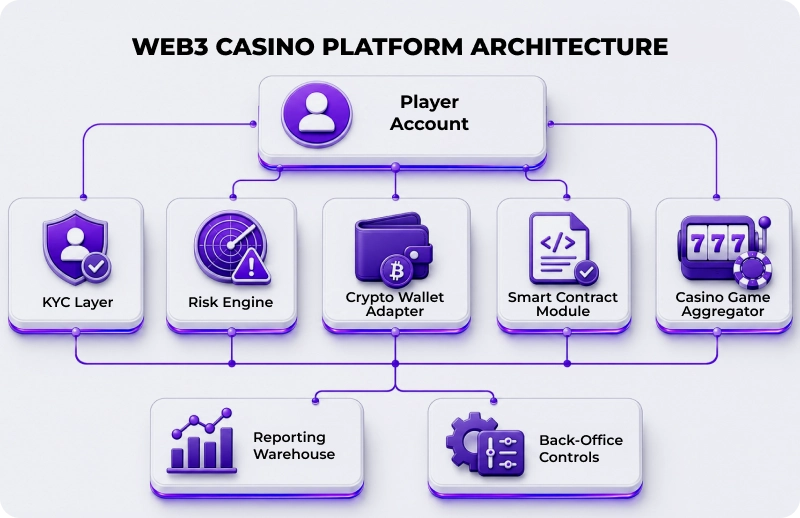
A Web3 casino is not simply a traditional online casino with Bitcoin deposits. The architecture changes once balances, account ownership, settlement status, and player identity must reconcile across external blockchain networks. The platform operates with dual-state logic: the casino account balance controls wagering, while the blockchain record verifies deposit, withdrawal, or token movement.
This distinction matters because traditional online gambling platforms depend mainly on card, bank, e-payment, or local payment rails. Blockchain technologies add confirmation timing, gas fees, address screening, and network-specific settlement rules. A decentralized casino model also changes fraud analysis because transaction history, chain exposure, and asset origin become part of payment risk.
For product teams, the key decision is scope. Some casino operators only need crypto payment support, while others need games, NFT loyalty, tokenized rewards, or games that utilize on-chain logic. Developing too much on-chain logic increases audit cost and launch risk, while developing too little removes the operational value of blockchain and Web3.
Wallet, Multi-Balance, and Payment Routing Architecture
Crypto account design defines the user experience and compliance workload. A custodial account keeps player funds inside the platform ledger, while a non-custodial crypto account gives users external signing control. Many casino solutions use a hybrid model, where deposits arrive from external wallets and are then converted into internal gaming credits within the casino.
Multi-balance logic is the core payment feature in a crypto gaming platform. It lets players hold BTC, ETH, USDT, fiat balances, or other cryptocurrencies without separate account objects. NuxGame’s crypto casino software supports Web3 wallet integration, major cryptocurrencies, direct crypto purchasing, and a multi-balance feature for managing multiple crypto balances.
Game Layer: Aggregation, RNG, and Web3 Casino Games
The game layer must separate payment innovation from game certification. Classic casino games, live dealer titles, table games, slots, and crash-style games still require approved math, certified RNG, session records, and clear paytable behavior. Games like blackjack, roulette, crash, poker, and online casino games require different event schemas and dispute data.
The NuxGame casino aggregation supports a wide range of games through a single API, including slot content, live dealer experiences, and table classics. Its aggregator page describes one API for casino games, game provider access, back-office visibility, reporting, and analytics. That reduces the number of direct vendor connections needed during the development process. Web3 game features are most useful when they support verification, rewards, or loyalty mechanics, while core gameplay should remain inside certified and auditable systems.
Smart Contract Design and Audit Controls
A smart contract should have a narrow job description. In Web3 gaming software, suitable use cases include escrow, jackpot distribution, tournament rewards, loyalty token redemption, NFT access passes, or immutable event anchoring. Putting all game development logic on-chain creates latency, cost, and responsible-gambling problems when sessions need rapid state changes.
Casino developers should require threat modeling before contract deployment. Review points include upgrade permissions, admin key storage, oracle dependency, arithmetic behavior, reentrancy protection, emergency pause logic, and event emission. OWASP Security Verification Standard lists security requirements for Solidity and EVM-based blockchain systems, including architecture, code, access control, communication, cryptography, oracles, and bridge-related risks.
The audit evidence should map to release control. A new casino launch needs a contract source, compiler version, deployed address, ABI, audit report, test coverage, owner permissions, and multisig policy. When launching your Web3 casino, freeze production contract changes behind change approval and maintain a rollback plan for front-end integration failures.
U.S. Compliance Architecture: KYC, AML, GLI-19, and PCI DSS
The U.S. is not a single online gambling market. Online gambling regulations differ by state, and lawful online casino availability remains limited compared with sports betting. AGA reported that 2025 internet gaming revenue across seven states exceeded $10 billion, while Michigan, New Jersey, and Pennsylvania represented nearly 90% of the national total.
Crypto adds financial-crime controls to the casino environment. U.S. casino AML obligations include suspicious activity reporting, supporting documentation, confidentiality, and five-year SAR record retention under FinCEN rules.
GLI-19 certification also affects system design. It requires time-stamping for transactions and games, synchronized system time, player account registration and verification, financial transaction records, game performance reports, liability reports, and operational audits covering technical security controls and service suppliers. PCI DSS v4.0.1 applies when card data enters payment flows, while ISO/IEC 27001:2022 provides an ISMS framework for managing security risk.
| Compliance area | Technical requirement | Operational consequence |
|---|---|---|
| GLI-19 | Time-stamped game, financial, account, and report data | Back office must reproduce game rounds, deposits, withdrawals, and alterations |
| AML / FinCEN | SAR workflow, supporting evidence, five-year record retention | Compliance teams need payment history, player risk notes, and case export controls |
| PCI DSS v4.0.1 | Cardholder data protection if cards are accepted | Payment architecture should isolate card data from casino and crypto ledgers |
| ISO/IEC 27001:2022 | Risk-based information security management | Access control, incident response, vendor review, and audit ownership need formal governance |
| Smart contract audit | Code, permissions, upgrade paths, and oracle review | Release managers need pre-launch sign-off and emergency pause procedures |
Developing a Web3 Casino Platform with NuxGame Infrastructure
Developing a Web3 casino platform starts with defining the project scope: crypto payments only, wallet integration, contract-based features, or a full blockchain-enabled casino environment. This decision affects compliance, development complexity, and launch planning.
NuxGame supports operators through modular software, crypto payment capability, casino API access, casino aggregation, multi-balance account logic, AML/KYC functions, and back-office controls. The online casino API page references 140+ iGaming providers and 17,500+ games through a single API integration service, while the AML/KYC page describes screening, reporting, OCR, biometrics, and suspicious activity controls.
Web3 casino development should start with a clear business choice: what needs to be on-chain and what should stay inside the platform. Operators do not need more moving parts; they need payment flexibility, audit-ready records, and player controls that work together. The smartest setup is the one that keeps innovation useful, not decorative.

Denis Kosinsky
Chief Product Officer at NuxGame
Technical Snapshot: Implementation Checklist for Web3 Platform Development
A Web3 platform needs measurable thresholds before launch. Recommended targets include API response latency below 150 ms for balance reads, wallet-crediting rules within 1–3 seconds after confirmed settlement, 99.95% monthly availability for player account services, and MTTR below 30 minutes for payment incidents. These are engineering targets, not claimed NuxGame performance metrics.
The checklist below helps CTOs and product managers assess Web3 readiness before go-live. It also supports compliance officers reviewing whether online casino solutions, blockchain modules, and crypto operations have enough evidence for launch approval.
| Layer | Required implementation | KPI or evidence |
|---|---|---|
| Player account | KYC, duplicate detection, limits, self-exclusion flags | KYC approval time, rejection reason codes, account audit trail |
| Payment layer | Crypto adapter, multi-balance, exchange-rate source | Sync delay, failed deposit rate, manual review queue |
| Game layer | Aggregator API, certified game catalog, event logs | Game launch success rate, RTP report availability, dispute replay data |
| Smart contract | Audit, multisig, pause logic, deployment registry | Audit report, contract address list, admin key register |
| Compliance reporting | AML cases, SAR support, GLI-19 reports | Five-year SAR evidence retention, report export checks |
| Operations | Monitoring, incident escalation, rollback plan | 99.95% availability target, MTTR under 30 minutes |
Bottom Line
Web3 development process in 2026 is an infrastructure decision, not a branding exercise. The strongest projects define what belongs on-chain, what stays inside the platform, how wallet activity becomes compliance evidence, and how game sessions remain auditable. The NuxGame platform approach helps operators reduce fragmented integrations while keeping casino, payment, and compliance workflows under operational control.
Need to plan a Web3 casino project with crypto payments, game aggregation, KYC/AML flows, and back-office controls in one platform? Contact NuxGame to discuss the right setup for your market, product scope, and compliance requirements.