Русский
 Best iGaming PAM Providers 2026: Technical Selection Guide for Operators

A PAM is the account control layer behind registration, verification, wallets, payments, bonuses, product access, reporting, and responsible gaming. The best PAM keeps those events tied to one verified record, not scattered across casino tools, payment services, and CRM exports. NuxGame works in this area through player account management, casino aggregation, payment configuration, sportsbook tools, and back-office controls for B2C brands.
Market scale makes PAM harder to treat as a back-office add-on. According to the AGA report, US iGaming revenue grew 27.6% in 2025 to $10.73 billion across the seven states with lawful online casino markets. For operators, that growth increases pressure on wallet synchronization, account controls, reporting, and compliance workflows. The NuxGame online casino platform connects PAM logic with casino content, payments, bonuses, and operational tools for brands building a regulated iGaming operation.
Key Takeaways
-
A strong PAM core ties identity, wallet, bonus, and product access to one auditable profile.
-
US operators need configurable controls for KYC, limits, payment status, self-exclusion, and state reporting.
-
The right PAM solution depends on launch model, regulated market scope, migration risk, and team capacity.
-
AI works best when it supports risk review, anomaly detection, and personalization under clear policy rules.
-
PAM integration quality decides how safely casino content, payments, CRM, and analytics connect.
What Separates Provider-Grade PAM From Basic Account Software
An iGaming PAM platform is not a profile database with a cashier attached. For provider selection, the real test is whether the system controls account state, wallet authority, product access, and review workflows under live operating pressure. This makes account management a technical control layer, not just a feature inside PAM software.
The strongest PAM solution links one player account to identity status, wallet state, bonus eligibility, payment history, product permissions, and reporting events. That structure protects the player experience and gameplay quality because visible balances, access rules, and support records come from the same source. It also lowers reconciliation work across the player journey after withdrawals, refunds, or disputed rounds.
| Control area | Operational purpose | Risk if separated |
|---|---|---|
| Registration and onboarding | Creates the verified user record | Duplicate or incomplete profiles |
| Wallet logic | Tracks cash, bonus, pending, and restricted balances | Incorrect settlement or disputes |
| Product permissions | Controls casino, sports betting, and content access | Market or license mismatch |
| Limits and exclusions | Applies harm-prevention and access rules | Delayed blocking or weak evidence |
| Reporting events | Feeds finance, compliance, and analytics | Manual reconstruction after incidents |
Provider Shortlist: Choosing by Technical Fit
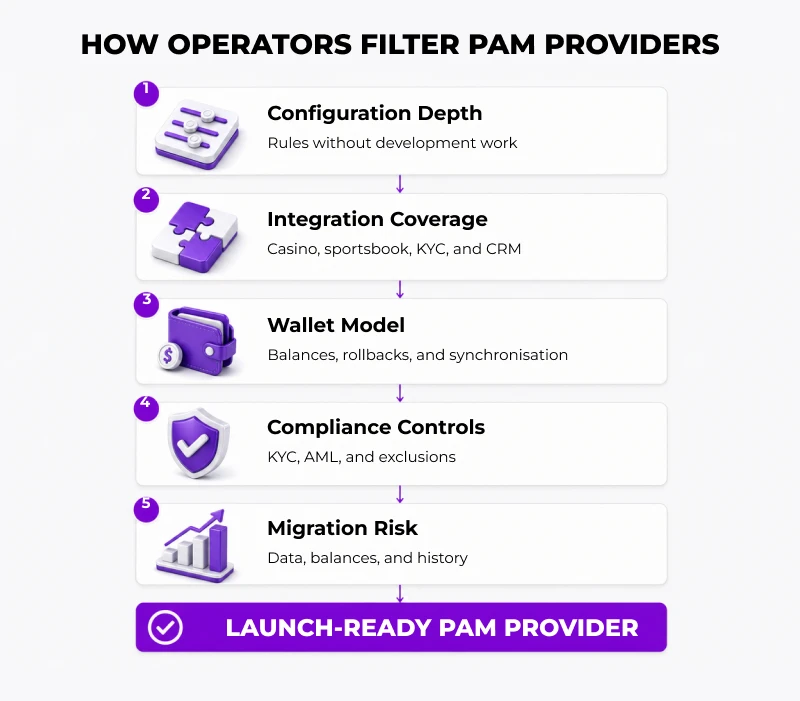
A useful shortlist compares operating fit before brand size and verifies key features against daily workflows. NuxGame, EveryMatrix, Playtech, White Hat Gaming, GiG, Digitain, SOFTSWISS, and Pragmatic Solutions are names buyers often review across platform, account, casino, game providers, and betting platform requirements. The top iGaming choice still depends on how much control the internal team needs after go-live, including access to player data.
A platform provider focused on turnkey launch solves different problems from an enterprise suite built for multi-brand groups. One operator may need fast content access and payment setup. Another may need migration tooling, custom reporting, and state-specific rules. The vendor question is not who looks broadest, but who reduces the exact launch dependencies.
| Vendor model | Best fit | Technical question |
|---|---|---|
| Modular B2B iGaming suite | Brands needing account, casino, payments, and back office together | Can rules change without code work? |
| Enterprise account suite | Groups with internal engineering and compliance teams | Which integrations remain outside scope? |
| US-focused stack | State expansion and tighter reporting duties | How are account rules split by market? |
| Casino-first platform | Content-heavy online casino launches | How are sessions tied to wallet events? |
| Custom software development route | Proprietary product logic | Who maintains certifications and audit logs? |
Account Architecture: Wallet, Session, and Product Logic
The technical center of the account layer is wallet authority. A frontend can show available funds, but the core should confirm the final balance state before play, withdrawal, or bonus conversion. This avoids stale displays during failed payments, expired promotions, provider rollbacks, or interrupted game sessions.
Modern PAM systems also separate account state from session state. The account record stores verified identity, limits, permissions, and risk status. A session record stores device, product, IP, token, timestamps, and status changes. That split gives support teams cleaner evidence when a session fails but the wallet remains correct.
Typical flow:
- Registration creates one account ID.
- KYC and risk checks update eligibility.
- Wallet services assign cash, bonus, and restricted balances.
- Product rules decide access to slot games, table content, or live dealer games.
- Session events write back to reports, CRM, and monitoring tools.
- Exceptions move to finance, support, or compliance review.
Compliance Controls for KYC, AML, and Responsible Gaming
A fully compliant label means little unless controls run before restricted actions. For US-facing teams, the account layer must record verification status, transaction context, review outcomes, and regulatory requirements. Under 31 CFR 1021.210, casinos must run written AML programs designed to assure and monitor compliance, so transaction evidence and account review notes matter operationally.
Interactive system standards add architecture pressure. GLI-19 covers interactive gaming systems and helps teams map account security, event records, game sessions, and system controls into testable requirements. UKGC remote gambling technical standards also connect software behavior with technical controls, security expectations, and responsible product design.
Responsible gaming and responsible gambling controls belong inside account logic, not only inside marketing tools. Deposit limits, cooling-off periods, affordability flags, and self-exclusion need immediate enforcement across products. GCGRA materials also reference deposit limits, cooling-off tools, self-monitoring capabilities, and exclusion options as safer gaming measures.
Integration Requirements for Multi-Product Teams
Casino and sportsbook teams need shared account logic, but each product creates different event types. Casino play produces game rounds, rollbacks, jackpot events, and bonus contribution checks. Sportsbook activity adds odds acceptance, settlement, voids, cashout, and market suspension. The account layer must integrate both without mixing product-specific controls.
The most important checkpoint is the wallet callback model. A bet, win, refund, bonus wager, or failed debit needs one event ID and one final state. A seamless user flow only works when technical confirmation happens behind the screen before the interface shows success.
| Integration checkpoint | Why it matters |
|---|---|
| Wallet callbacks | Confirms debit, credit, rollback, and refund state |
| Verification mapping | Blocks restricted activity until checks pass |
| Bonus rules | Applies excluded content and capped contributions |
| Provider launch tokens | Keeps sessions linked to the correct account |
| Reporting exports | Supports finance, tax, fraud, and audit review |
| Back-office roles | Restricts sensitive account and payment changes |
Operators do not lose control because one tool fails; they lose control when five tools disagree. A strong PAM gives every team the same account truth: finance sees the wallet, compliance sees the evidence, and product sees the journey. That is why NuxGame keeps account logic, payments, and product access in one clear operating layer.

Denis Kosinsky
Chief Product Officer at NuxGame
Analytics, AI, and Real-Time Controls
Analytics should explain account behavior, not just display dashboards. A data-driven model can unify deposits, product sessions, bonus activity, withdrawal attempts, limit changes, and support events. That creates real-time data for fraud review, player engagement, lifetime value analysis, campaign control, and regulatory reporting without waiting for nightly exports.
AI is practical when it ranks cases for human review. It can flag abnormal payment patterns, repeated bonus abuse, or identity inconsistencies. The decision layer still needs written policies, manual override paths, and traceable reasons. That balance supports personalization, player loyalty, and personalized experiences while avoiding unexplained automated treatment.
Real time enforcement matters when account status changes during active play. A withdrawal hold, exclusion request, failed payment, or risk flag should update connected tools quickly. When a batch job handles those changes later, the operator inherits avoidable disputes and weaker evidence.
Scalability, Migration Risk, and New Markets
Scalability in the iGaming industry means more than adding servers. A scalable PAM lets teams add brands, languages, currencies, products, payments, and market rules without rebuilding the account layer for a global iGaming roadmap. AWS notes that betting and gaming workloads often use hybrid architecture patterns to support low latency and data sovereignty needs.
Migration risk is often underestimated. Existing brands must move balances, identity results, consent records, bonus liabilities, payment histories, and exclusion flags without breaking audit continuity. Local laws and regulations can also require old records to remain accessible after the new system goes live.
A practical migration plan should cover:
- Freeze legacy bonus rules before extraction.
- Map every account field to the new data model.
- Reconcile cash, bonus, locked, and pending balances separately.
- Test access rules by jurisdiction before launch.
- Validate callbacks under failed-payment and rollback scenarios.
- Preserve legacy logs for review after go-live.
Why NuxGame Is the Best PAM Provider for iGaming Operators That Need One Operating Core
NuxGame is strongest as a PAM provider when an operator wants account control, casino aggregation, sportsbook, payments, bonuses, and reporting inside one configurable environment. The platform connects a single player record with wallet logic, product access, compliance checks, and back-office rules, so teams do not manage these flows through disconnected tools. This matters most for brands entering regulated markets, where every deposit, withdrawal, bet, bonus, and exclusion event needs a traceable account history.
The best PAM solution is not the one with the longest feature list; it is the one that reduces operational handoffs after launch. NuxGame helps iGaming operators configure limits, bonuses, segments, payment flows, affiliate logic, and reports without rebuilding the stack for every market change. For teams managing online casino and sportsbook products together, that gives a cleaner route to launch, monitor, and expand from one PAM-based platform environment.
Technical Snapshot
| Requirement | Acceptance signal |
|---|---|
| Account identity | One ID across wallet, CRM, products, and reports |
| Wallet synchronization | Balances reconcile after every material event |
| Regulatory compliance | Verification, AML, limits, and exclusions run before restricted actions |
| Reporting evidence | Events store timestamp, account ID, product, and status |
| Performance monitoring | Login, wallet write, game launch, and settlement have p95 targets |
| Market configuration | Jurisdiction rules change through controlled configuration |
| Access control | Back-office roles limit account and payment edits |
| Payment security | PCI DSS scope is mapped before card-processing decisions |
PCI DSS is relevant when card data or payment environments enter scope. The PCI Security Standards Council positions PCI DSS as the standard for protecting payment account data, which affects tokenization, access control, logging, network segmentation, and vendor responsibilities.
Conclusion
The PAM selection conversation should end with evidence, not feature volume. A strong solution protects account state, keeps wallet events accurate, supports compliance checks, and gives teams the data needed to operate without constant manual repair.
For an operator, the decision is commercial as much as technical. The right account core lowers launch friction, reduces integration risk, protects regulated workflows, and gives product teams enough control to expand without rebuilding the base system.
Before selecting a vendor, map your registration, verification, wallet, bonus, payment, reporting, and product-access flows. NuxGame can help review those dependencies against your launch model, compliance scope, and integration requirements.