Русский
 Where Is Online Casino Legal in 2026? US License Architecture and Compliance Risk
In 2026, online casino is legal and live in Connecticut, Delaware, Michigan, New Jersey, Pennsylvania, Rhode Island, and West Virginia. Maine authorized tribal online gambling, but launch depends on rulemaking and vendor approval. Real money online casinos need a state license, geolocation, KYC, payment controls, certified games, and daily reporting before players can wager.
Key Takeaways
The 2026 US Map: Live Online Casino States and Authorized Markets
Online casinos are currently legal and live in seven states: Connecticut, Delaware, Michigan, New Jersey, Pennsylvania, Rhode Island, and West Virginia. Maine became legal for tribal online gambling in January 2026, but authorization is not live availability. The market for online casinos is material: New Jersey reported $272.1M in March 2026 internet gaming win, while Michigan reported $322.1M in March 2026 iGaming gross receipts.
The states where online casino play is active differ from states with legal online sports betting. New Hampshire, New Mexico, Wyoming, and many states also allow online sports wagering in some form, but not full online casino gaming. Wyoming legalized online sports betting in 2021, creating access without approving online slots, tables, casinos and poker.
| State | 2026 status | Market model | Operator implication |
|---|---|---|---|
| Connecticut | Live | Tribal casino and lottery model | Three online brand relationships must be mapped to master wagering authority. |
| Delaware | Live | Lottery-controlled internet gaming and online gaming | The lottery structure limits vendor choice and centralizes state oversight. |
| Michigan | Live | Commercial and tribal casino access | Multiple online brands compete under state control. |
| New Jersey | Live | Commercial market | Broad skin access makes vendor governance and reporting critical. |
| Pennsylvania | Live | Commercial casino license model | Tax, game category, and promotional controls need granular setup. |
| Rhode Island | Live | Lottery and Bally exclusive model | One online channel reduces market choice but simplifies state control. |
| West Virginia | Live | Interactive wagering through licensed casinos | Each license can support several online brands under state rules. |
| Maine | Authorized | Tribal-exclusive model | Launch depends on rules, systems testing, and vendor approval. |
Why Online Sports Betting Expanded Faster Than Casino Gaming
The US Supreme Court’s 2018 decision struck down the Professional and Amateur Sports Protection Act, often called the amateur sports protection act in search queries. That ruling let individual states legalize sports betting, but it did not legalize online casino play. Federal gambling laws still leave online gambling laws, payments, and casino gambling to state frameworks.
That split explains why online sports betting and online casinos do not move together. Legalizing online casinos changes tax files, game certification, responsible gambling exposure, and server-control duties. Online sports betting can launch with odds feeds and event settlement, while online casinos require RNG testing, round logs, RTP controls, bonus rules, and provider reconciliation.
States can legalize sports betting without touching online slots or tables. Their gambling legislation may regulate online gambling for sports, yet prohibit casino apps. Events covered by sports betting are legal in far more markets, while legal online casino expansion remains slower in states like New Jersey because each game round creates auditable financial and technical records.
License Models: Commercial Casino, Tribal Casino, and Lottery Control
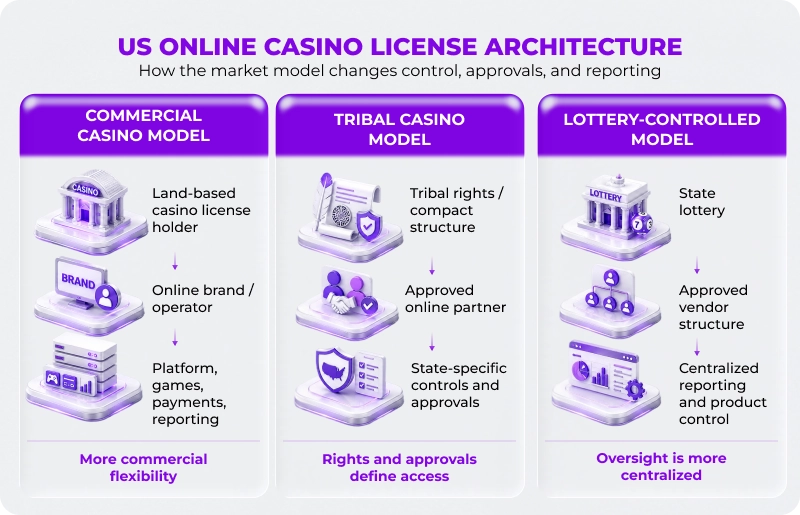
A license in the US online casino market defines far more than legal market entry. It determines who controls the player account, which online operators may connect, how tax and lottery reports are generated, and who approves platform changes. It also shapes whether online casino games, online poker, live dealer products, casinos and poker, or online sports betting can be offered under the same structure.
For operators, the key risk is assuming that legal online gambling follows one model across all US states. In practice, commercial casino, tribal casino, and lottery-led frameworks create different technical obligations. Each model affects PAM configuration, payment routing, provider approvals, geofencing rules, reporting frequency, and compliance ownership.
| License model | Example markets | How access works | Operational impact |
|---|---|---|---|
| Commercial license | New Jersey, Pennsylvania, West Virginia | Online brands connect through approved land-based casino license holders. Multiple online operators may work under permitted casino relationships. | Gives stronger commercial flexibility, but increases vendor governance, content approval, audit logging, and reporting workload. |
| Tribal casino framework | Connecticut, Maine, selected tribal markets | Tribal casino operators hold key market rights, often connected to state agreements or compact-based structures. Land-based tribal casinos remain central to access. | Requires careful review of tribal rights, IGRA implications, platform approval, revenue flow, and state-specific online gambling rules. |
| Lottery-controlled model | Delaware, Rhode Island | The lottery controls online gaming structure, vendor participation, reporting, online lotteries, and often revenue distribution. | Reduces market fragmentation, but creates stronger dependency on lottery workflows, approved suppliers, and state-defined reporting formats. |
| Hybrid sports and casino structure | Michigan, Connecticut | Online casinos and sports betting may exist in the same state, but approval routes and reporting duties differ by product. | Requires separate controls for casino games, sportsbook wallets, self-exclusion tools, tax files, and platform change management. |
The practical takeaway is simple: a legal online casino launch starts with license architecture, not game aggregation. A commercial model gives broader market flexibility, while a tribal casino model depends on rights, compacts, and platform approval. A lottery-led model may simplify market structure, but it places more operational control in the hands of the lottery.
NuxGame helps operators assess these differences before technical implementation begins. The platform setup can map license type to PAM rules, provider access, payment restrictions, reporting exports, online betting controls, and casino content availability. That early mapping reduces the risk of building a product that is legal in concept but not ready for regulated operation.
Technical Prerequisites for US Market Entry: Geofencing and PAM Standards
A US online casino license fails in practice when the platform lets a valid player wager from an invalid location. Geofencing should work before wallet activity, not after payment reconciliation. PAM, or player account management, links identity, location, wallet status, player protection controls, and product access. Online gambling is legal only when the player, state, payment method, license scope, and game category match at the same time.
| Technical layer | What it must control | Why it matters for legal online operation |
|---|---|---|
| Geofencing | Registration, login, deposit, session start, wager placement, and session resumption | Blocks illegal online traffic before casino or sportsbook funds move. |
| Location evidence | IP data, Wi-Fi signals, device checks, VPN detection, and proxy screening | Creates regulator-ready proof for disputed wagers and blocked sessions. |
| PAM | KYC status, age checks, limits, self-exclusion, bonus eligibility, problem gambling triggers, and account closure | Keeps online casino access aligned with responsible gambling rules. |
| Wallet segmentation | Cash, bonus, locked funds, withdrawal balance, sportsbook balance, and casino balance | Prevents mixed records across online casinos and sports betting. |
| Performance monitoring | Sub-second location checks and wallet sync below 500ms where possible | Helps detect rejected wagers, stale balances, and duplicate transaction events. |
The practical requirement is a synchronized control stack, not a single compliance plugin. Geofencing confirms where the player is, while PAM confirms whether the player is allowed to act. Wallet segmentation then proves which product moved money and under which license. This is the technical base for real money online casinos in regulated US states.
Regulated market entry is not only about getting approval on paper. Operators need to build the player journey so identity, location, payments, and product access work as one controlled system. When these checks are planned early, growth has fewer loose ends and far less room for costly surprises

Denis Kosinsky
Chief Product Officer at NuxGame
Emerging Markets: Decoding the Licensing Framework in Brazil and Ontario
Brazil and Ontario are useful comparison points because both require structured market entry, but their frameworks work differently. Brazil regulates fixed-odds betting and online gaming through federal authorization and local compliance rules. Ontario uses AGCO registration and an iGaming Ontario operating agreement. In both markets, legal online access depends on operating evidence, not light offshore paperwork.
| Market | Licensing structure | Main operator checks |
|---|---|---|
| Brazil | Federal authorization with local compliance requirements | Payment traceability, AML procedures, player identification, technical certification, and local reporting. |
| Ontario | AGCO registration plus iGaming Ontario agreement | PAM controls, limit-setting tools, player fund handling, game integrity, and supplier governance. |
Both markets show how online gambling regulation is becoming more technical. Operators need licensing strategy, payment logic, compliance policies, reporting architecture, and platform controls before marketing spend begins. A platform that cannot prove player identity, transaction history, and product access will struggle in legal and regulated markets.
Global iGaming Compliance: Navigating the 2026 Regulatory Patchwork
US online casino rules are strict, but they are not the only benchmark operators to compare in 2026. Global iGaming expansion often means weighing US-regulated states against Ontario, Brazil, MGA, and Curacao. Each route creates a different mix of costs, AML duties, platform evidence, payment restrictions, reporting formats, and supplier approval. The wrong assumption is treating international licensing as a faster version of US market entry.
Key differences operators should map before launch:
- US-regulated states: strict geofencing, PAM controls, state reporting, local access, and regulator testing.
- Ontario: registration, operating agreement, player protection controls, supplier governance, and fund handling.
- Brazil: federal authorization, local payment compliance, AML review, technical certification, and reporting.
- MGA: structured application, corporate checks, system review, responsible gambling policies, and game oversight.
- Curacao: direct licensing framework, AML documentation, supplier mapping, and player protection requirements.
The regulatory patchwork affects product sequencing. One jurisdiction may prioritize AML documentation, while another focuses on player funds, local payment rails, platform testing, or advertising rules. A reusable online gambling platform should support jurisdiction-level configuration instead of rebuilding the back office for every license. That makes global expansion a controlled implementation process, not a repeated technical reset.
State-by-State Risk Matrix for Product and Compliance Teams
The main product risk is assuming legal online gambling means the same thing in each state. To discover where online gambling is permitted, teams must separate legal gambling status by product, not headline market access. A guide to legal online launch planning should separate live access, authorized markets, casino options, sports-only markets, and prohibited states before teams build one roadmap.
| Market category | Example states | What is allowed | Implementation risk |
|---|---|---|---|
| Live online casino | Including New Jersey, Michigan, Pennsylvania, Rhode Island, West Virginia | Licensed online casinos, online poker in selected states, sportsbook where approved | Multi-license reporting, promo rules, and supplier approvals. |
| Authorized, not fully live | Maine | Tribal online gambling authorized, implementation pending | Launch timing, rules, vendor review, and compact interpretation. |
| Sports-only or limited | New Hampshire, New Mexico, Wyoming | Legal sports betting, retail tribal activity, or mobile sportsbook access; other forms of gambling vary | Product teams may confuse sports betting and online casinos. |
| Lottery-led market | Delaware, Rhode Island | Lottery controls internet gambling or iGaming operations | Vendor choice, reporting cadence, and payment visibility are state-led. |
| Prohibited or unavailable | Utah, Hawaii, and states without enabling law | Online gambling is illegal or gambling activities are not authorized | Illegal traffic risks processor blocks and enforcement. |
Online gambling is legal only inside the exact state framework, and the wider gambling market remains fragmented. Casino sites and online operators need state-specific controls. Individual US states also define age checks, tax files, supplier suitability, advertising rules, and whether platforms may offer online table games. States with legal online casino access still expect operators to prove compliance before production release.
How NuxGame Supports Legal Launch Planning
NuxGame helps casino operators reduce the number of separate systems needed for market entry. The platform combines casino aggregation, sportsbook integration, payment configuration, player account tools, bonus setup, provider controls, and back-office reporting. That structure matters when one license requires provider-level reporting while another state needs daily files.
Legal expansion also needs product discipline. The NuxGame team maps providers, payments, KYC, AML checks, and operational permissions before launch. The platform approach does not replace legal advice, but it gives technical teams documentation, integrations, test cases, and reporting views that reduce rework when gambling regulations change.
Technical Snapshot: Minimum Launch Architecture
A compliant online casino launch needs more than a front-end, cashier, and game lobby. The system must prove that each player, wager, payment, bonus, and provider event matches the conditions. Weak audit design usually appears during regulator review, payment disputes, or provider reconciliation.
| Layer | Minimum control | Measurable checkpoint |
|---|---|---|
| Identity | KYC, age check, sanctions screening, duplicate detection | KYC decision time tracked by provider and market |
| Location | Geolocation at login, session start, deposit, wager | Sub-second location decision target under normal load. |
| Wallet | Segmented cash, bonus, locked, and withdrawal balances | Wallet synchronization delay target below 500ms. |
| Game layer | Certified RNG, provider IDs, round logs, RTP records | Round events retained with provider reference and timestamp. |
| Payments | PCI DSS scope, tokenization, blocked methods, chargeback review | Payment approval rate and reversal reason tracked daily. |
| Reporting | State, lottery, provider, AML, and finance reports | Daily reconciliation between wallet, provider, and payment ledger. |
| Security | ISO 27001-style risk controls, access review, incident process | Privileged access review and incident MTTR monitored monthly. |
The NuxGame platform supports modular setup for these layers, including provider aggregation, payment routing, back-office permissions, and reporting exports. Each license still needs local validation, but modular architecture keeps account, wallet, game, and payment logic easier to adapt across individual states.
Bottom Line
Where is online casino legal in 2026? The answer is narrower than the sports betting map and more technical than a state name list. Online casino access depends on the license model, lottery control, tribal rights, provider approvals, payment rules, and audit evidence.
Planning a regulated launch or market review for 2026? NuxGame helps teams assess license requirements, provider aggregation, sportsbook integration, payment routing, KYC flows, back-office roles, and reporting needs before development starts. Contact NuxGame to review your launch model and identify which technical controls need attention first.