Русский
 What is a Social Casino in 2026 Guide: Software, Monetization, and Compliance
A social casino is a free-to-play platform with casino-style games, virtual coins, and no cash redemption. In 2026, the safest build model uses a single non-redeemable currency, so revenue comes from coin purchases, ads, and retention loops instead of wagers or payouts. This design affects compliance, wallet architecture, app-store setup, and geofencing. This guide covers the build the way NuxGame sets it up with operators.
Key Takeaways
What a Social Casino Is, in Build Terms — and Where the 2026 Revenue Sits
Social casinos are online platforms that feature classic casino style games like slots, blackjack and poker. Players can purchase virtual coins for fun and play casino games in a free-to-play app. The product offers an online casino or a traditional casino experience but it doesn’t pay out anything which changes the whole model.
Social casino gaming rewards reach and repeat play. Analysts estimate the global social casino market to be near $10.08 billion in 2026, climbing to about $14.42 billion by 2030 at a 9.4% CAGR. Roughly 72% of global users engage with social casino games through mobile platforms. Established social casino sites such as High 5 Casino set the content bar, and slots stay the most-played of all social casino games.
The Social Casino Business Model: Engineering a Freemium Economy
The model is freemium: free to play, paid to accelerate. Income concentrates in in-app purchases (IAP), which drive about 70% of revenue. Advertising contributes most of the rest, near 25%, usually through rewarded video. Social casino operators use this mix because players spend money on casino games as entertainment, not to gamble for cash.
The mechanic is a closed loop: coin purchase, engagement, viral invite. A player spends coins, hits a wait timer or a streak goal, then buys more or invites friends for bonus credits. Only about 8% of casino app installs convert into buyers globally, based on 4.95% one-time buyers and 3.01% repeat buyers. Casino players spend roughly $11.40 per user within 90 days of install.
A small payer base carries the economy. Heavy spenders, often called whales, complete 13–15 purchases a month. Reward cadence, limited-time offers, and progression keep them buying. Lifetime coin spend, not install volume, decides whether the unit economics work, and many social casinos add subscription layers on top of the most popular social formats.
Social Casino vs Sweepstakes vs Real-Money: The Legal Line That Defines Your Build
US gambling law turns on three elements: prize, chance, and consideration. Strip out any one and the activity sits outside gambling. A pure free-to-play model removes the prize: coins hold no cash value, so players cannot gamble for money. That choice sidesteps traditional online casino gambling rules, even in states where casinos are restricted, and it needs no gambling license.
The sweepstakes models take a riskier route. They keep a redeemable currency, then add a free-entry path to remove “consideration.” Regulators increasingly reject that logic where the product looks and feels like a real casino. Real-money casinos, the licensed face of online gambling, accept all three elements and run only under state-issued licenses.
The differences between social casinos and real-money casinos come down to redemption. In a real casino, players bet real money and can wager real money for cash. Real-money online casinos pay out, and the prizes online casinos offer have no equivalent in this category. The difference in social and licensed design is simple: one cashes out, one does not.
| Model | Player currency | Cash redemption | License required | US status | App-store treatment |
|---|---|---|---|---|---|
| Social casino (free-to-play) | Single virtual coin | None | Not required | Legal in most states; Washington high-risk | 17+ "simulated gambling"; store billing |
| Sweepstakes casino (dual-currency) | Gold + redeemable Sweeps Coins | Yes, via Sweeps Coins | Contested; treated as gambling in a growing list of states | Banned or under enforcement in CA, NY, MT, CT, IN, ME, IL, LA, MI | Restricted; payment-processor exposure |
| Real-money online casino | Cash balance | Yes | Required, state by state | Legal only in licensed states (e.g., NJ, PA, MI) | 18+, age-gated, licensed only |
The lesson is architectural, not cosmetic. If any path lets a coin become money, you inherit full real-money gaming obligations. Keeping the wallet one-directional, with deposits in and no cash-out, is what separates social casinos vs sweepstakes operations. Design that boundary first, because everything downstream depends on it.
In a social casino, currency is not a payment detail; it is the steering wheel. A single non-redeemable coin gives operators a cleaner compliance path, while the wallet, rewards, and social features keep the product commercially strong. Build that foundation early, because fixing the economy after launch is where good ideas become expensive lessons.

Denis Kosinsky
Chief Product Officer at NuxGame
The 2026 US Regulatory Shift You Have to Design Around
The sweepstakes model unwound across 2025 and 2026. California’s AB 831 banned dual-currency sweepstakes from January 1, 2026. New York followed with SB 5935A, signed in December 2025. Montana, Connecticut, Indiana, and Maine passed their own prohibitions, several attaching liability to vendors, processors, and affiliates.
Enforcement widened beyond statute. Illinois sent roughly 65 cease-and-desist letters in May 2026. Louisiana issued about 40 and sued operators for $44 million in back taxes. Michigan has run a functional ban since 2024. The pattern targets redemption, not virtual play, which is precisely what shields the pure social model.
One precedent still threatens single-currency builds. Washington courts have treated virtual chips as things of value, exposing operators to loss-recovery class actions. Geofence Washington and other high-risk jurisdictions at the infrastructure layer. Stand up state-level eligibility plus IP and geolocation checks before launch, not after a notice lands.
Technical Infrastructure: Managing Virtual Credits and Social-Graph Integrations
The hardest engineering in this genre is not the games. It is the credit economy and the friend graph that drives retention. Three systems carry the load: the wallet, the purchase pipeline, and the engagement layer. Because rival social casino platforms offer similar games, retention lives in the meta layer, not the slots themselves.
The virtual currency economy and the no-cash-out wallet
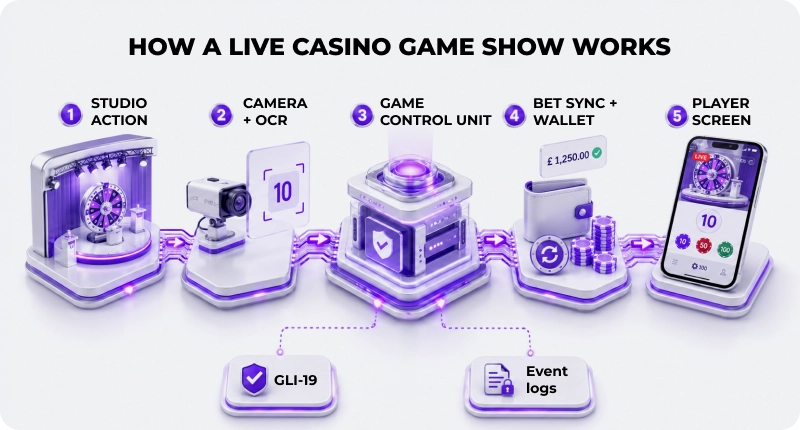
Run a single-currency wallet with deposit endpoints but no withdrawal endpoint at all. Model coins as a closed virtual currency economy with defined sources, such as bonuses and purchases, and sinks, such as spins and entry fees. Record every movement in a double-entry ledger using idempotent transactions. Target p95 wallet-write latency under 250 ms at peak concurrency, paired with certified RNGs and immutable game-event logs.
From retention to monetization: the role of in-app purchase APIs
Coin sales clear through store billing APIs: StoreKit on iOS, Play Billing on Android. Validate every receipt server-side before granting credits, so spoofed clients cannot mint coins. Make entitlement granting idempotent to survive network retries. Serve offers from a server-driven catalog, which lets you run price tests and limited-time bundles without shipping a new client build.
Leaderboard APIs, gamification engine, and social media integration
A gamification engine powers the features that retain players: daily rewards, tournaments, gifting, and achievements. Leaderboard APIs rank players in near real time and feed competitive events. The same layer adds invites and shareable wins across social media platforms. Social casinos also use shared wins, rankings, and friend-based mechanics to support retention. Subscription layers can be added later, but the core driver is still social engagement: players with in-game friends return about 4x more often.
Social Casino Feature List
A launch-ready build needs a defined feature set, each item earning its place by what it does for retention or monetization:
| Feature | Player function | Operator / monetization role |
|---|---|---|
| Daily rewards & login bonuses | Free coins on return | Drives daily active use and habit |
| Tournaments & leaderboards | Ranked competition | Lifts session length and event spend |
| Gifting | Send coins to friends | Expands the friend network; viral acquisition |
| Achievements & progression | Unlockable goals | Sustains retention loops over weeks |
| Limited-time offers | Discounted coin bundles | Converts payers; raises per-payer revenue |
| Rewarded video | Coins for watching ads | Monetizes non-payers (~25% of revenue) |
NuxGame supplies casino aggregation, player account management, wallet, and back-office configuration through one integration. Operators tune the coin economy, rewards, and content without rebuilding core systems. Target 99.9% uptime, roughly 8.8 hours of downtime per year, on wallet and game APIs.
Payments and App-Store Mechanics: How Coin Sales Actually Clear
Store billing is not only an API choice; it is a margin decision. Apple and Google take 15–30% of every in-app coin sale as commission. That cut is a fixed cost of goods you cannot route around within the app itself, which is why many operators steer purchases to a web storefront.
On the web you process cards directly and fall under PCI DSS 4.0.1, whose v4.0 future-dated requirements became mandatory in March 2025. That means tokenization, network segmentation, and quarterly external scanning. Weigh the saved commission against added checkout friction and fraud exposure before moving volume.
Coins are consumable goods, so refund and chargeback handling differ from withdrawals. Write a clear consumable policy, monitor chargeback rates, and reconcile store payouts against your ledger. Apple also steers this category toward native iOS builds rather than HTML5 wrappers, which shapes client-side engineering choices.
Compliance Beyond Real-Money Gaming Law: Age Gating, Responsible Play, and Privacy
Two compliance domains apply even without a gaming license: store policy and data law. Apple rates simulated-gambling apps 18+ worldwide and expects an age gate on first launch. Its 2025 rating overhaul tightened the rules further. Google applies IARC ratings with a mandatory disclosure step on submission.
Players never stake cash, yet responsible-play controls still cut consumer-protection exposure. Add coin-purchase spend caps, session reminders, cool-off windows, and self-exclusion. These controls blunt the loss-recovery claims that have succeeded in Washington. They also signal seriousness to app stores, payment partners, and advertisers vetting your product before approval.
Player data triggers ISO 27001 practices and privacy statutes. EU players bring GDPR; California residents bring CCPA and CPRA. Both demand a lawful basis, consent management, retention limits, and rights handling such as access and deletion. Map data flows and build subject-request tooling before you scale acquisition, not after.
Launch Sequence and Unit Economics for 2026
Sequence the build to remove risk early. Lock the currency model and geofencing first. Integrate content, wallet, and the purchase pipeline next. Then run a closed beta before any paid acquisition. Match the UI and game mix to the audience: gamified design for Gen Z, familiar slots for older players.
Social casinos are becoming a default on-ramp to the wider online gaming and online gambling industry. Social casinos attract Gen Z and women faster than cash products. Unlike cash gaming, social casinos are designed for retention, and social casinos focus on entertainment over payout size.
Acquisition cost must pay back against lifetime coin spend, not a single purchase. Game mix shifts the math directly. Skill, trivia, and hybrid formats post Day-30 retention near 38–41%, against 31–33% for slot-only catalogs. Track Day-1, Day-7, and Day-30 retention alongside conversion to first purchase.
Growth holds when live-ops never stop. Ship seasonal events, leaderboards, and streaks on a fixed calendar. Social casinos still run on habit, not jackpots. Test new formats, read the dashboard weekly, and reallocate budget toward what retains. The future of social gaming favors teams that iterate constantly, not quarterly.
Technical Snapshot
| Requirement | Target / standard |
|---|---|
| Currency model | Single, non-redeemable virtual coin; no withdrawal endpoint |
| Wallet latency (SLO) | p95 < 250 ms at peak concurrency |
| Service uptime (target) | 99.9% (~8.8 hours downtime per year) |
| Purchase pipeline | Server-side receipt validation; idempotent entitlement granting |
| RNG & fairness | Certified RNG from suppliers; immutable game-event logs; published RTP |
| Community layer | Leaderboard APIs, gifting, achievements; near-real-time ranking |
| Monetization mix | IAP ~70% / rewarded ads ~25%; US payer conversion ~9–10% |
| Requirement | Target / standard |
|---|---|
| In-app payments | Apple StoreKit / Google Play Billing (15–30% fee) |
| Web payments | PCI DSS 4.0.1 (tokenization, segmentation, quarterly scans) |
| Age rating / gate | 17+ (Apple), IARC (Google); age gate on first launch |
| Geofencing | Block Washington and banned or high-risk states; IP + geolocation |
| Responsible play | Spend caps, session limits, cool-off, self-exclusion |
| Data / privacy | ISO 27001 controls; GDPR (EU), CCPA/CPRA (US) |
| Core KPIs | D1/D7/D30 retention, ARPPU, first-purchase conversion, chargeback rate |
Bottom Line
The build decision for 2026 is narrow and consequential. Choose the single-currency social casino for speed, lighter legal exposure, and US reach without a gambling license. Choose a licensed real-money path only where you can carry the obligations it brings. Avoid the sweepstakes middle ground, because the regulatory ground under it keeps moving. Settle currency design, the coin economy, geofencing, and app-store rules before product specs are written. Then pick a partner who can implement those constraints at the core rather than bolt them on later.
NuxGame builds this software on a single-currency model, with casino aggregation, player account management, wallet, payments, and back-office controls in one integration. The same stack handles the coin economy, leaderboards, gifting, geofencing, and responsible-play tools. To learn more about social casinos, request a walkthrough and a turnkey solution scoped to your target states, or talk to the NuxGame team about migrating off the sweepstakes model.