Русский
 What an iGaming Back Office Should Include

An iGaming back office should combine player accounts, wallet and ledger control, payments, KYC, AML, responsible gaming, casino content, bonus rules, CRM, fraud controls, reporting, and governed administration. It should function as the operational control plane for an online casino, with every critical action traceable to a user, timestamp, reason, and before-and-after state.
Operators need this structure because disconnected tools create conflicting balances, player statuses, promotion records, and compliance evidence. The NuxGame online casino platform connects player management, payment logic, bonuses, operational reporting, and risk controls within one operating environment. A practical implementation should also set measurable service objectives, such as acknowledging critical configuration writes within two seconds.
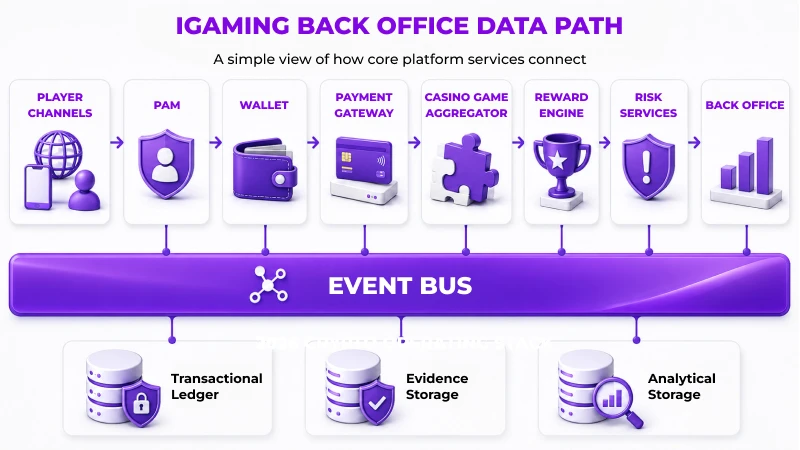
Separate financial records from marketing and analytical data to protect ledger integrity. Apply jurisdiction rules through versioned policy packs rather than manual team instructions. Record privileged changes with approvals, previous values, and rollback references. Use idempotent integrations to prevent duplicate debits, rewards, or status updates. Monitor operational latency, reconciliation exceptions, risk queues, and failed provider events.
Key takeaways
The Back Office Is an Operational Control Plane, Not an Admin Screen
A mature back office coordinates several bounded domains instead of placing every function inside one database. Player identity, wallet accounting, casino game sessions, payments, bonus logic, risk cases, and reporting need defined ownership. The casino management system should expose shared workflows while preserving each service’s data rules. These management tools become the control surface for the wider casino operation.
Configuration also needs structure. A strong back office stores versioned settings, effective dates, jurisdiction scope, approval state, and rollback information. Product teams should separate operational commands from read-only dashboards, while customer support receives only case-resolution controls. This design improves operational efficiency, limits accidental changes, and gives the casino operator a clearer incident record within the iGaming industry.
Player Management, KYC, and Responsible Gaming Workflows
Player management should operate as a state machine covering registration, verification, activation, suspension, self-exclusion, closure, and reactivation. Each transition needs an authorized trigger, supporting evidence, and downstream effects on wallets, promotions, lifecycle campaigns, and product access. The player account management layer should preserve consent, limits, verification results, player behavior markers, and account history across the online casino player lifecycle.
Jurisdiction rules belong inside configurable policy packs. New Jersey regulations require filed internal controls, re-authentication after 15 minutes of inactivity, and an annual independent system integrity and security assessment. UK remote technical standards cover customer information, transaction display, financial limits, interrupted play, third-party software, and security. This structure supports regulatory compliance while keeping the player experience and user experience predictable for the casino operator.
Wallet, Transaction, and Payment Processing Controls
The wallet ledger should be the authoritative source for deposits, withdrawals, wagers, wins, adjustments, chargebacks, and bonus movements. Each transaction needs a unique identifier, currency, source event, status, and reversal relationship. Casino back office screens may display balances, but direct balance editing should be prohibited outside controlled adjustment workflows. Every manual adjustment also needs a reason code and separate approval.
Payment orchestration sits beside the ledger, not inside CRM tools. It needs payment gateway routing, velocity limits, approval status, KYC dependencies, withdrawal review, and reconciliation. As of August 2026, PCI DSS v4.0.1 remains the payment-data baseline, so iGaming software and casino management software should isolate that scope. Casino software should retain tokens and gateway references instead of raw card details wherever the design permits.
Casino Management, Content, Bonus, and CRM Configuration
Casino management requires more than switching games on or off. Teams need provider status, jurisdiction availability, currency support, device eligibility, maintenance state, online casino lobby placement, and game performance visibility. Casino game aggregation reduces separate provider connections, but the casino back office still needs provider-level health checks, round tracing, and controlled content publication for every casino brand.
Bonus and casino CRM tools should execute governed rules, not unrestricted database updates. Eligibility should check verification, location, self-exclusion, payment state, previous claims, caps, and cooldowns. Player segmentation should use observed player behavior, consent, and risk state. CRM lifecycle controls and personalized marketing logic then support player retention, loyalty programs, and player engagement while keeping promotion exposure, bonus cost, and reversals traceable.
A back office should make complex operations visible without exposing teams to unnecessary system complexity. The real test is not the number of menus. It is whether payments, player status, game activity, risk signals, and configuration changes produce one traceable operational record that finance, support, product, and compliance teams can trust during every shift. Denis Kosinsky Chief Product Officer at NuxGame
KYC, AML, Fraud Monitoring, and Case Management Architecture
Anti-money laundering and fraud prevention need an event stream, a rules engine, and a case-management layer. Casino risk management signals may include failed verification, linked devices, unusual deposit velocity, incentive abuse, payment reversals, location conflicts, and suspicious activity. The system should preserve the source event, rule version, score, investigator decision, evidence, and final disposition for every escalated case.
For United States casino operations, AML obligations depend on legal structure, licensing, and federal or state rules. FinCEN casino guidance emphasizes risk-based suspicious transaction monitoring rather than mechanical review of every financial event. Fraud detection should combine automated prioritization with human review, while the casino operator tracks queue age in real time, false-positive rates, unresolved alerts, and reporting deadlines.
API Architecture, Integration, and Session Continuity
An advanced back office depends on stable service contracts. External casino providers should map data into canonical player, wallet, payment, game, and reward models. Idempotency keys prevent duplicates, correlation identifiers connect distributed events, and versioned APIs reduce breaking changes. A seamless handoff keeps the same identifiers across adapters and queues. AWS reliability guidance also emphasizes lifecycle testing and consistent workload behavior.
Provider failures need defined degradation paths. A delayed casino game callback should enter a retry queue without creating a second debit, while unresolved rounds remain visible. Payment and verification timeouts need explicit pending states rather than generic errors. The online casino back office system should expose queue depth, provider failure rate, and wallet synchronization delay through a real-time dashboard.
Reporting, Analytics, and Daily Operations
Operational reporting and analytical reporting serve different workloads. Casino support needs current account and financial activity views, casino finance needs reconciled settlement data, compliance needs evidence and exception histories, while product teams need aggregated performance trends. The back office system should publish timestamped read models rather than let every dashboard query production databases independently.
Data analysis also requires lineage. Every casino performance metric should identify its source events, calculation version, time zone, currency treatment, and refresh point. AI operations analysis becomes safer when models use governed datasets and return explainable recommendations, not direct financial actions. Operators should monitor stale data, schema failures, missing events, and divergence between operational and warehouse totals.
Access Control, Change Management, and Audit Evidence
Back-office access should follow job responsibilities, not broad departmental roles. In casino back office systems, a casino support agent may view player activities and initiate a review, while only finance approves balance adjustments. Zero trust principles require authentication, authorization, continuous validation, and least-privilege access. Sensitive exports, permission changes, payment overrides, and exclusion updates need stronger controls.
Change management should cover casino configuration as carefully as source code. Every material change needs an owner, business reason, approval, effective time, affected jurisdiction, test evidence, and rollback plan. The casino evidence trail should be append-only and searchable by player, financial entry, administrator, provider, and rule version. Temporary access must expire automatically rather than remain open after an incident.
Build, Buy, and Software Development Ownership
iGaming back office software development starts with a responsibility map for core code, integrations, security testing, deployment, and regulatory updates. Custom software development services suit an operator that owns differentiated workflows and permanent engineering capacity. They are less suitable when online gaming teams mainly need proven wallet, payment, compliance, and casino product modules.
A back office solution should define configuration ownership, release cadence, incident support, data export, and exit procedures before contract signature. Compare iGaming back office software solutions by changing lead time, API coverage, compliance evidence, and migration tooling rather than page count. The operator should also test whether platform management tools fit finance, compliance, support, and casino product workflows.
Technical Snapshot: Minimum Implementation Checkpoints
The following checkpoints convert back-office features into testable implementation requirements. The figures are suggested operational targets, not universal regulatory thresholds. Operators should calibrate them against event volume, provider contracts, jurisdiction requirements, and internal risk appetite before production approval. The resulting system should expose each target through monitoring and test evidence.
Domain
Required component
Control evidence
Suggested operational target
Administration
MFA, least privilege, approval workflow
Login, permission, and change records
100% of privileged changes attributed
Wallet
Immutable double-entry ledger and reversals
Linked debit, credit, and source event
Zero duplicate financial postings
Integration
Idempotency, retries, correlation IDs
Request and event trace
Critical API P95 below 500 ms
Game operations
Round state and provider monitoring
Round timeline and exception reason
Balance mismatch alert within 60 seconds
Payments
Routing, status mapping, reconciliation
Gateway response and settlement match
Daily reconciliation completed by T+1
Compliance
Identity verification, exclusions, limits, case management
Decision, evidence, reviewer, rule version
High-risk cases assigned within 15 minutes
Reporting
Operational read models and warehouse lineage
Source-to-metric mapping
Data freshness displayed on every dashboard
Resilience
Backups, recovery tests, queue replay
Test report and recovery evidence
Recovery objectives defined per service
An iGaming back office software provider should explain which targets are platform defaults, configurable limits, or operator responsibilities. A casino back office software provider must also define ownership for 3rd party integrations, regulatory reporting, customer support workflows, and incident response. Without those boundaries, an apparently complete solution creates gaps precisely when casino teams need evidence.
Choose an iGaming Back Office Around Evidence and Control
The right casino back office is not the product with the longest menu. It is the system that keeps financial records authoritative, compliance decisions reproducible, integrations observable, and operational changes reversible. Before contract signature, operators should test realistic failures, permission conflicts, delayed callbacks, blocked players, and reconciliation exceptions.
The NuxGame iGaming platform supports this approach through connected casino software, player account management, payments, bonuses, aggregation, reporting, and risk controls. Teams comparing iGaming back office solutions and iGaming back office software solutions should begin with their operating model, jurisdiction matrix, data ownership, and evidence requirements. A structured discovery session with NuxGame helps map those dependencies before implementation or migration.