Русский
 Sweepstakes Casino Payments in 2026

Sweepstakes casino payments run on two rails that most platforms wrongly treat as one. The purchase leg sells coin packages as digital goods. The redemption leg releases prize funds accrued as Sweeps Coins. Since April 1, 2026, Visa scores card merchants against a 1.5% combined fraud-and-dispute ratio, down from 2.2%.
That split decides where money and risk actually sit. A declined coin purchase costs session time; a stalled disbursement costs a compliance finding. The NuxGame sweepstakes casino software separates Gold Coin and Sweeps Coin balances, ties redemption requests to configurable thresholds and verification steps, and applies state access rules before a request reaches an acquirer.
Key Takeaways
-
MCC 5816 or 7994 preserves approval rates; a 7995 re-tag wipes them out.
-
Nacha caps unauthorized ACH returns at 0.5%, so account validation is mandatory.
-
The Form 1099-MISC prize threshold rose from $600 to $2,000 in 2026.
-
Rolling reserves park working capital exactly when redemption volume peaks.
-
AB 831 makes state eligibility a payment control, not a lobby setting.
Two Legs, Two Risk Profiles
The purchase leg is a retail sale, not a deposit. A player buys a coin package the way they buy in-game currency, and Sweeps Coins arrive alongside it or through the AMOE route. The redemption leg produces what players call sweepstakes casino real money prizes: cash released against an accrued balance.
Reversibility is where the two diverge hardest. Card purchases stay disputable for months under network rules, while instant credits are final within seconds. A single ledger treating both as generic transactions will eventually credit coins against a purchase that later reverses.
| Attribute | Purchase leg | Redemption leg |
|---|---|---|
| What moves | Card or bank debit for a coin package | Prize funds against a Sweeps Coin balance |
| Regulatory object | Retail sale of digital goods | Prize disbursement, reported as other income |
| Typical rail | Card, ACH debit, pay-by-bank, wallet | Push-to-card, ACH credit, RTP, FedNow |
| Reversal window | Up to 120 days under card network rules | Effectively final once released |
| Dominant failure | Issuer decline or MCC misclassification | Return, freeze, or reporting gap |
| Internal owner | Payments and growth | Compliance and finance |
Why Sweepstakes Businesses Are Classified as High-Risk Merchants
Acquirers assign the merchant category code at onboarding, and that four-digit number governs how every issuer rule engine reads your traffic. Most dual-currency brands sit under MCC 5816 (digital goods — games) or MCC 7994. MCC 7995 covers betting and casino gambling, which Visa lists among its high-integrity-risk codes.
A re-tag is not a paperwork event. Issuers that block gambling apply blanket declines, some treat the charge as a cash advance, and interchange rises. Since January 1, 2026, the Mastercard Merchant Monitoring Program also scans site content — gated pages included — before a new merchant processes anything.
What typically triggers a reclassification review:
- Casino-style URLs, descriptors, or cashier pages that mirror a regulated online casino
- Statement descriptors reading “casino” or “wager” instead of a coin-package reference
- An attorney general inquiry landing on the acquiring bank’s risk desk
- Transaction-profile drift: rising average ticket, high velocity, heavy repeat purchasing
- Redemption volume disclosed during the approval process for a sweepstakes merchant account
Payment processing for sweepstakes businesses therefore sits in a category acquirers price defensively. Traditional banks and payment processors decline this vertical for the reason they decline regulated iGaming: exposure they cannot model. A high-risk sweepstakes account attracts reserves, holdbacks, and shorter notice periods as standard terms.
Risk appetite also tracks legislative pressure. Five states passed explicit prohibitions during 2025 alone, per the American Gaming Association State of the States survey. Each new statute gives an acquirer a reason to re-run underwriting on merchants it already holds.
Sweepstakes Casino Payment Methods 2026: A Rail-by-Rail Comparison
Cards typically carry the bulk of first-purchase volume, since they convert best on mobile. They also carry the dispute exposure that the Visa Acquirer Monitoring Program (VAMP) now measures. Many sweepstakes casinos provide a handful of deposit-side options, and the number of payment methods on the cashier matters less than how traffic routes between them.
Each rail fails on its own terms, which argues for a diverse payment mix rather than a favorite. Route by BIN, ticket size, and player tenure, then cascade retries to a second acquirer on decline. The preferred payment rail also shifts by cohort and by device.
| Payment method | Settlement to operator | Reversal exposure | Best fit |
|---|---|---|---|
| Credit and debit cards | 1–3 business days | Chargebacks and TC40 fraud reports | Primary purchase rail, highest conversion |
| ACH debit (WEB entries) | 1–2 business days | R05 and R10 unauthorized returns | Lower cost, higher first-time friction |
| Pay-by-bank / open banking | Same day to next day | Minimal; authorized at source | Larger coin packages, bundled verification |
| Digital wallets | Follows the funding source | Inherits card or bank rules | Returning players, mobile checkout |
| Push-to-card | Minutes | Non-reversible by the operator | Redemption within network limits |
| RTP and FedNow credits | Seconds, 24/7/365 | Recall is a request, not a right | Redemption where both banks participate |
Common payment methods in sweepstakes casinos split cleanly by function: cards and wallets win conversion, bank rails win cost, and instant credits win on payment experience. Digital payment options inherit the risk rules of their funding source. Alternative payment methods matter most at redemption, where reach beats conversion, and the same rail economics run through iGaming payment methods generally.
Payment Gateway Integration for Sweepstakes Platforms
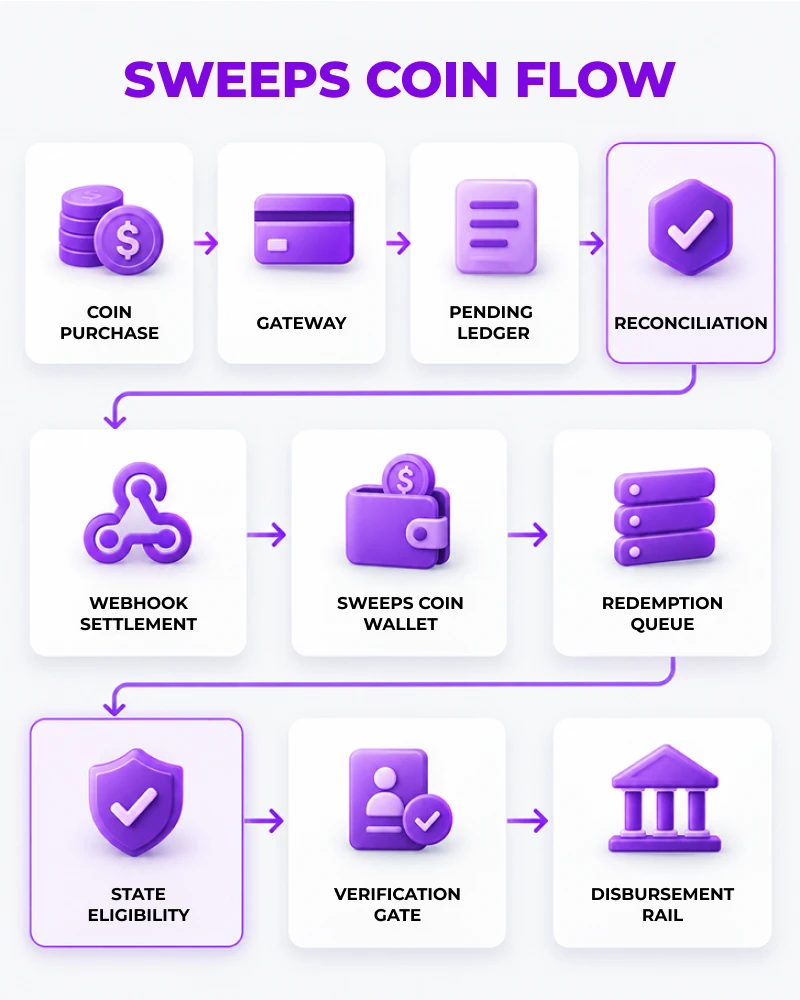
Coin credit belongs to the settlement confirmation, never to the authorization response. Authorize, write a pending ledger entry, wait for the processor webhook, then release the balance. Every write needs an idempotency key, because gateways retry and mobile clients double-submit. Without one, a network timeout mints free coins.
Model each transaction as an explicit state machine — pending, settled, failed, reversed, reconciled — and reject undefined transitions. A seamless payment handoff, meaning no redirect and one session token with the wallet updated in the same round trip, is a design constraint rather than a slogan.
Integration checkpoints worth enforcing before launch:
- Idempotency keys on every purchase, credit, and disbursement write
- Signed webhooks with replay protection and a dead-letter queue for failed deliveries
- Tokenization and hosted fields to keep the cardholder data environment narrow
- Timeout and circuit-breaker policy per gateway, with automatic failover to a second acquirer
- Daily three-way reconciliation across wallet ledger, gateway records, and bank settlement
Payment page integrity moved inside audit scope this cycle. All 51 previously future-dated PCI DSS v4.0.1 requirements became mandatory on March 31, 2025. Requirement 6.4.3 demands an authorized, integrity-checked inventory of every script served on the page. A secure payment page is now evidence, not a badge, and pairs naturally with script controls at the CDN layer.
Most teams budget for the deposit page and improvise the redemption queue. That order is backwards. The purchase decides whether a player starts; the redemption decides whether they come back and whether your compliance file survives an audit. Build the redemption path first, then let the purchase path inherit its controls. The reverse rarely works

Denis Kosinsky
Chief Product Officer at NuxGame
Redemption Rails, Return Rates, and Queue Discipline
Instant rails reset what players tolerate. The FedNow Service passed 1,500 participating institutions across all 50 states and raised its transaction limit to $10 million. The RTP network cleared its first billion payments in February 2025 and lifted its own ceiling to the same figure. Neither offers a unilateral recall.
Coverage is uneven, so instant credit needs a fallback. A flexible payment system ranks rails per player rather than fixing one, and ACH covers the long tail. Nacha enforces ACH return rate thresholds of 0.5% for unauthorized returns, 3% administrative, and 15% overall.
Queue design that survives volume:
- Validate the receiving account at request time, not at release time
- Rank the rail cascade per request: instant credit, then push-to-card, then ACH
- Publish a p95 target for request-to-release hours and instrument it as a product metric
- Hold partial disbursements atomically so a failed leg never double-debits the wallet
- Log every manual review decision with reviewer identity and reason code
Verification and Reporting Gates Inside the Disbursement Flow
Verification depth should follow cumulative redemption value, not a single request. A player redeeming $40 once and a player crossing $2,400 across eleven requests carry different exposure. Tiering by rolling twelve-month total keeps friction off casual users while forcing documentary evidence where the money concentrates.
Payer obligations moved this year. Section 70433 of the One Big Beautiful Bill Act amended IRC §6041. It raised the Form 1099-MISC threshold for Box 3 prizes from $600 to $2,000, effective for payments made after December 31, 2025. The form is an information return, not a tax assessment.
| Gate | Evaluated at | Blocks release when |
|---|---|---|
| Identity match | First redemption request | Name, date of birth, or address fails verification |
| Sanctions and PEP screen | Every redemption request | A hit remains unresolved |
| TIN collection (Form W-9) | Cumulative $2,000 threshold crossing | No valid TIN is on file |
| Backup withholding flag | Missing or mismatched TIN | Withholding has not been applied |
| Calendar-year aggregation | Nightly ledger job | The reporting file fails to reconcile |
Note the mismatch worth designing around: verification tiers work on a rolling window, while reporting totals reset every January 1. Secure sweepstakes disbursement depends on these gates running before release rather than after. An instant credit that clears a sanctions hit retroactively is not a control; it is an incident report with better latency.
State Eligibility as a Payment Control
Blocking a state at the lobby is no longer enough. California AB 831 extends liability to payment processors, financial institutions, geolocation providers, and platform providers that knowingly support a prohibited online sweepstakes game. Penalties run from $1,000 to $25,000, up to a year in county jail, or both.
The map keeps moving faster than most release cycles. Sweepstakes operators reading eligibility once at registration will keep serving a player whose state changed status months earlier. The NuxGame guide to sweepstakes rules and regulations covers the wider legal picture behind these controls.
Where the state decision has to be enforced:
- On the purchase call, before authorization reaches the gateway
- On the redemption request, before any rail is selected
- Against billing-address state, geolocation, and card BIN issuance in one consistency check
- In configuration that operations edits without a code release
- Through a defined settlement path for balances held when access closes
Choosing a Payment Gateway for Sweepstakes: Terms and Exit Risk
Underwriting terms move working capital more than the discount rate does. Rolling reserves and settlement delays park cash you cannot spend, and prize releases do not wait for a reserve to unlock. Model the combined drag against peak redemption weeks before you choose a payment gateway.
Portability is the clause nobody negotiates and everybody regrets. When card tokens live in only one vault, a termination notice becomes a re-authentication event for every returning player. A forced migration compounds the usual iGaming payment challenges with a conversion cliff.
Questions worth putting to a provider before contracting:
- Which MCC will you assign, and what triggers a review of that assignment?
- What is the rolling reserve percentage, holdback period, and release schedule?
- Are card tokens exportable in a PCI-compliant format on termination?
- Do you have a payment gateway to handle both the purchase and disbursement legs, or is a second contract required?
- Can state acceptance rules be updated by us without a deployment?
- What notice period applies, and what happens to in-flight redemptions?
Choosing the best sweepstakes payment partner turns on precedent. Payment processors that understand dual-currency mechanics argue the case internally when a risk review lands; a generalist escalates, then exits. A specialized payment provider familiar with the specific needs of the sweepstakes industry prices the model instead of refusing it.
Operators looking for a payment partner will find comparative context in the NuxGame review of sweepstakes software providers, which covers vendor evaluation beyond the payment layer alone.
Technical Snapshot: Sweepstakes Payment Processing Requirements
These requirements fall into four groups, each with a different internal owner. Hosting belongs to infrastructure: multi-region cloud hosting that isolates settlement and reporting workloads from game traffic stops a lobby spike from delaying a disbursement batch.
Implementation requirements
- Dual-wallet ledger with independent Gold Coin and Sweeps Coin balances
- Idempotent transaction API with explicit state machine and signed webhooks
- Multi-acquirer routing with cascade retry and per-gateway circuit breakers
- Redemption pipeline with threshold rules, verification gates, and status tracking
- State eligibility resolved at request time rather than cached from registration
System dependencies
- Acquiring bank with a documented MCC position on the dual-currency model
- Instant rail access via FedNow or RTP, with ACH credit as fallback
- Bank account validation satisfying the Nacha WEB debit requirement
- Identity verification, sanctions screening, and geolocation services
- Segregated settlement account with visibility into reserve balances
Indicators to instrument
- Authorization rate segmented by gateway, BIN range, and ticket size
- Combined fraud-and-dispute ratio held under the 1.5% Visa merchant threshold
- Unauthorized ACH return rate held under the 0.5% Nacha threshold
- Reconciliation break rate as a share of daily transactions, internal target below 0.1%
- Redemption request-to-release time at p50 and p95
Compliance checkpoints
- PCI DSS v4.0.1 assessment covering Requirements 6.4.3 and 11.6.1
- Annual Nacha rules compliance audit completed by December 31
- W-9 collection and 1099-MISC generation against the $2,000 threshold
- State eligibility matrix reviewed each legislative session
- Documented AML procedures with reviewer-level audit logging
Where the Next Engineering Hour Should Go
Sweepstakes casino payments fail in predictable places: a merchant category code accepted without argument, a wallet that credits on authorization, a redemption queue built after launch, and a state matrix nobody owns. Each is cheap to fix during integration and expensive once volume arrives. Ranking them by cost of reversal produces a defensible roadmap.
Approval rate is the number growth teams watch, but reserve terms, return rates, and reporting accuracy decide whether a sweepstakes business survives its first regulatory inquiry. Treat the payment strategy as infrastructure with a compliance surface, not as a checkout widget bolted on before launch.
If you are scoping a payment setup or reworking an existing one, NuxGame supports operators with dual-currency wallet architecture, AMOE and no-purchase entry logic, and a configurable redemption engine. The platform also covers KYC and AML checks bound to redemption activity, geo and state access control, and back-office reporting across coin movement and disbursements. Contact the NuxGame team for a technical walkthrough, or review the sweepstakes casino software specification directly.