Русский
 Top Online Casino Software Providers in 2026: How Platforms Behave When Systems Fail

Top iGaming software providers in 2026 include NuxGame, SoftSwiss, EveryMatrix, Soft2Bet, and Slotegrator — and the real difference between them comes down to how their systems process player actions, record data, and handle failures in real conditions. This is why the iGaming industry continues to move toward systems that can be explained step by step. Operators now focus on how platforms behave under failure, how actions are recorded, and how consistency is maintained.
A reliable online casino experience is created by clear system behavior. When a player opens a session, the platform must validate identity, confirm balance, and maintain a consistent state from start to finish. If one step breaks, the player does not see the error message first. But they feel it as confusion or loss of trust.
Beyond system behavior, iGaming regulations require platforms to prove what happened at any moment. Standards such as GLI-19 and authorities like the Malta Gaming Authority require systems to store logs, allow audits, as well as show full traceability. A platform provider must demonstrate how this is done in architecture, not just claim compliance.
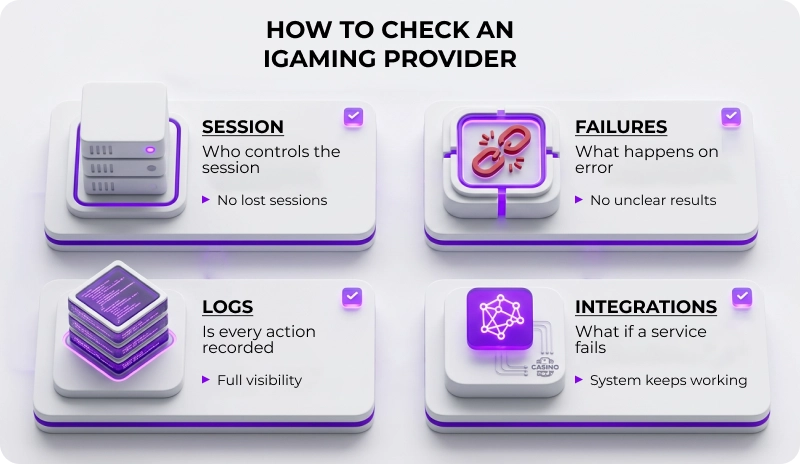
Evaluation Checklist
How Platform Providers Actually Control System Behavior
To create a gambling website, operators must understand that platform providers are responsible for system control. They decide how sessions are created, how actions move through the system, and how failures are handled. External services are only inputs. The platform remains the source of truth.
This means that when something fails, the platform must correct it. A request must either complete or be cancelled safely. No unclear states should exist. This level of system consistency is what separates reliable platforms from those that create errors.
Technical Snapshot: How Casino Platform Providers Control Player Sessions
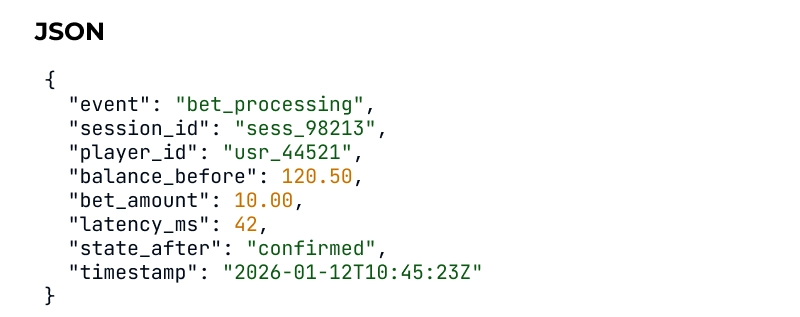
This snapshot shows how a casino platform provider processes a player bet as a structured event. The system validates the session and balance before executing the action, then records the result as a confirmed state. In this example, the bet is successfully processed and confirmed, with all details (including timing and outcome) stored for auditability. If a failure occurred, the system would revert to the last confirmed state instead of allowing an inconsistent result. This maintains balance accuracy and full traceability of every action.
5 Important Questions to Ask Online Casino Software Providers
- Who Owns the Session? A strong platform owns the session from start to finish. It does not allow external systems to define whether a session is valid. This maintains a single, consistent session state for all interactions, including live casino and live dealer games, where timing and continuity are critical.
- How Does the Platform Handle Failure? Reliable systems detect issues and recover without affecting the player. This is a major function of production-level gambling software.
- Is the System Built for Scalability? Growth requires scalability, but only modular systems support it. A platform must separate core logic from integrations so it can grow without breaking.
- Can the Platform Operate Across Jurisdictions? Operating in regulated markets requires flexibility in compliance logic. The platform must adapt rules without changing core behavior.
- Does the Platform Maintain Clear Logs? Every action must be recorded in a structured way. This makes every action verifiable during audits and gives responsible gaming tools access to complete and accurate records.
Top 10 Online Casino Software Providers in 2026: How They Handle Failures in Real Conditions
All platforms look stable (until something breaks). A delayed response, a failed transaction, a dropped session: this is where real system design shows. Below is how leading online casino software providers in 2026 are structured — and what that typically means when systems are under stress or failure.
- NuxGame uses a modular platform structure, separating session handling, reporting, and integrations. When failures occur, this separation helps isolate issues — so a session error, reporting delay, or integration failure doesn’t cascade across the system. In practice: problems can be traced and resolved at the correct layer without losing overall system control.
- SoftSwiss is built around a Player Account Management system with detailed reporting and logging. When something goes wrong, e.g., a failed bet or interrupted session, the system relies on account-level records and logs to reconstruct events. From an operational perspective: strong traceability helps operators investigate and resolve disputes.
- Soft2Bet integrates gamification and engagement features directly into platform workflows. Because bonuses, rewards, and gameplay are tightly connected, failures require precise synchronization between actions and outcomes. In practical terms: if timing or state tracking is off, inconsistencies can affect player experience — making control of event flow critical.
- BlueOcean Gaming acts as a casino aggregator, connecting multiple providers through one integration. In failure scenarios, behavior depends not only on BlueOcean, but also on upstream game providers and APIs. In practice: simplified integration, but less direct control over how individual provider failures are handled.
- Quantum Gaming offers custom iGaming solutions, allowing operators to define workflows and system behavior. When failures happen, recovery logic depends on how the system has been designed and configured. In practice: high flexibility — but operators must make sure failure management is properly implemented.
- EveryMatrix provides a modular platform with strong data and reporting capabilities. When issues occur (transaction mismatches or delays, for instance) operators rely on structured data and reporting tools to identify and understand the problem. From an operational perspective: visibility into system behavior helps diagnose and correct failures.
- SoftGamings provides a white-label platform that combines games, payments, as well as services into one system. System behavior during failures here depends on how these integrated components interact and recover. In practical terms: unified setup simplifies operations, but requires coordination between multiple services during incidents.
- Upgaming offers a multi-product platform: casino, sportsbook, esports, fantasy sports. Failures in one vertical may need to be handled without affecting others, depending on system separation. From an operational perspective: centralized management, with the need to control cross-product impact during issues.
- Uplatform provides a white-label solution with API-based integrations and localization tools. When failures take place (especially across regions), behavior depends on how APIs manage timeouts and data consistency. In practice: flexible expansion, but reliability depends on integration handling.
- Slotegrator combines platform solutions with aggregation services, connecting operators to many providers. In failure scenarios, system behavior depends on both Slotegrator’s platform and the external services it connects to. In practice: broad access, with failure handling influenced by multiple integration points.
Provider Comparison Table: Main Platform Logic for Provider Evaluation
| Area | What to Check | Why It Matters |
|---|---|---|
| Session Ownership | Platform defines and maintains session lifecycle | Prevents ghost sessions, duplicates, and loss of state |
| Failure Recovery | Logic How the platform retries, cancels, or restores interrupted flows | Avoids disputes and ensures data consistency after errors |
| Provider Dependency Control | How the platform isolates and contains external service failures | Keeps the system stable even when third-party services fail |
| Data Logging & Traceability | Whether each action is fully recorded from start to final result | Required for GLI audits and fast dispute resolution |
| Integration Orchestration | How services are connected, sequenced, and confirmed | Keeps behavior stable in complex operations |
Real-World Checks to Evaluate iGaming Software Providers Before You Commit
Many software providers focus on features, not behavior. This creates a gap between what is promised and how the system actually performs. To close this gap, operators should test how the platform reacts to failure. Interrupt a session and observe the result. In production environments, core actions such as session validation and balance checks are typically processed within a 50–150ms window. When this flow breaks, a production-grade platform resolves the issue within a single request cycle or reverts state clearly. A weak one creates delays, duplicate actions, or unclear outcomes.
This becomes even more important under real player activity. Operators should review how platforms behave under high concurrency (thousands of simultaneous sessions) and peak load conditions. Logs must remain clear, and system behavior must stay consistent even when response times increase beyond 200–300ms, where user-visible latency begins. This is a major indicator of mature iGaming software development, where stability is engineered and never assumed.
To understand the real difference between providers, consider a common failure scenario. If a player places a bet and the system confirms it internally but fails to return a response within a typical timeout window (2–5 seconds), weak platforms may leave the session in an undefined state. This creates balance disputes. In production systems, even brief response failures can lead to inconsistent session states if recovery logic is not enforced. Strong platforms enforce an atomic transaction rule: the action is either fully confirmed or fully reverted — never partially applied.
Another hidden risk appears when platforms accept a request but delay logging. In this case, actions exist without a confirmed record. Strong systems write logs at the moment of validation, typically within milliseconds, rather than after completion. This allows every action to be captured as part of a complete event chain, even if the process fails midway — a requirement for auditability under standards like GLI-19.
Think of an iGaming software platform as a railway system where many trains arrive from different directions every minute. Without central control, delays and collisions happen. The best providers manage every route and every recovery step, so even unexpected disruptions are handled clearly and operations continue with full system control maintained.

Denis Kosinsky
Chief Operating Officer at NuxGame
Bottom Line
The future of online platforms belongs to systems that are controlled, traceable, and clear. Operators must evaluate how platforms behave, not how they are described, when opting for the best partner. The NuxGame iGaming platform follows this approach, helping teams start their online casino brands with reliable and structured gaming solutions.