Русский
White Label Casino: What It Is, What It Costs and How to Launch One

A white label casino platform is a ready-made solution where a software provider runs the site under the operator’s brand. As such, the software provider takes care of the games, payments and technology, while the operator handles the players and marketing.
In 2026, a white label online casino setup costs between €10,000 and €60,000, plus a 10% to 30% revenue share, and takes 3 to 8 weeks to launch. The fastest and cheapest route to the online gaming market, it also means the operator depends on the provider for payments and the product roadmap. As the operator grows the revenue, the margin shrinks.
Key takeaways
-
The cost of setting up a white label casino is €10,000 to €60,000, plus a 10% to 30% revenue share.
-
Payment approval is the usual bottleneck in the 3-to-8-week launch window.
-
Acquiring players, at $150 to $400+ per first-time depositor, is the main expense.
-
Since December 24, 2024, Curaçao's LOK has replaced sublicenses with direct permits.
-
A turnkey agreement takes 2% to 5% of GGR, making the shift profitable as revenue grows.
What an Operator Gets with a White Label Casino Solution
A white label casino solution is a complete package for a new brand. It includes most of the crucial components of starting a business. Depending on the provider, the components of white label casino software may vary, but generally they cover:
| Component | What it covers | A typical setup in a white label deal |
|---|---|---|
| Casino platform and back office | Player accounts and wallets, admin roles, reports and bonuses | A shared casino platform configured for each brand |
| Game content | Crash, live and table games, and slots | Content chosen from the provider's catalog |
| Payments | Fraud checks and cashier, deposit and withdrawal methods | PSPs connected by the provider |
| Licenses | Permit to take real money bets in defined markets | Held by the provider in the classic model |
| KYC and AML | Identity checks and transaction monitoring | The provider's compliance tooling and policies |
| Front end | Mobile and desktop templates | Branded website |
| Hosting and security | Servers, uptime, DDoS protection and backups | Fully on the provider's side |
| Sportsbook | Live and pre-match betting | Optional, so a brand can run a sportsbook or casino |
| Support and maintenance | Tech support | Optional player support |
The catalog is the most visible part of the offer. The NuxGame game aggregator gives access to more than 18,500 titles from 140 plus studios. The payments side of the platform offers 180+ currencies with cards, e-wallets, bank transfers and crypto.
A white label gaming platform usually leaves out a lot of stuff, and it matters just as much. Marketing, affiliate deals, and acquiring players usually stay with the operator, and customer support often does as well.
Who’s Responsible for What: Provider or Operator
Disputes in such partnerships often begin with a failure to clearly define lines of responsibility. The usual split looks like this, though the contract has the final say on each of the following:
| Area | Provider | Operator |
|---|---|---|
| License and regulator reporting | Holds the license and files reports | Follows its conditions and provides data on time |
| KYC and AML | Sets the policy, runs the tools and makes final calls on flagged accounts | Collects documents and escalates suspicious activity |
| Responsible gambling | Provides limits, self-exclusion and reality checks | Applies responsible gambling measures to players and responds to requests for self-exclusion |
| Payments | Signs PSP contracts and runs the cashier | Chooses methods for each market from the provider's list |
| Games | Integrates and certifies content | Sets games and lobby |
| Platform | Security, updates and general maintenance | Reports bugs and suggests improvements |
| Brand | Delivers the template and its customization | Owner of the brand and content and design brief |
| Marketing and affiliates | Provides tracking tools | Runs acquisition, affiliate deals and campaigns |
| Player support | Optional, as a paid service | Usually handled in-house |
KYC is where the split in responsibility is most critical on a day-to-day basis. While the provider supplies the KYC screens, it is the license holder that makes the final call on blocking or unblocking an account. That can leave players’ funds on hold.
White Label Casino Costs and Pricing Models
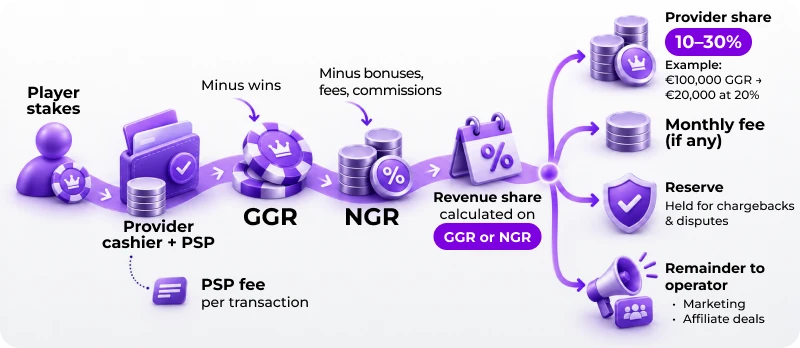
The white label casino price consists of three main costs. First is a one-time fee to set up the solution. Second is a percentage share of the revenue. Third is a monthly charge, which some vendors include in the price. In a comparison of 13 vendors made by iGamingFirms (updated in November), the entry-level prices ranged from €10,000 to €60,000, and the revenue share varied from 10% to 30% of the GGR. Monthly charges are usually not disclosed and show up only in commercial proposals.
| Cost items | Typical range | What to check |
|---|---|---|
| Setup fee | €10,000 - €60,000 (one-time) | What is included: design, payment integration and game selection |
| Monthly charge | Set in the proposal | Whether it is charged from the launch or only above a predefined revenue threshold |
| Revenue share | 10% - 30% of GGR | Whether it is calculated on GGR or NGR |
| Reserve | A portion of revenue is held for a specific time period | When it is released |
| Game content | Revenue share typically includes games. Sometimes content is charged as a separate fee per studio. | Which game studios are charged as a separate fee |
| Payment processing | Fees charged by PSPs for each transaction | Fees for payment in and payout in different countries |
The real cost is determined by the base of the revenue share. Gross gaming revenue (GGR) is total stakes minus wins, while NGR also deducts bonuses, charges and fees. Keeping other things constant, a 20% share of NGR costs less than the same rate on GGR. Some providers also hold a reserve, which reduces the cash available for marketing, to cover chargebacks and disputes.
The white label partner fee is rarely the biggest cost in a startup budget. The competition for new players is very aggressive, with operators spending between $150 and $400 or more per first-time depositor. Affiliate deals on revenue share also add long-term expenses. The full launch budget, including legal fees, design, marketing and other items, is typically several times the white label fee.
How to Launch a White Label Online Casino: Steps and Timeline
As several steps run in parallel, the entire process, from the first call to real-money traffic, takes anywhere between 3 and 8 weeks. A standard process looks like the following:
| Step | What happens | Typical time |
|---|---|---|
| 1. Markets and license | Operator selects target countries and confirms that the provider's license covers them and that they are not on the restricted list | 1-2 weeks |
| 2. Provider and contract | The provider gives a demo of the platform and discusses commercial terms, SLA, data ownership and an exit clause | 1-2 weeks |
| 3. Operator onboarding | The provider conducts due diligence on the company and its beneficial owners | About 1 week |
| 4. Branding and front end | Domain, logo and design of the casino lobby | 1-3 weeks |
| 5. White label casino integration | Integration of payment methods and game providers, bonus terms, responsible gaming settings, affiliate tracking and casino analytics | 1-2 weeks |
| 6. Testing | Simulation of various transactions and tests of the KYC process and the responsible gaming tools | About 1 week |
| 7. Soft launch | Limited traffic before the full-scale launch | 1-2 weeks |
Payments cause the biggest delays. Some methods supported by payment service providers (PSPs) take weeks to get approved. A custom design, meaning work outside the template, also increases the time it takes for the launch.
Local laws on online casinos differ around the world, and the results from step 1 inform a lot of the rest of the analysis. A market outside of the service provider’s coverage area means changing partners, or obtaining a license in the brand’s name, which is a different business model already.
Mobile Version and Apps
In most white-label situations, the casino front-end is responsive, which means the site is mobile-friendly and there is no need for a specific mobile build. Some mobile casino white label platforms offer a progressive web app (PWA), where the app is not listed on a store and is instead pinned to the home screen by the player.
Real mobile apps are more difficult. The Apple App Store review process rejects real money gaming apps if they are not geo-restricted to areas where they hold required licenses, and if they are not free to download. In regulated fields, submissions must be by the legal entity that offers the service, which under a white label is often the provider, not the brand. Google Play allows such titles only in approved countries.
The mobile version of the site is worth testing on a mid-range phone rather than a demo on a big-screen computer. The cashier and lobby load times, as well as the upload of documents for KYC and live dealer streams, show the quality of the mobile product.
How to Choose a White Label Casino Provider
The differences between providers often show up after the contract is signed, and particularly after live traffic is directed to the site. While reviewing a new white label casino provider, five things should be closely analyzed:
- Regulatory framework and compliance structure. Which licenses does the brand run under? Which markets does it cover and what happens to each operator on the platform after a suspension?
- Financial reporting transparency. How is the revenue share calculated? Are GGR or NGR reports broken down by game, studio and payment method? Is raw data available?
- Payment gateway relationships. Which PSPs are available in the target markets? How long do payouts take? Is a reserve applied?
- Technical support responsiveness. What is the service level agreement (SLA) for incident response times and is it 24/7? Is a dedicated account manager available?
- Future transition options to a turnkey online casino. Does the white label allow for the brand, domain and player database to be migrated to the operator’s own setup or another platform?
The best way to get answers to the above questions is to get references from brands already on the platform. Payout speed, quality of support and the handling of a frozen payment account can best be assessed by speaking with such an operator.
Risks and Constraints of the White Label Model
Some of the advantages of this model are also constraints. The main areas of risk are things the operator can’t control directly, such as:
- Shared license. An operator uses one permit together with other brands, so all suffer the consequences together. The license can be suspended or revoked, and rules can be changed.
- Payment control. The platform picks the PSPs, and if a merchant account is frozen, the brand has no way to address the situation directly.
- Product limits. Features and integrations are up to the vendor, so the brand is powerless when something is missing.
- Data and exit. In some cases, the database belongs to the provider, and if the operator wants to move elsewhere, the records can’t be ported.
- Shrinking margin. Revenue is taken as a fixed percentage, so the provider’s share grows as the operator earns more.
- Market limits. The license covers only certain countries, and Great Britain, Malta or Ontario require local approval in any case.
Regulatory change is the thing an operator can control the least. As of December 24, 2024, Curaçao’s National Ordinance on Games of Chance (LOK) repealed the previous law which regulated the old master license and sublicense system. Operators who ran under a sublicense had to apply for their own permit or find a new host.
When Operators Outgrow a White Label Casino
Operators pay more for a turnkey solution because they also foot the bill for legal and compliance work and staff. However, they gain more flexibility and can tailor payment methods, games and markets to their preference. The difference between white label and turnkey solutions can be explained by who owns the permit and the commercial contracts. The application process and hiring take longer and increase costs. In the industry, such deals are said to take 2-5% of GGR, as opposed to 10-30% for white label. A custom platform is a third route, but it often needs 9 to 14 months to build.
Because of the growing expenses and lack of control, operators consider a turnkey solution when the 20% revenue share costs more than their own license and team would, or when they are required to get local approval to work in a new market. For example, if an operator’s GGR was approximately €100,000 a month, a 20% share would cost €20,000. A NuxGame turnkey casino allows a brand to be up and running in a new market in days or weeks, if the design, paperwork and payment service providers (PSPs) are in place.
A smart operator uses white label like training wheels: helpful at the start, but not meant for racing forever. The best strategy is planning the next step early, which means investing in stronger reporting, tighter PSP control, and deeper compliance readiness. Scale is a system you prepare, not a switch you flip.

Denis Kosinsky
Chief Operating Officer at NuxGame