Русский
 International iGaming Licenses Compared in 2026

International iGaming licenses are jurisdiction-issued authorisations, not passports into every regulated market. There is no single global gambling license or international gambling authority that overrides national or state law. An international casino license usually describes an offshore or cross-border operating authorisation, while actual market access still depends on local iGaming regulations, payment restrictions, advertising rules, and supplier acceptance.
For operators, the practical question is therefore broader than obtaining an international gambling license. The selected jurisdiction affects KYC, reporting, game approvals, payment flows, infrastructure, supplier contracts, and platform configuration. The NuxGame online casino platform combines player management, payments, game integrations, reporting, and back-office controls that can be configured around the selected operating model.
Key takeaways
-
No international authorisation automatically permits an operator to accept players in every country.
-
B2C and B2B requirements increasingly affect both operators and their platform, game, and technology suppliers.
-
Licence cost alone gives an incomplete comparison; hosting, audits, corporate substance, reporting, and compliance create additional operating costs.
-
Multi-jurisdiction operators need technical controls that separate common platform functions from market-specific rules.
-
For U.S. operations, offshore or European approvals do not replace state-level authorisation.
International iGaming Licenses: General Comparison
The main license jurisdictions differ most in regulatory scope, supplier treatment, infrastructure requirements, and supervision depth. The table compares the operating models rather than ranking them. A lower license fee does not automatically mean lower launch cost, because technical audits, local presence, banking, hosting, and compliance staffing often sit outside headline regulator charges.
| Jurisdiction | Regulator / authority | Main route | Published fee baseline | Main technical or operational characteristic |
|---|---|---|---|---|
| Curaçao | Curaçao Gaming Authority (CGA) | B2C operating and B2B supplier routes | B2C application: €4,592; annual B2C fees: €47,450 | Direct licensing under LOK; supplier registration and ongoing compliance controls |
| Malta | Malta Gaming Authority (MGA) | B2C Gaming Service and B2B Gaming Supply | Application: €5,000; standard B2C annual fee: €25,000 | Technical setup review, system audit, activity-based compliance requirements |
| United Kingdom | UK Gambling Commission | Remote operating and software approvals | Activity and GGY-band dependent | Detailed Remote Technical Standards, testing, security, and consumer controls |
| Isle of Man | Gambling Supervision Commission | Full, sub, network, and supplier routes | Application: £5,250; full annual fee: £36,750 | Corporate, hosting, supplier, player-fund, and operational controls depend on model |
| Gibraltar | Licensing Authority / Gambling Commissioner | B2C, B2B, key functions and related regulated activities | Depends on licence class and duties | Gambling Act 2025 expanded regulatory scope during the 2026 transition |
| Alderney | Alderney Gambling Control Commission | Category 1 and Category 2 | £10,000 initial investigation deposit | Separates player relationship/funds from gambling transaction infrastructure |
| Kahnawake | Kahnawà Gaming Commission | CPA plus supporting authorisations | Authorisation-specific | Control-system submission, due diligence, key-person and supplier approvals |
| Anjouan | Claimed Anjouan internet gaming authority | Published B2C and B2B routes | Current fee schedule published by issuing body | Legal recognition requires additional verification following 2026 Comoros warnings |
The Curaçao and Malta figures come from current regulator fee schedules, while Isle of Man amounts come directly from statutory fee regulations. UK, Gibraltar, Alderney, and Kahnawake use materially different structures, so comparing them through one headline license cost would hide important operational differences.
Curaçao Gaming License
The former master-license structure ended when the LOK took effect on 24 December 2024. The Curaçao Gaming Authority, formerly associated with the Curaçao Gaming Control Board structure, now licenses operators directly. In 2026, the framework is also moving deeper into supplier oversight, making vendor status part of the operator compliance model.
Key features:
- Direct B2C operating authorisation rather than the former master/sub-license chain.
- Separate B2B supplier route for relevant Curaçao-established technology businesses.
- Domains, UBO information, and qualified interest holders form part of regulator-controlled records.
- Local substance obligations under Article 5.12 are postponed until 1 April 2027.
- AML, KYC, responsible gambling, and player protection remain supervisory priorities.
NuxGame guide: Curaçao Gaming License 2026.
Malta Gaming Authority License
An MGA license follows a different model. The Malta Gaming Authority separates B2C Gaming Service activity from B2B Gaming Supply. Applications extend beyond corporate documentation into business modelling, technical setup, and system review. The €25,000 standard annual B2C fee also sits alongside activity-dependent compliance contributions rather than representing total regulatory cost.
Key features:
- Dedicated B2C and B2B authorisation structures.
- Gaming activity is classified by regulated game type.
- Technical architecture forms part of the application assessment.
- System audits connect the submitted operating model with the deployed environment.
- Ongoing compliance contributions depend on the licensed activity and revenue structure.
NuxGame guide: Malta Gambling License Guide.
UK Gambling Commission License
Great Britain operates as a domestic regulated market rather than an offshore licensing base. Remote operators and relevant software businesses fall under UK technical standards maintained by the UK Gambling Commission. The RTS were updated in January 2026, with further changes effective from 30 June 2026. Their security requirements incorporate a subset of ISO/IEC 27001:2013 controls.
Key features:
- Remote operating approval is tied to the activity offered to British consumers.
- Gambling-software activity has a separate regulatory route where applicable.
- Technical standards cover product behaviour as well as security requirements.
- Testing procedures must align with UKGC requirements before regulated deployment.
- Product changes require continuing compliance, not only pre-launch certification.
NuxGame guide: UK Gambling Regulations in 2026.
Licensing becomes an engineering task once a regulator asks for evidence. The platform needs controls that teams can configure, log, and audit without rebuilding the core for every market. Separating shared platform services from jurisdiction-specific rules keeps compliance changes traceable while product teams maintain one operating model instead of parallel systems.

Denis Kosinsky
Chief Product Officer at NuxGame
Isle of Man Gambling License
The Isle of Man gambling framework provides full, sub-license, network-services, and supplier routes under OGRA. Published Isle of Man fee rules set a £5,250 application charge. Annual fees range from £5,250 for a sub-license to £52,500 for network or token-based supplier activity, depending on the approved model.
Key features:
- Full authorisation supports B2C activity and can include software supply.
- A sub-license remains tied to services from one full licence holder.
- Network-services approval covers a distinct platform and infrastructure model.
- Dedicated supplier routes exist for conventional and token-based technology.
- Applicants need an Isle of Man incorporated company meeting statutory suitability tests.
NuxGame guide: Isle of Man License Guide.
Gibraltar Gambling License
The Gibraltar gambling license framework changed materially in 2026. Under the Gibraltar licensing framework, the Gambling Act 2025 entered the operational transition phase on 1 April 2026. Existing 2005 Act holders were carried into the new framework, while newly captured businesses received six months to notify the Gambling Division and submit applications.
Key features:
- B2C and B2B regulatory scope expanded under the new Act.
- Certain key management functions fall within regulated-individual requirements.
- Marketing activity conducted in or from Gibraltar can enter regulatory scope.
- Certain holding-company structures are also captured.
- Licensing authority and regulatory supervision remain institutionally separate.
For an August 2026 project, the transition itself belongs in the launch plan. A team evaluating Gibraltar should validate which new rules, codes, and approvals apply before freezing its entity and platform architecture.
Alderney Gambling Control Commission License
Alderney separates two functions that many licensing jurisdictions combine. Under the AGCC licence framework, Category 1 covers player registration, verification, contractual relationships, and player funds. Category 2 covers the gambling transaction and operational management of a platform located within an approved hosting centre. An applicant may require either category or both.
Key features:
- Category 1 focuses on the operator-to-player relationship.
- Category 2 focuses on transaction processing and platform operations.
- Applications require an Alderney-registered company.
- The initial investigation deposit is £10,000.
- Category 1 businesses holding player balances generally maintain segregated customer accounts.
This split matters technically. Wallet ownership, registration services, hosting responsibilities, and transaction processing should match the regulated entity map before contracts with platform and payment suppliers are signed.
Kahnawake Gaming License
The Kahnawake Gaming Commission uses the Client Provider Authorization as a principal route for interactive operators. Its Kahnawake application process also identifies key-person, control-system, live-dealer, and Casino Software Provider application forms. That makes the control environment and supplier structure visible during licensing rather than leaving them as post-launch operational details.
Key features:
- Client Provider Authorization covers the principal interactive operating route.
- Key individuals have a dedicated approval process.
- Control System Submission documentation forms part of regulatory preparation.
- A separate Casino Software Provider Authorization exists.
- Due diligence covers both corporate entities and relevant individuals.
NuxGame guide: Kahnawake Gambling License Guide.
Anjouan Gaming License
Anjouan requires a different risk assessment in 2026. The current licensing website publishes B2C and B2B categories and describes due diligence, reporting, and licence conditions. However, a 2026 Comoros central-bank warning states that online betting, gaming, and gambling licensing is not an authorised activity in Union territory and that no corresponding licence had been issued.
Key features and risk checks:
- The issuing website currently advertises separate B2C and B2B categories.
- Corporate, financial, ownership, and technical documents are requested.
- Nominal authorisation should not be treated as automatic market recognition.
- PSP, content-provider, banking, and target-market acceptance need independent confirmation.
- Operators should obtain current legal advice before relying on this route.
NuxGame guide: Anjouan Gaming License Guide.
How iGaming License Requirements Change Platform Architecture
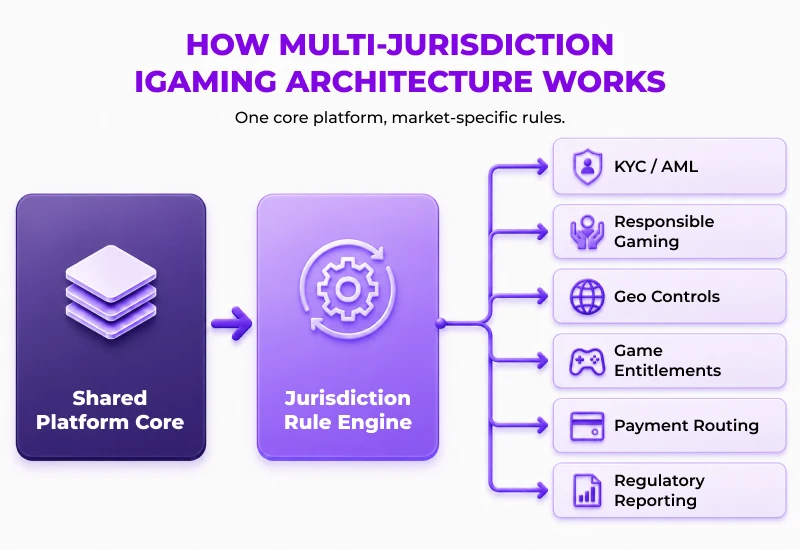
A gaming platform serving several jurisdictions should keep common product services separate from jurisdiction rules. Player accounts, wallets, game sessions, payments, and reporting remain shared services. Eligibility, KYC thresholds, responsible gaming controls, permitted suppliers, country restrictions, payment methods, and reporting schedules should sit in configurable policy layers rather than market-specific code forks.
The audit layer matters equally. Compliance-relevant changes should capture the jurisdiction, configuration version, timestamp, responsible user, previous value, new value, and approval state. This structure lets operations teams demonstrate what rule applied during a specific player event. It also reduces the risk of one market configuration unintentionally changing another regulated environment.
Multi-Jurisdiction Operations: Supplier Approval, Reporting, and Change Control
iGaming software licenses increasingly affect the full vendor chain, not only the B2C operator. A practical entitlement register should connect each supplier’s legal entity with its regulatory status, approved products, game versions, brands, domains, countries, currencies, and expiry dates. The deployment pipeline can then prevent an unapproved provider or product configuration from reaching a restricted jurisdiction.
Curaçao shows why this data model matters. From 24 December 2026, supplier licensing and registration rules become fully enforceable. Foreign suppliers providing critical services do not need a Curaçao supplier licence, but they must register with the CGA. The authority specifically identifies game manufacturers, sportsbook suppliers, bet-settlement systems, and game aggregators among critical-service categories.
For U.S.-focused online gambling operators, this jurisdiction layer becomes even more important. An offshore gaming authorization does not replace state approval. The American Gaming Association reported lawful online casino activity in seven states during 2025, while Maine legislation became law in early 2026. Product eligibility therefore needs to be evaluated state by state rather than inherited from an international licence configuration.
Technical Snapshot: What the Platform Must Prove
A technical snapshot should connect the legal entity, product configuration, and actual production environment. The objective is not to create more compliance documentation. It is to make regulatory evidence reproducible from systems the operator already uses.
| Control area | Platform implementation | Evidence to retain |
|---|---|---|
| Entity and jurisdiction scope | Map brands, domains, products, and markets to the authorised entity | Approval records, domain register, configuration history |
| KYC and AML | Jurisdiction-specific verification and monitoring workflows | Verification events, risk decisions, escalation history |
| Responsible gaming | Configurable limits, exclusions, intervention rules, and player states | Limit changes, exclusion records, intervention events |
| Game and supplier entitlement | Whitelist approved suppliers, games, versions, and markets | Supplier status, certification references, deployment history |
| Payments | Route supported methods by entity, currency, geography, and risk status | PSP decisions, transaction logs, settlement records |
| Change control | Regulatory review before jurisdiction-sensitive releases | Version history, approvers, release IDs, rollback records |
| Reporting | Convert platform events into regulator-specific reporting formats | Submitted reports, source records, reconciliation results |
| Security | Access controls, logging, incident handling, and controlled production changes | Audit logs, access history, incident records, test evidence |
Choosing the right iGaming license therefore starts with an operating model, not a regulator shortlist. The legal team should define markets and entity scope while product and technical teams map those requirements into the platform before submission. NuxGame supports that work through player management, payment configuration, game aggregation, reporting, and back-office controls within one operating environment.
For teams already comparing license jurisdictions, the next useful step is a license-to-platform gap assessment: identify which requirements exist today, which require configuration, and which create new supplier, hosting, or integration dependencies before committing to the jurisdiction.