Русский
 2026 Sports Betting Trends: Agentic AI, Micro-Betting, and the Engineering Behind the Shift

The sports betting technology trends that matter in 2026 are platform-level, not player-level. American bettors placed bets worth $166.94 billion in 2025, an 11% year-on-year rise, and revenue jumped 22.8% to $16.96 billion as national hold stayed near 10%. Legal betting now spans 39 states and Washington, D.C., with more than 80% of bets placed on mobile. Growth on that scale no longer comes from new marketing; it comes from pricing, latency, and compliance engineering.
That shift is why sportsbook operators can no longer treat the tech stack as back-office plumbing. Margins now depend on repricing markets in under a second, scoring risk in real time, and proving compliance continuously — capabilities a marketing budget cannot buy. The NuxGame sportsbook is built for that side of the business, pairing an in-house trading engine and low-latency odds feeds with wallet synchronization, KYC/AML tooling, and a single back office, so B2C brands run pricing, payments, and reporting from one platform instead of stitching together vendors.
Key Takeaways
-
Agentic AI reprices markets in under a second and cuts risk 15–25%.
-
Micro-betting makes sub-two-second odds delivery mandatory.
-
The market is projected to reach $325.71B by 2035 (11.24% CAGR).
-
Blockchain adds funding rails but doesn't reduce payment-security scope.
-
College-prop rules make market coverage a per-state setting.
-
PCI DSS 4.0.1 turned compliance into a continuous process.
2026 Sports Betting Trends: Why the Platform, Not the Player, Is Changing
The sports betting industry stopped being a growth story and became an engineering problem. Modern betting platforms now behave like real-time data systems, not odds boards. The forces reshaping the field are software-defined: autonomous pricing, real-time risk, and integrity monitoring. Winning margins come from hold and speed, so books keep more of each bet.
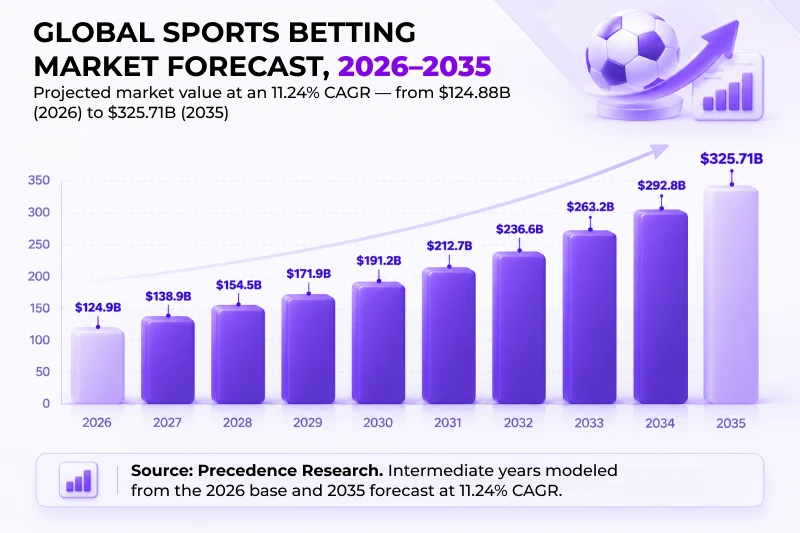
The market backdrop rewards that change. Precedence Research values the global market at $124.88 billion in 2026, projected to reach roughly $325.71 billion by 2035 at an 11.24% CAGR, with North America among the fastest regions of rapid growth. In the U.S., record commercial gaming revenue figures show sportsbooks settled more bets at a higher hold in 2025, and state betting-tax receipts rose 32.4% from 2024 to $3.71 billion.
Participation widened alongside it. In a 2025 survey, roughly 20% of adults said they place bets online, and reported betting over the past 12 months rose from 12% in 2023. Active accounts also log more live bets per session. This article maps six shifts to concrete platform requirements:
Trend 1 — Agentic AI in Sportsbook Operations
Agentic AI is the defining forecast for the 2026–2035 stack. These autonomous systems price markets, manage exposure, and flag fraud without a trader reviewing each bet. Even the two giants, FanDuel and DraftKings, now price full slates and prop bets with models rather than desks. Books running machine learning reprice in under a second and cut risk by a reported 15–25%.
The model layer is specialized rather than a single engine. A working trading stack blends several analytics roles that turn raw data into pricing insight:
- Gradient-boosted models (XGBoost, LightGBM) for fast pre-match odds.
- Sequence models for momentum and in-play probability shifts.
- Graph networks for collusion and match-fixing detection.
Agentic AI also reaches the bettor side, and that is the new integrity problem. Autonomous agents compare prices across books, exploit latency, and slip bets in the milliseconds before a market closes. When chance is engineered out, betting edges toward financial trading. The NuxGame platform gives books odds feeds and back-office risk controls, so pricing and exposure stay governed as the book accepts more bets per second.
Trend 2 — Micro-Betting and Sub-Second Latency
Micro-betting is the sharpest engineering constraint of 2026. Markets open and close on single bets within a possession, and live betting already produced about 62% of online sports betting revenue in 2025. The workflow is now a real-time data system: event detection, price calculation, odds update, then bet acceptance. Every stage adds delay, and delay is exposure.
A workable in-play latency budget across that chain looks like this:
| Stage | Target latency |
|---|---|
| Data ingestion from official feed | 300–500 ms |
| Odds recalculation and correlation modeling | 200–400 ms |
| Client delivery and bet acceptance | under 300 ms at scale |
Premium feeds now advertise sub-0.5-second delivery to price and suspend thousands of in-play bets. Distribution is shifting too: the NBA supplies an official micro-betting feed through a data partnership, and DraftKings has powered live-stream markets. Online betting now runs mostly on phones, so a bet slip must render fast on mid-range smartphones through mobile betting apps. The NuxGame sportsbook lets books price and accept bets on any market through API-based odds feeds without an in-house trading stack.
In 2026, the market you can price in under a second is the market you actually own. Speed, disciplined risk, and clean compliance now decide margin — long before marketing does. We build for that reality, so our partners spend their attention on players, not on holding vendors together.

Denis Kosinsky
Chief Product Officer at NuxGame
eSports Betting Evolution: Beyond Traditional Match-Winner Markets
Competitive-gaming markets have outgrown simple match-winner lines. Bettors now bet on first blood and first tower, and place bets on map handicaps and round totals across League of Legends, Dota 2, Counter-Strike 2, and Valorant. Each title carries its own pacing, so models cannot be copied between them. The global esports market reached roughly $2.8 billion in 2025, an esports industry growing rapidly around year-round esports tournaments.
Depth raises the integrity bar. Tier-2 matchups pair thin oversight and low prize pools with small sample sizes, which invites match-fixing. Interest runs highest among younger demographics, and among bettors who already play the titles. New gamblers often place bets on esports before betting an NBA or NFL line. The NuxGame aggregation layer lets books expand a betting portfolio and run these markets from one back office.
Trend 3 — Blockchain-Based Wagering and Web3 Fan Engagement
As on-chain rails emerge, blockchain-based betting is moving from novelty to a funding rail. In states like Wyoming, blockchain accounts and digital wallets push faster payout and withdrawal into regulated markets, improving accessibility for players who fund bets in crypto. Smart-contract settlement clears bets and reduces manual reconciliation, and on-chain records support provably fair outcomes. The trade-off is custody, key management, and per-jurisdiction legality, not raw feasibility.
Web3 fan engagement is the adjacent commercial layer. Tokenized loyalty, fan tokens, and on-chain rewards tie recurring play to verifiable ownership rather than points in a database. This kind of innovation widens online gambling reach, yet real-money funding still routes through card and bank rails, so security scope does not shrink. The NuxGame platform handles payment routing, provider configuration, and wallet synchronization through one integration, so books add funding methods without rebuilding settlement logic.
Trend 4 — Subscription and Loyalty Models
Subscription-style loyalty is displacing the sign-up bonus as the retention engine. Acquisition costs climbed as markets matured and influencer channels saturated, and retention is now the primary KPI. Recurring models — VIP tiers, gamified streaks, and promotion calendars — reward repeat bets over one-time bonuses. Market research now ties profitability to retention, not sign-up volume; a profitable, loyal bettor and their evolving consumer preferences outweigh raw acquisition.
Event calendars like the 2026 FIFA World Cup let books capitalize on acquisition spikes, but retention decides the payoff in highly competitive states where competition centers on lifetime value. Loyalty also carries a safer-gambling duty the gambling industry now shares. The same behavioral pipeline that ranks offers reads harm signals and can flag a developing gambling problem early. Most play stays recreational, yet responsible gambling measures must stay visible, and design should never increase the amount at risk.
A shared behavioral pipeline typically reads:
- Bet frequency, stake velocity, and the amount spent on gambling per session.
- Session length, time-of-day, and cash-out behavior.
- Market and sport preference, used for both offers and risk flags.
Programs must surface loss and time limits, deposit limits, self-exclusion, and visible help resources, including the national helpline, Call 1-800-GAMBLER. In 2025, BetMGM and bet365 both extended in-app tools that score player risk, flag risky bets, and nudge safer play. The NuxGame back office provides player account management, segmentation, and configurable limits, so personalization and protection run from one data set.
Trend 5 — NIL, College Markets, and Betting Integrity
The professionalization of college sport is quietly reshaping bettable markets. Since the House v. NCAA settlement took effect on July 1, 2025, schools can pay athletes directly under a cap near $20.5 million per school, separate from NIL earnings. The legalization of sports betting keeps expanding and continues to fuel new markets, but money and transfer churn raise integrity risk around college games.
Regulators responded by narrowing which college markets books may offer:
- Several states restrict or ban prop bets on individual student-athletes.
- Integrity monitoring must cover unusual line movement on college games.
- Market coverage now varies by state, not just by sport.
For the business, this is a configuration and monitoring problem, not a content one. A single platform must enable or disable college prop bets per jurisdiction, log every bet, and flag suspicious bets for review. Handled well, tighter rules become opportunities for betting operators rather than friction. The NuxGame system gives betting brands configurable market rules, reporting exports, and player controls aligned to state requirements.
Trend 6 — Predictive Compliance as Continuous Architecture
Compliance in 2026 is continuous, not annual. Under PCI DSS 4.0.1, every script on a payment page must be authorized and inventoried, and a payment-page tamper detection mechanism must flag unauthorized changes. These controls became mandatory in March 2025 to counter e-skimming. Non-compliance penalties reach $100,000 per month until gaps close, so every bet has to flow through a checkout that runs only authorized scripts.
Cross-border books face heavier reporting regimes abroad. The UKGC enforces affordability and stake checks, while the MGA requires audited technical systems for licensees. Germany’s LUGAS adds a monthly cross-book cap and near-real-time activity reporting, turning obligations into audit insight. Each regime adds monitoring endpoints, so a single codebase must export jurisdiction-specific reports without forking per market.
2026–2035 Engineering Forecast: How the Sportsbook Stack Evolves
Trends describe what is changing now, while an engineering forecast describes what the stack must support later. The Precedence Research outlook runs to 2035, and so do several technical deadlines that already shape platform roadmaps. Planning against those dates turns market growth into build decisions. The horizons below are NuxGame projections anchored to published standards, not guaranteed outcomes.
Each horizon raises the baseline set by the one before it. Once AI-generated odds become the norm, differentiation moves to model governance, explainability, and audit trails for automated decisions. Payment security shifts from script control toward cryptographic agility. By 2035, a book that cannot swap algorithms, report per jurisdiction, and reprice in-play markets fast carries structural risk.
| Horizon | Pricing and trading | In-play and data | Payments and security | Compliance and reporting |
|---|---|---|---|---|
| 2026–2027 | AI-generated odds on props and in-play, with human override | Sub-two-second end-to-end updates on micro-markets | PCI DSS 4.0.1 script controls plus a full cipher inventory | Per-state market toggles and exportable reports |
| 2028–2030 | Agentic pricing across full slates, with every override logged | Latency budgets tighten as more handle moves in-play | Hybrid classical and post-quantum key exchange on payment and wallet traffic | Near-real-time activity reporting spreads beyond early adopters |
| 2031–2035 | Autonomous risk agents audited like trading systems | Session-level micro-markets generated on demand | Quantum-vulnerable RSA and ECC removed from account and payment flows | Continuous, API-based supervisory access to betting data |
Post-Quantum Cryptography: The Security Deadline Inside the Forecast
Post-quantum cryptography is the least visible item on that roadmap and the hardest to rush. NIST finalized its first three post-quantum standards, FIPS 203, 204, and 205, in August 2024. Its draft transition roadmap proposes deprecating 112-bit RSA and elliptic-curve algorithms after 2030 and disallowing quantum-vulnerable public-key algorithms after 2035.
The risk for betting platforms is harvest now, decrypt later: recorded KYC files and payment traffic stay valuable for years. PCI DSS v4.0.1 does not mandate quantum-safe algorithms. Requirement 12.3.3 does require a cipher suite and protocol inventory, reviewed every 12 months, plus a plan for anticipated cryptographic weaknesses. That inventory is where migration starts.
Migration steps worth scheduling before 2030:
- Map every certificate, key, and cipher suite across wallet, KYC, and payment flows.
- Prefer libraries and HSMs that already support hybrid key exchange.
- Rotate long-lived keys that protect stored identity documents.
- Add crypto-agility clauses to payment and data provider contracts.
The NuxGame platform routes payments and synchronizes wallets through one integration, which narrows the number of vendor endpoints a cryptographic inventory has to cover. Fewer integrations leave fewer places for a quantum-vulnerable algorithm to hide.
Technical Snapshot
This section maps the 2026 shifts above to implementation requirements and the indicators to monitor. Availability at event peaks leans on redundant capacity and network-layer DDoS mitigation, since downtime during marquee events erases earnings directly. Technological advancements such as virtual reality (VR) remain early, with meaningful adoption unlikely in the near term, so this checklist prioritizes systems already earning today.
| Layer | Implementation requirement | Target indicator |
|---|---|---|
| Pricing (Agentic AI) | Model ensemble plus human override | Sub-second repricing; 15–25% risk reduction |
| In-play odds | API feed plus market-suspension logic | End-to-end update ≤ 2 s |
| Data feed | Official or low-latency source | Feed latency < 0.5 s |
| Payments | PCI DSS 4.0.1 script and tamper controls | Zero unauthorized payment-page scripts |
| KYC / AML | Automated verification and manual queue | Approval in minutes; low manual-review rate |
| Wallet / blockchain | Routing plus wallet synchronization | Low sync delay; reconciled settlement |
| Compliance | Per-jurisdiction reporting exports | On-time regulatory submission |
| Safer gambling | Limits, exclusion registers, risk scoring | Enforced pre-bet and in-session |
Conclusion and Next Step
The books that gain ground will treat these sports betting trends as engineering and compliance decisions, not campaign themes. The strategic question is no longer which markets to offer, but whether the platform can price, settle, and monitor every bet within regulatory limits at event-peak load. That is the winning question for 2026. Evaluate providers on latency, model governance, reporting obligations, and integration count before committing to a season.
Planning a book launch or migration before the next major season? The NuxGame team can map your Agentic AI pricing, in-play, payment, and compliance requirements to a single integration. Request a technical walkthrough to see how the sportsbook, aggregation, and back-office tools fit your target markets and jurisdictions.