Русский
 Top 10 High-RTP Games in 2026: Highest RTP Slots for Online Casino Operators

The list of top 10 highest RTP slots for 2026 gives operators a certified shortlist of online slot titles with return to player rates between 97.04% and 99.10%. Each game’s RTP is calculated across billions of simulated rounds during math-model certification by GLI, iTech Labs, or BMM before jurisdictional approval.
For online casino brands, high-RTP inventory shapes GGR margins, promo liability, contribution ratios, and 30-day retention curves. NuxGame aggregates over 15,000 casino games from 130+ studios and helps operators configure the exact certified build exposed per market, per segment, and per campaign cohort.
TL;DR
-
Highest RTP online slots for 2026 range from 97.04% to 99.10%, with three titles clearing 99%.
-
Studios ship 2–4 certified builds per slot; operators, select which variant goes live.
-
GLI-19, UKGC RTS 7A, and MGA Critical Gaming Supply mandate cryptographic version-locking of every payout table.
-
Slots with high theoretical returns absorb 3–6% more promo liability across a 90-day cycle than mid-tier casino inventory.
-
Aggregation-level switches let operators pin builds per country in under 15 minutes.
Understanding RTP as an Operator Metric, Not a Player Statistic
The RTP metric is derived by running 1 to 10 billion theoretical spins against a slot’s PAR sheet during math-model certification. The lab confirms the declared payout matches the studio submission within a defined tolerance, usually ±0.1%. RTP first appeared as a regulated concept on the physical casino floor in the 1990s and moved with the industry onto remote game servers.
Portfolio decisions require more than a headline percentage. A five-reel slot at 99.10% with high volatility can outperform a 96% medium volatility reel on retention while underperforming on short-session GGR. Operators pair the statistical return figure with hit frequency, feature trigger cadence, and slot features like expanding wilds or retriggers pulled from certified math sheets under the GLI-19 interactive gaming standard.
Key measurements operators pull from certified math sheets:
- Theoretical payout percentage with base-game and feature contribution split
- Hit frequency across base game and bonus features
- Standard deviation and volatility index (studio scale, 1–10 or Low/Medium/High)
- Maximum win potential expressed as a bet multiplier
- Feature trigger frequency for slots that include free spins, respins, and jackpot rounds
2026 Operator Portfolios: Top 10 High-RTP Games by Certified Payback
The shortlist below reflects public math sheets and lab certifications valid as of June 2026. When looking for the highest published returns, operators licensing these online slot games through casino aggregation should verify which build ships for each target market. Studios routinely publish 92%, 94%, 95%, and 96%+ builds of the same slot game, and jurisdictional filters determine which loads for the end player.
| Rank | Slot | Studio | Certified RTP | Volatility | Max Win (bet multiplier) |
|---|---|---|---|---|---|
| 1 | Ryse of the Mighty Gods | Peter & Sons / Yggdrasil | 99.10% | High | 10,000x |
| 2 | Ugga Bugga | Playtech | 99.07% | Low | 1,000x |
| 3 | Book of 99 | Relax Gaming | 99.00% | High | 10,000x |
| 4 | Mega Joker (Supermeter) | NetEnt | 99.00% | High | 2,000x |
| 5 | Jackpot 6000 | NetEnt | 98.86% | Medium | 12,000x |
| 6 | 1429 Uncharted Seas | Thunderkick | 98.60% | Low | 1,459x |
| 7 | Money Cart 3 | Relax Gaming | 98.12% | High | 50,000x |
| 8 | Blood Suckers | NetEnt | 98.00% | Low | 900x |
| 9 | Starmania | NextGen Gaming | 97.87% | Low-Medium | 2,400x |
| 10 | Steam Tower | NetEnt | 97.04% | Medium | 1,000x |
Each entry above exists in multiple certified variants. Positioning one of the highest RTP titles as headline promo bait works only when the deployed build actually matches the advertised gameplay figure. Operator liability rises fast when a landing page cites a 99% return while the live game loads a 94% variant that the aggregator routed for a different license.
Volatility, Hit Frequency, and Portfolio Balance
Best RTP slots alone do not predict commercial performance. A high-volatility slot at 98.12% delivers 60–80% of its return through rare free spins and feature triggers, so a low-deposit segment may churn before ever hitting the bonus round. Balancing acquisition against LTV means pairing one high-payback low-volatility anchor with two medium volatility slots and one high-variance title per lobby tile.
Hit frequency ranges from roughly 18% on classic three-reel builds to 45% on modern cluster-pay titles. Operators can surface high hit-frequency inventory to new registrations and rotate volatility slots into VIP tiles. Deployment data across the NuxGame platform points to a 4–7% uplift in day-14 retention when portfolios follow this segmentation pattern.
High-RTP content should not be treated as a trophy shelf. The real value comes from matching the right certified build to the right market, player segment, and campaign rules. When operators manage RTP, volatility, and contribution settings together, the game catalog becomes a controlled growth tool rather than a margin surprise.

Denis Kosinsky
Chief Product Officer at NuxGame
Session Thrill Cycles, Bankroll Dynamics, and Segmentation
The thrill of a rare feature trigger drives session extension on high-variance builds, but low-deposit bankroll churn offsets the effect when the operator surfaces the wrong build to the wrong cohort. Players who expect to win frequently gravitate to high hit-frequency titles; players chasing the highest return through concentrated variance cluster on Money Cart 3 or Book of 99. Segmentation therefore drives more GGR than raw catalog size.
Player-Friendly Games and Cross-Vertical Comparison
Player-friendly games with a high RTP percentage and low variance — Blood Suckers, Starmania, 1429 Uncharted Seas — extend session time and reduce first-week churn. Blackjack titles on the same casino platform run at 99.4–99.6% payback, so operators comparing vertical margins should weight the slot mix against table exposure. RTPs across studios vary by math team, but audit rules stay identical.
RTP Certification Under GLI-19, UKGC RTS, and MGA Frameworks
Slot RTP is not a marketing figure. It is a certified attribute of a game submitted to accredited labs and audited against jurisdictional rules. Under the GLI-19 framework, every RNG output, payout table, and variant is cryptographically hashed and version-locked in the certification report. Operators cannot alter the certified value; they can only choose which build to deploy.
The UKGC’s remote technical standards require operators to display each slot’s RTP figure or an accessible link to it, and to maintain audit logs proving the deployed build matches the certified version. Malta’s Critical Gaming Supply framework treats tampering as a Class II breach. Non-compliance triggers license review, delisting from the regulator’s approved supplier register, and player refund liability that can reach seven figures per incident.
US state regulators (NJ DGE, PA GCB, MI MGCB, WV LCB) require the same evidence chain plus state-specific test amendments. Online casino operators serving Ontario, Connecticut, and West Virginia typically maintain a separate certified build per state, even when the studio’s base math model is identical across markets. Top sweepstakes operators face similar disclosure rules under state consumer-protection frameworks despite sitting outside standard gambling licensure.
Aggregation Architecture and Multi-Version Configuration
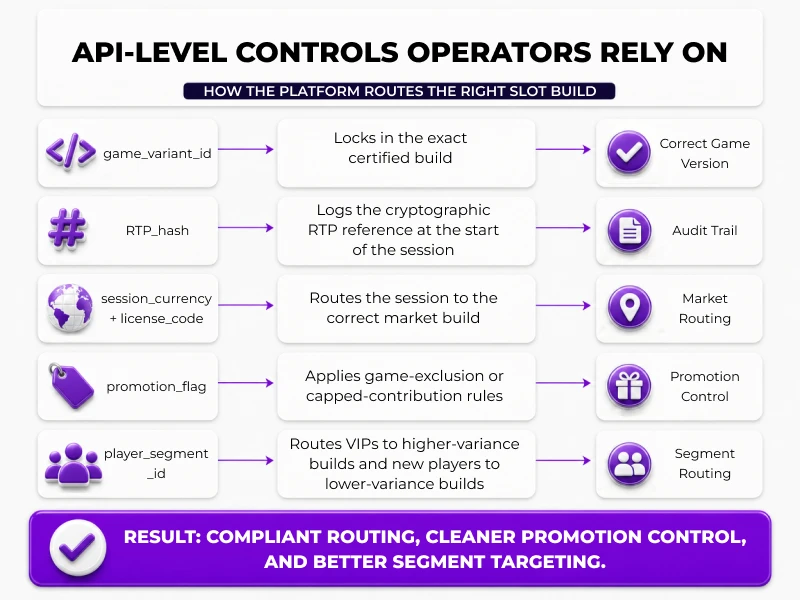
Casino aggregators sit between the operator’s platform and 100+ game studios. Each studio pushes a game ID plus a certified profile per jurisdiction. The aggregation layer routes the correct build using license-code matching, geo-lookup, and currency mapping. If the routing table is misconfigured, a player in Ontario can load a Curaçao-market build — a reportable compliance event under GLI-19 audit trail rules.
The best casino aggregator from NuxGame handles this at platform level. Casino operators integrate once and can pin variants per brand, per country, and per player segment across the best online catalog in a single API. Version switches propagate to production in under 15 minutes, and every game load event carries the payout hash back into the operator’s reporting layer for regulator audits and internal reconciliation against studio wallet callbacks.
Commercial Impact: Contribution Weights, Promo Design, and Abuse Vectors
The higher the RTP, the lower the operator edge becomes during bonus play, especially on 98–99% slots. On a 30x wagering requirement, a 99% slot returns the player 74% of the promo value in expected losses versus 45% on a 96% title. Sharp promo hunters concentrate stake volume on the highest paying shortlist, so casino operators cap slot contribution at 10–20% or exclude specific game IDs entirely.
Standard controls operators configure on high-value promo mechanics:
- Slot contribution weight per game ID (0–100%)
- Max bet cap during active promos (typically $5–$10)
- Excluded list surfaced through aggregation flags at session start
- Bonus buy feature disabled during wagering runs
- Session-level wager velocity monitoring to flag pattern abuse
The house edge on this shortlist sits between 0.9% and 3%. Operators running big win acquisition campaigns must model expected margin dilution and set a promo-abuse threshold at the risk layer. Anything under 1% house edge without contribution controls creates negative expected value on the promo cohort within four weeks.
Operator Notes on Configuring High RTP Portfolios
Slot machine mechanics inherited from land-based cabinets still shape how modern penny slot inventory pays out. When a slot has an RTP above 98%, the studio typically compensates by extending hit frequency and reducing peak win size, so best-paying slots sit closer to the low-volatility end of the shortlist. High RTP slots therefore drive smaller sessions but higher return frequency — a retention lever, not a churn signal.
Operator-side tips for deploying this shortlist:
- Route penny slot cohorts to low-volatility builds like Blood Suckers or 1429 Uncharted Seas
- Position high return games for those who play online at entry-level bet sizes
- Include free spin triggers as a UX signal for return transparency
- Segment player behavior by session length rather than deposit size
- Monitor bonus-hunter traffic patterns on customers playing slots at consistent bet levels
Technical Snapshot
Implementation checkpoints for a compliant top-payback portfolio on the NuxGame platform:
| Checkpoint | Requirement | Data Point |
|---|---|---|
| Studio math ingestion | PAR sheets and hashes into versioned catalog | Weekly sync per studio |
| Jurisdictional routing | Game ID → license code → currency mapping | Under 15 min propagation |
| Session logging | Return value, build hash, player ID per game load | 100% event capture |
| Disclosure surface | In-game info panel or linked page per UKGC RTS 7E | Mandatory for UK, NL, MGA, US |
| Reporting integration | Regulator endpoint per market (NJ IGRS, MGA CMS, UKGC portal) | Daily or real-time |
| Wallet reconciliation | Aggregator GGR vs. studio callback ledgers | T+1 close |
| Uptime target | Platform SLA per operator contract | 99.95% |
| Security scope | Card and payment flows meet PCI DSS scope | PCI DSS v4.0.1 |
Conclusion
Content selection at the payback layer is a commercial and compliance decision, not a marketing one. The shortlist above helps operators discover the highest RTP titles and build a defensible starting position for 2026 catalog planning across regulated US and European markets. Anchor the top shortlist in high-visibility tiles, pin the correct certified builds per jurisdiction, and instrument reporting from day one.
Operators evaluating high-RTP games can use the NuxGame casino aggregator to test build-level configuration across 15,000+ games and 130+ studios in a single integration. Version-pinning, jurisdictional routing, and reporting hooks are exposed through one API and one back office. Book a technical walkthrough with the NuxGame team to see live sandbox configuration for your target markets.