Best Bookmaker Software Providers in 2026: A Technical and Compliance Guide for Sports Betting Sites

Best Bookmaker Software Providers in 2026: A Technical and Compliance Guide for Sports Betting Sites
Choosing the best bookmaker software in 2026 is no longer only about odds coverage or front-end design. For US-focused sports betting sites, the right platform needs to combine a low-latency odds engine, trading controls, certified geolocation, payment security, and clear compliance logic across every bet. This is where providers like NuxGame become relevant for operators that want sportsbook software built around risk control, player account management, and scalable daily operations.
In a high-volume online sportsbook environment, pricing accuracy, uptime, and settlement control directly affect margin. A platform that cannot suspend markets quickly, verify player location, or connect payments and wallet activity under one operational view creates risk before growth even starts.
Key Takeaways
What Counts as the Best Bookmaker Software for a US Operator
“Best” is not a feature list. It is the fit between a sportsbook software stack and the jurisdiction you intend to license in. Operators sometimes use the term bookmakers software for this stack, but the real question is how well it connects odds, wallet logic, reporting, and compliance controls. Choosing betting software for bookmakers starts with knowing what to look for in a sports betting platform before comparing design, bonuses, or front-end templates.
Three delivery models dominate the market: turnkey packages platform, payments, and back office for fast launch. API/SaaS sports betting software exposes feeds and wallet logic to your own front end. White-label sits between them, trading control for speed and shared compliance. For a sports betting site connected to an existing website, the choice also affects wallet flow, reporting, and the daily work behind the betting business.
The choice sets cost and risk before a single bet clears. Turnkey builds typically land in the $50K–$150K range and shorten launch windows. Custom API integration costs more and demands engineering, but it gives operators direct control over the interface and odds presentation. The right software also depends on channel strategy, including web sportsbooks, mobile betting apps, and customizable betting platforms. In practice, the best fit comes down to your betting business model, target states, and internal trading team.
US Compliance Architecture: GLI-33, GLI-19, and Geolocation
US sportsbook software must satisfy technical standards before any commercial discussion. GLI-33 covers the event-wagering layer, including wager integrity, settlement logic, and audit trails. GLI-19 supports the interactive gaming and player account management layer beneath it. In the US sports betting market, regulated sports betting activity must be recorded, verified, and reported correctly.
A compliant online betting and mobile betting setup needs to prove several things from day one:
| Compliance layer | What it controls | Why it matters |
|---|---|---|
| GLI-33 | Wagers, voids, payouts, and audit trails | Regulators need a clear record of every bet and settlement decision. |
| GLI-19 | Player accounts, balances, and platform controls | The account layer must support responsible, secure, and traceable activity. |
| Geolocation | Real-time state-border checks | Sports wagering cannot cross into states where the operator is not licensed. |
| KYC and age gates | 21-plus checks and identity verification | Registration must block underage or unverified players before betting starts. |
Geolocation carries special weight because legal sports betting and online sports wagering are licensed state by state. A failed location check is not a UX issue; it is a compliance event. The system must block bet acceptance in real time when a device sits outside licensed borders, while KYC and age checks protect the rest of the player journey.
For operators, compliance should not be treated as a gate at the end of the road. It has to be built into daily operations: location checks, player accounts, payments, and risk controls. When these pieces work together, the platform gives teams room to grow without turning every new market into a fire drill.

Denis Kosinsky
Chief Product Officer at NuxGame
Inside the Odds Engine and Trading Console
The odds engine is where margin lives. It ingests feeds from data suppliers, prices betting markets, and adjusts lines as money and volatility move. Per the AGA revenue tracker, in April 2026, US sports betting hold reached 11.1%, up from 9.3% in April 2025, so even small pricing errors can compound quickly across a busy sportsbook.
| Layer | Role | Operator risk |
|---|---|---|
| Odds engine | Prices markets and adjusts betting odds as conditions change. | Slow or inaccurate pricing can reduce hold. |
| Trading console | Gives traders manual control over automation. | Weak controls make it harder to manage exposure. |
| Feed depth | Expands sports coverage across major sports, niche sports, and esports. | More markets create more monitoring work for the risk team. |
A reliable sportsbook software setup should keep these controls in one interface. Traders need to set betting limits, suspend volatile markets, and manage exposure without switching between disconnected modules. A variety of sports like football, basketball, tennis, esports, and smaller leagues can improve betting coverage, but every added market also increases the risk surface the trading team must watch. This is especially important in a dynamic sports calendar where traditional betting and in-play demand shift quickly.
Payment Routing, Wallet, and PCI DSS Settlement
Payment architecture determines whether deposits convert and withdrawals clear undisputed. The standard is PCI DSS v4.0.1, which establishes controls for the storage, processing and transmission of cardholder data. Operators are subject to fines and termination by processors for non-compliance.
It is a single wallet design to keep one balance on the sportsbooks and casinos. It eliminates the transfer delays and reconciliation gaps that come with multi-wallet configurations. When a bettor transitions from a parlay to slots, the balance is updated without a sync step, enabling a more seamless betting flow and reducing the wallet sync delay to near-zero levels. For hybrid operators, software for online casinos and bookmaking websites should connect sportsbook, casino, payments, bonuses, and settlement under one financial view.
Payment routing then directs each transaction through the processor most likely to approve it. Smart routing lifts approval rates and trims the chargeback rate that erodes net revenue. Crypto rails add a parallel settlement path, with platforms supporting 30-plus cryptocurrencies including BTC, USDT, and Ethereum. In practice, this type of software provides cleaner reconciliation, while the same wallet logic allows operators to connect deposits, withdrawals, bonuses, and settlement under one financial view.
Live Betting at Scale: Latency and Session Continuity
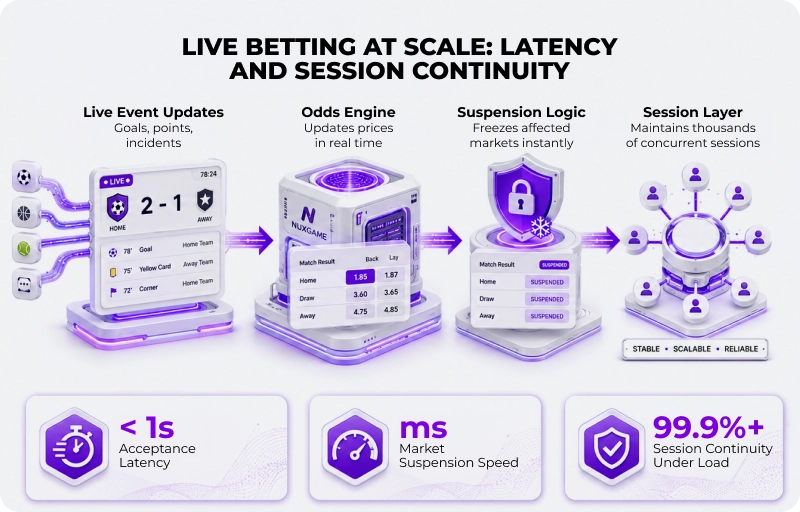
Live betting is the highest-revenue and highest-risk surface in the stack. Live betting options shift second by second, so bet acceptance latency directly affects both player trust and operator exposure. Operators should require sub-second acceptance and audited suspension logic before signing a provider contract.
Suspension is the safety valve. When a goal, point, or red card lands, the engine must freeze affected live betting markets within milliseconds to block stale-price wagers. Slow suspension is a direct path to arbitrage losses, especially on fast events and low-margin betting markets.
Scale is the second test. A live betting platform must hold thousands of concurrent sessions without dropping odds pushes. Cashout, bet builder, match betting, quick bet tools, and other live betting features all run on this layer, so session continuity under load defines the mobile betting experience for sports bettors who want to bet on sports during active play. Without reliable betting performance, even strong market coverage can turn into operational risk.
Integration Models and Migration Risk
For operators evaluating sports bookmaking software, the integration model is a product decision with a long tail. It sets launch speed, engineering cost, and who manages the sports betting license process in each target market. Migration between models later is expensive because wallet history, bet records, and KYC data must move without loss.
| Model | Time to Market | Operator Control | Cost Band | Compliance Ownership |
|---|---|---|---|---|
| Turnkey | Weeks | Configuration only | $50K–$150K | Mostly provider-managed |
| API / SaaS | Weeks to months | Full front-end control | Custom | Shared, operator-led |
| White-label | Days to weeks | Brand and content | Lower entry | Provider-led |
Vendor consolidation is the underrated lever. Each separate connection for feeds, payments, KYC, aggregation, free bets, and betting promos adds a reconciliation point and a failure point. For sports betting software providers in 2026, consolidation is also a commercial advantage because different vendors offer different levels of software services, support, and post-launch responsibility. Cutting the number of vendors lowers integration complexity and the operational cost of monitoring uptime across them.
Migration risk peaks at data handover. A clean cutover preserves open bets, pending withdrawals, and audit logs the regulator expects. Plan a parallel-run window and a rollback path before switching any betting software provider in a live market. When comparing sportsbook software providers, operators should also check whether the package covers sports betting services, retail betting extensions, betting operations, online bookmaking software workflows, and the practical needs of a growing betting business.
Technical Snapshot
| Layer | Requirement | Indicator / Benchmark |
|---|---|---|
| Event wagering | GLI-33 certified logic and audit log | Immutable, time-stamped wager records |
| Account layer | GLI-19 PAM certification | Single source of player truth |
| Geolocation | Certified provider, real-time blocking | 350+ checks per verification |
| KYC / age | SSN verification, 21+ gate at registration | Pre-deposit completion |
| Odds engine | Automated repricing plus manual override | Sub-second line and suspension updates |
| Payments | PCI DSS v4.0.1 controls, smart routing | High approval, low chargeback rate |
| Wallet | Single-balance design | Near-zero synchronization delay |
| Reliability | High-availability hosting | 99.9% uptime target |
Where the NuxGame Platform Fits
The NuxGame sportsbook brings the main sportsbook software layers into one back office instead of splitting them across multiple vendors. Operating since 2018, the platform carries 400,000-plus monthly events across 125-plus sports and 3,000-plus betting markets, with odds supported by an in-house hub and tier-one data suppliers.
| Layer | How NuxGame supports it | Operator benefit |
|---|---|---|
| Odds and trading | In-house odds engine with a single trading console | Traders can adjust lines, monitor volatility, and manage risk from one interface. |
| Live betting tools | Cashout, bet builder, quick bet, tournament widget, and match tracker | Operators can support a richer betting experience during high-volume events. |
| Platform operations | Payments, player account management, KYC, and casino content under configurable modules | Teams reduce the number of separate systems they need to manage. |
| Integration | Sports Betting API and modular setup | Operators can connect sportsbook features without rebuilding the full platform stack. |
| Reliability and growth | Reported 99.9% uptime and gamification modules for major sports events | The platform supports traffic peaks while helping teams improve user engagement. |
This makes the NuxGame platform relevant for operators planning a US or multi-jurisdiction launch, especially when they want one sportsbook software provider to cover trading, payments, KYC, casino content, and back-office controls. Before choosing a provider, map the setup against your target markets, compliance scope, and integration timeline. Then request a demo to review the odds engine, trading console, payment routing, and configuration controls in practice.
Bottom Line
The best bookmaker software is not the longest feature sheet. It is the stack whose compliance scope, odds-engine latency, sports betting API connectivity, and settlement architecture match the jurisdiction where you intend to become licensed and the margin you defend. Sports betting hold was about 10.2% in 2025, so pricing accuracy and uptime are commercial questions, not technical footnotes.
Score candidates on certification fit, geolocation, live-betting latency, and integration model — then weigh migration risk before you commit. The NuxGame platform supports this approach by bringing sportsbook, payments, KYC, and back-office controls into one operational setup. Start the evaluation against your markets, not against a brochure.