AI iGaming Fraud Prevention 2026: Real-Time Detection Architecture Without Conversion Damage

AI iGaming fraud prevention in 2026 is no longer about blocking every suspicious action instantly. For an operator, the real task is to separate automated fraud, bonus abuse, payment risk, and verification issues from unusual but valid player behavior. From the NuxGame platform perspective, this means connecting real-time scoring, review workflows, AML and KYC checks, cashier controls, and evidence logs without slowing down legitimate players.
Key Takeaways
Why Old Rule Sets Miss Coordinated Abuse
Traditional fraud detection relied on fixed rules, chargeback reports, and reviewer notes after damage had already appeared. That misses modern iGaming fraud because one fraudster rarely acts in one channel. Signals now move across signup, KYC checks, deposit attempts, reward use, wagering behavior, withdrawals, and support requests.
The scope of iGaming includes account takeover, identity fraud, synthetic identities, payment fraud, bonus abuse, collusion, bot traffic, and money laundering indicators. These types of fraud often look harmless in isolation. Detection improves only when transaction, behavioral, device, wallet, and gaming data are compared together.
| Abuse signal | Why old rules miss it | What AI detection adds |
|---|---|---|
| Account takeover | The login may look valid at first. | Behavioral changes expose unusual session patterns. |
| Bonus abuse | Each claim may match the promotion rules. | Shared devices and repeated reward paths reveal fraud patterns. |
| Payment fraud | A single deposit attempt may not prove intent. | Velocity checks connect failed cards, wallets, and transaction trails. |
| Synthetic identities | Documents may pass basic verification. | Ownership links expose repeated templates, devices, or data reuse. |
| Money laundering | Each bet may look ordinary. | Machine learning highlights anomaly clusters across wallet movement. |
The use of AI changes detection by ranking weak signals before losses materialize. Machine learning helps identify anomaly clusters, fraud patterns, evolving fraud tactics, and new fraud techniques faster than static rules. The NIST AI Risk Management Framework provides useful guidance for building trustworthy AI controls, evaluation processes, and governance around automated decisions.
What to Automate During Live Sessions
Automation works where the signal is objective, repeatable, and low-cost for a good player. Examples include impossible travel, device fingerprint reuse, bot-like request timing, breached credential reuse, and creating multiple accounts from the same device cluster. These checks protect signup and login flows without forcing every player into extra verification.
Real-time fraud detection should run inside the session, not after settlement. A practical design target is a scoring response below 150ms for login, promotion, and cashier checkpoints. Slower checks should move to background review, queue-based enrichment, or step-up checks only when the score crosses a defined threshold.
| Signal area | Automate | Review | Conversion control |
|---|---|---|---|
| Device and bot signals | Block scripted signup bursts | Review borderline emulator activity | Avoid blanket CAPTCHA |
| Identity checks | Step-up verification | Review document mismatches | Preserve verified players |
| Cashier behavior | Hold card testing patterns | Review unusual withdrawal routes | Do not block normal deposit retries |
| Reward behavior | Limit repeat claim patterns | Review VIP or affiliate exceptions | Keep valid free spins active |
| Gameplay events | Flag abnormal wagering velocity | Review strategy-based outliers | Avoid punishing skill variation |
What to Review Before Blocking Value
Manual review remains essential when a decision affects withdrawals, winnings, or account closure. High-risk does not always mean fraudulent. A player may gamble from a new device, use a travel IP, change a financial method, or place a larger wager after a promotion.
The reviewer needs evidence, not a vague AI label. The review queue should show KYC status, transaction history, reward triggers, device links, IP reputation, bet behavior, and support contact. This helps separate real fraud from unusual but legitimate player activity.
| Review trigger | Evidence needed | Correct action |
|---|---|---|
| Withdrawal from a new device | Login history, device link, wallet data | Step-up verification |
| Large bet after a promotion | Promotion terms, wager pattern, player history | Review before applying a block |
| Suspicious deposit behavior | Payment attempts, transaction trail, PSP response | Hold only if risk is clear |
| Account takeover signal | Password change, IP shift, support request | Freeze sensitive actions |
| Fraud ring activity | Shared devices, identity links, reward patterns | Escalate to compliance |
The operator should define three actions: allow, step up, or hold. “Allow” keeps the session open. “Step up” asks for biometrics, document checks, or ownership checks. “Hold” pauses withdrawal, reward redemption, or account access while compliance reviews possible sophisticated fraud.
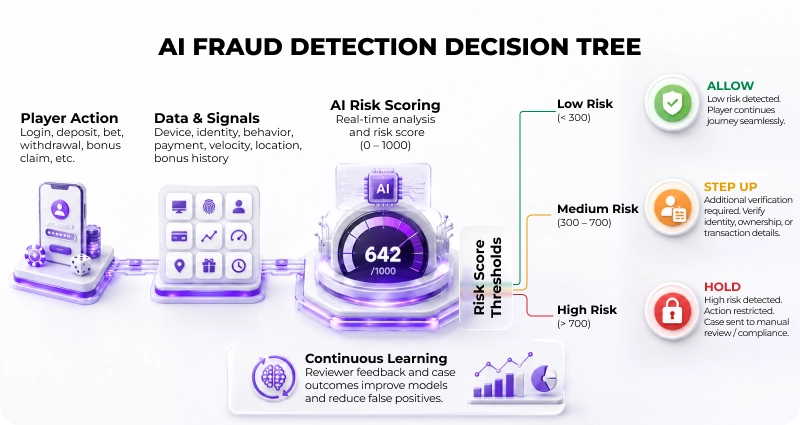
Fraud prevention should work like a traffic light, not a roadblock. Clear risk can stop, uncertain cases can slow down for review, and trusted players should keep moving. For operators, the value is not only catching abuse, but protecting conversion, compliance, and player trust at the same time. That balance is where better architecture pays back

Denis Kosinsky
Chief Product Officer at NuxGame
KYC, AML, and Transaction Monitoring Architecture
A serious iGaming fraud detection software stack needs data from registration, KYC, wallet, casino, sportsbook, payment gateway, CRM, and support systems. Event streaming reduces blind spots because each transaction can update the risk context in real time. Batch analytics still matter for patterns that appear over hours or days.
A practical architecture uses five layers: event collection, profile resolution, scoring, decision orchestration, and reviewer feedback. The scoring service should expose API decisions for the iGaming platform, while the case tool records reviewer outcomes. This loop trains detection systems without hiding operational judgment inside the model.
NuxGame helps operators coordinate this architecture through modular account controls, iGaming secure payment configuration, back-office settings, and integration support. The NuxGame platform approach reduces the number of separate vendor connections an operator maintains. It also gives product and compliance teams clearer ownership over rules, thresholds, and reporting workflows.
Bonus Abuse Detection and Account Takeover Signals
Bonus abuse detection needs different evidence from financial screening. A fraudster may create multiple accounts, claim welcome bonuses, use free spins, meet minimum wagering requirements, and cash out quickly. Another group may coordinate account ownership, shared devices, and affiliate traffic to claim welcome offers at scale.
Account takeover follows a different pattern. The attacker tries to gain access to legitimate player accounts, change credentials, drain balances, or exploit saved financial methods. Behavioral signals often include typing changes, device changes, location shifts, support-password requests, and withdrawal attempts soon after login.
Key signals to review include:
- Reused profile details across accounts, especially matching documents, names, addresses, or phone patterns.
- Shared device clusters linked to repeated reward claims, free spins use, or fast cash-out behavior.
- New device activity after long inactivity, especially before a withdrawal or financial method change.
- Reward redemption soon after credential changes, support requests, or unusual session movement.
- Similar bet patterns across accounts, which may indicate coordinated reward abuse or a fraud ring.
- Session rhythm changes after login, including faster navigation, a new location, or unusual wallet actions.
Bonus abuse and account takeover should share one behavioral layer because both rely on identity confusion. The operator should connect reward rules, identity checks, device clusters, and ownership evidence into one graph. That graph helps detect fraudulent accounts before rewards are paid, withdrawals are reversed, or valid promotional traffic is blocked.
Compliance Architecture for USA-Facing Operator Teams
Regulatory compliance turns detection from a product feature into an evidence system. For USA-facing projects, controls should stay configurable by state, product scope, cashier model, and business structure. The operator needs rules that match licensing exposure, transaction value, player geography, and reporting duties.
Where 31 CFR Part 1021 applies, casinos need AML programs, internal controls, independent testing, staff training, and procedures for reporting and verification. Suspicious activity processes also need machine-readable evidence. The case file should connect player profile data, transaction history, risk indicators, and reviewer decisions.
| Standard or regulation | Implementation impact | Architecture requirement |
|---|---|---|
| 31 CFR Part 1021 | Supports AML controls, suspicious activity review, and record retention. | Link KYC, wallet, payment, and reviewer evidence in one case trail. |
| UK Gambling Commission standards | Connect technical controls with testing, security, and documented procedures. | Keep system settings, audit logs, and supplier controls ready for inspection. |
| GLI-19 | Gives an audit lens for gambling platforms and gambling operators. | Record configuration, game events, access controls, and operator-level changes. |
| PCI DSS v4.0.1 | Applies when cardholder data or hosted cashier pages enter scope. | Separate card data, restrict access, and secure payment infrastructure. |
The UK Gambling Commission also matters for global benchmarking, even when the project targets the USA. Its remote technical standards show how regulators connect technical controls, testing, supplier systems, and operational evidence. That makes the standard useful for internal control design, not only licensing preparation.
GLI-19 and PCI DSS v4.0.1 add two different layers. GLI-19 focuses on interactive gaming system auditability, internal controls, and final operator configuration. PCI DSS v4.0.1 matters when cashier flows touch cardholder data, hosted cashier pages, or service providers inside the payment chain.
DDoS Protection, Bot Detection, and Infrastructure Continuity
Online gaming traffic attracts bots because registration, login, promotion, and cashier flows expose valuable endpoints. OWASP describes automated abuse patterns such as credential stuffing, fake account creation, cashing out, carding, and account takeover. These patterns are not only security issues. They distort analytics, pressure support, and inflate acquisition costs.
DDoS protection belongs in the fraud stack because downtime changes player behavior and compliance exposure. A real-time layer is useless if the cashier, wallet, or login service fails under attack. In 2026, Cloudflare reported a 31.4 Tbps DDoS attack, showing why origin protection and traffic scrubbing need to be designed in advance.
Infrastructure planning should separate bot friction from human friction. The operator can rate-limit suspicious clusters, challenge scripted traffic, and isolate promotion endpoints without adding barriers for every user. Modern iGaming platforms should also log attack windows against approval rate, KYC approval time, and reward redemption anomalies.
How to Measure iGaming Fraud Prevention Without Hurting Conversion
Online gambling fraud prevention fails when the team only measures blocked accounts. A better scorecard tracks chargeback rate, approval rate, KYC pass rate, manual-review time, withdrawal hold time, reward recovery, and appeal outcomes. These metrics show whether fraud prevention strategies protect revenue without damaging user experience.
Two engineering targets help align product and risk teams. First, keep real-time scoring under 150ms for checkout-style checkpoints. Second, keep critical event delivery delay below five seconds between wallet, reward, and detection systems. Those are design targets, not universal guarantees, because hosting, vendor latency, and jurisdictional checks change the budget.
A robust fraud prevention program works only when every rule has an owner, threshold, evidence field, and rollback path. Product managers should know which control affects conversion. Compliance officers should know which control supports reporting. CTOs should know which dependency threatens uptime during a peak sports event.
Technical Snapshot: Implementation Requirements for AI Scoring
| Layer | Requirement | System dependency | KPI |
|---|---|---|---|
| Identity | KYC status, biometrics, document data | KYC provider and player account | Approval time and mismatch rate |
| Payment | Deposit, withdrawal, card testing, wallet events | PSP, cashier, ledger, payout queue | Approval rate and chargeback rate |
| Behavioral | Session, device, bet, bonus, and support signals | Event stream and analytics warehouse | Signal coverage and review accuracy |
| AI | Model scoring, versioning, feedback, explainability | Feature store and case tool | False positives and lift over rules |
| Security | Bot defense, WAF, DDoS scrubbing, access logs | CDN, edge controls, SIEM | Availability and MTTR |
| Compliance | SAR evidence, audit logs, access control | Back office and reporting export | Case completeness and retention status |
AI-powered fraud detection should start with signal mapping, not model selection. The operator first lists where fraud in iGaming creates cost: signup, welcome-bonus claim flow, cashier, wagering, support, and withdrawal. Then each checkpoint receives a decision type: allow, step up, hold, reject, or escalate.
The strongest implementation records why each decision happened. That evidence protects the operator when a player appeals, a regulator asks for documentation, or a financial partner challenges a dispute ratio. It also helps detect and prevent fraud without treating every unusual player as a criminal.
Conclusion
Fraud control in 2026 is a design decision, not a plug-in purchase. Operators need automation for clean signals, human review for disputed value, and evidence for regulators, financial partners, and players. NuxGame gives teams a practical platform base for connecting account controls, cashier configuration, player tools, aggregation, sportsbook operations, and back-office workflows into one fraud prevention architecture.
NuxGame helps operators build a fraud stack around account controls, cashier configuration, player tools, casino aggregation, sportsbook operations, and back-office workflows. Teams planning detection in an iGaming environment use the NuxGame platform to map signals, define review actions, and reduce fragmented vendor logic before launch.