South Korea Online iGaming in 2026: Market Regulation, Enforcement Stack, and Platform Readiness

The online iGaming market in South Korea stays closed to private operators in 2026. Korean law applies a single prohibition test to online gambling and land-based gambling, and carves out only state-run exceptions. The National Gambling Control Commission puts illegal turnover at KRW 96 trillion, near USD 65 billion. Payment-layer enforcement has since cut offshore demand by 37% between October 2025 and April 2026.
That gap between demand and legal supply is why the country still lands on expansion shortlists. Reading the perimeter correctly saves an operator from wasted integration work, PSP exposure, and criminal referral. It also shows which systems must exist before any channelization framework appears. NuxGame supplies platform, aggregation, payment, and compliance configuration to licensed operators, and applies the same architectural checklist to restricted markets such as this one.
Digest List
-
South Korea permits seven forms of gambling, all state-run; private casino and sportsbook products sit outside that list.
-
The Criminal Act applies extraterritorially, so nationals remain liable when they wager on offshore sites.
-
Enforcement has moved to the payment layer: six payment gateway firms were referred to prosecutors in July 2025.
-
Sports Toto caps stakes at KRW 100,000; KRA online betting caps KRW 50,000 per race behind a 21+ age gate.
-
A future license class will demand GLI-19 event logging, PCI DSS scope control, and ISMS-P-aligned data residency.
South Korea Gaming Laws: The Regulatory Perimeter in 2026
The Republic of Korea runs gambling policy on a general prohibition principle. Everything is banned unless a statute names it. Articles 246 and 247 of the Criminal Act criminalize wagering, and the Korean gaming statutes draw no line between digital and physical play. The test is whether an activity is speculative, not whether it runs on a server. That single rule collapses most market-entry theories.
Seven state-run sectors sit inside the permitted perimeter, each under its own act and ministry:
| Permitted sector | Governing act | Online sales | Open to nationals |
|---|---|---|---|
| Casino (17 venues) | Tourism Promotion Act | No | Foreigners only |
| Casino (Kangwon Land) | Special Act on Abandoned Mine Areas | No | Yes |
| Sports betting (Sports Toto) | National Sports Promotion Act | Yes (Betman) | Yes |
| Lottery (Lotto 6/45) | Lottery Tickets and Lottery Fund Act | Yes | Yes |
| Horse racing | KRA Act | Yes (since 2024) | Yes |
| Cycle and motorboat racing | Bicycle and Motorboat Racing Act | No | Yes |
| Bullfighting | Traditional Bullfighting Act | No | Yes |
The statutes also split gaming and gambling by mechanic, not by platform. Online gaming companies operate under the Game Industry Promotion Act, which bars speculative payouts, while gambling activities fall under the Criminal Act. Extraterritoriality closes the loop: a national who wagers abroad remains prosecutable at home, with habitual offenders facing up to three years or KRW 20 million in fines.
Market Size, Data Gaps, and the Channelization Problem
Any market overview of the South Korea online gambling market starts on the illegal side. The Korean gaming market shows up in every market research report on Asia because of one number. According to the regulator’s 2026 estimate, illegal turnover reached KRW 96 trillion, roughly USD 65 billion. An earlier commission figure of KRW 102.7 trillion covered the same unlicensed universe. Against that, the licensed total gambling market is small.
- Illegal turnover: KRW 96 trillion, near USD 65 billion.
- Youth enforcement cases: 478 in 2024, rising to 777 the following year, a 62% increase.
- Offshore demand: down 37% in the six months to April 2026, from a peak of 1.12 million.
- Licensed supply: 17 foreigner-only venues, one domestic casino, four state channels.
That contraction is the market insight most operators overlook. The 37% demand decline tracked by the Blask Index followed payment-rail enforcement, not a change in appetite. Penetration of illegal online gambling reflects supply limits rather than culture. Policy is driving the market, and the gross gambling revenue sitting offshore feeds every reform argument.
Data quality is a second problem. No agency publishes a Korea online gambling market report, and no verified Korea online gambling market size exists for unlicensed play. The online gaming sector is measured separately under game-industry statistics, so the two datasets never reconcile. Any growth rate quoted for this segment rests on seizure data and blocked-domain counts.
Legal Online Channels: Sports Toto, Lottery, and Horse Racing
Three online channels already run legally, and each one is instructive. Sports Toto sells pari-mutuel online sports betting through Betman under a KRW 100,000 stake cap. The lottery sells tickets through state online platforms. The Korea Racing Authority added online horse race betting after a 2023 amendment, piloting from December 2023 and launching fully in 2024.
| Control | Sports Toto (Betman) | KRA online betting |
|---|---|---|
| Minimum age | 19 | 21 |
| Account opening | Real-name digital verification | In-person registration at a racecourse |
| Stake ceiling | KRW 100,000 per ticket | KRW 50,000 per race |
| Daily ceiling | Product-level caps | KRW 750,000 |
| Bet model | Pari-mutuel pools | Pari-mutuel tote |
South Korea has therefore already built the compliance rails a licensed regime would need. Identity binding, hard stake ceilings, and account-level daily limits run in production today. The competitive landscape in the market comes down to one monopoly per vertical, each holding full market share. Nothing forces an upgrade to user experience, so experienced bettors drift toward offshore online gambling platforms.
Enforcement Architecture: SNI Filtering and Payment Choke Points
Blocking here is not a DNS blacklist alone. Internet service providers inspect the TLS Server Name Indication field, which travels unencrypted in the handshake, and drop sessions to blacklisted domains. Filtering is domain-specific, so the offshore online gambling industry rotates mirror domains within days. In 2026 the media content regulator shortened takedown cycles further.
The enforcement stack now operates on four layers:
- Network: ISP-level SNI and DNS filtering coordinated by the Korea Communications Standards Commission.
- Financial: mandatory monthly transaction reporting from payment gateways and e-payment operators.
- Criminal: police cyber patrols, ring dismantlement, and referral to prosecutors.
- Civic: a reward tip line paying KRW 10,000 per blocked site, and KRW 50,000 when bank account details are attached.
Money is now the primary choke point. The Financial Supervisory Service referred six payment gateway providers to prosecutors in July 2025 after transaction-pattern analysis linked them to illicit casino sites. Exposure for facilitating firms reaches decades in prison. The practical consequence is that PSP relationships, not domains, carry terminal risk in this jurisdiction.
Operators keep asking how to keep a domain reachable. That is the cheap half of the problem. A blocked domain is a flat tire; a frozen payment chain is a seized engine. Before any restricted market goes on the roadmap, audit the license, the PSP chain, and the settlement route together. One weak link decides the outcome.

Denis Kosinsky
Chief Product Officer at NuxGame
KYC, AML, and Wallet Synchronization Architecture
A licensed Korean framework, if it arrives, will not accept a generic international onboarding flow. Expect resident registration matching, mobile carrier verification, and a bank account bound to the same legal identity. Data sits under the Personal Information Protection Act, so gaming platforms hosted outside the country fail the residency test. That pushes deployment toward in-country regional infrastructure and ISMS-P certification.
Deposit Caps, Loss Limits, and Self-Exclusion Sync
Limits belong in the wallet, never in the interface. A UI-level cap fails the first time a player calls the API directly. The NuxGame player account management layer applies deposit, loss, and session limits at transaction level, with per-jurisdiction back-office configuration. Engineering budgets are tight: wallet callbacks should resolve under 200 ms at p95, with balance reconciliation below one second.
- Identity: real-name verification, duplicate-account detection, age gate at 19 or 21 depending on vertical.
- AML: threshold and velocity rules, suspicious transaction reporting, source-of-funds triggers.
- Responsible play: national self-exclusion registry sync, cooling-off, mandatory reality checks.
- Reporting: immutable audit trail of limit changes, with operator and timestamp attribution.
Every one of those controls exists because the reported rate of gambling addiction among minors keeps climbing. Regulators read logs, not policy documents. An operator that cannot produce the exact sequence of a limit change, a self-exclusion request, and the wagers that followed will lose the argument during an audit.
Compliance Mapping: PCI DSS, ISO 27001, GLI-19, and Local Reporting
Standards are not badges. Each one changes system architecture. The PCI Security Standards Council requirements dictate how far the cardholder data environment extends, and tokenization at the PSP boundary is what keeps that scope small. ISO/IEC 27001 governs the information security management system, and Korean ISMS-P overlaps with it heavily, which cuts duplicate audit work.
| Standard | Technical requirement | Reporting obligation | Operational consequence |
|---|---|---|---|
| PCI DSS v4.x | Network segmentation, tokenization, key rotation | Annual ROC or SAQ, quarterly ASV scans | Weak scope control multiplies audit cost |
| ISO 27001 / ISMS-P | ISMS, risk register, access control | Surveillance audits, incident logs | Prerequisite for local hosting approval |
| GLI-19 | RNG certification, event logging, session recovery | Lab reports, game change submissions | Uncertified content cannot go live |
| PIPA / GDPR-aligned | Consent records, retention limits, DSAR flow | Breach notification windows | Data residency drives infrastructure choice |
GLI-19 is the standard operators underestimate. It requires every game event, bet, and disconnect to be logged in a recoverable sequence, so an interrupted session resumes at the exact wager state. Regulated online gambling regimes converge here. Comparable rules appear in the remote technical standards of the UK Gambling Commission, in Malta Gaming Authority rules, and in the Dubai gaming regulator framework.
Product Design for the Korean Player: Live Dealer and Mobile Formats
Korean gamers are mobile-first and latency-sensitive. South Korea’s video gaming culture exports globally, which sets an unusually high bar for gaming experiences of any kind. Players weigh domestic gaming options against offshore catalogues, where baccarat, blackjack, and Asian-themed slots dominate demand. Live dealer games pull hardest because they reproduce traditional casino games on a phone. Any online gambling experience built for Korean audiences is measured against that standard.
- Live stream glass-to-glass latency under two seconds, or bet windows desynchronize from the dealer.
- Adaptive bitrate down to 480p, since mobile gaming sessions run on transit connections.
- Cold start under three seconds for online games on mid-tier Android devices, the benchmark set by mobile games.
- Korean-language UI, local settlement times, and real depth in domestic sports.
Two adjacent formats shape the roadmap. Virtual reality and live dealer games extend the same immersive gaming logic, where sustained user engagement depends on session quality rather than novelty. Trends like esports wagering sit outside every license class, though annual wagering revenue projected near USD 164.1 million already flows offshore. Cryptocurrency-based gambling is the opposite of an opportunity: it is precisely the payment pattern transaction monitoring is built to detect.
Platform Readiness for Online iGaming in the South Korea Market
The country stays a key market on APAC roadmaps, yet only some routes into it are lawful. Operators who came through US state-by-state licensing will recognize the pattern: the compliant path is the slower one. Demand in the South Korean market does not create a license, and advertising campaigns by online gambling operators aimed at residents carry criminal exposure under aiding-and-abetting provisions.
| Scenario | Legal basis | Technical requirement | Risk level |
|---|---|---|---|
| Supply B2B technology to state operators | Procurement, not licensing | Local hosting, ISMS-P, Korean language stack | Low |
| Serve Korean-speaking players in licensed markets | Foreign license plus strict geo-fencing | IP, device, and payment geo-controls | Medium |
| Digital extension for foreigner-only venues | Tourism Promotion Act limits | Passport-based KYC, on-property scope | Medium |
| Target residents from offshore | None | Not applicable | Prohibited |
Real market growth depends on the legalization of online gambling, not on tolerance of offshore supply. The land-based casino market remains foreigner-facing, which keeps any digital extension inside on-property scope. Meanwhile the appeal of online gambling keeps domestic spend flowing to offshore books.
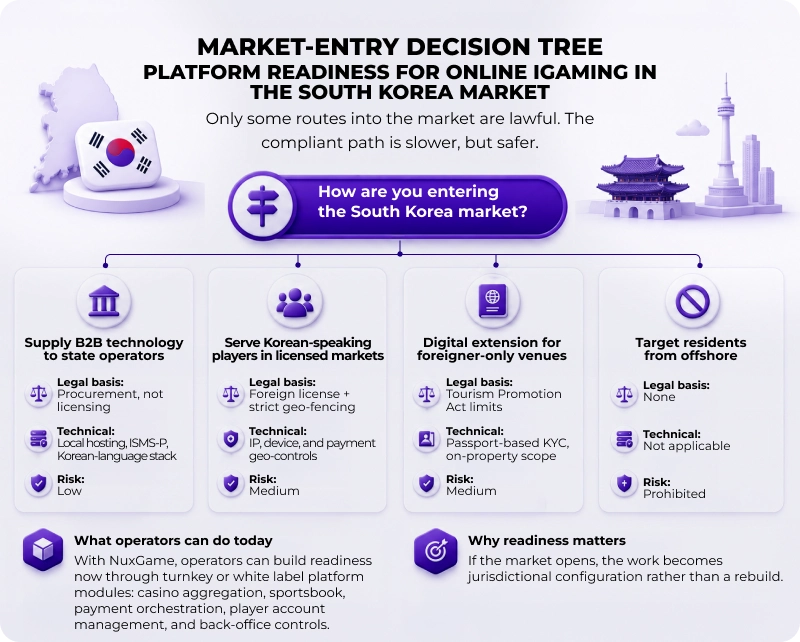
Readiness is what an operator can build today. NuxGame delivers turnkey and white label platforms with casino aggregation, sportsbook, payment orchestration, player account management, and back-office controls for limits, bonuses, and reporting. Where a market opens, the work becomes jurisdictional configuration rather than a rebuild. That distinction decides whether a launch takes a quarter or a year.
Technical Snapshot
| Item | Requirement |
|---|---|
| Legal status (private online operator) | Prohibited for residents; no license class exists |
| Legal online verticals | Sports Toto, lottery, KRA horse betting |
| Identity | Real-name verification; age 19, or 21 for online racing |
| Limit enforcement | Transaction layer, not UI; audit-logged changes |
| Wallet callback budget | Under 200 ms at p95; reconciliation under one second |
| Live dealer latency | Under two seconds glass-to-glass |
| Availability target | 99.9%+ monthly uptime with regional failover |
| Certification set | GLI-19, PCI DSS v4.x, ISO 27001 / ISMS-P |
| Payment risk | PSP monitoring is the primary enforcement vector |
| Blocking method | ISP SNI and DNS filtering, shortened takedown cycles |
Bottom Line
Online iGaming in the South Korea market is a policy question, not a product question. Demand exists, infrastructure exists, and the state has already proven it can run identity-bound wagering with hard caps. What does not exist is a private license, and enforcement now targets the payment layer that every offshore model depends on. For the iGaming industry, the correct move is readiness rather than exposure. Operators holding GLI-19 logging, PCI-scoped payments, and configurable limit engines will be positioned when the framework changes, and profitable in licensed markets while it does not.
If you are mapping APAC expansion and need a platform that can be reconfigured per jurisdiction instead of rebuilt, talk to the NuxGame team. Bring your target license, payment corridors, and content mix, and we will walk through aggregation, wallet, KYC integration, and back-office limit controls against that specific regulatory profile.