2026 iGaming Server Infrastructure: Hosting, Latency, and Compliance Analysis

An iGaming server is dedicated hosting infrastructure built for real-time casino and sportsbook workloads — wallet writes, RNG calls, and thousands of concurrent sessions. It differs from a general web server through single-tenant CPU isolation, NVMe storage, and jurisdiction-bound data placement that targets response times under 50 ms.
Operators need this dedicated layer because generic infrastructure buckles under gaming’s demands. Online gambling now ranks among the most DDoS-targeted sectors, and US regulators tie server location to each state license — so weak provisioning shows up as failed bets and license exposure, not just slow pages. NuxGame delivers it to B2C operators through a managed platform deployment that bundles hosting, aggregation, and compliance tooling under one vendor.
Key Takeaways
-
Server placement is a licensing constraint, not just a performance choice: US regulators require in-jurisdiction data handling.
-
PCI DSS 4.0.1 and ISO 27001:2022 are now the only valid versions, mandating MFA and network segmentation at the server layer.
-
Always-on DDoS protection matters because gaming absorbed a rising share of the record 2025 attack volume.
-
Demand surges during major sporting events expose the database tier, not the web tier, as the real bottleneck.
What Separates an iGaming Server From a Web Server
Such a server carries stateful, write-heavy traffic. Every spin, bet, and cash-out updates a player wallet on each action. Generic web infrastructure optimizes for stateless page delivery and caching. Gaming platforms cannot cache a live balance. They serialize transactions, log each game event, and hold session state for audit.
This workload profile reshapes the server hardware beneath it. RNG execution and live-dealer streams need steady CPU cycles, not burst credits. NVMe storage cuts write times on high-frequency wallet updates. Game logic gets certified against interactive gaming systems standards, so a dedicated gaming server must reproduce results deterministically under audit conditions.
Bare Metal, Cloud, and Hybrid Hosting Models
The infrastructure model decision balances three variables: response predictability, cost, and operational control. A bare metal server gives single-tenant hardware with no hypervisor overhead. Public cloud gives elastic capacity and fast provisioning. Most iGaming businesses run a hybrid, using dedicated server hosting for wallet, RNG, and live origin, with cloud for the front-end and burst traffic.
| Model | Strength | Trade-off | Typical use in iGaming |
|---|---|---|---|
| Bare metal / dedicated server | Isolated cores, NVMe, predictable latency | Slower to scale, higher fixed cost | Wallet, RNG, live-dealer origin |
| Public cloud | Elastic capacity, fast provisioning | Noisy-neighbor jitter, egress cost | Front-end, promotions, analytics |
| Hybrid | Combines isolation and elasticity | Added orchestration complexity | Most regulated multi-state operators |
The real trade-off is variance, not raw speed. A shared cloud instance can post a strong median yet miss its 99th-percentile targets at peak. For live casino and in-play betting, low-latency delivery matters more than the average. Distributing static assets across global edge locations trims round trips for content delivery, while dedicated hardware keeps the origin predictable.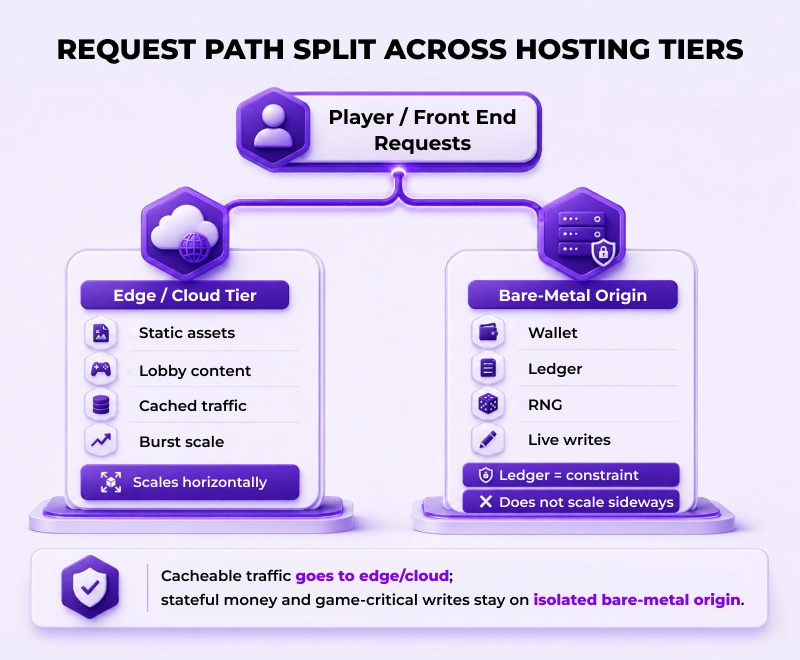
Latency, Throughput, and Session Continuity
Latency in iGaming is not a single number. It splits into network, application, and database components. A live-dealer round tolerates roughly 100–200 ms of glass-to-glass delay before play degrades. A wallet write should confirm well under 50 ms. Placing the server in an in-jurisdiction data center removes the physics tax of cross-country round trips.
Throughput and continuity are separate engineering concerns. A sportsbook sustains thousands of odds updates per second during a live event. Connection pooling, read replicas, and sticky routing keep sessions seamless when a node recycles — meaning open bets survive a restart. Uninterrupted gameplay, not peak requests per second, is what players read as reliability and shapes the user experience.
Players rarely notice a fast server, but they remember a dropped bet. That is the standard we hold at NuxGame: continuity that survives peak load, not just strong numbers on a quiet afternoon. For operators, session reliability is a retention strategy — the least glamorous line in the budget, and the one that protects the rest.

Denis Kosinsky
Chief Product Officer, NuxGame
DDoS Mitigation and Availability Engineering
Availability is an attack-surface problem before it is a hardware problem. The iGaming industry drew a rising share of attack traffic in 2025, when total attack events more than doubled and gaming ranked among the three most-targeted sectors. Per automated mitigation reporting from Cloudflare, one November flood peaked at 31.4 Tbps and lasted 35 seconds.
Effective DDoS protection layers L3/L4 volumetric scrubbing with L7 application filtering. Always-on mitigation beats on-demand rerouting, since a 35-second flood ends before a manual scrubbing center engages. A global network soaks up bandwidth floods at the edge. Availability targets follow arithmetic: 99.99% permits about 52 minutes of downtime a year, and operators track MTTR alongside it.
Server-Layer Compliance and Certification
Compliance lives in the architecture, not the policy binder. Under PCI DSS 4.0.1 — the only active version since March 2025 — the cardholder data environment stays segmented from game logic, with MFA on all non-console access. Isolating card data in its own network zone shrinks the audit scope operators pay to certify.
Two further layers apply above payments. Information security management under ISO 27001:2022 now spans 93 Annex A controls, valid since the 2013 edition expired in October 2025. Gaming-specific testing follows GLI-19, which separates lab-evaluated platform and RNG logic from on-site operational audits. Meeting these regulatory requirements is an architecture task, not a paperwork exercise.
Server-layer compliance checkpoints:
- Network segmentation isolating the CDE from game and player-account services
- MFA on every administrative and remote server access path
- Encryption at rest on NVMe drives and TLS 1.3 in transit for data protection
- Immutable event logging for regulator audit and dispute resolution
- Geo-fencing that rejects any wager placed outside the licensed state
Capacity Planning for Demand Surges
Growth in iGaming is bursty yet predictable. A sporting event or new game launch multiplies concurrent sessions within minutes. With regulated US online casino revenue reaching $10.73 billion in 2025 across seven states, peak concurrency during major events is a design input. Horizontal scaling of the front-end is straightforward; the database tier is not, and stateful gaming workloads make that asymmetry sharper.
Wallet consistency forces synchronous writes, so the ledger becomes the constraint every plan orbits. Operators pre-warm dedicated resources ahead of an NFL slate or a title fight, because cold provisioning lags the spike. Read replicas absorb balance and odds queries; write sharding relieves the ledger. Capacity math starts from projected peak player count during traffic spikes, not average daily load across game servers.
How NuxGame Structures Server Deployments
The NuxGame approach folds infrastructure and the iGaming platform into one managed deployment. Operators receive server provisioning, casino aggregation, sportsbook, payment routing, and player account management through a single vendor. This cuts the number of separate integrations a technical team maintains. Fewer vendor connections mean fewer failure points, one support path, and consistent regulatory reporting across the stack.
Control stays with the operator through the back-office. Teams adjust game settings, RTP configuration where permitted, bonus logic, and jurisdiction-specific rule sets. The platform from NuxGame synchronizes the wallet across aggregated content, so a player balance holds consistent from slots to live casino to live betting. Managed server deployments ship with attack mitigation, monitoring, and audit-ready logging by default.
Technical Snapshot
The table below distills iGaming dedicated server hosting solutions into measurable targets and compliance checkpoints for planning sound iGaming infrastructure.
| Layer | Target / Requirement | Why it matters |
|---|---|---|
| Wallet write latency | < 50 ms confirmed | Player-perceived responsiveness |
| Live-dealer glass-to-glass | 100–200 ms | Stream and interaction sync |
| Uptime SLA | 99.99% (~52 min/year) | Revenue continuity |
| DDoS mitigation | Always-on L3/L4 + L7 | Sub-minute flood defense |
| Storage | NVMe, encrypted at rest | Write throughput plus PCI/ISO |
| Card data | Segmented CDE, MFA, PCI DSS 4.0.1 | Audit scope and compliance |
| Security certification | ISO 27001:2022 (93 controls) | Vendor and regulator trust |
| Game / RNG certification | GLI-19 tested | Fairness and licensing |
| Data placement | In-jurisdiction per state license | Legal operation |
Conclusion
Server decisions set the ceiling for everything built above them. Choosing between a bare metal server, cloud, or hybrid hosting environments is a compliance and risk call as much as a server performance one, and it compounds with every new state and content vertical. Treat iGaming server selection as an architecture commitment, then validate latency, availability, and audit evidence before launch. Operators that find a hosting provider early in product design avoid costly migrations later, and the right iGaming hosting provider turns specialized infrastructure into a licensing and gaming experience advantage rather than a liability.
Mapping infrastructure requirements for a new market, or migrating off a strained host? The NuxGame team aligns your concurrency, response time, and jurisdiction needs to manage iGaming hosting solutions — dedicated servers, platform, aggregation, and compliance tooling in one turnkey iGaming deployment. Request a technical walkthrough to pressure-test your server configurations before launch.