Русский
 Payout Models for Online Casino Operators: RTP Floors, Jackpot Liability, and 2026 US Compliance

Casino payout models define how much of each stake returns to players, how that return is distributed across outcomes, and what remains as margin. Three variables carry the weight: theoretical RTP, hit frequency, and volatility. United States regulators set floors, not targets. Michigan permits 80% on house-banked internet games, New Jersey requires 83%, and Pennsylvania demands 85%.
Those numbers sit inside one country, and an operator running all three states cannot ship a single configuration. Certification is per-jurisdiction, per-title, and per-variant, so payout structures become an integration problem before they become a commercial one. NuxGame supports operators through casino aggregation, per-market game catalog control, wallet and payment configuration, and back-office reporting — the layer where payout rules meet operating economics.
Key Takeaways
-
Michigan excludes progressive contributions from the minimum return; New Jersey counts them.
-
Pennsylvania taxes online slots at 54%, against 19.75% for iGaming in New Jersey.
-
The Michigan free play deduction drops to 4% in 2026 and ends in 2027.
-
Adaptive payout logic is prohibited, so variance lands on the balance sheet.
-
Progressive prize pools accrue as a liability, reported separately from operating cash.
What Casino Payout Models Actually Control
A payout model is not one number. It is a set of four independently configured levers that together decide the revenue model and the gaming experience. Studios tune them during casino game development, and each lever moves retention and casino revenue in a different direction. Confusing them is the most common product management error in new launches.
- Theoretical RTP — the return to player share of total stakes across the full game cycle, counting every possible reel combination.
- Hit frequency — how often any return occurs, typically 20–30% on modern video slots.
- Volatility — the dispersion of returns around the mean, which sets bankroll survival time.
- House edge — the residual before tax and operational costs, fixed at 5.26% on American roulette and variable on slots.
Two titles at 96% behave nothing alike. One pays small amounts on nearly a third of spins; the other pays almost nothing until a rare big win lands. The first supports longer gameplay; the second produces sharper swings. That distinction carries portfolio weight at current scale: the regulated US online gambling market produced $10.74 billion in iGaming revenue during 2025.
Payout Rates Diverge Sharply Across US iGaming States
Seven states offered lawful online casino operations through 2025, and no two apply identical arithmetic. Pennsylvania sets its floor through slot machine minimum design standards at 85%, measured on the lowest possible stake, and caps the theoretical figure below 100% on the highest. Both points matter, because a title whose math varies with bet size can pass one test and fail the other.
| Requirement | New Jersey | Michigan | Pennsylvania |
|---|---|---|---|
| Minimum theoretical return | 83% | 80% (house-banked internet games) | 85% |
| Upper bound | — | 100% | Must not reach 100% |
| Progressive counts toward minimum | Yes, projected contribution | No | No, amount above reset excluded |
| Odds cap on top award | No play beyond 100 million to 1 | Top chance award at least 1 in 50 million | No combination beyond 50 million to 1 |
| Permitted drop on higher stakes | 0.01 percentage point per step; 0.5% aggregate | 0.01 percentage point per step; 0.5% aggregate | 0.5% aggregate |
| Tax on iGaming revenue | 19.75% | 20–28% graduated | 54% online slots |
New Jersey applies its 83% threshold under the Division of Gaming Enforcement rule on slot machine game approval. That rule disqualifies complimentaries and requires strategy games such as video poker to be measured on optimal play. Read the tax row alongside the return row, and the commercial picture inverts. Pennsylvania demands the highest payout and takes the largest share of what remains, which is why identical casino payout rates yield different contribution margins per state.
Random Number Generation and the Non-Compensated Payout System
The payout system does not decide outcomes. A certified random number generator produces the raw values, and game math maps those values onto a paytable fixed at certification. Nothing downstream adjusts the odds. The UK Gambling Commission states this plainly in its standard on generation of random outcomes: results must be demonstrably random, and adaptive or compensated behavior is not permitted.
That prohibition shapes operator risk more than any RTP figure. A game cannot claw back a losing run, so short-term variance hits operator cash directly. A slot with 96% theoretical return may pay back 88% or 104% across a week at modest volumes. Launch capital needs sizing for the tail, not the mean. Laboratories test the generator and the mapping together to ensure fairness, covering:
- Statistical randomness, seeding, and scaling of each generated random number
- Paytable accuracy and winning combination values against the declared return
- Round-level event logging and replay capability
- Behavior on disconnection, timeout, and interrupted rounds
Gaming Laboratories International publishes GLI-19 for interactive gaming systems, covering platform, generator, and game requirements. The UAE regulator adopted that series wholesale, and several US states reference it alongside their own rules. Outcome generation is covered further in this breakdown of RNG in iGaming.
Progressive Jackpots Are a Liability Before They Are a Feature
A progressive prize is an accruing obligation. Each qualifying stake diverts a fixed share, commonly 0.5% to 2%, into a pool that must be funded and paid regardless of when it hits. The seed sits on the operator or supplier balance sheet from day one. Seed and contribution are separate line items, and regulators expect both to reconcile against reported prize liability.
Jurisdictions disagree on whether that contribution counts as return. New Jersey permits the projected contribution to help reach the minimum threshold. Michigan does not: under its rules for the approval of internet games, the progressive component is excluded entirely, so the base game alone must clear 80%. The same title needs a rebuilt paytable to cross that state line.
Operators often ask us to raise RTP so they can compete on headline numbers. The better question is where that return sits. A game paying 96% through frequent small wins retains very differently from one paying 96% through rare large ones. We help teams model both before certification, because reworking a paytable after launch costs weeks, not hours.

Denis Kosinsky
Chief Product Officer at NuxGame
Malta offers a useful contrast for multi-region brands. The regulator lowered its return floor from 92% to 85% in 2021, citing high-tax markets as the reason. Minimums move, and so does the qualifying jackpot amount a supplier will underwrite. Roadmaps built on assumed stability are the ones that need emergency recertification.
Bonus Cost, Wagering Requirements, and Effective Payout
Headline RTP describes the game. Effective payout describes the operator. Bonus credits, free spins, loyalty rewards, and VIP programs all move value to players outside the paytable, and none of it appears in a certification report. A 96% title promoted with a 100% match at 30x playthrough carries a very different real cost from the same title promoted with nothing.
Wagering requirements are the control mechanism, and game weighting is where they bite. Playthrough counts every dollar gambled, but not at the same rate across the catalog. Set weighting too generously and low-edge products become a withdrawal route. Set it too aggressively and completion rates collapse, damaging player engagement without reducing cost. Typical weighting looks like this:
- Slots and bonus rounds: 100% contribution
- Video poker and table games: 10–20%, or excluded entirely
- Live dealer content: frequently excluded from qualifying play
- Progressive-eligible titles: often capped to protect the pool
Tax treatment decides whether any of this is affordable. Pennsylvania allows promotional credits to be deducted before tax; New Jersey does not. The Michigan free play deduction tapers by statute: 10% of gross receipts for years one to three, 6% in year four, 4% in year five, and nothing from year six.
Operators that have been live since January 2021 are capped at 4% during 2026 and lose the deduction entirely in 2027. That is a budget line for next year rather than a December surprise, and it changes the payback period on every acquisition campaign. How promotional spend moves through the taxable base is set out in this guide to gross gaming revenue.
Paying Players Out: Withdrawal Rails, Settlement, and PCI Scope
Winning is a ledger event; being paid is an infrastructure event. The two are separated by wallet reconciliation, KYC verification, AML screening, payment routing, and settlement. Each stage can add hours to a withdrawal the game engine resolved in milliseconds. Approval rate and time-to-cash are what a gambler actually judges, and neither appears in any payout percentage.
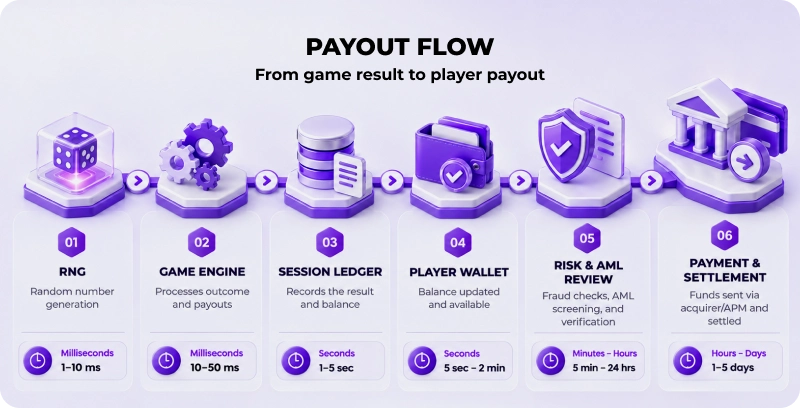
Card rails bring compliance scope with them. PCI DSS v4.0.1 is the only active version of that standard, and every previously future-dated requirement became mandatory on March 31, 2025, with no grace period. Payment page integrity and script authorization controls fail assessments most often, and they fail on governance gaps rather than missing technology. Routing and failover are examined in this overview of the iGaming payment gateway layer.
Configuration Control, Variance Monitoring, and Studio Math Models
Studios ship most titles in several certified variants, and 96.5%, 94.5%, and 92% builds of one slot game are routine. Operators select a variant per market, but selection is not a runtime toggle. Each variant carries its own certificate, and swapping one after launch triggers recertification and laboratory lead time. Treat variant choice as a launch decision, not a lever available to casino managers mid-quarter.
What operators control in-flight is merchandising and monitoring. Lobby placement, category weighting, and personalized game recommendations shift volume between titles without touching a paytable. Machine learning models that analyze player behavior decide which segments see high-volatility slots and which see immersive live dealer formats. That shifts blended hold faster than any math change. Player preferences move; certified RTP does not. Useful thresholds include:
- Actual versus theoretical variance by rolling round count, not calendar month
- Hit frequency drift against the certified figure for each slot machine title
- Progressive contribution accrual reconciled to reported liability
- Withdrawal approval rate and median time-to-cash by payment method
Availability underpins the picture. A 99.99% uptime commitment, the AWS region-level standard for multi-zone deployments, still permits roughly 4.3 minutes of downtime a month. Interrupted rounds create disputes that distort variance reporting until they are cleared. The math models behind slot game development assume complete round data; missing rounds break the comparison rather than delaying it.
Technical Snapshot
| Checkpoint | Requirement | Owner |
|---|---|---|
| Return certification | Per title, per variant, per jurisdiction; laboratory report retained | Compliance |
| Paytable change | Full recertification; assume weeks of laboratory lead time | Product |
| Progressive accounting | Seed and contribution tracked separately; liability reconciled monthly | Finance |
| Outcome generation | Certified generator; adaptive logic prohibited | Platform |
| Event logging | Round-level records retained per state retention rules | Platform |
| Cardholder data | PCI DSS v4.0.1, all requirements in scope since March 2025 | Security |
| Variance alerting | Actual versus theoretical thresholds by rolling round count | BI |
| Promotional tax | Deduction rules verified per state before campaign approval | Finance |
| Availability | Multi-AZ deployment; documented MTTR for interrupted rounds | Infrastructure |
Making the Payout Decision
Casino payout models are chosen at portfolio level, not title level. The sequence that works is fixed: confirm the floor, the tax rate, the progressive treatment, and the promotional deductibility for each target state, then select content against those constraints. Teams working the other way around meet the problem in the certification queue, once the catalog is already built. That ordering decides long-term profitability more reliably than any headline payout percentage.
NuxGame helps operators manage this through content aggregation with per-market catalog control, wallet and payment orchestration, jurisdiction-specific back-office configuration, and reporting built for regulatory submission. If you are scoping a US launch or extending a license into another state, our team will map the payout, tax, and integration implications against your market list. Start a technical conversation rather than a sales call.