Русский
Disaster Recovery and High Availability for iGaming Platforms: 2026 RTO, RPO, and Compliance Guide

A betting site or casino that goes down during a major event can’t get that revenue back, and it faces regulatory consequences if it restores the wrong wallet copy. That’s why high availability and disaster recovery for iGaming have targets in minutes. Even at a 99.9% service level, a provider can lose service for almost nine hours a year.
High availability keeps a platform operational through small failures, while disaster recovery restores it after large ones. In the U.S., both have to operate under the rules of the state that licenses the operator. NuxGame provides 24/7 technical support for its casino API and turnkey iGaming platform.
Key Takeaways
-
The recovery target varies for each service. Wallets must be fully recovered. Marketing tools can wait a day.
-
In New Jersey, a backup server that runs gaming has to be in Atlantic City.
-
A write-once backup, which can't be altered, provides protection against ransomware.
-
In nine years, roughly two-thirds of publicly reported outages were caused by third parties.
-
Failovers only count after they're proven functional by a timed test.
What Makes iGaming Different from Other Industries When It Comes to Continuity and Cost of Downtime?
It is critical for iGaming to maintain business continuity because, unlike other industries, iGaming’s revenue is real-time. A disruption to a sportsbook means a lost opportunity to take a bet on an in-play market that cannot be made back. When lobby games go down, players have no way to place a bet. These losses can’t simply be recovered the next day, like unfulfilled orders in an online store.
Per the May 2026 Uptime Institute outage analysis, failure rates per site fell for the fifth year in a row. However, the cost of incidents kept climbing. Therefore, the focal point shifts from how often a platform fails to how quickly it recovers.
- Costly outages: 57% of respondents stated their most recent major outage cost over $100,000.
- Severe outages: 20% of respondents stated their outages cost over $1,000,000, for the second year in a row.
- Main causes: electrical issues with UPS (uninterruptible power supply) units, transfer switches and generators.
Losses are only the tip of the iceberg. Other consequences of a long outage include a regulatory fine, an even bigger loss when players leave for a competitor, and issues with payment partners, which is why it is essential to include continuity plans in the iGaming risk management strategy.
Recovery Objectives: Determining RTO and RPO for Each Service
For each service in a disaster recovery plan, there are two key metrics. The first is RTO, the recovery time objective. This is the maximum acceptable duration a service can remain offline. For an email tool, there may be a 24-hour window where it is unavailable. However, if it is down for longer than that, the impact on the business likely becomes unacceptable. For a wallet, that window is significantly shorter.
The other key metric for each service is RPO, the recovery point objective. RPO is the maximum allowable data loss. For a wallet service, which processes transactions in real time, we would likely require an RPO near zero. A missing deposit or bet record breaks the integrity of the system and the audit trail, which is reviewed by a regulator.
| Service | Illustrative RTO | Illustrative RPO | Why it matters |
|---|---|---|---|
| Wallet and bet acceptance | 5 minutes | Near zero | Every lost record becomes a balance dispute |
| Game sessions and lobby | 15 minutes | Seconds | Unfinished rounds must resume or be voided |
| KYC and geolocation | 15 minutes | Minutes | Without them, no new players can register or play |
| Back office and reports | 4 hours | 1 hour | Regulator exports run on fixed schedules |
| CRM and marketing tools | 24 hours | 24 hours | Campaigns can be paused, and no rule is brokenCampaigns can be paused, and no rule is broken |
High Availability Architecture
High Availability (HA) is a model of fault tolerance in which a service keeps running despite the failure of a component, unlike disaster recovery, which restores the service after the complete failure of a site. In HA, there must be at least one spare for each critical component, as well as continuous replication of transactional data to a second database or site.
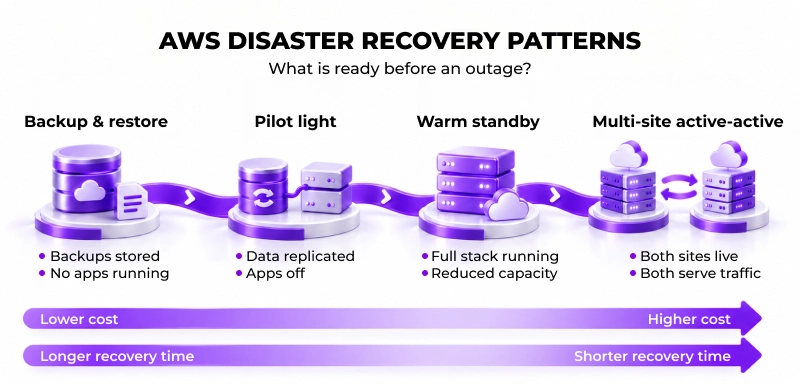
Of the various designs for standby components, the AWS guide describes four, listed here from the least to the most expensive. An automated failover fits best with the last two.
- Backup and restore: data is copied periodically, so its freshness depends on the copy schedule, and restoring takes the longest.
- Pilot light: data is copied continuously, but application servers are turned off, so they have to be brought online and scaled first when a disaster hits.
- Warm standby: a smaller, fully working copy of the application is ready and only needs to be scaled to serve the traffic.
- Multi-site active-active: each site processes player requests, achieving the shortest recovery times for most failures at the highest cost and complexity.
For iGaming and sportsbooks, failover also includes business rules. Sportsbooks usually suspend in-play (or live) betting markets during the switch and reopen them after prices synchronize. Additionally, all game rounds in progress must be allowed to finish or settle to ensure no player balance is altered by an interruption more than once.
Redundancy Within State Lines: Regulatory Requirements
In the traditional sense, geo-redundancy means having a secondary data center in a different region. However, in US iGaming, the choice narrows to data centers inside the licensing state, since each state’s regulator decides where gaming systems and their backups can sit.
New Jersey’s internet gaming rules outline three sets of gaming equipment, each with a specific function.
- Primary equipment has to be housed within a restricted area of a casino hotel in Atlantic City.
- Standby equipment that can take bets must also be within Atlantic City and can stay in a hotel restricted area for 60 days, a limit the regulator can extend.
- Data-only backup equipment can be anywhere in the state of New Jersey.
- Records: operators must retain game play and account data for at least 10 years, which is longer than most service contracts.
- Backup power: a UPS allows systems to continue functioning during power outages that last only a few minutes.
Finance teams always ask why the backup site cannot sit in a cheaper state. The honest answer is that it can, right up to the first audit. A second in-state site looks expensive on a budget line and remarkably cheap next to a suspended license and a weekend of player refunds."

Denis Kosinsky
Chief Product Officer at NuxGame
The NuxGame legal and licensing services include market reviews and assistance with application documents, as well as the preparation of policies for AML and KYC. The team coordinates the necessary filings and local sign-offs, which are handled by licensed gaming counsel.
Choosing a Hosting Model for In-State Resilience
The hosting model influences how much redundancy an operator can buy in one state. A cloud-based model offers flexibility and capacity on an hourly basis, while dedicated servers offer fixed, predictable performance, and leased racks allow operators to keep control of the hardware.
| Model | Strength for recovery | Constraint in US iGaming |
|---|---|---|
| Cloud hosting | Spare capacity on demand with standby copies created from config scripts | Needs an in-state zone (e.g. an AWS Local Zone or Outposts rack) |
| Bare metal | Predictable performance for wallet and game servers | Spare hardware is purchased and racked in advance |
| Co-location | The operator owns the hardware in a secured facility | A second in-state site and on-call staff are needed |
| Multi-cloud | No single provider can take all services down | More complex network topologies, monitoring and auditing evidence |
AI workloads create a new constraint. Fraud scoring and personalization models are often run on GPU servers, and that capacity can be hard to procure at short notice for a standby site. A resilient design therefore may implement a reduced mode where rule-based fraud checks cover until the full system is back online.
Whichever model wins, standby copies are deployed from the same code and config as production. A copy that drifts out of date will fail during an outage in ways nobody has tested.
Cyber Resilience: Ransomware, Immutable Backups and DDoS
Ransomware turns a cyber incident into a data recovery problem. The Sophos ransomware survey of 2,158 IT and security leaders in 17 countries, conducted in early 2026, measured how often attacks were successful and what the costs of recovery were.
- Encryption rate: attackers encrypted data in 56% of reported incidents.
- Recovery cost: the average cost was $1.7 million.
- Median ransom paid: $769,000.
Backups survive ransomware only if attackers do not have access to them. The industry standard is called the 3-2-1 rule: three copies of data, stored on two different types of media, with one off-site, plus at least one copy in write-once storage which no account can change or delete before its retention period ends.
- Frequent backups: wallet and account database copies made continuously or at short intervals, in line with the RPO of each service.
- Cloud backups in a separate account: production credentials cannot delete them, even after a breach.
- Clean OS images: encrypted templates of the operating system, to be used for rebuilding a server in the case of a security vulnerability.
Distributed denial-of-service (DDoS) attacks flood a website with traffic to slow it down or take it offline, often timed to major sporting events. Edge filtering can absorb a lot of that traffic before it reaches the platform. If attackers get further, data protection measures, like encryption at rest and in transit, help minimize the damage.
Supplier Dependencies and Disaster Recovery Plan Testing
A majority (66%) of publicly reported incidents in the nine years covered by the 2026 analysis were caused by cloud, telecom and data center firms. An operator can outsource hosting or payments, but the regulator will still hold the licensee responsible for recovery.
- Payments: a second processor configured for the same methods, to reroute transactions automatically if the first one fails.
- Odds and data feeds: a second (or backup) feed, or rules to suspend the markets if the primary feed becomes unavailable.
- Game content: an aggregator connection that keeps the lobby running if one studio fails, weighed against the extra link it adds.
- Identity and location checks: contracts that bring each vendor’s recovery objectives in line with the operator’s.
Testing shows where the unknowns, gaps, and differences are in the disaster recovery plan. Continuous testing ensures teams are prepared for a real incident. Automate repeated steps to minimize errors, and record each test so an audit shows real recovery times.
A holistic test covers vendors as well as servers, because a lobby that relies on multiple studios for game content can fail in several places. A comparison of direct integration trade-offs shows how the connection model changes that exposure.
Technical Snapshot
The checklist captures the implementation of a compliance-ready recovery setup and allows the assessment of gaps and differences during test reviews.
| Area | Requirement | Indicator to monitor |
|---|---|---|
| Targets | RTO and RPO set for each service and approved by management | Measured recovery time in the last test against target |
| Service availability | Contracted level for each service | Minutes of unplanned downtime per month |
| Data integrity | Wallet replicated with no unconfirmed transactions after failover | Ledger mismatches found in reconciliation |
| Backups | Locked copy in a separate account to protect data availability | Successful test restores per quarter |
| In-state hosting | Primary and gaming backup deployment in-state | Regulator findings on hosting location |
| Dependencies | Second route or documented fallback for each vendor | Vendors with no tested failover |
Deciding How Much Availability to Buy
Any iGaming operator setting recovery targets for each service and keeping standby capacity in the licensed state turns availability into a competitive advantage. Clear targets also reduce the likelihood of lengthy and costly unplanned outages.
For brands comparing DR solutions for iGaming, the NuxGame turnkey casino platform uses microservices and Kubernetes for autoscaling, and is ISO 27001 and PCI DSS Level 1 compliant, with AES-256 data encryption. A technical call with a list of planned states is enough to define recovery targets for each service.