Русский
Offshore Gambling License in 2026: Market Access, Payment Rails, and Platform Controls

Many casino and sportsbook brands begin their operations under an offshore gambling license and then proceed to get local licenses. It is faster and cheaper than going through any national regime. The trade-off is coverage: the license covers only the company, not the markets where its players are based. Offshore regimes are also tightening. Since December 2024, Curaçao’s new gaming law (LOK) has placed all operators under direct supervision.
In practice, acquirers, game studios, and US state regulators each do their own due diligence on what a particular gambling permit allows before they engage with a brand. This guide outlines these checks and the platform controls needed to meet them, from payment routing to geo-blocking. NuxGame supports this process with legal services for licensing and a platform that enforces the limits of each permit.
Key Takeaways
-
Regulators of small jurisdictions publish restricted-territory lists. It is the licensee’s responsibility to enforce these.
-
No offshore gambling permit legitimizes real-money gaming in any US state.
-
Acquirer underwriting under MCC 7995 is what ultimately determines the cost of a gambling permit, not the fee schedule.
-
Game studios approve games for particular markets and licenses, so lobbies differ by entity.
-
Having a separate entity and wallet ledger per permit simplifies a later upgrade to a local license.
What an Offshore Gambling License Covers
An offshore gambling license from a small jurisdiction allows a company to offer remote gambling from that territory. The regulator vets its owners, policies, and systems. The license lets the business target players from other countries, provided local law permits it. Regular fees, compliance reviews, and dispute resolution processes form the oversight mechanism.
Most offshore jurisdictions split B2C and B2B licenses. The B2C permit covers the player-facing entity, while the B2B one covers the supply of the gaming platform and services. Curaçao no longer issues combined licenses. For a comparison of costs and timelines, see the NuxGame overview of types of gaming licenses. Here, the focus is on how each permit affects daily operations.
Types of Offshore Licenses: Regulators, Structures, and Constraints
Offshore jurisdictions differ less in costs than in what their licenses omit. Each regime pairs its license structure with conditions the platform must meet from day one, as shown in the table below. Under the LOK reform, the Curaçao Gaming Authority keeps a public register of license holders. Acquirers and game studios check the register before doing business with a brand.
Malta is an exception and does not belong in this group, even though many resources list it alongside offshore jurisdictions. The Malta Gaming Authority works within the EU regulatory framework, and banks consider its licensees lower-risk clients. Costa Rica is on the other end of the spectrum and doesn’t issue gaming licenses. Operators there use a corporate registration and a municipal business permit to open a gambling site.
| Jurisdiction | Regulator | License structure | Operational constraint to plan for |
|---|---|---|---|
| Curaçao | Curaçao Gaming Authority (formerly the Gaming Control Board) | Direct B2C and B2B licenses under the LOK | One role per license; fee invoices due within 14 days |
| Anjouan | Anjouan Licensing Services Inc. | One B2C license for casino and betting; B2B supplier approval issued separately | Restricted list includes the US, UK, France, Germany, Spain, and others; geo-blocking is mandatory |
| Kahnawake | Kahnawake Gaming Commission | Client Provider Authorization | Hosting arrangements must satisfy KGC requirements |
| Isle of Man | Gambling Supervision Commission | License issued under the Online Gambling Regulation Act 2001 | Key gaming equipment located on the island |
| Alderney | Alderney Gambling Control Commission | Category 1 (B2C) and Category 2 (B2B) eGambling licenses | The platform’s role decides the license category |
| Costa Rica | No gaming regulator | Corporate registration and municipal permit | No licensing body to show acquirers or studios |
Where an Offshore License Stops: Regulated Markets and Local Permits
The player’s location determines which license is required under the point-of-consumption model used in regulated jurisdictions. Offshore permits are irrelevant in these cases. Since 2014, any operator wanting to serve UK players needs a license from the UK Gambling Commission, regardless of where its servers are located. Similar rules are in place in Germany, the Netherlands, and Sweden.
The German regulator GGL and the Swedish Gambling Authority both order payment service providers to block transactions with unlicensed operators. Entering these markets often means obtaining a local license, sometimes a domestic entity, and certified game versions. Product rules also change. Online slot stakes, for example, are capped by the UKGC. Offshore regulators rarely impose such limits.
An offshore license works like a passport with few visas in it. It lets the company trade, but every border still checks the papers: the acquirer, the game studio, the regulator in the player's country. We map those checkpoints with clients before they pick a jurisdiction, because rerouting a live brand later costs far more than planning the route.

Denis Kosinsky
Chief Product Officer at NuxGame
Offshore Online Casinos and the US Market
In the US, each state regulates its own online gambling market. Real-money iGaming is live in seven of them: New Jersey, Pennsylvania, Michigan, West Virginia, Delaware, Connecticut, and Rhode Island. Maine passed a tribal online casino law in January 2026, but no sites had launched by September. Regulations differ in other states, so for current information, see the NuxGame US legality guide.
Offshore licenses are not recognized in any state, so brands holding them cannot legally accept US players. A study by the American Gaming Association (AGA) estimates that illegal and unregulated betting makes up 31.9% of the US gambling market, totaling $673.6 billion per year. This equates to $15.3 billion in lost state taxes. Regulators push back: the Michigan Gaming Control Board, for example, has sent cease-and-desist letters to offshore operators.
Payment Systems and the Real Cost of Going Offshore
Card networks classify gambling businesses as high-risk under merchant category code (MCC) 7995, which also covers lottery tickets. Visa and Mastercard require acquirers to register these merchants, and underwriting starts with the licensing jurisdiction. In the US, the 2006 Unlawful Internet Gambling Enforcement Act (UIGEA) requires payment processors to block restricted transactions. Hence, it is the acquirer’s appetite that shapes the cashier more than the regulator.
Headline fees will not decide the budget when banking friction comes into the picture. Curaçao charges €4,592 to apply for a B2C license and €47,450 a year to hold it. Our study on the cost of gambling licenses includes renewal and audit fees across jurisdictions. Where card acceptance is thin, a number of operators opt for alternative payment methods (APMs) like e-wallets, vouchers, and crypto.
Payment Processing and Scope of Card Data
Operators that host card fields on their websites fall into PCI DSS scope. Since December 31, 2024, v4.0.1 has been the only active version of the standard. Two future-dated requirements, 6.4.3 and 11.6.1, enforceable from March 31, 2025, mandate an inventory of payment-page scripts and detection of changes and tampering on those pages. Outsourcing card capture to a third-party provider with tokenized fields takes most of that scope off the operator.
Software Providers and Game Supply
Game studios carry out compliance checks before giving a licensee access to their content. Each provider has a blacklist of restricted territories and avoids markets that its own regulator treats as high-risk. Studios that hold a UKGC or MGA supplier license are also accountable for whom they supply. As a result, an offshore online casino may lose specific game titles, even if it still holds a valid gaming license.
Approved content may also vary from jurisdiction to jurisdiction. Studios build each title in multiple variants to satisfy different regulators. Because of this, a casino game aggregation platform has to match each lobby to the variants approved for its license and territory. As part of its offering, NuxGame filters content by territory before a gaming session starts.
Geo-Blocking and Restricted-Territory Enforcement Architecture
Most offshore regulators expect operators to block access from restricted territories. Acquirers check the same controls during their audits. IP blocking alone is ineffective because players can hide behind a VPN or a residential proxy, or simply travel. A better approach is to use several independent signals and log every access decision. Later, the operator can use these logs as evidence of enforcement.
- Checking the IP and ASN at registration and login, coupled with VPN and hosting-provider detection.
- Comparing the country and address on KYC documents against the restricted list.
- Verifying the card BIN country at every deposit and withdrawal.
- Using device signals such as timezone, locale, and mobile GPS where permitted.
- Applying game-level territory flags through the aggregation layer at game launch.
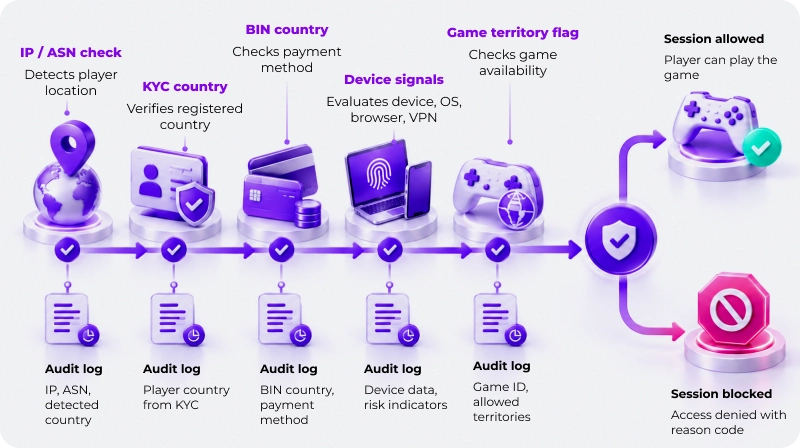
Each signal covers a different evasion route, so the combination matters the most. For example, a player can pass an IP check and still fail KYC if the documents provided show a restricted country. Responsible gaming tools employ the same strategy: self-exclusion works best if it covers all the brands under a single gaming license. Serving a restricted country breaches the license conditions the operator signed.
How to Obtain an Offshore License Without Blocking a Later Upgrade
Obtaining an offshore gambling license typically starts with the ownership file and not the application form. Regulators normally want to review the business plan, UBO documents, AML/KYC policies, player terms, game certificates, and the platform contract. For a startup, a platform partner that already holds these documents covers a major portion of the work.
The group structure chosen at this stage determines whether a later upgrade stays affordable. Holding the offshore license in a separate entity, with its own wallet ledger, keeps the option open to add an MGA or national license without migrating players. NuxGame’s turnkey platform runs brands, balances, and jurisdictions as independent units.
Technical Snapshot: Readiness Checkpoints
| Area | Checkpoint | Evidence to keep |
|---|---|---|
| Licensing | B2C and B2B roles mapped to the right license type | Group chart and UBO file |
| Territory control | Restricted list synced to IP, KYC, BIN, and game flags | Timestamped decision logs |
| Payments | MCC 7995 registration through the acquirer; PCI DSS v4.0.1 scope defined | Acquirer agreement and SAQ or ROC |
| Content | Provider approval per license and territory | Approved game-version list |
| Player protection | Self-exclusion, deposit limits, and safer-play messages available at launch | Limit configuration per brand |
| Upgrade path | Separate entity and wallet ledgers per license | Monthly ledger reconciliation report |
Choosing a Jurisdiction That Fits the Roadmap
Think of a jurisdiction’s license in terms of the markets, payment rails, and studios it opens up. Low taxes and quick approvals become important only once these three checks pass. Write down the markets you want to enter in the next two years and test each jurisdiction against them.
NuxGame works with operators from the jurisdiction shortlist to the first real-money deposit. Its launch support covers payment methods, content, and back-office reporting for new entities. To check your licensing plan against your target markets, book a walkthrough of our online casino platform.