Русский
 SMS Betting Didn’t Die in 2026 — It Moved Down the Stack

SMS betting covers two architectures that share one name. In a handful of licensed markets, users can bet by replying to a short code, with no data session and no smartphone required. In the United States, no licensed sportsbook accepts a wager by text. Throughput also splits by number type: a US short code clears 100 message parts per second, a toll-free number only three.
Operators need that distinction because carrier registration, consent records, and geolocation rules decide what the channel may legally do in each jurisdiction. Getting it wrong produces blocked traffic, filtered campaigns, and TCPA exposure priced per send. NuxGame wires text triggers into player account management, bonus logic, and reporting inside the sportsbook platform, keeping consent and suppression in one record.
Key Takeaways
-
Unregistered application-to-person traffic is blocked outright, and gambling registrations require age gating plus license evidence.
-
Regulated US wagering depends on a device-level location check that a text message cannot produce.
-
Carrier throughput runs from 0.2 to 100 message parts per second, set by origination type and registry vetting score.
-
NIST reclassified one-time passcodes sent over the PSTN as a restricted authenticator in July 2025.
-
Artificially inflated traffic is roughly 5% of international A2P volume, making unprotected verification endpoints a direct cost line.
What SMS Betting Actually Means Across Markets
Two systems trade under the same label. The first places bets over the short message service, where the text body is the wager instruction and settlement happens server-side. The second treats text as an authentication and alert layer around an app or gambling website. Confusing them produces poor roadmap decisions and awkward licensing conversations.
| Model | Where it operates | What the text carries |
|---|---|---|
| Transactional SMS betting | Kenya, Nigeria, Tanzania, Ghana | Selection, stake, confirmation code |
| Supporting text layer | US, UK, Malta, regulated EU | OTP, balance change, settlement, promotion |
Model one survives where feature phones and prepaid airtime dominate. Betting companies there pair a USSD menu with mobile money rails, and these SMS betting services run the full betting experience over 2G. Model two applies in regulated Western markets, where identity and location checks sit in front of all online betting options. Applying one model’s economics to the other is a common error for teams shopping iGaming platforms.
Why US Sportsbooks Cannot Accept Bets via SMS
Each state licensing online betting demands location verification at the moment a stake is accepted. New Jersey obliges licensees to use an approved geolocation methodology and to re-check position at defined intervals. A single SMS message carries no reliable location signal, no device attestation, and no session state. That closes the question before commercial teams reach unit economics.
Scale explains why nobody is lobbying to reopen it. Americans legally staked $166.94 billion on sports during 2025, an 11% rise on 2024 and a record 2025 handle across 38 commercial gaming jurisdictions. Almost all of it moved through a betting app or browser. Text stays a supporting tool for gambling operators, never the interface.
What the channel legitimately carries in US operations:
- Login and withdrawal step-up verification
- Settlement confirmations and SMS updates on pending payouts
- SMS alerts for fraud, limit changes, and self-exclusion acknowledgements
- Opted-in betting promotions and dormant-account reactivation
Carrier Registration Gates All Betting SMS Campaigns
US carriers stopped filtering unregistered application-to-person traffic and began blocking it in February 2025. Brands and campaigns must be registered with The Campaign Registry through a service provider before traffic leaves the queue. Gambling falls under restricted carrier content, which means date-of-birth capture at opt-in and evidence of a state license.
Registration is per use case, not per brand. A transactional SMS program and SMS marketing campaigns need separate registrations; mixing them on one number invites post-approval filtering. Each new SMS use case receives a vetting score, and that score sets throughput. T-Mobile publishes penalty schedules reaching $10,000 per content violation.
| Origination type | US throughput ceiling | Registration path | Practical betting use |
|---|---|---|---|
| Toll-free | 3 MPS | Toll-free verification | Low-volume account notifications |
| 10DLC, unvetted | 0.2 MPS, 2,000/day (T-Mobile) | Registry brand + campaign | Not viable for live traffic |
| 10DLC, vetted 76–100 | 75 MPS, 200,000/day (T-Mobile) | Registry brand + campaign + vetting | Odds updates, OTP, settlement |
| Short code | 100 MPS, extendable | CTIA short code program | Bulk SMS bursts around major events |
Those ceilings are carrier limits expressed in message parts per second, not whole sends. A 200-character text in GSM-7 splits into two segments and consumes two units of throughput. Non-Latin characters force UCS-2 encoding, cutting the segment to 70 characters and tripling cost on identical copy.
Teams budget for the creative and forget the registration queue. A campaign that clears carrier vetting in three days is worth more than clever copy that never reaches a handset. Treat the messaging channel as a release dependency rather than a marketing afterthought, and the launch calendar stops slipping in its final week.

Denis Kosinsky
Chief Product Officer at NuxGame
Delivery Architecture for Live Odds Alerts and In-Play Betting
Latency budgets decide whether a send is useful or merely accurate. A price move in live sports betting is worth communicating only while that market stays open. The path runs from trading feed to CRM rules engine, through suppression checks, into the SMS gateway, then across carrier infrastructure. Carrier-side delivery is the only leg the product team cannot tune.
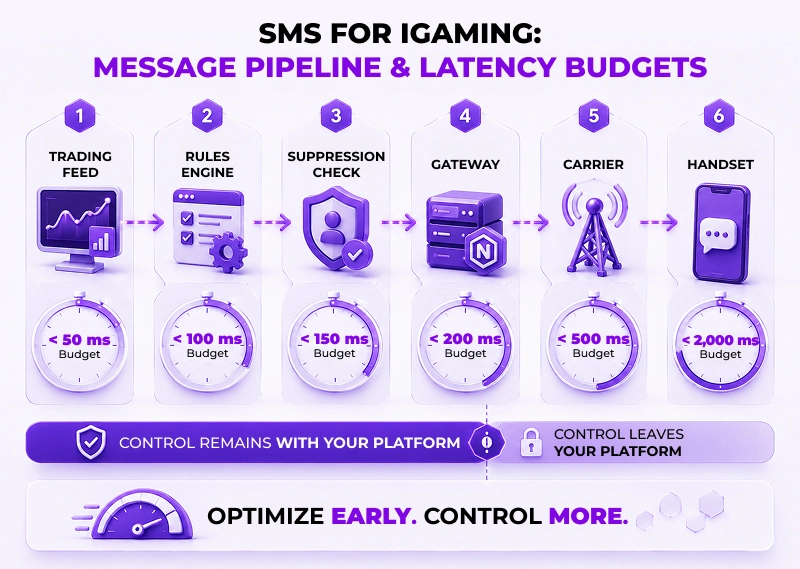
Burst sizing matters more than average volume. A goal in a televised sporting event triggers tens of thousands of sends within seconds. At 100 MPS, a 50,000-recipient burst needs eight minutes to clear one short code. The last cohort will receive SMS after the price has gone. Real-time is a design constraint, not an adjective.
Three controls that shorten the critical path:
- Pre-render copy before kick-off so templating sits outside the dispatch window
- Rank recipients by open-bet exposure, dispatching the highest-value bettor cohort first
- Treat delivery receipts as a monitored metric with thresholds, not a log line nobody reads
Consent, Suppression, and the Compliance Data Model
Consent is not a boolean field. Under the TCPA, marketing text messages require prior express written consent, and revocation must be processed within ten business days. The FCC consent revocation order has twice delayed its broadest provision — treating one opt-out as universal — most recently to January 31, 2027. Quiet hours vary, with Florida, Oklahoma, and Washington closing at 8 p.m. local.
Licensees across gambling and iGaming carry parallel obligations that rarely map onto one preference table. Great Britain has required per-channel marketing consent, off by default and split by product, since May 1, 2025. Malta enforces player protection rules halting commercial contact within 24 hours of a self-exclusion request. The UAE applies its own advertising standards framework.
| Requirement | Authority | Operational control |
|---|---|---|
| Prior express written consent for marketing | FCC / TCPA | Timestamped opt-in evidence per channel |
| Opt-out honored within 10 business days | FCC / TCPA | Suppression sync between wallet and gateway |
| Per-product, per-channel opt-in, default off | UKGC | Preference center enforced at first login |
| No commercial contact 24h after self-exclusion | MGA | Suppression flag propagated to the send queue |
| Age gating plus license evidence | CTIA / carriers | Date-of-birth capture before opt-in confirmation |
Fraud Economics: SMS Pumping and Verification Endpoint Abuse
Every unauthenticated endpoint that triggers a text is a billable attack surface. Artificially inflated traffic drives bot-generated verification requests toward premium routes the attacker profits from. Enea and Mobilesquared put AIT at around 5% of international A2P traffic, costing brands roughly $1.16 billion during 2023. Registration and password-reset forms are the usual entry points.
Controls belong at the edge, ahead of the gateway. Cloudflare rate limiting rules cap requests per session against a specific path, blunting scripted bursts before they become invoices. Pair that with country allow-lists, per-account send ceilings, and hard spend thresholds. Separating an attack from regular betting activity around a large fixture requires baselines rather than intuition.
SMS as an Authentication Factor After NIST 800-63B-4
NIST assigned restricted authenticator status to one-time passcodes sent over the PSTN in July 2025, superseding guidance from 2017. Continued use is permitted, but requires a documented risk assessment, user notification, and a migration roadmap. The PCI Security Standards Council flags comparable weaknesses in its out-of-band authentication guidance. Neither body bans the channel; both expect a plan.
Where SMS Works Best Inside the Retention Stack
Push notifications cost almost nothing per send and reach only installed applications. The advantage is narrow but real: a direct line of communication to any handset with signal. It reaches players who deleted the app months ago. That asymmetry sets the boundary. Reserve the channel for reactivation, failed withdrawals, document requests, and expiring free bets.
Segmentation should be behavioral rather than demographic. Effective betting SMS marketing triggers SMS based on player behavior — deposit gaps, abandoned slips, sport-specific interest — instead of broadcasting to a full base. Frequency caps protect deliverability, since elevated opt-out rates degrade carrier trust scores and invite silent filtering. Unsolicited betting tips push opt-outs up and trust scores down at the same time.
Where SMS and Telegram Betting Diverge
Chat channels invert the cost model. A bot carries no per-send fee and supports menus, buttons, and a richer user experience, but reaches only people who installed the client. Combine SMS for reach with chat for depth. The Telegram casino product from NuxGame handles bonus prompts and account actions inside the thread itself.
How the NuxGame Platform Handles Player Events
Channel logic fails at the seams between systems. A player self-excludes in the back office, the suppression flag never reaches the campaign tool, and a promotion goes out regardless. NuxGame holds player state, bonus rules, and reporting in a single back office, so consent reads from the same record the wallet writes to.
Integration runs through the platform API and event hooks rather than nightly exports. Product teams map events — registration, first deposit, withdrawal request, self-exclusion — onto their chosen SMS API or aggregator. The agent system extends that model to agent hierarchies, which matters where retail agents drive most acquisition.
Configuration control available to iGaming operators:
- Per-channel consent flags stored against the player account, not the campaign tool
- Event-driven triggers across deposit, withdrawal, and verification states
- Campaign reporting tied to wagering volume rather than click counts
- Multi-brand separation for licensees running more than one betting platform
Technical Snapshot
Implementation requirements
- Registry brand registration plus one campaign per use case; gambling categories draw longer reviews
- Age gating that captures date of birth before opt-in, not a yes/no prompt
- Separate origination numbers for transactional and promotional SMS streams
System dependencies
- Aggregator with direct US carrier connections and delivery-receipt reporting
- Edge rate limiting on every public endpoint capable of triggering a send
Performance indicators
- Sustained message parts per second as a share of the carrier ceiling, alerting at 80%
- Delivery-receipt ratio and p95 time-to-deliver, tracked per route
- Opt-out rate per campaign, reviewed weekly against filtering thresholds
Compliance checkpoints
- Timestamped consent evidence held per product and per channel
- Quiet-hours enforcement resolved against the recipient’s state of residence
Deciding Whether Text Belongs in Your Channel Mix
The decision splits by market, not by preference. Where feature phones and airtime rails dominate, SMS betting stays a primary interface worth engineering around. Entry into new markets should budget for USSD session state. In regulated US territory, text is a compliance-bound notification rail with a hard ceiling and a per-segment cost. Both conclusions hold; drifting between them does not.
If the channel is entering a launch plan, audit where consent, suppression, and event triggers currently live. The real question is whether they agree. NuxGame supports that review through player account management, back-office configuration, and API-level event hooks across the turnkey platform. Contact the team to walk your event model against your target jurisdictions.