Русский
 iGaming Industry Revenue Growth in 2026

iGaming industry revenue growth is the steepest curve in US regulated gambling. Online casino win reached $10.74 billion last year, a 27.6% rise, while land-based play added 2.3%. The first quarter cleared $3 billion across seven states for the first time.
Those curves hit infrastructure before they reach the P&L. Session concurrency, wallet writes, and per-jurisdiction reporting scale with handle rather than headcount. NuxGame supplies the platform layer that carries the load: casino aggregation, sportsbook, payment routing, player account management, and back-office control through one integration. The iGaming market analysis from NuxGame maps where demand concentrates.
Growth Drivers Behind the iGaming Sector Since 2022
The mix moved faster than the total. Commercial gaming revenue reached $78.72 billion last year, up from $60.4 billion three years earlier. Those figures come from tracker data published by the American Gaming Association. Online casino win more than doubled across the same span, while the land-based line barely moved.
| Vertical | 2022 GGR | 2024 GGR | 2025 GGR | 3-year CAGR |
|---|---|---|---|---|
| Online casino | $5.02B | $8.41B | $10.74B | ~29% |
| Online sports betting | $7.50B | $13.78B | $16.96B | ~31% |
| Land-based | ~$47.9B | $49.89B | $50.94B | ~2%~2% |
| Total commercial | $60.4B | $71.9B | $78.72B | ~9% |
Two structural points follow. Digital verticals now generate over a third of the industry’s revenue on a fraction of the physical footprint. Slot win of $37.13 billion still needs floor space, staff, and cash handling across 493 properties. Online gaming carries a different cost curve: certified integrations, wallet throughput, and jurisdiction-specific reporting. This breakdown of iGaming operations sets out the components. 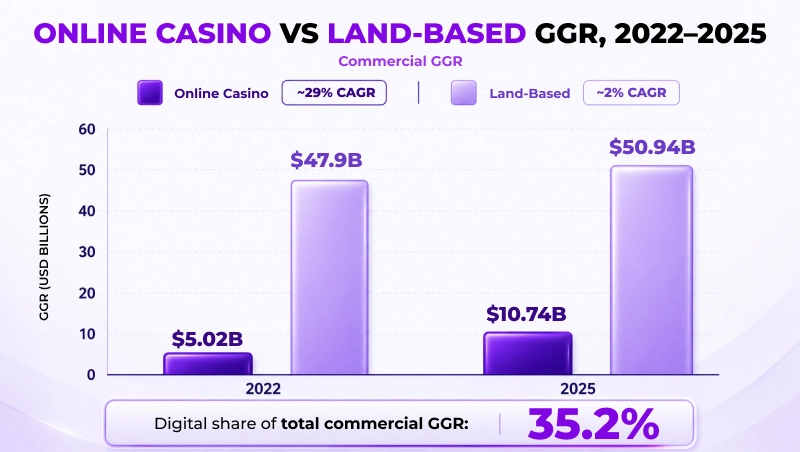
Gaming Industry Revenue 2026: What the First Four Months Show
Seven states produced $4.01 billion of iGaming GGR through April, against $3.39 billion in the same window a year earlier. March set a single-month record above $1.06 billion and returned $287 million in state taxes. April growth slowed to 15.1% year on year, down from about 20% across the first quarter.
Online casino revenue grew without a single new license being issued anywhere. Pennsylvania holds the largest revenue position at $948 million for the quarter, with Michigan close behind at $893 million. Capacity, content velocity, and retention now decide market growth inside existing borders, a shift covered in the strategies for operator expansion guide.
The iGaming states currently reporting win data:
- New Jersey, Pennsylvania, Michigan, West Virginia, Delaware, Connecticut, Rhode Island — live online casino markets
- Maine — eighth authorized jurisdiction, tribal-exclusive model, rules still in drafting
- Nevada — online poker only, with no published win data
Market Size Estimates Versus Net Yield
Published estimates of the global online gambling market for this year run from roughly $94 billion to $143 billion. The spread comes from scope rather than disagreement about demand: some models count GGR, others count total staking or include lotteries. Treat market size as a directional input, then model unit economics per license. The iGaming market’s growth means little if duty consumes the margin.
Duty schedules decide what survives to EBITDA. Britain moved remote gaming duty from 21% to 40% on April 1. The Treasury expects operators to pass most of that cost to consumers. British regulator statistics recorded £7.8 billion in online yield in its latest annual statistics, up 13.1%, before the new duty applied.
| Jurisdiction | Online casino duty | Structural note |
|---|---|---|
| Pennsylvania | 54% slots, 16% tables and poker | Steepest US slot duty; promo deductions permitted |
| Rhode Island | 50% | Single-operator model |
| Michigan | 20–28% graduated on gross revenue | Municipal share applies in Detroit |
| New Jersey | 19.75% | Raised from 17.5% in July 2025 |
| West Virginia | 15% | Lowest among live US markets |
| United Kingdom | 40% duty on online casino win | Doubled from 21% this April |
Growth forecasts are the easy part. Operators arrive with a launch date and a number they have promised the board, then meet the duty schedule. The teams that stay profitable model the tax before they choose the content mix, not after. Rebuilding a lobby you have already launched is an expensive way to learn arithmetic."

Denis Kosinsky
Chief Product Officer at NuxGame
Infrastructure Load Behind iGaming Industry Growth
Win totals understate system load. One spin produces a bet debit, an RNG outcome, a credit, a bonus evaluation, a limit check, and several log writes. At current compounding, transaction volume doubles about every 30 months. Capacity plans built on last season’s peak fail during the second holiday weekend.
Attack surface expands on the same curve. Cloudflare mitigated 47.1 million DDoS attacks last year, a 121% increase. Its quarterly DDoS report placed gambling and casinos third among targeted sectors. Always-on, latency-sensitive products draw volumetric traffic during exactly the windows that generate peak handle.
Wallet Synchronization and Idempotent Settlement
Single-wallet architecture removes transfer delays but concentrates risk in one ledger. Every game round needs an idempotency key so a retried settlement cannot double-credit a balance. Timeouts must resolve deterministically: the round either settles or voids, never both. Reconciliation between aggregator, game provider, and platform ledger should run continuously rather than overnight.
Latency Budgets and Recovery Objectives
A defensible budget allocates under 200 ms for the full bet-to-settle round trip at p95, measured from the game client. Wallet calls warrant a tighter ceiling near 80 ms, since they serialize within the round. Failover deserves the same discipline: AWS documents defined recovery strategies with explicit RTO and RPO per workload. Publish those numbers before launch, not after the first incident review.
Compliance Architecture Regulated iGaming Operators Need
GLI-19 v3.0 sets the event schema before any BI team touches it. The standard requires per-round capture of unique game cycle ID, session ID, game theme and paytable ID, and player ID. That forces an append-only event store with regulator-ready export, not a mutable reporting table. Its appendices add operational audits covering technical security controls and third-party service providers.
Payment scope runs on a separate clock. All 51 future-dated PCI DSS v4.x requirements became mandatory on March 31, 2025. Requirement 6.4.3 forces an authorized inventory of every script on the cashier page. Requirement 11.6.1 adds tamper detection on payment-page content, and 8.4.2 extends MFA to all cardholder data environment access.
Four controls carry most of the operational weight:
- Deposit, wagering, and session limits enforced at stake placement, not in a nightly batch
- Self-exclusion propagated across brands, wallets, and marketing systems within one tenancy
- Five-year retention for customer due diligence, sanctions screening, and suspicious transaction filing
- Geolocation and age verification before the first stake, logged against round-level identifiers
Two regulators show the configuration range. The Malta player protection directive makes limits, reality checks, and self-exclusion mandatory system functions rather than responsible gambling policy text. In the UAE, licensed firms became designated non-financial businesses last December, so the federal regulator supervises AML programs directly. One control set with per-license thresholds beats parallel builds.
Integration Load Limits How Fast iGaming Companies Convert Demand
Content velocity is the constraint most roadmaps underestimate. Each studio added to a lobby brings a contract, certification per jurisdiction, RTP variant configuration, and lobby metadata. Every direct connection also adds a failure domain that on-call engineers diagnose during peak hours. Twenty vendors mean twenty runbooks, twenty reconciliation formats, and twenty renewal cycles.
NuxGame reduces that count through casino aggregation behind a single wallet contract. Sportsbook integration, payment routing, and one back office for reporting sit on the same platform. Operators keep control over game availability, bonus rules, limits, and jurisdiction settings. Changing the gaming experience in a lobby then costs a configuration edit, not a vendor ticket. Sequencing guidance sits in the iGaming business investment breakdown from NuxGame.
Measuring the Growth Trajectory Inside the Business
National totals make a poor management signal. Total revenue says nothing about bonus cost, payment success, or cohort quality. Net yield after bonuses, chargebacks, and processing fees funds the roadmap. The distance between those two figures is where launch models usually break. Operational metrics expose that erosion long before quarterly filings do.
Five numbers worth instrumenting from day one:
- Payment approval rate by rail and issuer, tracked per jurisdiction
- Chargeback ratio held under card scheme thresholds to protect acquiring
- KYC pass rate and median verification time from registration to first stake
- Hold percentage by product, separated for slots, live tables, and sports bets
- Revenue share terms per content provider, reconciled against certified round logs
Definitions have to be fixed before dashboards are built. A shared reference for how GGR is calculated and the KPI set for operators prevents finance and product from reporting different figures. Where definitions drift, growth trends read as data faults rather than market signals.
Future of iGaming: Where the Next Yield Comes From
Two pressures shape the next 24 months. Prediction markets absorb sports-adjacent volume outside state licensing. The AGA puts diverted tax revenue above $500 million to date, with Super Bowl LX contract turnover past $1.6 billion. Bills in New York, Virginia, Ohio, Massachusetts, and Illinois remain unresolved, so US market expansion stays slow and political.
New revenue also comes from adjacent inventory rather than new borders. The esports betting market and fantasy sports extend the content set without a separate license in most live states. Maine adds an eighth market later this year, and the UAE opens a new market for licensed remote operators. Diversified revenue streams across betting and iGaming reduce single-product duty exposure.
Technical Snapshot
| Checkpoint | Requirement | Indicator to track |
|---|---|---|
| Capacity | Peak-hour headroom above the trailing 12-month maximum | Concurrent sessions, rounds per second |
| Wallet | Idempotent settlement, deterministic timeout resolution | Duplicate credits, unreconciled rounds |
| Latency | Bet-to-settle budget enforced at p95 | Client-side round trip, wallet call time |
| Resilience | Documented RTO and RPO per workload, tested failover | MTTR, failed health checks per region |
| Certification | GLI-19 aligned round logging and RNG evidence | Fields captured per round, audit findings |
| Payments | PCI DSS v4.0.1 scope, script inventory, tamper detection | Approval rate, chargeback ratio |
| Player protection | Limits and self-exclusion applied at stake placement | Blocked stakes, limit propagation time |
Sequencing matters as much as coverage. Certification evidence depends on logging built in the first sprint, and payment scope decisions constrain cashier design later. Operators that defer these items to pre-launch testing usually pay twice, once in rework and once in delayed license sign-off.
Conclusion and Next Step
The direction of gaming industry revenue growth is settled; the open question is who carries the load profitably. Duty schedules, certification scope, and integration count determine margin more than headline growth potential does. Model those three per license before committing to a launch date, and treat responsible gaming controls as system functions rather than documents.
NuxGame works with operators on exactly that layer: iGaming software for casino aggregation, sportsbook, payments, player account management, compliance tooling, and back-office configuration under one contract. Teams planning a launch or a migration can request a technical walkthrough. It covers the integration path, reporting model, and jurisdiction settings for their target markets.