Русский
 Sweepstakes Casinos in Canada 2026: Legal Structure, Compliance Load, and Platform Build
Sweepstakes casinos in Canada operate as promotional contests, not licensed gambling. They avoid Criminal Code section 206 by adding a free alternate entry route and a skill-testing question, with prizes paid from a separate Sweeps Coin ledger. Disclosure falls under Competition Act section 74.06, where a first corporate breach carries an administrative penalty of up to C$10 million.
With experience in sweepstakes casino software development, NuxGame helps operators build platforms around the core mechanics this model requires: dual-currency wallets, player onboarding, redemption controls, anti-fraud tools, content aggregation, and back-office management. The NuxGame sweepstakes casino software solution supports operators that need a flexible technical base for launching and managing promotional-contest casino products.
Key Takeaways
How the Canadian Market Is Structured
Before looking at the legal mechanics behind sweepstakes casinos, it helps to understand how online gambling in Canada in 2026 works overall. Real-money online gaming is regulated mainly at the provincial level: Ontario already runs an open licensed market, Alberta is preparing its own framework, while most other provinces remain tied to lottery-led or restricted models.
Sweepstakes casinos follow a different route because they are built as promotional contests rather than wagering products. That makes the model more flexible, but also more dependent on correct structure, clear prize rules, free entry access, geolocation controls, and redemption records. For a broader view of Canadian market entry, licensing logic, payments, and platform setup, see the NuxGame case study on how to start an online casino in Canada.
How the Criminal Code Exemption Actually Works
It helps to first define what sweepstakes casinos are in plain terms. They borrow the look of slots, and the sweepstake casino model gives players the same lobby that traditional online casinos do. The difference is that no stake is placed in real money. Players play casino games for free with Gold Coins, and the prize side runs as a contest.
Understanding how sweepstakes casinos work starts with the three-element test. Canadian sweepstakes law treats a game as illegal gambling when chance, consideration, and a prize combine. Section 206(1)(f) of the Criminal Code makes mixed skill-and-chance contests with paid entry an indictable offense. Knowing how the casinos work means knowing which element the design removes.
The dual-currency build attacks two of the three. Gold Coins carry no monetary value, so they read as entertainment. A second currency — sweepstakes coins — reaches players through free channels such as sign-up bonuses and mail-in requests, which strips out paid consideration. A mandatory skill-testing question at payout supplies the skill element, and sweepstakes casinos provide a near-identical casino-style experience around it.
Why It Is a Gray Area, Not a Green Light
Provinces hold the conduct-and-manage monopoly over real gaming under the Criminal Code. Against that backdrop, the model’s standing breaks down into a few hard points an operator has to weigh before committing budget:
- No regulator owns it. Strictly read, sweepstakes casinos aren’t regulated by any gaming authority; they operate under sweepstakes laws and contest rules instead.
- Legality is a framing question. Whether sweepstakes casinos are legal in Canada turns on that framing, and the legality stays unproven in court.
- The games are still chance-based. Like a traditional casino floor, sweepstakes casinos use random number generators to settle each spin. That those generators are certified for fairness does not turn the underlying spins into skill.
- Permitted is not licensed. The model is broadly legal across Canada because no statute names it, but Canadian sweepstakes casinos sit beside, not inside, the licensed market, and few Canada sweepstakes casinos hold provincial registration unlike real money casinos.
- Enforcement risk, not settled law. A regulator could read cash-redeemable play on chance-based games as unlicensed gaming. The risk is enforcement-driven, not settled.
- The VGW precedent. VGW’s Canada exit on 23 October 2025 pulled Chumba Casino and Global Poker without a single Canadian cease-and-desist — a margin call, but also a risk recalculation.
- Access cuts both ways. In practice, most platforms stay available in Canada outside the regulated provinces, yet that access is not the same as being licensed.
Taken together, these points describe a tolerated structure rather than an endorsed one. The distinction is not academic: it sets the risk appetite, the geo-fencing rules, and the exit plan an operator needs in place before the first redemption clears. Operators also need to review wider sweepstakes rules and regulations, because the legal argument depends not only on the model name, but on how entry, prizes, disclosures, and redemptions are structured.
The Compliance Load Under the Competition Act
Section 74.06 is a civil provision administered federally. Under it, sweepstakes casinos are required by law to disclose prize counts, values, odds, and regional allocation, and these casinos are required to deliver prizes without undue delay. Winners are selected by skill or random draw. The full text of section 74.06 sets the standard sponsors are measured against. This is where the distinction between contests and sweepstakes in iGaming becomes practical: the operator has to prove that prize access, winner selection, and free entry rules match the chosen structure.
Penalties are material, not nominal. A first corporate breach reaches C$10 million, and repeat orders climb to C$15 million. The Competition Bureau enforcement guidelines were reinforced in a February 2026 notice: entrants must never be forced to buy a product or hand over data simply to read the rules. Sweepstakes casinos must offer a genuine free route to entry alongside any paid coin packs, and Sweeps Coins convert to real cash prizes only once the redemption threshold clears.
Two more federal layers attach. Canada’s anti-spam law governs every promotional message used to distribute coins, and PIPEDA or its provincial equivalents govern consent for player data. Quebec removed Régie publicity-contest registration formalities for contests launched on or after 27 October 2023, leaving French-language disclosure as the main practical obligation.
Dual-Wallet Architecture and Redemption Controls
The platform runs two ledgers, not one balance. The Gold Coin ledger holds non-redeemable entertainment credit; the Sweeps Coin ledger holds promotional value eligible for payout. Database-level separation stops the two from contaminating each other during play, bonus drops, or refunds, which keeps the contest framing intact under audit. Redemption — not the lobby — is the control point, and an online sweepstakes casino has to enforce that gate at the architecture level, not bolt it on later.
| Control | When it fires | Target / benchmark |
|---|---|---|
| KYC and AML checks | At payout, not first play | Identity cleared in under two minutes for low-risk profiles |
| Skill-testing question | Before every prize release | Correct answer required to redeem |
| Age and geolocation filters | Session start | Restricted provinces blocked before play |
| Free alternate method of entry | Logged on every entry | Equal-access, retained for audit |
| Wallet synchronization | Continuous | Drift held below 200 ms |
| Concurrent session load | Peak traffic | Several thousand sessions with no ledger lag |
Audit defensibility depends on each of those records existing and reconciling, so the stack has to capture them by default rather than on request. The NuxGame platform delivers player account management, wallet logic, content aggregation, payment configuration, and back-office controls through one connection instead of several separate vendor integrations — helping keep the dual-ledger structure intact as volume grows. Where a provincial route is chosen, operators should map platform controls against the AGCO Registrar’s Standards for Internet Gaming or AGLC Standards and Requirements for Internet Gaming, depending on the province.
A sweepstakes model only works when the product, compliance logic, and redemption flow are built as one system. Operators should not treat wallet separation as a technical detail; it is the guardrail that keeps the business model standing. If the architecture bends, the legal argument bends with it. That is where margin and trust are protected.

Denis Kosinsky
Chief Product Officer at NuxGame
Sweepstakes vs the Regulated Provincial Route
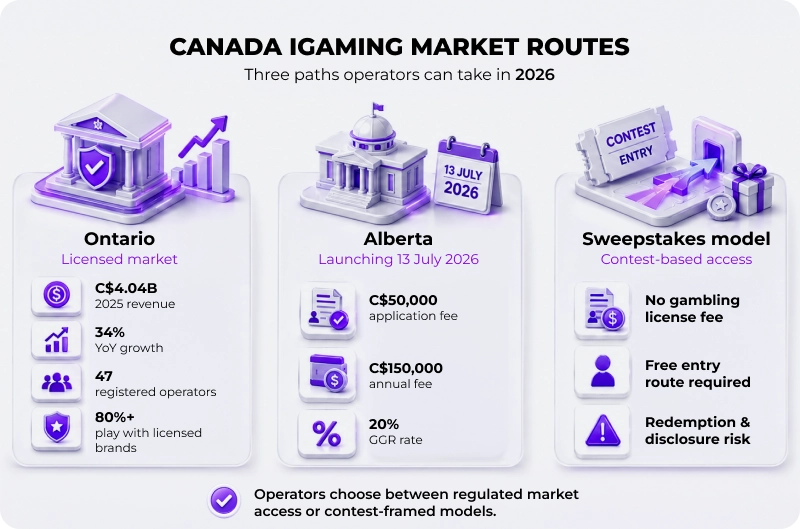
Two provinces will run open, licensed markets. Ontario launched through the AGCO and iGaming Ontario in April 2022 and reported C$4.04 billion in revenue for 2025, up 34% year over year, across 47 registered operators. More than 80% of provincial online play now sits with licensed brands rather than offshore sites.
Alberta is set to launch on 13 July 2026 under the AGLC and the Alberta iGaming Corporation. The Alberta launch date brings a C$50,000 application fee, C$150,000 annually, and a 20% rate on gross gaming revenue. Everywhere else, a provincial lottery monopoly — PlayNow, OLG, Atlantic Lottery, Loto-Québec — controls online play. For operators comparing Canada with other markets, the main difference is that the answer to where online casino is legal depends heavily on local licensing models, provincial control, and how each product is structured.
| Dimension | Sweepstakes model | Regulated (Ontario / Alberta) | Offshore license (Kahnawake / Tobique) |
|---|---|---|---|
| Legal basis | Promotional contest (Competition Act + Criminal Code) | Provincial conduct-and-manage registration | First Nation interactive gaming license |
| Real-money wagering | Not permitted; prizes via Sweeps Coins | Permitted | Permitted in accepting markets, not Ontario |
| Up-front cost | Low; no license fee | High; C$50k + C$150k/yr in Alberta | Moderate; roughly C$40k–C$60k |
| Tax on revenue | None specific to the model | 20% GGR in Alberta | No local gaming tax |
| Player-protection mandate | Contest disclosure only | Self-exclusion, limits, audited RG tools | Operator policy plus regulator oversight |
| Canadian market access | Most provinces, contest-framed | Province of registration only | Global, excludes restricted provinces |
For a sweepstakes company in Canada, the fork is strategic, not cosmetic. A provincial registration buys legitimacy and real-money revenue at high fixed cost; a Kahnawake gaming license or Tobique online gambling license buys speed and global reach without provincial real-money rights. The wider picture is mapped in online gambling in Canada in 2026. Operators working with platform providers should also consider the role of a B2B gaming license, especially when the product depends on regulated software, payment, compliance, or content-supply infrastructure.
Best Online Sweepstakes Casinos in Canada: A Competitive Read for Operators
A short comparison of the best sweepstakes casinos in Canada teaches an operator more than a market report. Treat the names below as a teardown, not a buyer’s guide. We drew this list of sweepstakes casinos from sweepstakes casino reviews and live testing; read it as a list of the best operational lessons, not a sign-up sheet. These sweepstakes casino sites are case studies in how leading sweepstakes casinos have become credible without a gambling license.
Discover the best sweepstakes casinos by what they engineer, not what they market. Each of these platforms solves the same B2B problems — catalog, currency design, redemption, retention — differently. The breadth of sweepstakes games in Canada, and the most-used sweepstakes casinos for Canadian players, cluster around a few patterns worth copying. Reputable sweepstakes casinos use a wide range of certified studios, and that breadth is the credibility signal. For a broader vendor-side view, operators can also compare how leading sweepstakes software companies approach compliance readiness, content supply, platform stability, and operational flexibility.
WOW Vegas
WOW Vegas runs a library above 1,100 titles from suppliers such as Pragmatic Play and Betsoft. For an operator, the lesson is supply depth: a sweepstakes casino in Canada competes on catalog, not headline coin counts. Its welcome bonus and daily bonus cadence drive retention, and casino offers refresh weekly to pull repeat sessions. WOW Vegas is among the best Canadian-facing examples of supply depth, and catalog is the moat.
Fortune Wins Casino
Fortune Wins, rebranded from Fortune Coins in April 2026, sits inside the PriorityPlay network — one company running several sweeps brands. The operator geo-fences Ontario and Quebec, the two regulated provinces, and serves the rest at 19-plus. That choice is the real B2B signal: the online casino mirrors a licensed lobby yet routes around provincial monopolies. Its catalog spans 1,000-plus casino games from studios including NetEnt and Hacksaw Gaming, KYC fires on every redemption, and the welcome bonus stacks 3M Gold Coins with 3,000 Sweeps Coins.
Stake.us
Stake.us shows the crypto angle. Sweeps Coins here can be redeemed for real prizes that settle partly in digital assets. For a sweepstakes casino operator weighing payment rails, the takeaway is that brands which offer the best redemption speed retain better, and a sweeps casino can lean on non-bank rails where local banking is slow.
Crown Coins Casino
Crown Coins Casino leans on a tight onboarding flow. Getting started at a sweepstakes casino here takes only minutes, which matters because drop-off at registration is where many sweepstakes sites bleed volume. The lesson: friction at sign-up costs more than a thin lobby. A single clumsy form loses more users than a missing game ever will.
Pulsz
Pulsz pairs a deep slot library with frequent sweepstakes casino bonuses and promotions. Players participate in sweepstakes through tournaments and challenges rather than flat coin drops, which lifts session length. These casinos also run loyalty ladders, and, depending on the casino, those mechanics raise daily active users without raising prize cost.
Shared Traits Worth Copying
Across these examples the pattern holds. Sweepstakes casinos offer the same casino experience as a real-money lobby while sidestepping the license. Sweepstakes and social casinos blur at the edges; a sweeps cash casino is a social casino with a redemption layer bolted on. Many sweepstakes casinos chase the same audience as real-money brands, and these casinos offer players a near-identical front end. The build question is which sweepstakes casino games to license, how to source sweeps casino games at scale, and how to gate the cash prize. Operators of sweepstakes or social casinos win on catalog depth and clean compliance. Bonus design is the retention lever: the welcome bonus pulls sign-ups, the daily bonus drives return visits, and reload bonus value sets lifetime value.
Market Reality After the VGW Exit
The commercial case is thin and concentrated. Roughly 98% of global sweepstakes gaming revenue sits in the United States, against a US market valued near US$4 billion. This shift also reflects wider sweepstakes industry trends, where compliance exposure, content-supply pressure, and platform adaptability now matter as much as acquisition speed. Canada was never the center of gravity, and the leading operator treated it as a side market. The casinos available to Canadians narrowed sharply once VGW left.
The wider social casino segment grew from US$8.69 billion in 2024 to US$9.33 billion in 2025, a 7.4% annual rate, but that figure blends free-to-play with sweepstakes. Sweepstakes casinos often switch off paid coin packages for Canadian users and lean on free distribution, which caps monetization and lengthens the path to revenue.
The post-exit map leaves room for smaller entrants but rewards careful structuring over raw volume. A new sweepstakes casino entering now competes for a market that a category leader judged too small to defend, so the build has to be lean and the compliance logic airtight from day one.
Technical Snapshot
Architecture dependencies
- Two-ledger wallet with segregated Gold Coin and Sweeps Coin accounting
- Auditable alternate-method-of-entry intake (mail-in and web form), logged and equal-access
- Geolocation and age gate enforced at session start
- KYC and AML checks triggered at redemption, not at play
- Skill-testing question logic gating every prize release
Compliance checkpoints
- Competition Act s.74.06 disclosure: prize count, value, odds, regional split, delivery timing
- Anti-spam consent (CASL) captured for all promotional messaging
- PIPEDA or provincial privacy consent for player data collection and use
- Quebec French-language disclosure of contest rules
Performance indicators
- KYC clearance under two minutes for low-risk profiles
- Wallet synchronization drift below 200 ms
- Redemption SLA target of 24 hours or less for e-gift cards
- Concurrent-session headroom validated under load before launch
Reporting obligations
- Prize register, winner-selection logs, and AMOE entry records retained for audit
Bottom Line
Sweepstakes casinos in Canada are less a loophole than a precise legal construction that has to hold under audit and, eventually, under a regulator’s reading. The model reaches a market that licensed real-money play does not, but it trades legal certainty and monetization for that access. The real decision is not whether the structure is clever; it is whether the route fits the risk appetite, the product roadmap, and the jurisdictions on the expansion map. Set the architecture and compliance logic before the launch date, not after the first redemption.
Planning a compliant entertainment or real-money build for the Canadian market? The NuxGame team supplies the platform, wallet logic, content aggregation, payment configuration, and compliance tooling to support either a promotional-contest model or a fully licensed provincial launch. Book a technical walkthrough to map your stack against the route you choose.